A background checks national inquiry is a comprehensive screening process that searches federal, state, and county databases—and often utilizes FBI fingerprinting—to verify an individual’s criminal history, identity, and credentials across the entire United States. However, attempting to navigate these fragmented databases on your own or relying on cheap «instant» online portals often yields incomplete, outdated, or legally non-compliant data. If you need accurate records for employment, licensing, or corporate due diligence, you must rely on rigorous, professional screening.
In today’s complex regulatory environment, a simple internet search is not enough. Compliance Officers specializes in providing deep, accurate, and fully compliant national background checks. Our experts navigate federal and state repositories to ensure you receive verified information without exposing your business to liability.
First principles: “National” abroad ≠ “National” in the U.S.
In many countries, the national police is a single, centralized authority, so a “national background check” is obvious. The U.S. is different:
State & local police: Each state runs its own criminal history systems. A “state police clearance” (or Department of Justice letter) reflects what that state knows about you.
Federal (FBI): The FBI maintains the Identity History Summary at the national (federal) level.
Therefore, when a consulate says “national police certificate,” they might mean:
“Bring the state-level police certificate from your last state of residence,” or
“Bring the FBI federal report,” or
“Bring both.”
Actionable tip: mirror the exact wording in your instructions. If it names a state agency (e.g., FDLE in Florida, CA DOJ, Texas DPS, NJ State Police), they want the state document. If it says FBI, that’s a different document.
What Are Background Checks National?
When organizations and individuals request a national background check, they are looking for a unified report that transcends state borders. Because the United States does not have a single, publicly accessible central database that contains every record, conducting a true national check requires querying multiple distinct systems.
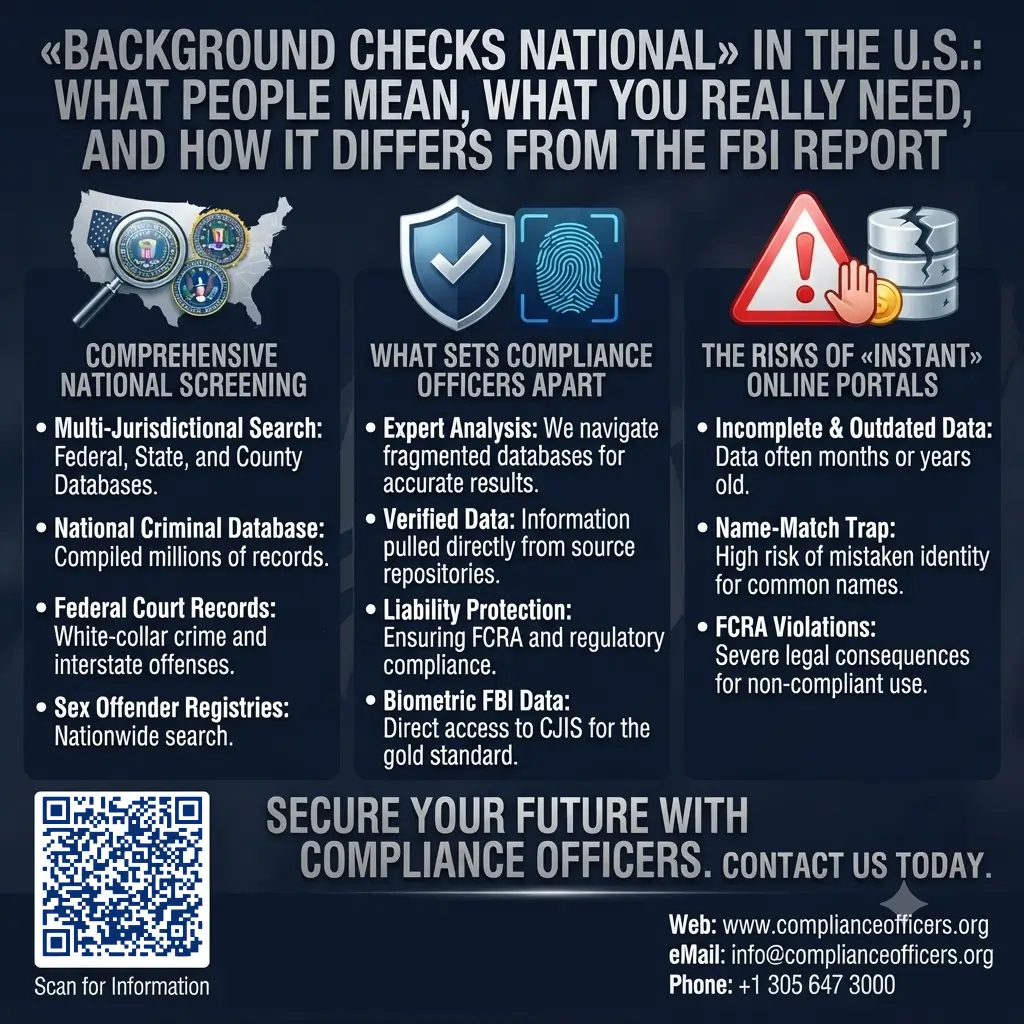
Therefore, a comprehensive national screening typically compiles data from:
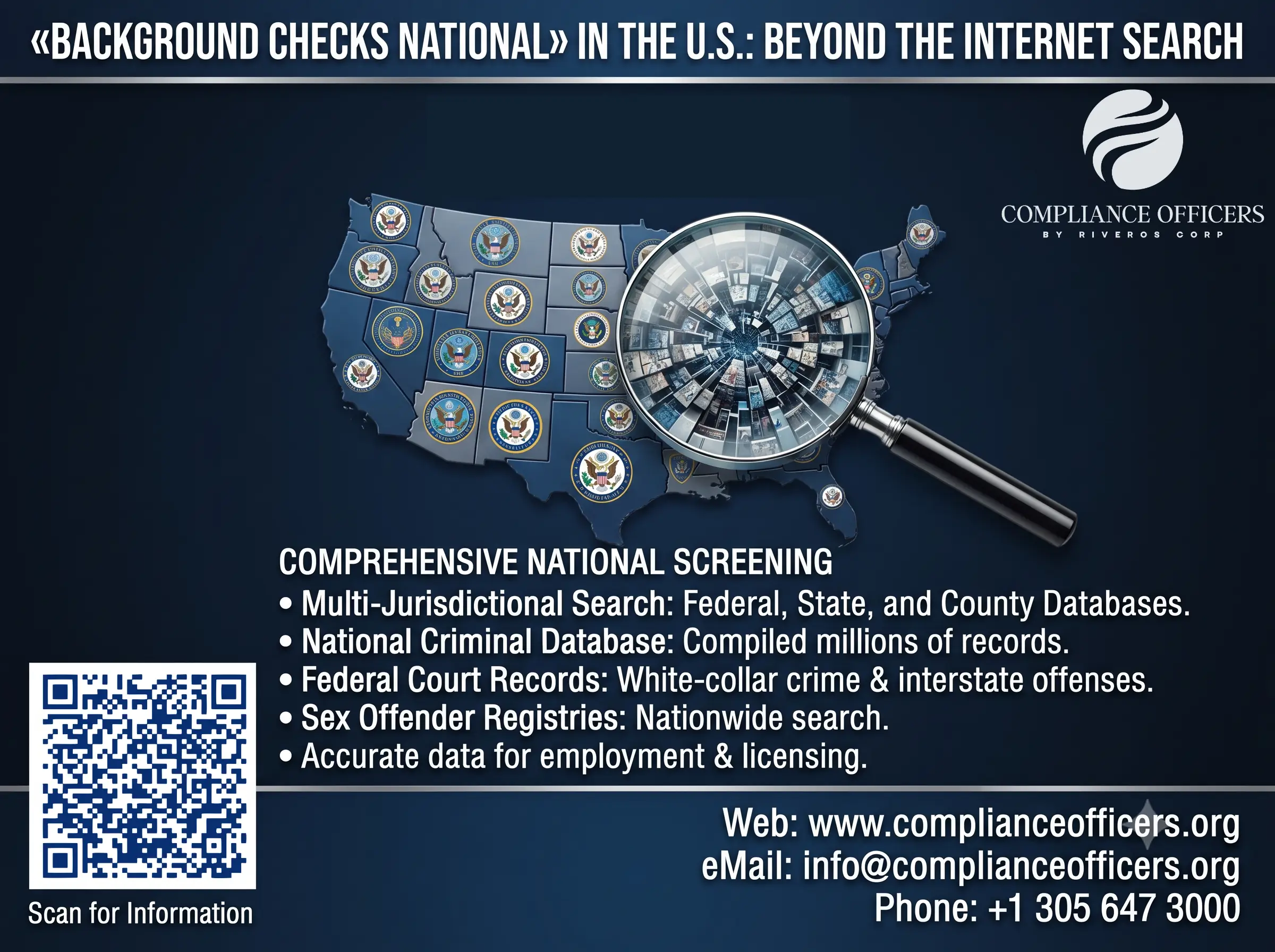
The National Criminal Database: A compiled database of millions of records sourced from state departments of correction, county courts, and sex offender registries.
Federal Court Records: Documents detailing federal crimes (such as white-collar fraud, interstate trafficking, or federal tax evasion) which do not appear in local or state county checks.
FBI CJIS Systems: The gold standard of national checks, which uses biometric data (fingerprints) to pull records directly from the FBI’s Criminal Justice Information Services Division.
What makes a state background check “apostillable”?
While each state publishes its own acceptance rules, the most common requirements are:
The document carries the original signature of a recognized state official (e.g., state DOJ or State Police signatory) or it is properly notarized by a notary commissioned in the same state.
It contains the official seal or certification language the state recognizes.
It is not a plain photocopy. If a copy is necessary for downstream steps, it’s typically accompanied by a notarized custodian affidavit (again, by a notary in that state) or obtained as a certified copy when the issuing office provides that format.
Its physical integrity isn’t altered (no removing staples or resealing certified sets).
Its identity data is consistent (names with diacritics, hyphens, DOB).
It meets any freshness requirement (many authorities want issuance within 60–90 days).
Some states add a county-level authentication step for notarized documents (e.g., the county clerk authenticates the notary before the state issues the apostille). This is state-specific and easy to miss.
Compliance Officers sanity-checks the issuing state’s apostille rules and builds the correct path so your document is accepted on first presentation.
Choosing the right state document: a quick decision tool
Ask yourself:
Which authority is named on the instruction?
If it says FBI, get the federal report (different lane).
If it names a state agency (FDLE, CA DOJ, TX DPS, NJSP, etc.), get the state document from that agency.
If it says city/county police, obtain a local police letter and make sure it’s notarized properly in the same state.
Does the destination accept local police letters, or does it insist on the state-level letter?
Some destinations accept either if apostillable; others are strict.
Is a specific time window required (e.g., ≤90 days)?
Time your request so it’s still “fresh” on submission day.
Will the document need translation?
Usually, the flow is apostille first, translation second (destination rules may vary).
The issuing state drives the apostille authority and the formatting you’ll need.
The Hidden Risks of «Instant» DIY Background Checks
Many employers and individuals are tempted by websites offering «instant» national background checks for a few dollars. Unfortunately, taking this «Do-It-Yourself» (DIY) approach is incredibly risky and can lead to severe consequences.
1. Incomplete and Outdated Information
Instant online portals rely on scraped data from public records that are often months or years out of date. For example, if a candidate had a charge expunged or dismissed last month, a cheap database check might still show them as convicted. Making a decision based on this flawed data exposes you to immediate risk.
2. The Name-Match Trap
Database-only checks usually rely on a name and date of birth. If the subject shares a common name (like John Smith), you might receive the criminal history of a completely different person. Consequently, you risk rejecting a highly qualified candidate or, conversely, hiring someone with a dangerous past who used an alias.
3. FCRA Violations and Lawsuits
If you are using a background check for employment, tenancy, or credit purposes, federal law mandates strict adherence to the Fair Credit Reporting Act (FCRA). Most instant websites specifically state in their fine print that they are not consumer reporting agencies and cannot be used for hiring. As a result, using their data can trigger massive class-action lawsuits and regulatory fines against your company.
What Does a True National Background Check Reveal?
When conducted properly by compliance professionals, a national background check provides a 360-degree view of an individual’s history. Specifically, our comprehensive reports can include:
Criminal History and Federal Records
Our team accesses top-tier repositories to uncover felony and misdemeanor convictions, active warrants, and incarceration records across multiple jurisdictions. We also cross-reference federal district courts for crimes prosecuted at the national level.
Identity Verification and SSN Trace
Before checking criminal records, it is vital to know exactly who you are investigating. We perform Social Security Number (SSN) traces to verify identity, reveal past aliases, and map out the individual’s address history over the past 7 to 10 years.
National Sex Offender Registry and Watchlists
A rigorous check scans the national sex offender public registry, as well as domestic and international watchlists such as the OFAC sanctions lists, to identify whether the individual is flagged for terrorism, money laundering, or severe financial fraud.
Employment and Education Verification
Beyond criminal data, corporate due diligence often requires validating a candidate’s resume. Our specialists directly contact educational institutions and past employers to verify degrees, dates of attendance, and job titles, exposing any fraudulent claims.
Why You Need Professional Experts for Your Screening
The architecture of US public records is decentralized. Therefore, securing accurate data requires professional intervention.
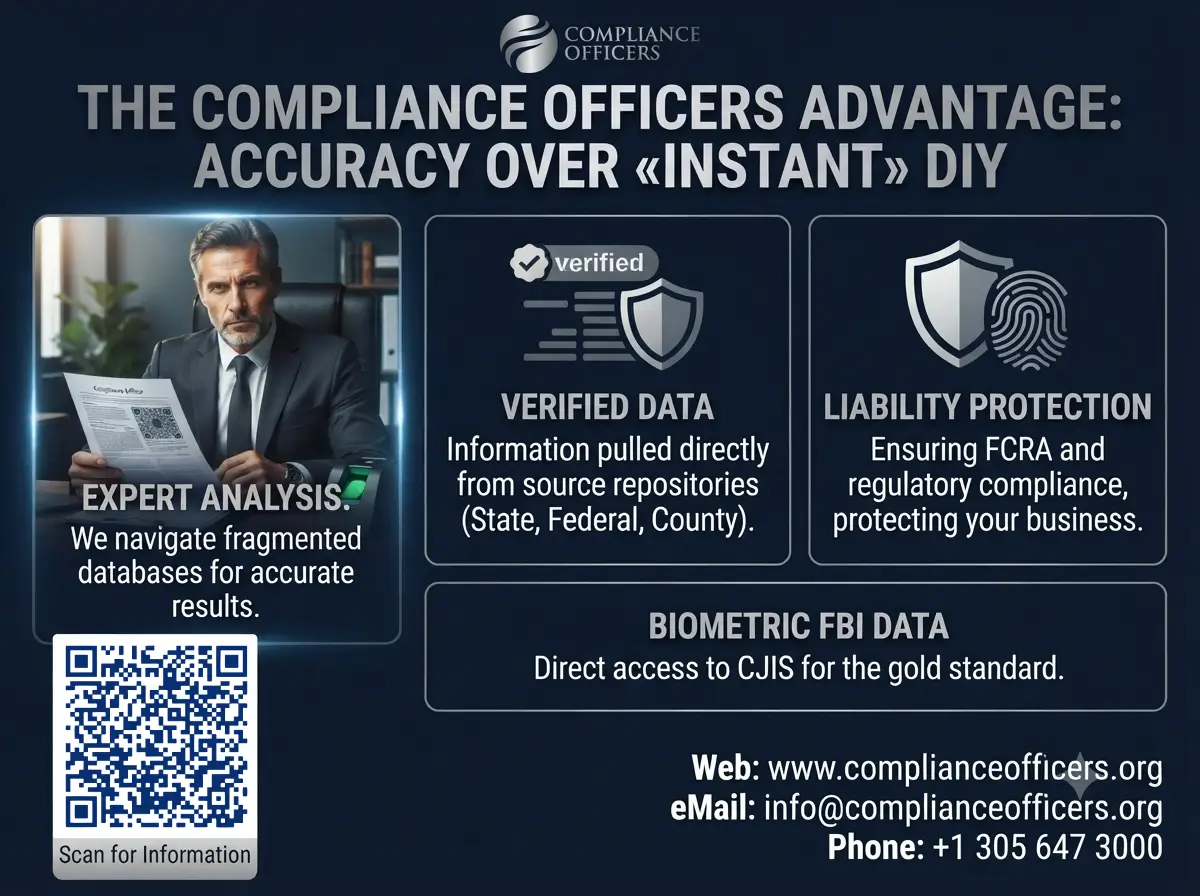
When you partner with Compliance Officers, you are not just buying a database search; you are investing in peace of mind. Our specialists meticulously cross-reference data from multiple official sources. If a «hit» occurs in a national database, we automatically dispatch researchers to the specific county court to pull the physical files, ensuring the record is accurate, up-to-date, and legally reportable.
Furthermore, we handle the complex compliance landscape. We ensure that adverse action protocols, disclosure forms, and privacy mandates are strictly followed, protecting your organization from liability.
Secure Your Future with Compliance Officers
Do not gamble your company’s reputation or safety on fragmented DIY searches or unverified online databases. Whether you require standard employee screening, executive due diligence, or specialized FBI fingerprinting, our team provides the accuracy and speed you need.
Contact Compliance Officers today to structure a background screening program that meets the highest standards of accuracy and national compliance.
FAQ
How long do background checks national take?
While cheap database searches are «instant,» they are highly inaccurate. A professional, compliant national background check takes longer than an instant database search, and its timing depends on the sources involved. However, if a physical county court search is required to verify a record, it may take slightly longer depending on the court’s administrative delays.
What is the difference between a state and a national background check?
A state background check only queries the criminal databases within one specific state. If the applicant committed a crime in a neighboring state, it will not appear. A national background check casts a wider net, searching repositories across all 50 states to uncover multi-jurisdictional histories.
Do national background checks show international records?
No. Standard background checks national strictly cover the United States and its territories. If you are hiring an expatriate or a foreign national, Compliance Officers can conduct an International Background Check, which is a separate and highly specialized process.
Can I use an instant online background check to hire an employee?
Absolutely not. Using non-FCRA-compliant websites to make hiring, firing, or tenancy decisions is illegal under US federal law. You must use a professional screening service to ensure the data is accurate and legally permissible for employment decisions.
Are national background checks based on fingerprints or just names?
There are two types. Standard national database checks are name-based and use SSNs and dates of birth to find records. Conversely, an FBI Background Check is biometric (fingerprint-based), meaning it is tied to the physical identity of the person, eliminating the risk of alias fraud or common-name mix-ups.
The information contained in this publication is provided for general informational purposes only and does not constitute legal advice. Reading or using this content does not create and is not intended to create an attorney-client relationship. No reader or user should act or refrain from acting based on the information presented herein without first consulting an attorney duly licensed to practice law in their jurisdiction.