
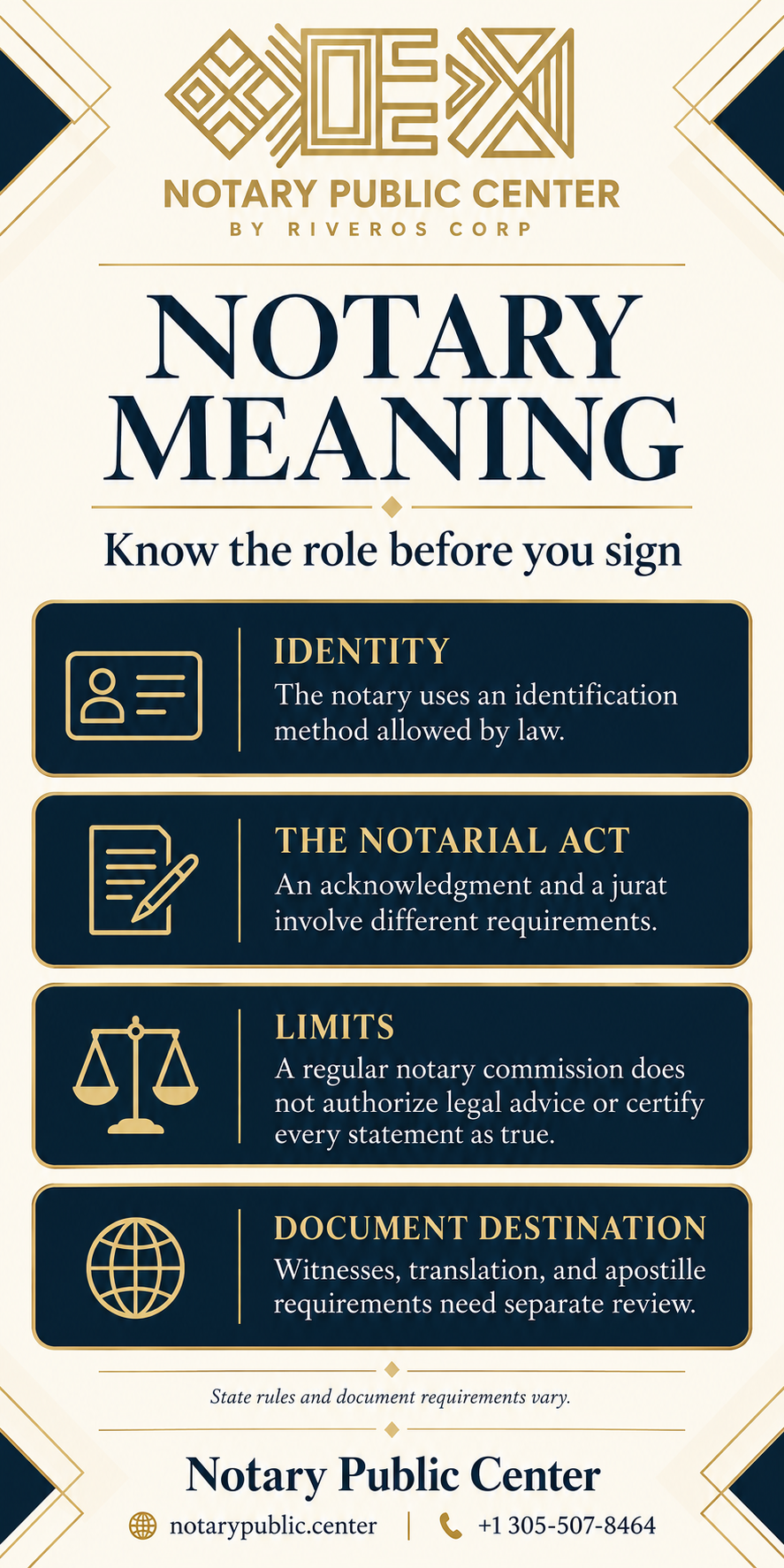
The basic notary meaning in the United States is a public official authorized to perform specified notarial acts. These often include taking acknowledgments and administering oaths. A notary checks the signer’s identity and completes the certificate for the act performed. The appointment does not turn the notary into your legal adviser.
That distinction matters when someone asks you to “get a document notarized.” You still need to know which document to use, what notarial act it requires, and where you will submit it. A stamp alone cannot answer those questions.
Notary Public Center provides in-person notarization in Miami and Florida remote online notarization for eligible transactions. The team can also coordinate document authentication through Apostille de la Haya. The right service depends on your document and its destination.
Notary meaning: authority and limits
A notary’s commission comes from the relevant public authority. In New York, for example, the Secretary of State commissions notaries. Their authorized functions include acknowledgments, oaths, affidavits, and other acts defined by state law.
Many notaries work in banks, law offices, or other businesses. Their employer does not replace the rules governing the commission. Likewise, paying for a notarization does not entitle a customer to skip the required identification or appearance.
Rules vary by jurisdiction. Florida examples throughout this article explain the services available through our Miami office. They should not serve as a substitute for another state’s requirements.
When comparing services, ask where the notary holds a commission and whether the proposed method suits the document. An office location, a professional-looking seal, or a website description does not establish the scope of someone’s authority.
What a notarization establishes
The certificate records a specific notarial act. It is not a general endorsement of the document. California acknowledgment certificates, for example, expressly distinguish identifying the signer from verifying the document’s truth, accuracy, or validity.
This explains an important part of the notary meaning: the official performs the required ceremony without taking responsibility for the entire transaction. A notarized statement can still contain an error. A notarized contract can still raise questions about its terms.
For example, signing a declaration about a property does not establish ownership merely because a notary completes a jurat. The signer remains responsible for the declaration. A dispute about ownership may require records, legal analysis, or a court decision.
Therefore, resolve questions about the document’s legal effect before the appointment. If you need advice about giving someone authority, transferring an asset, or accepting an obligation, consult an appropriately licensed attorney.
Acknowledgment and jurat: different notarial acts
An acknowledgment involves appearing before the notary and acknowledging execution of the document. The signer may have signed earlier. The acknowledgment itself still requires the appearance permitted by applicable law.
A jurat involves an oath or affirmation and signing before the notary. The signer swears or affirms the truth of the statement. An affirmation provides a nonreligious way to make that solemn commitment.
Neither act allows the notary to certify facts simply because the signer states them. The difference concerns the ceremony and certificate, rather than how trustworthy the notary considers the document.
| Question | Acknowledgment | Jurat |
|---|---|---|
| What happens? | The signer acknowledges execution. | The signer takes an oath or affirmation and signs before the notary. |
| Can the signature already be on the document? | Generally, yes; the required acknowledgment still follows. | Plan to sign during the notarial act. |
| Does this establish the truth of every statement? | No. | No. The signer makes the sworn or affirmed statement. |
If the form lacks a clear certificate, obtain instructions from its recipient or legal preparer. A nonlawyer notary should not choose the legal effect of your document for you.
Identification, appearance, and willingness
A notary needs an identification method that the governing law permits. Government-issued identification is common, but it is not the only possible method in every jurisdiction. Florida law also addresses personal knowledge and qualifying credible witnesses.
Tell the service about an identification issue before the appointment. A familiar name, a photograph sent by a relative, or another person’s assurance does not automatically satisfy the applicable standard.
The signer must participate. In Florida, appearance means physical presence or authorized audio-video communication. Sending someone else with a signed page does not replace that appearance.
Florida also prohibits notarization when the person appears unable to understand the document’s nature and effect at that time. If communication, understanding, or willingness raises a concern, the appointment may need to stop. Pressure from another participant cannot resolve it.
Notary meaning and legal advice
A regular notary commission does not authorize someone to practice law. Some notaries separately hold a law license, but the commission itself is not that license. Ask which professional role the person is performing.
This matters when translating professional titles across countries. The responsibilities associated with a notary in another legal system may differ substantially from those of a regular U.S. notary public.
Florida also has a separate civil-law notary appointment for qualified attorneys. That distinct program should not be confused with a regular notary commission. The title alone is not enough to identify the service you need.
For a power of attorney, for example, choosing powers and explaining their consequences involves legal questions. Our guide to types of power of attorney explains the distinctions to discuss with the document’s preparer. Notarization comes after the document’s terms are ready.
Can a notary act for a relative or employer?
There is no single national rule that prohibits every notarization involving any relative. Florida specifically prohibits notarizing the signature of a spouse, son, daughter, mother, or father. Other conflicts can also prevent the act.
Florida generally bars a notary from acting when the notary is a party to or has a financial interest in the underlying transaction. However, employment alone does not automatically create that prohibited interest. The statute includes conditions for employees notarizing for an employer.
Disclose the relationship before arranging the appointment. Choosing an independent notary may be appropriate when the facts create a conflict. Do not assume that a family relationship is irrelevant because everyone agrees to the signing.
In-person and online notarization
In-person appointments in Miami
An in-person appointment brings the signer and notary together. Before attending, confirm the identification, document, and witness requirements. Bring the complete document, including its certificate and any relevant instructions from the recipient.
Also explain whether the recipient needs an original with handwritten signatures. This can affect the service you arrange and the way you deliver the finished document.
If you need assistance with language or accessibility, raise it before booking. A rushed appointment is a poor time to discover that the signer cannot follow the document or that an additional participant is necessary.
Florida remote online notarization
For a Florida online notarization, the online notary must be physically in Florida. The signer may be elsewhere, subject to the requirements for the transaction. The procedure uses qualifying audio-video communication and a recorded session.
Identity verification may rely on personal knowledge or the required combination of identification, credential analysis, and identity proofing. Knowledge-based questions are one permitted method, rather than an unavoidable step for every signer.
Thus, an ordinary video call does not by itself constitute remote online notarization. Ask about the platform, participants, and final file. Our guide to online notarization apps covers the practical questions to resolve before starting.
Witnesses, language, and document requirements
A witness and a notary may perform different roles. A witness observes the signing under the applicable requirements. A notary performs the notarial act. Some documents require both; others do not.
Confirm the number and qualifications of witnesses with the document’s preparer. Do not assume that the notary can fill a witness role in every transaction. Likewise, online availability does not establish that remote witnesses satisfy the particular document’s rules.
Language requires a separate review. The signer must understand what the document does, and the participants must meet the communication requirements. A translation may also be necessary for the recipient.
If you are preparing a bilingual instrument, see our discussion of a power of attorney in Spanish. Decide which version will govern and what the receiving office requires before arranging signatures.

Copies, vital records, and apostilles
The notary meaning does not include an unrestricted power to certify every copy. Florida permits certain copy attestations, but excludes vital records and public records for which the official custodian can supply a copy.
For a birth or marriage record, start with the appropriate issuing authority. A notarized photocopy is not automatically a substitute for its certified record. If you need help obtaining that record, confirm eligibility and the required format.
An apostille is a separate government certificate. It authenticates the origin of a covered public document, including the relevant signature, official capacity, and seal where applicable. It does not certify all of the document’s contents.
The appropriate route depends on the document’s origin and destination. Some authorities issue electronic apostilles for eligible documents. Other procedures require physical delivery. Therefore, neither “online” nor “paper” describes every case.
Notary Public Center can coordinate with Apostille de la Haya to review those stages. The issuing authority controls its own decision and processing schedule. No private service can guarantee acceptance by every foreign recipient.
What to clarify before booking
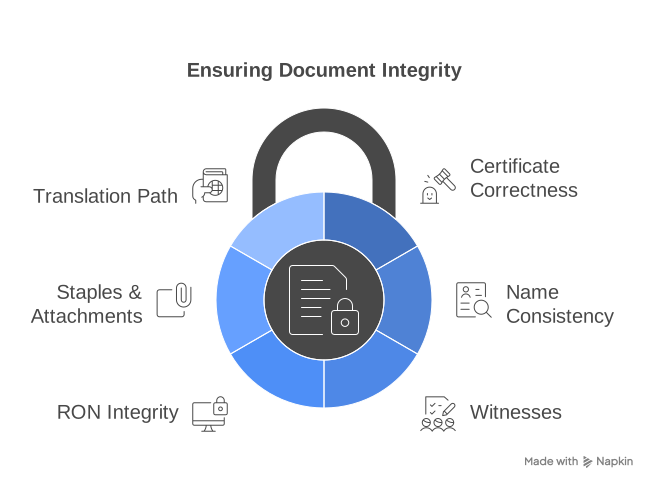
Start with the complete document and the recipient’s instructions. Identify who must sign and whether anyone acts for a company or another person. The certificate and document may need to reflect that representative role.
Next, ask whether witnesses, translation, or international authentication form part of the request. These services have different purposes. A notarization quote should make clear which of them it includes.
Finally, explain your deadline and preferred delivery format. If the document requires legal changes, obtain them before signing. Do not ask a notary to backdate an act or revise a completed certificate to make the paperwork fit a later request.
These checks help you arrange the appropriate appointment. They cannot replace the recipient’s review or settle a dispute about the underlying transaction.
Notary meaning: common questions
What is the simple notary meaning?
A notary public is an official authorized to perform specified notarial acts, such as acknowledgments and oaths. The notary follows the governing identification, appearance, and certificate requirements. A regular commission does not authorize legal advice.
Does notarization prove that a document is legally correct?
No. A notarial certificate records the act performed. It does not establish the fairness of a contract, the accuracy of every statement, or the validity of every clause. Obtain legal advice when those questions affect your decision.
Can I sign before the appointment?
That depends on the required act. An acknowledgment can generally concern an existing signature, but the signer must still appear and acknowledge it. For a jurat, plan to sign during the act and take the oath or affirmation.
Can a notary appointment happen online?
Yes, when the applicable law permits the procedure and the transaction meets its requirements. Florida remote online notarization uses authorized audio-video technology, identity verification, and a recorded session. Confirm the document’s suitability and the recipient’s requirements first.
Which documents may need notarization?
Examples include affidavits, certain real estate documents, powers of attorney, and consent forms. The document’s name alone does not establish its requirements. Check the applicable law and the receiving entity’s instructions, including any separate witness requirements.
Does a notarized document automatically work abroad?
No. Depending on the destination and document, an apostille or another authentication process may be necessary. Translation and document-specific requirements can also apply. Notarization does not guarantee approval of the foreign transaction.
Arrange the appropriate notary service
If your search for notary meaning began with a document you need to sign, contact Notary Public Center with the document type and destination. The team can review the appointment requirements and explain the available service.
Call +1 (305) 507-8464 or contact us through WhatsApp. Mention any witnesses, language needs, or planned use outside the United States before booking.
This publication provides general information and does not constitute legal advice or create an attorney-client relationship. Consult an attorney licensed in the relevant jurisdiction before acting or refraining from action on a legal matter.