
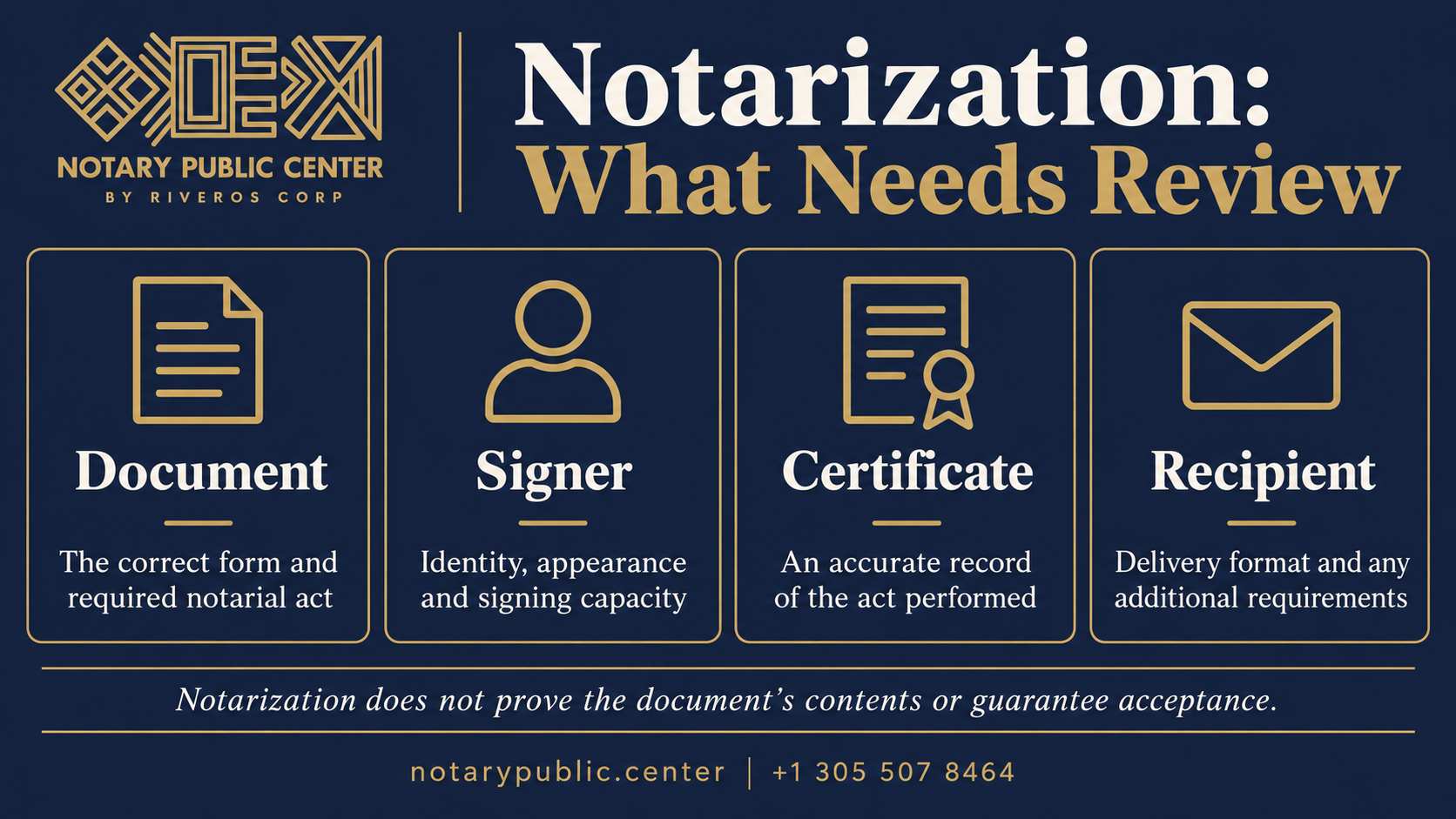
Notarization is the performance of an authorized notarial act, such as taking an acknowledgment or administering an oath for a sworn statement. For a signature notarization, the notary applies the required identity and appearance rules and completes a certificate describing the act.
The certificate does not establish that every statement in the document is true or that the transaction is legally effective. It also does not guarantee acceptance by a bank, court or foreign authority. Those questions may involve requirements beyond the notarial act.
Notary Public Center can discuss online or in-person service for documents requiring Florida notarization. The team can also review related apostille coordination when a document will be used abroad. This guide explains what to clarify before arranging an appointment.
What notarization establishes
The effect depends on the act performed. An acknowledgment records acknowledgment of execution. A jurat records the required sworn or affirmed signing. Florida also permits certain copy attestations, subject to statutory limits.
Therefore, notarization should not be described as one identical process for every document. The certificate must correspond to the actual act. A notary’s seal supplies identifying information, but it cannot replace the underlying requirements.
Florida’s section 117.05 addresses certificates, identification, seals and other duties. The details should be read in the context of the service and document involved.
What the notary does not decide
A notarial commission does not itself authorize legal advice. A notary who is not an attorney cannot select legal provisions or advise which document will protect your interests. Obtain that advice from a qualified professional when needed.
The notary also does not guarantee the truth of an affidavit or the fairness of a contract. The signer remains responsible for the statement or commitment. A receiving institution evaluates the document under its own applicable rules.
Jurat and acknowledgment: identify the required act
A jurat involves an oath or affirmation and signing as required before the notary. An acknowledgment involves acknowledgment of execution. A signature may already exist when an acknowledgment is taken, provided the act otherwise meets the governing requirements.
Under Florida section 117.03, an acknowledgment cannot replace an oath when an oath is required. The distinction matters even if both certificates use a notary’s signature and seal.
Our guide to oaths and affirmations explains sworn statements. Provide the actual form and instructions rather than asking for a generic stamp.
When the document has no clear instructions
Ask the receiving party or your attorney which notarial act is required. If the certificate conflicts with the instructions, resolve that issue before signing. The provider can then assess whether the requested service is available.
Also tell the notary whether anyone has already signed. A prior signature does not necessarily prevent an acknowledgment, but it may require different handling for a jurat. The certificate must reflect what actually occurs during the appointment.
Documents that may involve a notary
Affidavits, powers of attorney, banking forms and corporate statements often raise notarial questions. However, a document’s category alone does not determine whether notarization is legally required or which act applies.
For example, a sworn affidavit differs from an acknowledgment of a company officer’s signature. An ordinary business agreement may not require notarization at all. Review the governing law and the particular form instead of assuming every important document needs the same service.
Where a person signs for a company, trust or another individual, identify that capacity. A notarial certificate does not automatically prove the signer’s authority to represent someone else. The transaction may require separate evidence of that authority.
Academic and translation documents
A school record may require certification from the registrar or another authorized official. A private statement concerning academic records may involve a different act. Clarify whether the recipient wants an official record, an eligible copy attestation or a sworn statement.
A translator’s declaration may also require notarization in some contexts. That act concerns the translator’s signature or sworn statement; it does not mean the notary has independently verified every translated word. Obtain the recipient’s translation requirements before arranging the service.
Vital records and certified copies
Florida law excludes vital records from a notary’s copy-attestation authority. It also excludes public records when the custodian can provide a copy. A notary cannot turn an ordinary birth-certificate photocopy into the official certified record.
Obtain the appropriate certified copy from its authorized source. A related affidavit may separately require notarization, but the affidavit does not replace the record itself. Our guide to Florida birth-certificate apostilles discusses that distinction.
Eligible private documents can raise different copy-attestation questions. The provider should assess the actual record and intended use under section 117.05. Avoid assuming that every copy or electronic printout qualifies.
Identity and appearance requirements
For signature notarization, the person must appear in the manner required by law. Florida recognizes physical appearance and qualifying online appearance. Simply sending a signed page to a notary does not complete that requirement.
Identity may be established through personal knowledge or legally sufficient evidence, depending on the applicable process. The requirements differ between in-person and online service. Discuss identification before the appointment rather than assuming any photo ID will be enough.
Material differences between the document and identification deserve review. Explain name changes, signing capacity or other relevant details in advance. Do not alter a legal document merely to make it resemble an ID without appropriate guidance.
Willingness, understanding and communication
Florida law restricts notarization when the person appears unable to understand the nature and effect of the document. Section 117.107 also addresses language and other prohibited acts.
Tell the provider about communication or accessibility needs beforehand. The appointment must permit the required interaction. Assistance with logistics does not allow another person to make a sworn statement or decision on the signer’s behalf without legal authority.
Online notarization and in-person appointments
Remote online notarization uses live audiovisual communication and an electronic record. Florida requires the online notary to be physically in Florida. A signer may be elsewhere, subject to the applicable document and participant conditions.
Section 117.265 sets out identity, recording and other online procedures. Personal knowledge or the permitted alternative identity process may apply. The statute does not impose one universal package of biometric checks on every session.
In-person service may fit a document requiring physical participants or a paper original. Our article on online signatures and RON explains why an electronic signature and an electronic notarial act are different requirements.
Compare the practical requirements
| Question | In-person service | Remote online service |
|---|---|---|
| How does the signer appear? | Physically before the notary | Through qualifying live audiovisual communication |
| Which identity rules apply? | The applicable in-person rules | The applicable online identification rules |
| What record is delivered? | Usually the completed paper document | The completed electronic record |
| Are witnesses automatic? | No; identify any required witnesses | No; eligibility and location need separate review |
| Is recipient acceptance guaranteed? | No | No |
The appropriate choice depends on the act, document and intended use. Scheduling convenience is one consideration, but it cannot override a legal requirement for physical participation or a particular record.
Witnesses and documents needing additional review
Some transactions require witnesses as well as a notary. The roles serve different purposes. Explain the document’s witness requirements before the appointment, including any restrictions on relationships or interests.
Florida’s remote-witnessing rules contain conditions for witness identity, location and certain documents. Estate planning, health care directives and powers of attorney can require closer review. Do not assume that a video connection makes every proposed witness arrangement effective.
If the document affects substantial legal rights, have qualified counsel confirm the execution requirements. The notarial appointment can then be arranged around those requirements. The provider should not promise that one format works for all documents.
The certificate, seal and completed record
The notarial certificate records details such as the act, date, signer and manner of appearance. It must also carry the required signature and identifying information. A seal alone does not complete that record.
For electronic acts, Florida requires technology and signatures that meet the relevant standards. Section 117.021 addresses control, verification and evidence of later alteration. This is different from claiming that a file can never be changed.
Keep the completed document in the appropriate format. A screenshot, scan or printout may not preserve all features of the original record. Confirm what the receiving institution needs before converting or rearranging files.
Raise an error without altering the certificate
If you notice a problem after the appointment, contact the provider and explain it. Do not change a date, paste a seal or alter a signed certificate yourself. Florida restricts amendments to completed notarial certificates.
The appropriate response depends on the issue and governing law. A new appointment may be needed. It is too broad to say that every minor defect automatically invalidates the entire transaction or that any defect can be fixed by editing the page.
How notarization relates to an apostille
An apostille authenticates the origin of a qualifying public document, including the relevant official signature, capacity and seal. It does not establish the truth of the document’s contents. The HCCH Apostille Convention supplies the international framework.
A private document notarized in Florida may follow the state authentication route. An official vital record or a federal document can require a different underlying document and authority. Not every apostille request begins with notarization.
The Florida Department of State publishes its accepted document types and requirements. Review those alongside the destination’s instructions. International use alone does not make notarization and apostille universally mandatory.
Coordinate the required documents before delivery
Notary Public Center can discuss related coordination through Apostille de la Haya. Confirm whether the request concerns the base document, a translator’s declaration or separate records in the same packet.
For destinations outside the applicable Apostille Convention relationship, another authentication or legalization route may be relevant. Requirements and agency processing vary. The provider can explain the proposed scope without guaranteeing acceptance or a fixed government timeline.
What to clarify before requesting service
Identify the receiving institution, document type and country of use. Keep the complete instructions available, including any required certificate wording, witnesses or delivery format. These details make the initial discussion more useful.
Also explain whether the document is complete and whether anyone has already signed. If names, facts or legal terms need correction, address them with the preparer or qualified adviser before the appointment.
Finally, confirm the service scope and timing. Notarial work, translation, official record retrieval and apostille coordination are separate tasks even when one provider helps arrange them. A clear scope helps avoid assumptions about what has been included.
Frequently asked questions about notarization
What is notarization?
It is the performance of an authorized notarial act and completion of the required certificate. For signature notarization, identity and appearance rules apply. The particular act determines what is certified; it does not prove every fact or legal conclusion in the document.
Can my document be notarized online?
Possibly, if the document and participants meet the applicable Florida RON requirements. Review identity, witnesses, location and delivery needs first. A valid online act does not guarantee that every receiving institution accepts every proposed electronic format.
Can a notary certify a copy of my birth certificate?
A Florida notary cannot use copy-attestation authority to certify a vital-record photocopy. Obtain the appropriate certified copy from the authorized issuing office. A related affidavit may separately require notarization, but it does not replace that official record.
Is notarization the same as an apostille?
No. The notarial act and the competent authority’s apostille serve different purposes. An apostille may authenticate a notary’s official signature, but some official records follow a route that does not require preliminary notarization. The document’s origin and intended use matter.
Does a notarized document guarantee approval?
No. The receiving institution applies its own relevant requirements, and the document’s legal effect depends on applicable law. Notarization does not guarantee the truth of its statements, the enforceability of a transaction or approval of an application.
Request notarization with Notary Public Center
Contact Notary Public Center with the document and recipient instructions to discuss online or in-person service. Mention any witnesses, communication needs and planned use abroad.
Request information by WhatsApp at +1 305 507 8464. The team can discuss the notarial appointment and related coordination. Consult qualified counsel for advice about the document’s content or legal effect.
This article provides general information and does not constitute legal advice. Reading it does not create an attorney-client relationship. Consult a qualified attorney about your circumstances and the applicable requirements.