If you are deciding where to translate a birth certificate to Spanish, start with the office that will receive it. Ask what type of translation it accepts and who may prepare it. The answer can change by country, institution and purpose.
Notary Public Center can help coordinate translation services, related notarization and apostille arrangements when needed. However, those services perform different jobs. A translator addresses the language, a notary performs a specified notarial act, and the competent authority issues an apostille.
Before ordering the work, share the receiving office’s written instructions. This helps define the service and the documents involved. A provider can review those requirements, but cannot guarantee a visa, citizenship decision, marriage registration or other final approval.
Where to translate a birth certificate to Spanish
Your options may include a professional translator, a translation company or a sworn translator recognized by the destination. The right choice depends on the receiving authority’s rules. A convenient location or an attractive website does not establish acceptance.
For example, an office may require a particular translator credential. Another may accept a signed statement of completeness and accuracy. Some procedures accept documents in English and do not require a Spanish translation at all.
Therefore, identify the actual procedure before comparing services. A birth registration at a consulate may differ from a marriage application inside the same country. Instructions for one procedure should not be treated as a general rule for every use.
Certified translation and translator credentials
In U.S. usage, a certified translation generally includes a statement addressing completeness and accuracy. The American Translators Association’s explanation distinguishes this statement from a translator’s professional certification. These are related concepts, but they are not interchangeable.
A translator’s credential may demonstrate qualifications in a specific language combination. It does not automatically make every document acceptable worldwide. Likewise, a signed certification statement does not prove that its signer holds an appointment required by a foreign authority.
When discussing the service, ask who will translate or review the document and what certification will accompany it. Also confirm whether the recipient requires particular wording. These questions are more useful than asking for a generic “official stamp.”
Sworn and public translators
Terms such as traductor jurado, traductor oficial and traductor público refer to roles defined by particular legal systems. A U.S. notary commission does not create any of those translator qualifications.
If the instructions name a recognized register or professional body, check that requirement before ordering. The translator’s location alone may not answer the question. A person working remotely can still need the credential specified for the intended use.
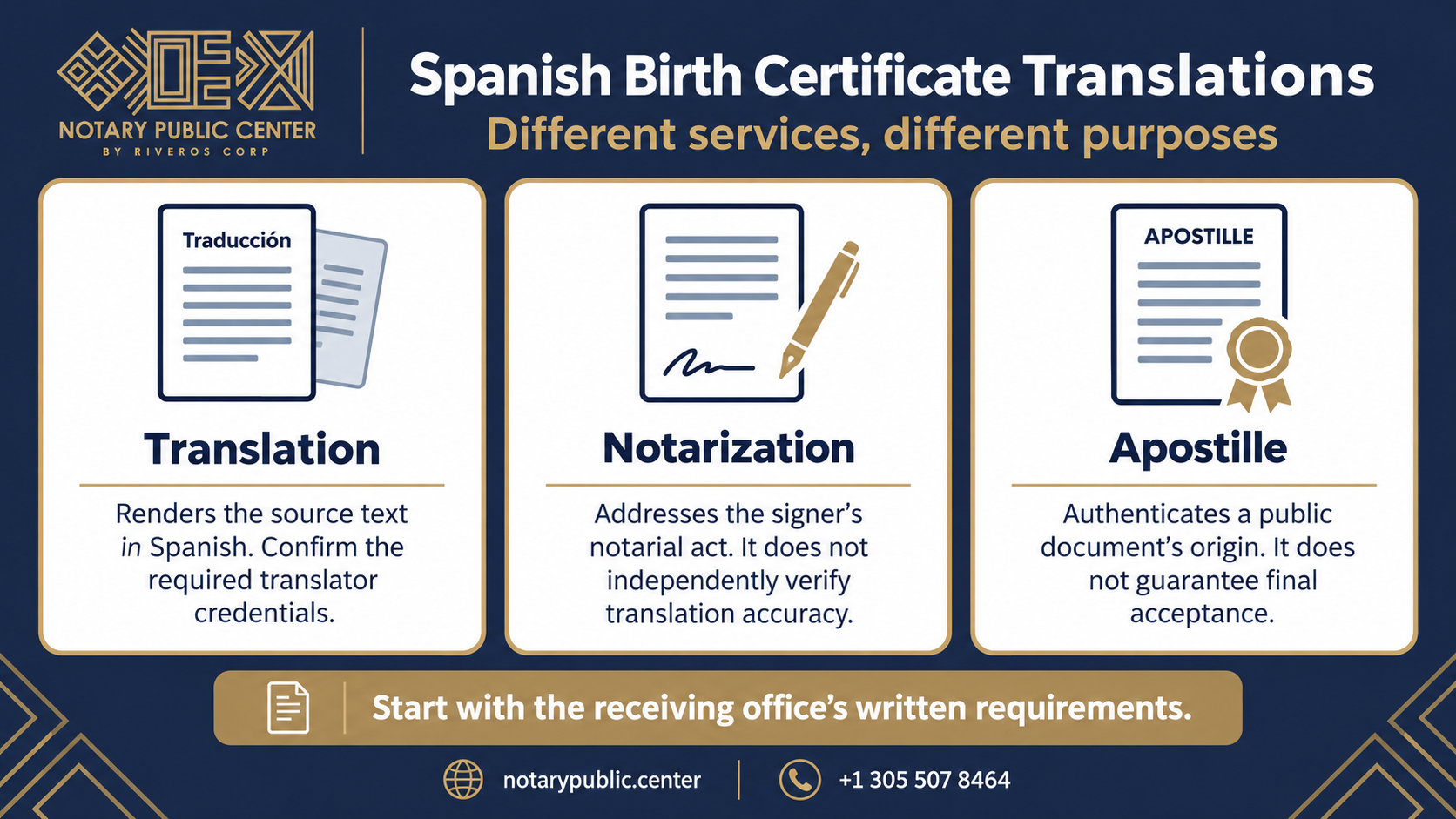
Translation, notarization and apostille compared
| Service or document | What it addresses | What it does not establish by itself |
|---|---|---|
| Birth record issued by a public office | The official record held by the issuing authority | Acceptance of a particular copy for every procedure |
| Spanish translation | The meaning of the source text in Spanish | Authentication of the source official's signature |
| Translator's certification | The translator's stated responsibility for the work | A foreign sworn-translator appointment |
| Notarial certificate | The notarial act performed for the signer | An independent judgment of translation accuracy |
| Apostille | The origin of a public document within its scope | Approval of the underlying application |
Some files require several of these components. Others require fewer. Adding certifications without checking the purpose can increase the work while leaving the receiving office’s actual requirement unresolved.
What a notarized translation means
When an office asks for a “notarized translation,” it commonly means a notarial act connected to the translator’s statement. The exact certificate and act still matter. The notary does not become the translator or independently certify linguistic accuracy.
In Florida, the notarial certificate rules identify information required for the act. An acknowledgment and an oath-based statement serve different purposes. The document and applicable instructions should establish what is needed.
Our guide to notarization explains these distinctions. If you are unsure which act your legal document requires, obtain direction from the receiving office or an authorized lawyer. A notary should not select legal terms for your application.
Does a birth certificate need an apostille?
An apostille may be required for a foreign public document when the relevant rules call for authentication. However, the fact that two countries participate in the Apostille Convention does not make an apostille mandatory for every possible submission.
The HCCH’s Apostille information explains the Convention’s purpose and scope. An apostille concerns the document’s origin, including the signature and the signer’s capacity. It does not verify every fact stated in the record or translation.
For a state-issued U.S. birth certificate, the competent state authority generally handles the relevant apostille. Federal and consular records can follow different routes. The U.S. Department of State’s guidance separates these document categories.
Which document is being authenticated?
A birth certificate and a translator’s notarized statement are separate documents. An apostille on the notary’s signature does not automatically authenticate the registrar’s signature on the birth record. Confirm which document the receiving office wants authenticated.
This distinction matters when someone offers a single package described as “translation with apostille.” Ask what the package includes and which signature receives the certificate. The service description should match the actual requirement.
Country examples: why one rule is not enough
Spain, Mexico, Colombia and Argentina all use Spanish, yet their document rules differ. Even within one country, a consulate, university and civil registry may handle different procedures. The examples below show why the intended use must guide the review.
Spain
Spain recognizes translations by sworn translators appointed or recognized through its foreign affairs ministry. Its official translation guidance also describes other recognized routes, including specified diplomatic, consular and European Union arrangements.
Consequently, a generic U.S. certification is not automatically equivalent to a Spanish sworn translation. Confirm the permitted route for your file. Also distinguish requirements for the foreign birth record from those applicable to the translation itself.
Mexico
Do not assume that every Mexican procedure requires translating an English-language U.S. birth certificate. For example, the Mexican Consulate in Calexico’s 2026 birth-registration instructions require Spanish translation when the certificate is in a language other than English or Spanish.
That example concerns a specific consular procedure. It does not establish the requirements of every civil registry in Mexico. Ask the office handling your application about the record, any authentication requirement and the translator it will accept.
Colombia
Colombia’s foreign ministry guidance on official translations distinguishes translations prepared there from those issued abroad. Official translations made in Colombia for use there do not themselves require Colombian apostille or legalization under the guidance.
The underlying foreign document may still need authentication when the receiving entity requires it. Translations issued abroad follow a separate authentication requirement. Therefore, it is inaccurate to say that all translations must be prepared inside Colombia.
Argentina
Argentina’s TAD apostille guidance describes requirements for public translations submitted through that service, including certification by the appropriate translators’ association. This is a defined authentication route, rather than a rule for every Spanish-language submission.
For a birth record destined for Argentina, obtain the instructions for the actual procedure. Confirm whether a locally registered public translator or another accepted route is required. Do not rely on a provider’s general list of countries served.
Which comes first: translation or apostille?
The sequence depends on what must be translated and authenticated. When the recipient needs the birth certificate and its apostille translated together, obtaining the source-document apostille first can avoid an incomplete translation.
However, another file may require authentication of the translator’s notarized statement. That involves a document created after translation. A blanket instruction to “always apostille first” misses the difference between authenticating the source record and authenticating a later statement.
Before commissioning either service, ask for a description of the intended document set. It should identify the source record, translation, certification and any required authentication. This makes it easier to spot missing items without assuming every file follows one sequence.
The birth certificate copy matters
The receiving office may ask for an official certified copy, a full version or a document issued within a specified period. A translation cannot turn an unsuitable source document into the required record. Check the copy before paying for language work.
Similarly, a notary’s stamp on a photocopy does not necessarily satisfy official-record requirements. Florida limits notarial copy certification for vital records and certain public records. The appropriate issuing office may need to provide the certified copy.
For related terminology, see our article about an English-language birth certificate. It distinguishes the official record from a translation. Keep those components clearly identified when requesting a service proposal.
Names, dates and incomplete records
A translation should reflect the source record accurately, including relevant annotations, stamps and entries. Names should not be casually changed to resemble those on another document. If the source contains an error, ask the issuing authority about correction.
Date formats also need care. A sequence of numbers can be read differently across countries. A translator should preserve the actual date while expressing it clearly in the target language, without guessing at an ambiguous or unreadable entry.
In addition, a cropped photograph may omit a reverse-side annotation or certification. Provide the complete document through the agreed channel. If something is illegible, the provider should identify that issue before representing the translation as complete.
Online services and document delivery
You may be able to coordinate a translation remotely. Nevertheless, an emailed PDF is not automatically sufficient for the final submission. Ask whether the recipient requires a paper version, an electronic signature or another specific format.
If a related notarial act will take place online, it must meet the applicable remote-notarization rules. The translator or other required signer participates in that act; sending a file alone is not a notarial appearance.
Also confirm how original records will be handled and returned. Before sending personal documents, verify the provider’s contact and delivery instructions. Share the information needed for the service and avoid posting birth records in public comments or forums.
How Notary Public Center can help
Notary Public Center can review the service request and coordinate appropriate translation channels. Depending on the file, the work may include related notarization and apostille coordination. Confirm availability, scope and destination requirements before scheduling.
The proposal should identify which services are included and which depend on outside authorities. Translation time, notarial availability, apostille processing and delivery are separate considerations. An urgent appointment does not establish how quickly an authority will decide an application.
If the matter involves eligibility for citizenship, immigration status, parentage or another legal right, seek advice from an authorized lawyer. Administrative coordination and notarial services do not replace that legal assessment.
Frequently asked questions about Spanish birth certificate translations
Where can I translate a birth certificate to Spanish for official use?
Choose a translator or service that can meet the receiving office’s specific requirements. These may include a certification statement or a recognized sworn-translator credential. Confirm the procedure, destination and required document format before ordering.
Can I translate my own birth certificate?
Acceptance depends on the recipient’s rules. A personal or family translation may raise impartiality concerns or fail a credential requirement, but rejection is not universal. Ask the receiving office before relying on it for an official application.
Does notarization prove that a translation is accurate?
No. The notary performs the specified act connected to the signer’s statement. The translator remains responsible for the translation. A notarial certificate does not independently establish linguistic accuracy or a foreign translator qualification.
Will an apostille on the translation cover the birth certificate?
Not automatically. The source record and the translator’s statement have different signatures and functions. Confirm which document needs authentication. An apostille on a notary’s signature does not by itself authenticate the birth registrar’s signature.
Can Notary Public Center guarantee acceptance abroad?
No provider can guarantee every receiving authority’s decision. Notary Public Center can help coordinate the services agreed for your file. Written instructions and a complete document review help identify requirements, while the recipient determines acceptance.
Discuss your document with Notary Public Center
If you need to decide where to translate a birth certificate to Spanish, contact Notary Public Center. Share the receiving office’s instructions, the document’s origin and your deadline so the team can assess the service request.
Request information on WhatsApp at +1 305 507 8464. Confirm translation, notarization, authentication and delivery needs before sending originals or booking an appointment.
This article provides general information and is not legal advice. Reading it does not create an attorney-client relationship. Consult an authorized professional about legal eligibility and the requirements affecting your particular case.