
An in-depth guide to understanding Corporate KYC, its role in preventing financial risks, and why Compliance Officers is the ideal partner for background checks, structure verification, and risk-list screening.
Introduction
What happens when a trusted supplier turns out to be a front for financial fraud? In today’s interconnected business landscape, where companies depend on strategic suppliers and clients for success, corporate KYC (Know Your Customer) has become a non-negotiable shield against such risks. This process goes beyond simple trust, digging into the backgrounds, structures, and reputations of high-priority partners to safeguard your operations. Businesses can’t afford to roll the dice with disreputable entities—compliance gaps could spark legal battles, financial losses, or a tarnished public image.
This article unpacks the power of Corporate KYC, showing how it roots out financial crime and why Compliance Officers stands out as your go-to ally for thorough due diligence. From unmasking hidden owners to screening global risk lists, Compliance Officers delivers the insights you need to protect your company at every step.
What Is Corporate KYC?
Corporate KYC adapts the classic Know Your Customer framework—typically used for individuals—to the business realm. Often dubbed Know Your Business (KYB), it’s a cornerstone of corporate due diligence, focusing on verifying a company’s legitimacy, ownership, and risk profile. Unlike checking a driver’s license, Corporate KYC dives into:
Legal Verification: Confirming a business exists through registration papers, incorporation certificates, and articles of association.
- Ownership Structure: Pinpointing ultimate beneficial owners (UBOs) who control the entity.
- Risk-List Screening: Scanning databases for signs of fraud, sanctions, or unethical behavior.
This rigorous process helps you avoid partnering with criminals or fronts for money laundering, terrorism financing, or other illicit schemes.
How Corporate KYC Prevents Financial Crimes
Corporate KYC is your frontline defense against financial threats. By demanding transparency from partners, it plugs gaps where crime could thrive. Here’s how it works:
Identifying Shell Companies
Fraudsters love shell companies—empty husks masking shady dealings. Corporate KYC peels back these layers, spotting red flags like vague ownership or inactive operations before you sign a deal.
Risk Assessment
Does your client show up on a sanctions list? Are they linked to politically exposed persons (PEPs)? Corporate KYC uncovers these risks, giving you the data to decide if a partnership is worth pursuing.
Regulatory Compliance
Governments worldwide enforce KYC to fight money laundering and terrorism financing. A solid Corporate KYC process keeps you on the right side of Anti-Money Laundering (AML) laws, dodging fines and protecting your brand.
Enhancing Stakeholder Confidence
Investors, regulators, and customers notice when you prioritize compliance. A strong Corporate KYC approach signals integrity, strengthening trust and opening doors to better relationships.
Differences Between Individual KYC and Corporate KYC
Both aim to verify legitimacy, but Corporate KYC is a different beast:
- Complexity: Individual KYC checks IDs; Corporate KYC dissects ownership layers, addresses, and legal documents.
- Scope: Individual KYC suits banks; Corporate KYC spans industries, vetting suppliers, clients, and partners for financial or legal breaches.
- Regulations: Individual KYC focuses on personal identity; Corporate KYC tackles AML and international watchlists, too.
- Monitoring: Individual updates are occasional; Corporate KYC demands frequent reviews as businesses evolve.
These distinctions make Corporate KYC a heavier lift—but a vital one for strategic ties.
Key Elements of a Robust Corporate KYC Process
A top-tier Corporate KYC strategy goes deep, delivering a full risk picture:
- Background Verification: Checking registration and legal records confirms a partner’s identity.
- Ownership Structure Analysis: Mapping out UBOs reveals who’s really in charge—crucial for spotting hidden risks.
- Risk-List Screening: Cross-referencing sanction lists, PEP databases, and adverse media flags potential troublemakers.
- Ongoing Monitoring: Regular updates catch shifts like mergers or new red flags, keeping your diligence current.
For example, a supplier might look solid on paper but hide a sanctioned owner. Corporate KYC catches that before it’s too late.
Challenges in Implementing Corporate KYC
It’s not all smooth sailing:
- Data Fragmentation: Ownership details might be scattered across jurisdictions or missing entirely, muddying the waters.
- Lack of Standardization: Varying global rules create compliance headaches without a unified approach.
- Resource Intensity: Manual checks on complex entities drain time and budgets, tempting shortcuts.
- Evolving Requirements: Fast-changing laws demand constant vigilance to stay compliant.
These hurdles underscore the need for expertise—like what Compliance Officers provides.
Why Automation and Technology Matter
Technology is revolutionizing Corporate KYC. Automated tools, AI, and analytics speed up background checks, flag suspicious patterns, and track ownership shifts. They don’t replace human judgment but amplify it—cutting errors and delivering quick insights on risks like sanctions or negative press. For instance, software can scan large sets of watchlists in seconds, a task that would take days manually. Pairing this with expert oversight improves precision and efficiency, making Corporate KYC manageable for any business.
Compliance Officers: The Premier Ally for Strategic Supplier and Client Verification
Compliance Officers shines by zeroing in on what matters: verifying strategic partners through Corporate KYC. Here’s how they excel:
- Background Verification: They scrutinize legal records and financial histories, catching fraud early.
- Ownership Analysis: Digging into complex structures, they expose hidden UBOs tied to misconduct.
- Risk-List Screening: Using up-to-date databases, they screen partners for sanctions and illicit ties.
- Focus on Strategy: They prioritize high-stakes partners, protecting your core operations.
Imagine a key supplier with a clean facade but a sanctioned owner—Compliance Officers helps uncover that risk before it hits your bottom line.
Practical Tips for Integrating Corporate KYC
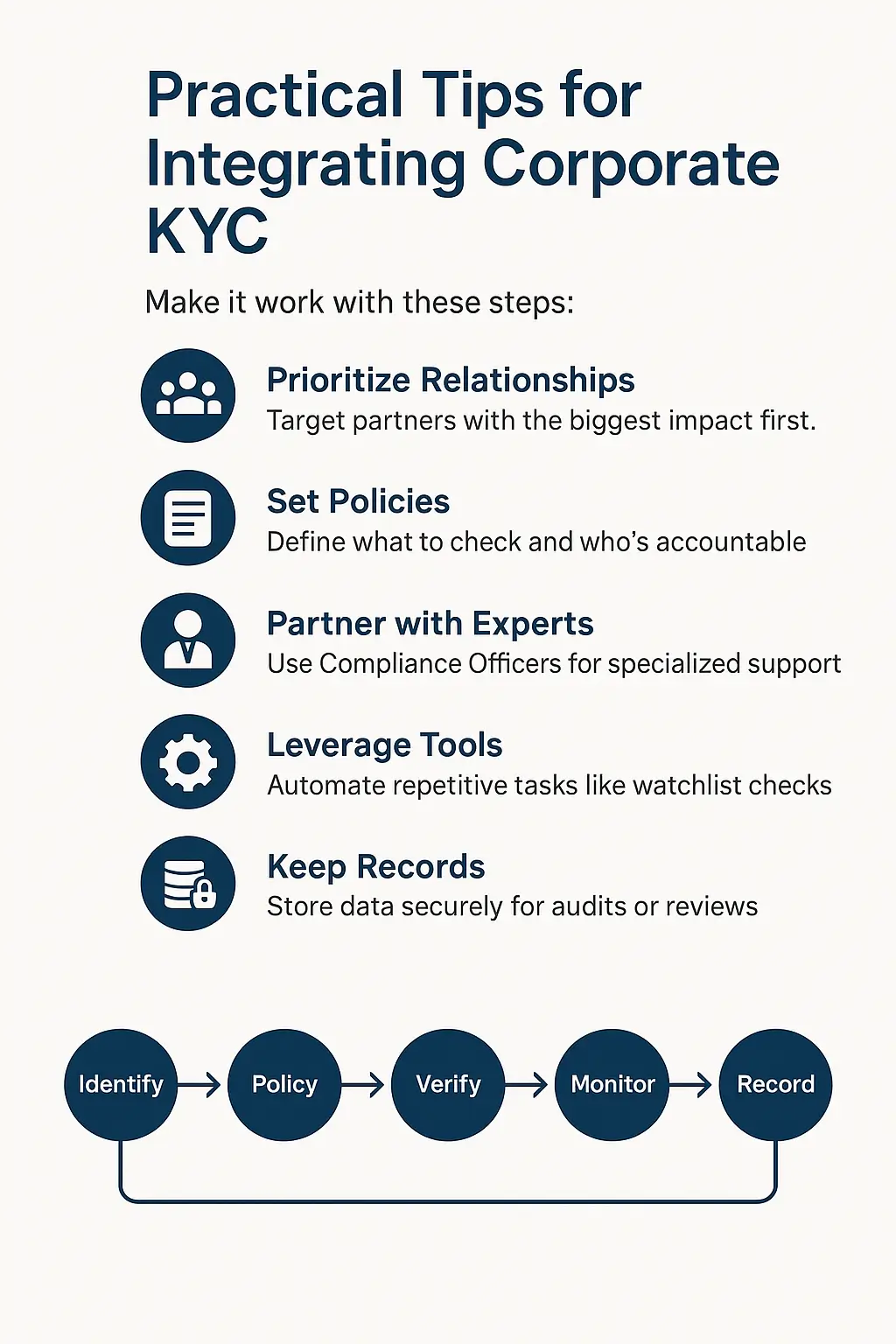
Turning theory into practice, an effective Corporate KYC program follows a few clear principles. Adopt a risk-based approach: apply deeper scrutiny to high-value or high-risk partners and lighter checks to low-risk ones, so resources go where they matter most. Centralize your data so verification documents, ownership maps, and screening results live in one place rather than scattered inboxes. Define clear UBO thresholds (for example, anyone owning or controlling a set percentage) so your team knows exactly whom to identify. When a partner clears those thresholds through opaque layers, escalate to enhanced due diligence instead of accepting the file as it stands. Finally, automate screening against watchlists while keeping expert review for judgment calls, and document every decision to create an audit trail regulators will respect.
Corporate KYC and AML: How They Work Together
Corporate KYC is the entry point of a broader Anti-Money Laundering (AML) framework. KYC establishes who your business partners really are; AML monitors the transactions and relationships that follow. Without solid KYC, AML monitoring is built on sand—you cannot flag suspicious behavior if you never confirmed who the counterparty is.
Together they form a continuous cycle: verify the partner, assess their risk, monitor activity, and refresh the verification as circumstances change. Regulators increasingly expect this integrated approach, and gaps in either half can expose a company to fines, frozen relationships, and reputational damage. Compliance Officers supports the due diligence side of that cycle. What a regulated counterparty is actually obliged to collect is set by the customer due diligence requirements that bind covered financial institutions, and those demands reach ordinary operating companies second-hand, through their banks.
Red Flags to Watch for During Corporate KYC
Certain warning signs should trigger deeper investigation before you commit to a partnership:
- Opaque or overly complex ownership structures that obscure the ultimate beneficial owner.
- A registered address that is a mail drop, shared with dozens of unrelated entities, or clearly inactive.
- Reluctance to provide standard incorporation or ownership documents.
- Links to sanctioned parties, politically exposed persons, or adverse media coverage.
- Mismatches between stated business activity and actual financial behavior.
None of these guarantees wrongdoing, but each warrants a closer look. Catching a red flag before signing is far cheaper than unwinding a compromised relationship afterward. When the counterparty is a supplier rather than a customer, the same signals are triaged through vendor due diligence tiering, so the depth of the check matches the exposure.
Building a Corporate KYC Checklist
A repeatable checklist keeps your due diligence consistent across every partner. At a minimum it should confirm:
- Legal existence: registration papers, incorporation certificate, and articles of association.
- Ownership: a mapped structure identifying all ultimate beneficial owners.
- Authorized representatives: who is empowered to sign and act for the entity.
- Screening results: sanctions, PEP, and adverse-media checks with dates.
- Risk rating: a documented assessment that determines the level of ongoing monitoring.
Standardizing these steps not only strengthens compliance but also speeds up onboarding, because your team follows the same clear path every time.
How Often Should You Refresh Corporate KYC?
Corporate KYC is not a one-time event. Businesses change ownership, expand into new markets, or fall onto watchlists, and your records must keep pace. A common practice is to set review cadences by risk level: high-risk partners reviewed more frequently, lower-risk partners on a longer cycle, and any partner re-screened immediately when a trigger event occurs—such as a merger, a change in ownership, or negative news.
This ongoing monitoring is what separates a checkbox exercise from genuine protection. When a trigger event occurs, Compliance Officers can run a new verification so the file reflects the partner as it is today.
Frequently Asked Questions About Corporate KYC
1. What is Corporate KYC?
Corporate KYC (also called Know Your Business, or KYB) is the process of verifying a company’s legitimacy, ownership structure, and risk profile before entering a business relationship. It confirms the entity legally exists, identifies its ultimate beneficial owners, and screens it against sanctions and watchlists.
2. How is Corporate KYC different from individual KYC?
Individual KYC verifies a person’s identity, typically with an ID check. Corporate KYC is more complex: it dissects layered ownership structures, legal documents, and addresses, and it screens against AML and international watchlists, with more frequent reviews as the business evolves.
3. Why is Corporate KYC important for preventing financial crime?
It exposes shell companies, hidden owners, and sanctioned parties before you sign a deal, keeping you compliant with Anti-Money Laundering laws and protecting your company from fines, legal exposure, and reputational damage.
4. What is an ultimate beneficial owner (UBO)?
A UBO is the individual who ultimately owns or controls a company, even through layers of intermediate entities. Identifying UBOs is central to Corporate KYC because hidden owners are where much financial risk is concealed. There is no public federal registry of company ownership in the United States—FinCEN’s beneficial ownership database is confidential and, since 2025, covers only foreign companies registered in the U.S.—so beneficial ownership verification has to be built from state records and corporate documents.
5. How often should Corporate KYC be updated?
It should be refreshed on a risk-based cadence—more often for high-risk partners—and immediately after trigger events such as a merger, a change of ownership, or adverse news. Ongoing monitoring keeps your due diligence current.
6. How can Compliance Officers help with Corporate KYC?
Compliance Officers provides background verification, ownership analysis, and risk-list screening, focusing on your most strategic suppliers and clients so hidden risks are caught before they affect your operations.
Conclusion
Corporate KYC isn’t just a buzzword—it’s a must-have for businesses relying on strategic suppliers and clients. By verifying backgrounds, mapping ownership, and screening risks, it shields you from legal woes and financial hits while boosting trust. Compliance Officers takes this to the next level, offering targeted expertise that simplifies Corporate KYC for your most critical partnerships. In a world where one bad partner can sink your reputation, their focus on due diligence is your edge. Embrace Corporate KYC with Compliance Officers and turn compliance into a strength.
Legal Disclaimer:
This article is provided for informational purposes only and does not constitute legal advice. The content herein is not intended to substitute professional legal consultation. For specific guidance regarding your individual circumstances, please consult directly with a qualified attorney licensed to practice in your jurisdiction.