Authenticate an existing export certificate
FDA Certificate Apostille: Choose the Right Route
Published
An FDA certificate apostille authenticates an eligible federal export certificate for a destination where the Hague Apostille Convention applies. Confirm the recipient’s requirement, the issuing FDA program and the format of the certificate already in your company’s hands before arranging certification.
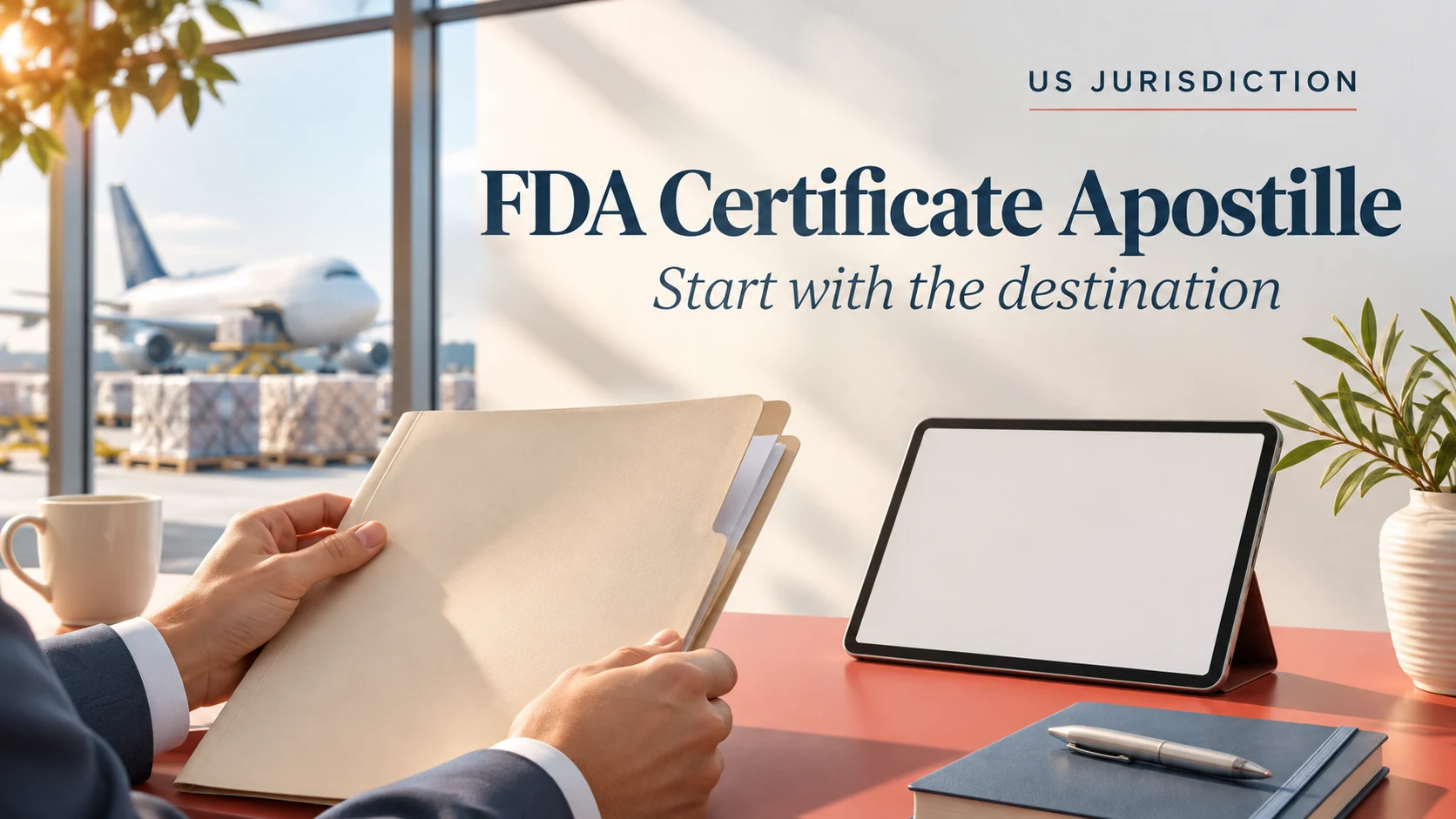
Match the issued certificate and its electronic or paper format to the destination’s actual requirement.
Before you start
Destination determines the requirement
Ask whether the recipient requires an apostille, legalization or official electronic verification for the particular filing.
Issuer determines the authority
An FDA certificate is federal. A state-related or chamber certificate may follow a different signature-certification route.
Format depends on the program
FDA device certificates have explicit color-print instructions. Check food certificates and drug eCPPs under their own requirements.
01 / Start with the recipient
When does an FDA certificate need an apostille?
An importing regulator or other foreign recipient may require an FDA export certificate and specify how it must be authenticated. Obtain that request in writing. The certificate needed for a product and the later authentication are separate parts of the file.
Confirm whether the applicable Hague Convention framework supports an apostille or whether the destination requires an authentication and legalization route. Also ask whether the regulator accepts direct verification on the issuing authority’s official platform. Do not assume every electronic certificate needs a paper stamp or that a verification link always replaces one.
Record the accepted issuer, certificate title, issue-date conditions and translation requirements. Requirements may differ between product categories or filing procedures within the same country. An example from another exporter is useful only after those circumstances have been checked.
02 / Document identification
Which FDA certificate do you already hold?
A free sale certificate issued by a state-related program or chamber is not an FDA certificate. Check the issuing organization and actual signature before planning the authentication office. An apostille cannot change a chamber document into a federal regulatory certificate.
Match the certificate to the importer’s requested product. If the buyer requires a CFG and the company holds a different document, resolve that mismatch first. Certifying the wrong record does not complete the underlying regulatory requirement.
Food and dietary supplements
The food program uses different certificates for conventional foods and specified supplement or special-food categories. Identify the actual CFG, Certificate of Exportability or Certificate of Free Sale.
Medical devices
CDRH certificates include CFG, CFG-NE and applicable Certificates of Exportability. Read the certificate type and product information rather than relying on the generic term FDA certificate.
Human drugs
CDER’s electronic Certificate of Pharmaceutical Product provides drug-specific information in the WHO format. It is distinct from device and food export certificates.
Let’s review your document
Tell us what document you have, where it was issued and where you need to use it.
03 / Competent authority
Which office handles the certificate’s authentication?
| Document held | Starting point for review | Key limitation |
|---|---|---|
| FDA-issued certificate | The U.S. Department of State’s applicable federal certification process. | Confirm the issued version and required submission format. |
| State agency or state-related certificate | The actual signer and authority responsible for its signature. | The program’s name alone does not settle the route. |
| Private chamber certificate | Applicable notarization and state certification requirements. | The recipient must first accept that private issuer’s certificate. |
The FDA does not notarize export certificates. For an original federal record, adding a private notarial act is not a routine substitute for the required federal review. Use the current Department of State instructions and preserve the official certificate and attachments.
An apostille or authentication concerns the relevant signature or seal. It does not approve the product, extend the certificate’s validity or compel a regulator to accept the underlying document.
04 / Electronic certificates
How should an electronic FDA certificate be prepared?
CDRH issues device export documents electronically through CECATS and provides verification through the FURLS Export Certificate Validator. Its official letter and device FAQ specify color printing for apostille or authentication. Follow the certificate’s current access and printing instructions, and save the original PDF when it becomes available.
Most FDA food export certificates are also issued as PDFs and can be verified online. CDER eCPPs have their own online verification process. These facts do not establish that every printout is ready for federal authentication or that the device color-print instructions apply unchanged to those other programs.
Confirm the format required for the exact certificate before submitting it. Keep all pages, certificate numbers and QR codes legible. Do not edit the original PDF, remove official information or recreate a certificate in another layout. Retain an unchanged official file separately from internal working copies.
05 / Beyond the apostille
What changes when the destination requires legalization?
For a destination outside the applicable apostille framework, a federal authentication certificate may be followed by the destination’s consular legalization or attestation requirements. Identify the competent mission and document category instead of sending the file through an apostille route intended for another country.
The UAE, Qatar, Kuwait, Egypt and Iraq require their own destination review. A commercial or product certificate should not automatically inherit the checklist used for a personal birth or marriage record. Verify the current service and any remaining foreign-affairs or recipient requirements.
Keep translations in the plan as well. Ask whether the recipient requires the original certificate, attached authentication pages and later consular acts translated. A correctly certified record can still leave an application incomplete if a required translation or supporting certificate is missing.
06 / Before dispatch
What should be ready before apostille or legalization?
Apostille de la Haya is a private company independent of the FDA and government agencies. It does not request, obtain or file for FDA certificates. Its work begins after issuance. No authentication service can guarantee the regulator’s acceptance or replace a missing certificate from the proper issuer.
The certificate already issued
Provide the complete record, including the original electronic file where available. Identify the issuer, program, certificate number and product.
The destination’s written requirement
Confirm the accepted certificate, issuer, format, translation and authentication. Resolve unclear product or company details with the issuer before proceeding.
Dates and remaining stages
Check certificate validity and any stricter recipient issue-date rule. Separate issuer work, government certification, consular steps and delivery when discussing a deadline.
An agreed service scope
Ask Apostille de la Haya to review the applicable route for the existing certificate and explain the assistance and document handling involved.
07 / Common questions
What should you know about an FDA certificate apostille?
No. The destination’s requirements determine whether an apostille, legalization or another accepted verification method is needed. Obtain the written requirement for the particular product and filing. Confirm the issuer and certificate format before proceeding, because an electronic record and a paper submission can raise different questions for the receiving authority.
No. An eligible FDA certificate follows the applicable federal certification process through the U.S. Department of State. The FDA issues the underlying export certificate and provides its program’s verification instructions. These functions are separate, so confirm the certificate already issued and the destination’s requirement before arranging the additional authentication.
Do not assume so. A chamber certificate is a private document with a different signer from an FDA certificate. Review the appropriate notarization and state certification requirements for that signature. First confirm that the receiving authority accepts the chamber document; an apostille cannot turn it into an FDA certificate.
Yes. FDA device guidance specifies color printing for apostille or authentication of electronic device certificates. Keep the original PDF and follow the current printing instructions so the official content and verification details remain legible. This device-specific guidance should not be applied automatically to food certificates or drug eCPPs.
Confirm the format for the exact certificate before submitting a printout. FDA food certificates and CDER eCPPs have official electronic verification methods, but those methods do not by themselves establish every authentication office’s requirements. Preserve the issued file and check both the certification route and the recipient’s required format.
No. An apostille authenticates the relevant signature or seal, not the product’s regulatory approval in the destination. The receiving regulator evaluates the underlying certificate and other filing requirements separately. It may require additional product information, translations or documents even when the certificate has been authenticated through the appropriate route.
Review the authentication and consular route for that destination instead of ordering an apostille intended for another country. Identify the competent mission and the certificate’s commercial or regulatory category. Confirm any later foreign-affairs or recipient requirements and keep them separate from the federal office’s certification stage and return delivery.
No. Apostille de la Haya does not request, obtain or file for FDA export certificates. It reviews the certificate your company already holds and the destination’s written instructions to discuss apostille or legalization assistance. Share the complete record and original electronic file where available before arranging its next certification stage.
Apostille de la Haya · Contact
Contact Apostille de la Haya about your FDA certificate
Share the issued certificate, destination and recipient’s instructions to review the appropriate apostille or legalization route. Use the contact form or WhatsApp at +1 305 500 0185.
Tell us about your document
Related guides

Professional background
Florida Supreme Court Certified County Court Mediator. Certified Notary Signing Agent through the National Notary Association (NNA), Certified Anti-Money Laundering Specialist (CAMS) and Florida Notary Public. With legal training in Colombia and 30 years of professional experience, she combines technical knowledge, business leadership and international experience. Since 2009, she has led Riveros Corp and a network of services helping individuals and businesses navigate cross-border processes involving the United States.
Official sources
- FDA — Exporting Medical Devices
- FDA — Exporting Medical Devices: Frequently Asked Questions
- FDA — Transition to Electronic Export Documents, Letter to Industry — January 2, 2024
- FDA — Online Verification of Export Certificates for Food
- FDA — Online Verification of Electronic Certificates of Pharmaceutical Product
- FDA — Food Export Certificates
- U.S. Department of State — Prepare Document for an Apostille Certificate
- U.S. Department of State — Prepare Document for an Authentication Certificate
- HCCH — Apostille Convention status table
Legal notice
This publication provides general information and is not legal advice. Apostille de la Haya is a private company and is not affiliated with the FDA or any government agency. Confirm current requirements with the competent authority and the institution receiving your document.