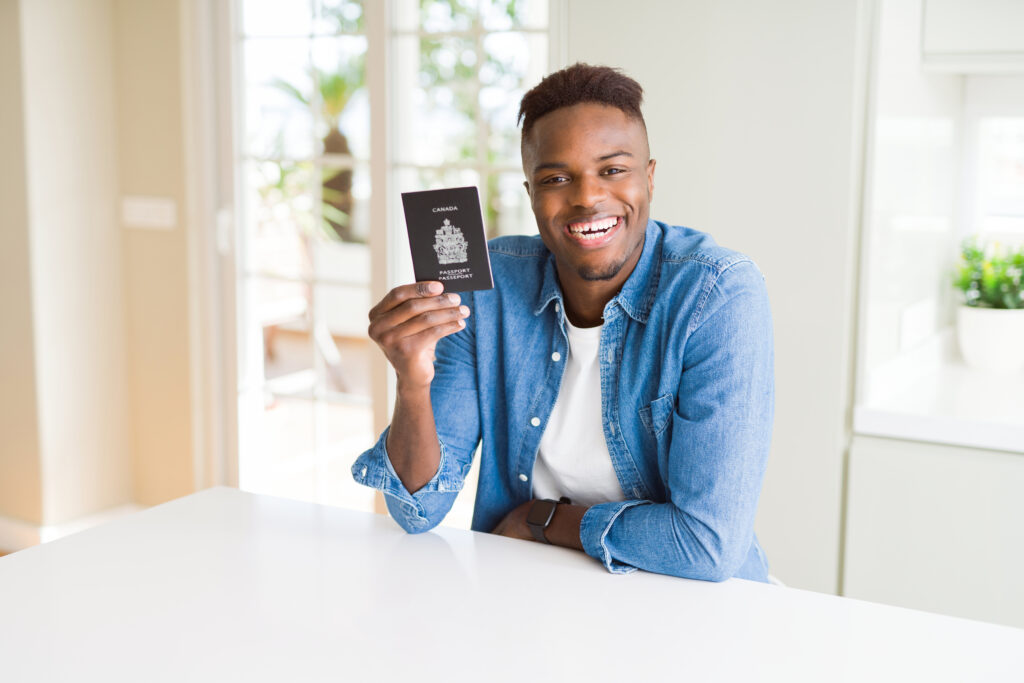
If you want a notarization that your recipient accepts the first time—and a smooth path to any apostille afterward—start with a proper ID check. It is more than a quick glance at a plastic card; it is a structured verification of who is signing and under what conditions. At Notary Public Center, we perform ID checks with multiple layers of technology and clear human oversight. We verify identity documents, we document the ceremony, and we deliver a tamper-evident result online or a wet-ink original in office. Because quality at the identity step prevents downstream rejections, we treat the ID check as the heart of every file.
Keyword note for clarity: we use ID check to refer to the complete identity-verification process that precedes the notarial act and supports an apostille later.
What is an ID check (in practical terms)?
An ID check for notarization is the process of confirming that the signer is who they claim to be and is legally competent to sign. (Note: For comprehensive background checks or FBI reports, please visit our Compliance Officers division).In our service, the ID check combines:
Credential analysis of the ID document — We inspect data integrity and machine-readable zones (where available), confirm validity, and assess security elements.
KBA (Knowledge-Based Authentication) — The signer answers time-limited questions based on public/credit records linked to them.
Biometrics/liveness — The platform confirms a real person is present and that the face matches the ID. (Need biometric identity verification for employment, licensing, or FBI reports rather than a simple notarization? Our Compliance Officers team specializes in livescan fingerprinting and comprehensive background checks)
Recorded two-way video call — The notary verifies willingness and awareness, administers the oath (for jurats) or takes the acknowledgment, and completes the notarial certificate.
This layered approach creates a defensible record that banks, universities, agencies, and foreign authorities can trust. It also produces a digital audit trail that a classic mobile visit cannot match.
How the ID check supports apostille
An apostille authenticates the signature and capacity of the notary or public official—not the content of your document. Still, authorities and recipients expect the notarization underneath the apostille to be solid. When identity proofing is weak, the entire packet can be questioned. A robust ID check avoids:
Name mismatches between document and ID (including accents, hyphens, and middle names).
Doubts about in-person presence during an online ceremony.
Reprocessing at the competent authority due to incomplete or inconsistent signer data.
In short, a clean ID check is the fastest way to an apostille that is accepted the first time.
Primary and secondary documents for the ID check
Primary, government-issued photo IDs
U.S. or foreign passport (preferred for international signers)
U.S. driver’s license or state ID
U.S. permanent resident card (where permissible)
National ID (country-specific; legibility and Latin characters help)
Secondary or supporting evidence (used when the recipient requests or to strengthen the file)
Vehicle registration/title, voter card
Lease/mortgage/deed, utility bill, insurance card
Current student ID (policies vary)
Because rules differ by receiver, we first confirm what your recipient accepts and then assemble the ID evidence accordingly.
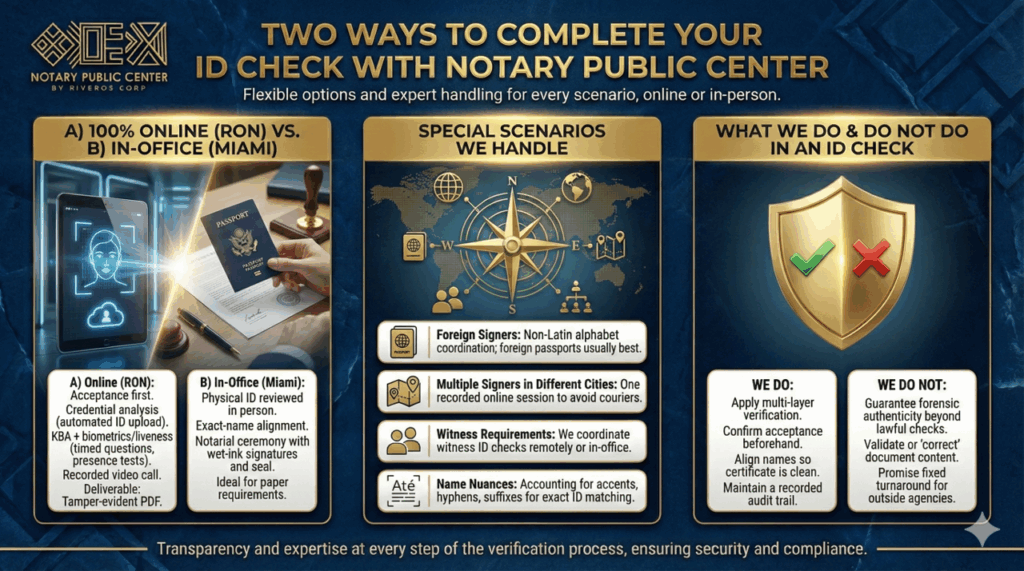
Two ways to complete your ID check with Notary Public Center
A) 100% Online (RON)
Acceptance first: We confirm your recipient accepts online notarization.
Credential analysis: You upload an ID for automated checks.
KBA + biometrics/liveness: You pass timed questions and facial-match presence tests.
Recorded video call: We conduct the notarial ceremony and finalize the certificate.
Deliverable: A tamper-evident PDF. If anyone edits it after signing, standard PDF viewers show modified/invalid.
B) In office (Miami)
Physical ID reviewed in person.
Exact-name alignment between your ID and the document.
Notarial ceremony with wet-ink signatures and seal.
Ideal if the recipient requires paper or if remote checks are not feasible.
Timeframes may vary based on schedules, holidays, and the needs of third-party recipients.
“Not only passport or driver’s license”: special scenarios we handle
Foreign signers — A foreign passport is usually best. If your national ID uses a non-Latin alphabet, we coordinate the most acceptable alternative for your recipient.
Multiple signers in different cities — Online we place everyone in the same recorded session (if allowed), so you avoid couriers and repeat visits.
Witness requirements — If your document needs one or two witnesses, we coordinate witness ID checks as well (remotely where permitted or in office).
Name nuances — We account for accents, hyphens, suffixes, and middle names so the notarial certificate matches your ID exactly.
What we can and cannot do within an ID check
We do
Apply multi-layer verification and notarial best practices.
Confirm acceptance with the receiving institution before you sign.
Align names and data so the notarial certificate is clean.
Maintain a recorded audit trail and notarial log, as required.
We do not
Guarantee the absolute authenticity of an ID beyond lawful checks; we do diligence, not forensic certification.
Validate or “correct” the content of your document (that’s not what an ID check does).
Promise fixed turnaround for outside agencies—timeframes can vary.
Benefits you’ll notice immediately
Fewer rejections at banks, schools, courts, and consulates.
A documented chain of evidence that stands up to audits.
Faster apostille routing because your notarization is trusted.
Protection for the signer against impersonation and unauthorized use.
Operational efficiency: we fix small issues during the session instead of scheduling second visits.
From notarization to apostille: where the ID check fits
Notarized documents (affidavits, powers of attorney, consent letters): the apostille authenticates the notary’s signature. A rigorous ID check keeps the underlying notarial act unquestioned.
Vital records (birth, marriage, death): these are not notarized; you must present (or allow our team to retrieve for you) certified originals from the issuing office. In such cases, ID checks apply to any related affidavits or powers, not to the vital record itself.
Translations: we help decide whether the apostille attaches to the translator’s notarized statement, the base document, or both—depending on the receiver’s rule.
For non-Hague destinations, we map the authentication + consular legalization path, always starting from a compliant ID check.
Our service flow
Intake & acceptance check
Tell us who will receive your document and where it will be used. We confirm RON vs. paper, witnesses, certificate type (jurat vs. acknowledgment), and any template language.ID check
Online (credential analysis + KBA + biometrics + recorded call) or in office (physical ID review).Notarization
Jurat when you must swear/affirm and sign during the session.
Acknowledgment when you acknowledge a prior signature.
Delivery
Tamper-evident PDF (online) or wet-ink original (in office).Apostille/authentication (optional)
We assemble the filing and manage return through our seamless integration with Apostille de la Haya. Timeframes may vary.
Quality checklist (copy/paste)
Recipient & country confirmed (acceptance of RON vs. paper).
Type of notarial act: jurat or acknowledgment.
Valid, legible ID (passport, driver’s license, state ID, foreign passport, national ID).
Exact name on document matches ID (accents/hyphens/middle names).
Witnesses lined up if required (with valid IDs).
Translation or apostille needs scoped early; decide where the certificate will attach.
Clear scans for any exhibits.
Timeline buffer for shipping and outside offices — timeframes may vary.
Common mistakes we prevent
Pre-signing a jurat document before the ceremony. Jurats must be signed during the session.
Using the wrong notarial certificate (acknowledgment instead of jurat, or vice versa).
Name mismatches between document and ID.
Trying to notarize/apostille photocopies of vital records (vital records require certified originals).
Sending a modified PDF after signing—our sealed files reveal any change as invalid/modified.
Skipping the acceptance check, which triggers reshipments and re-signs.
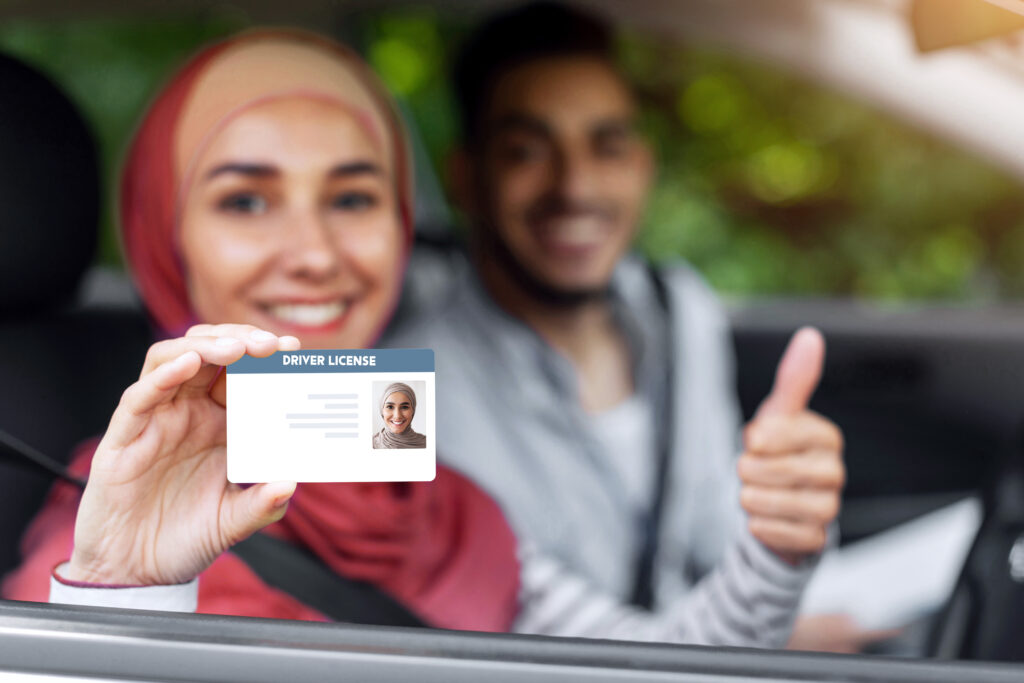
Why choose Notary Public Center for your ID check
Acceptance-first approach: we build to your receiver’s policy, not the other way around.
Four online layers of identity proofing, plus an in-office option.
Tamper-evident PDFs and a recorded ceremony for compliance confidence.
Apostille-ready: we route notarized documents through apostille/authentication when they travel abroad.
Bilingual support (EN/ES) and a consultative
Ready for an ID check that unlocks a clean notarization and a smooth path to apostille? Contact Notary Public Center. We confirm recipient requirements, verify identity with multiple layers, notarize 100% online or in office, and deliver a package built for acceptance. Timeframes may vary.
FAQ
1) Which IDs do you accept for the ID check?
U.S. or foreign passport, driver’s license, state ID, permanent resident card, and some national IDs. We may request supporting evidence if your receiver requires it. Contact us to validate your case.
2) Does your ID check help with apostilles?
Yes. A strong ID check supports a trusted notarization, and the apostille then authenticates the notary’s signature. We design the file to match the receiver’s rule.
3) Can I notarize online if my document will be used abroad?
Often yes. Many destinations accept RON-notarized documents for apostille. We verify acceptance first; if someone demands wet-ink, we host you in office.
The information contained in this publication is provided for general informational purposes only and does not constitute legal advice. Reading or using this content does not create and is not intended to create an attorney-client relationship. No reader or user should act or refrain from acting based on the information presented herein without first consulting an attorney duly licensed to practice law in their jurisdiction.