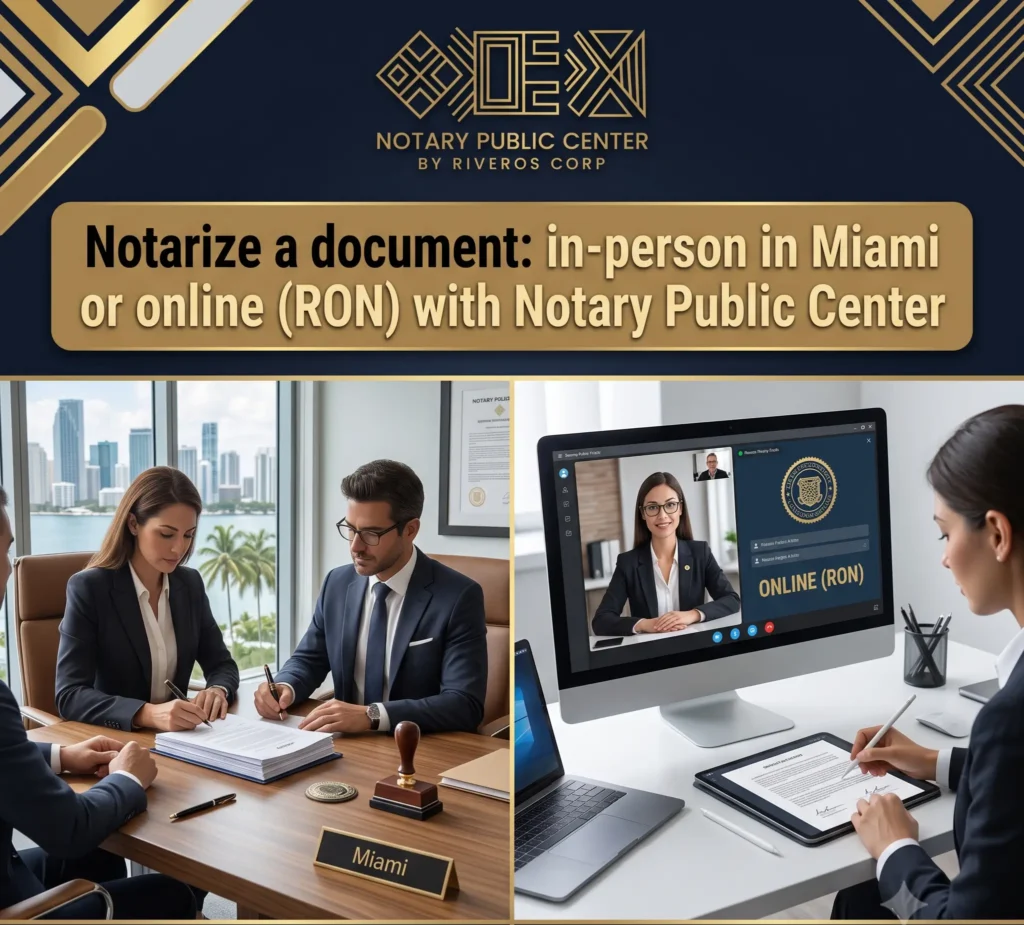
If you need to notarize a document, you likely want two things: speed and acceptance. At Notary Public Center, we provide both routes—in-person notarization in Miami and online notarization—so you can choose the method that fits your timing, location, and the expectations of the party who will receive your paperwork. Our Florida RON workflow uses biometrics, a recorded audio-video session, and KBA (knowledge-based authentication linked to your SSN) to verify identity and produce a defensible audit trail. Florida law requires identity proofing and recording for RON, and treats an online act performed by a notary physically in Florida as performed in Florida.
Bottom line: we can notarize a document today—from Miami, or online—while keeping compliance and acceptance front and center.
What it means to notarize a document (and why the details matter)
To notarize a document is to attach a notarial certificate confirming who signed, when, and under what acknowledgment or oath. For traditional notarization, signers appear physically before the notary. For RON, signers appear remotely over two-way audio-video, and the notary must verify identity, analyze credentials, and record the session. Florida’s statute lays out the core elements: remote presentation of ID, credential analysis, and identity proofing via KBA or another conforming method—and it explicitly requires recording the session. If identity proofing databases lack sufficient information or the criteria aren’t met, the notary may not complete the online notarization.
Two ways to notarize a document with us
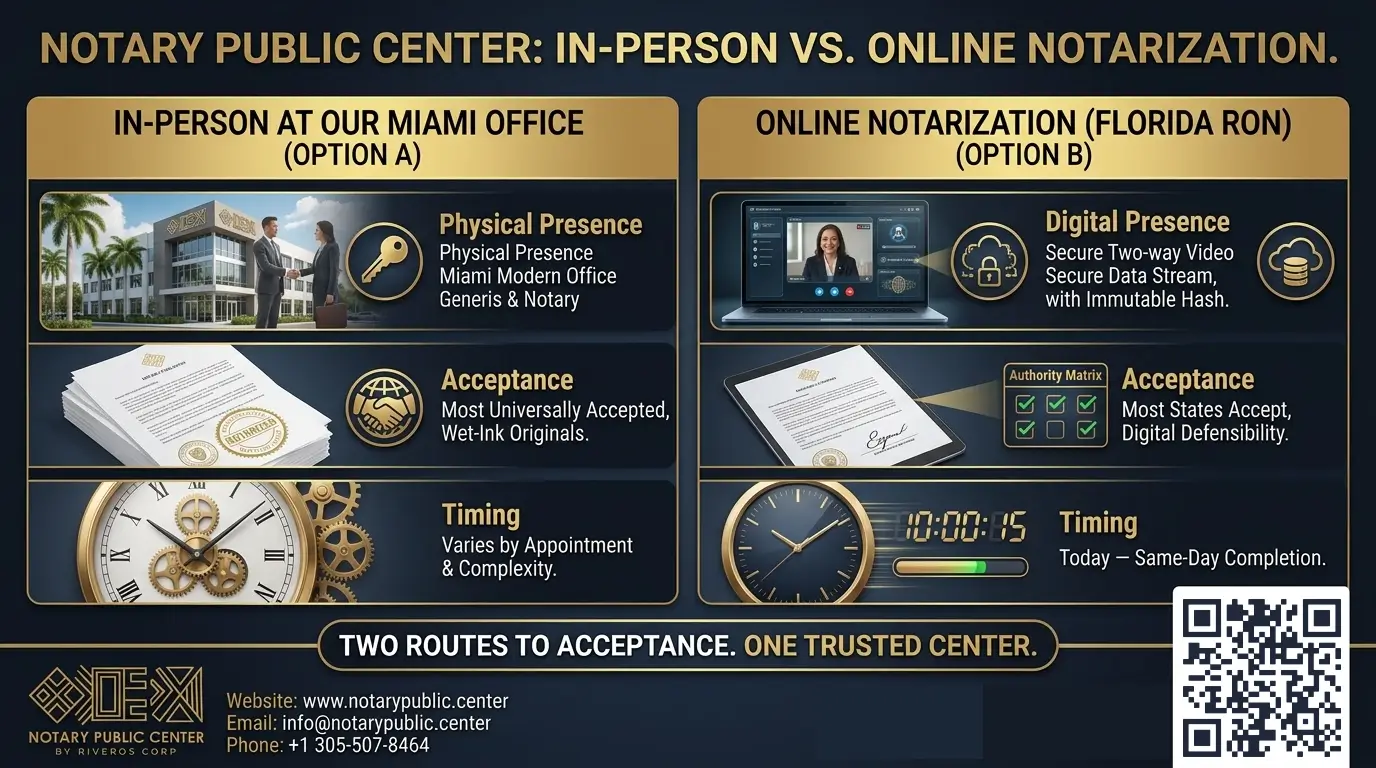
Option A — In-person notarization at our Miami office
Prefer a face-to-face signing? Come to our Miami location. We’ll verify your ID, confirm your willingness and awareness, and notarize the document on the spot. This is the most universally accepted method and is ideal when the recipient insists on wet-ink signatures or when signers are unfamiliar with online sessions. (Some recorders, agencies, or private companies still prefer paper originals.)
Good for:
Paper forms that will be hand-delivered or recorded locally.
Signers who prefer a traditional setting.
Situations where the receiving office explicitly requires physical documents.
Timing: Timeframes may vary based on availability and document complexity.
Option B — Online notarization (Florida RON)
When distance or time matters, we can notarize a document online. Florida’s RON framework allows a notary physically located in Florida to notarize even if signers and witnesses are outside Florida, provided the session follows the statute (ID checks, credential analysis, identity proofing, and a recorded two-way connection). We use a Florida-listed RON service provider and follow Florida Administrative Code standards for security, custody of recordings, and seal control.
How the online flow works (high level):
Scheduling & tech check — You’ll test audio/video and prepare a valid government ID.
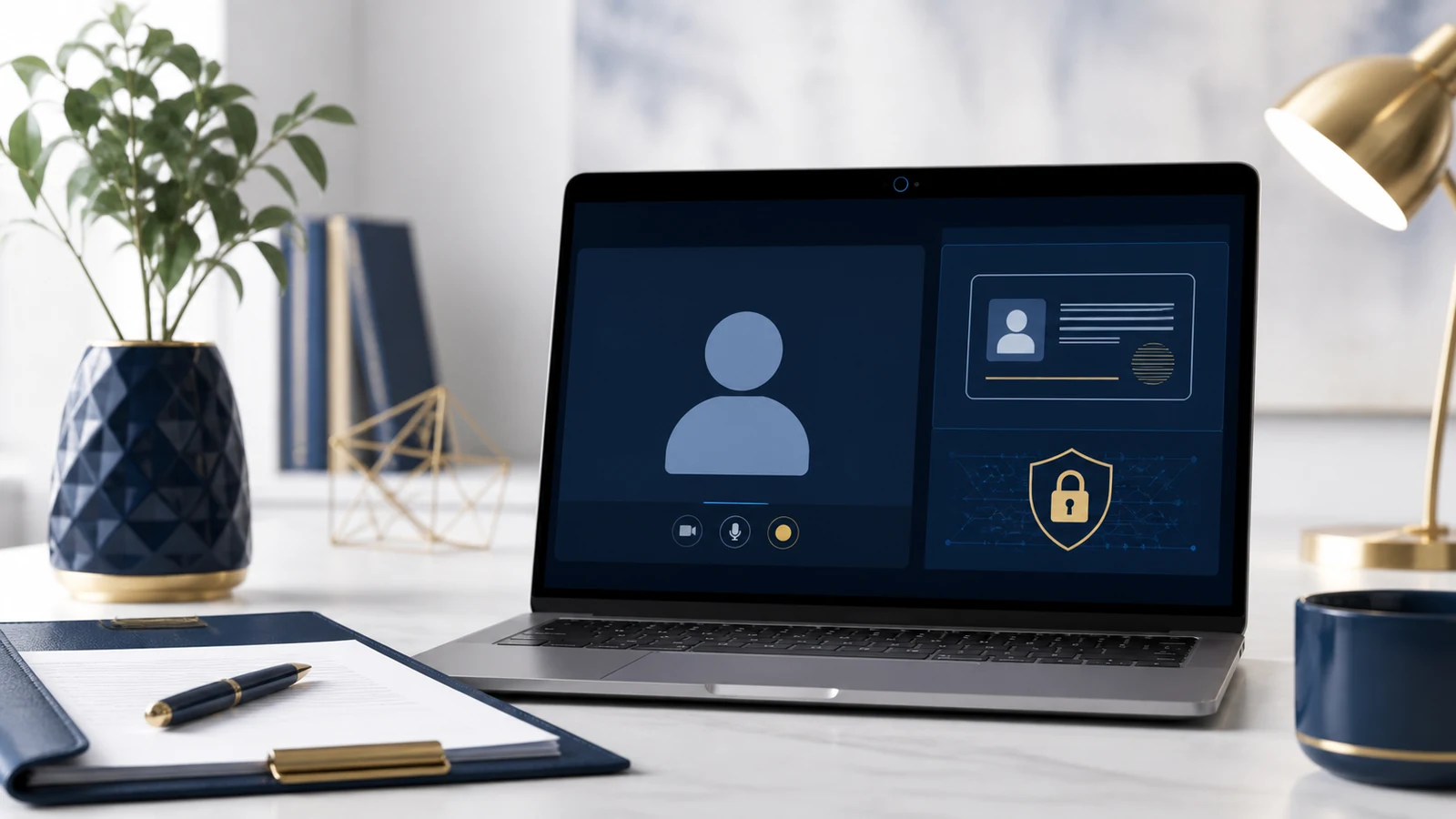
Identity layers — You’ll complete KBA (time-boxed questions tied to your personal/credit history), pass credential analysis of your ID, and complete biometric live-ness/face match—then join a recorded session with the notary.
Sign & seal — We notarize the document electronically; the platform retains a tamper-evident record and logs.
Evidence package — You receive your notarized file and (when appropriate) instructions for verifying the notarization if a reviewer asks.
If identity proofing fails or databases lack enough data, Florida law bars us from proceeding online. In that case we pivot to an in-person notarization so your project doesn’t stall.
The three identity layers we use online (why they matter)
KBA (Knowledge-Based Authentication): The system generates time-limited questions from public/credit data linked to your SSN and personal history. You must reach a passing score to proceed. This step satisfies the identity proofing requirement in Florida’s statute.
Biometric live-ness & match: We add biometric checks to compare your face to the ID you present and confirm a live, present person—not a photo or replay. Florida law recognizes identity proofing methods that can include biometric verification.
Recorded audio-video session: Florida requires us to record the session and keep the record under program rules. That recording becomes part of the evidence behind your notarization.
Together, these layers make it safer and more defensible to notarize a document online—especially for parties that audit identity steps.
Is online notarization valid in your state? (short answer: usually yes—verify first)
As of now, 47 states and DC have laws allowing remote e-notarization. That’s “most states,” and it’s why RON has become a standard option for businesses and families. However, procedures and acceptance policies vary. A county recorder, a bank, a school, or a court clerk might impose format or submission preferences (e.g., wet-ink originals, specific certificates). Because of this variability, we strongly recommend confirming acceptance with your receiving party before you notarize a document online. We’re happy to help you ask the right questions.
Tip: If the recipient is unsure, ask whether they recognize documents notarized under Florida law and whether they accept electronic notarizations. If they say “paper only,” we’ll book in person at our Miami office.
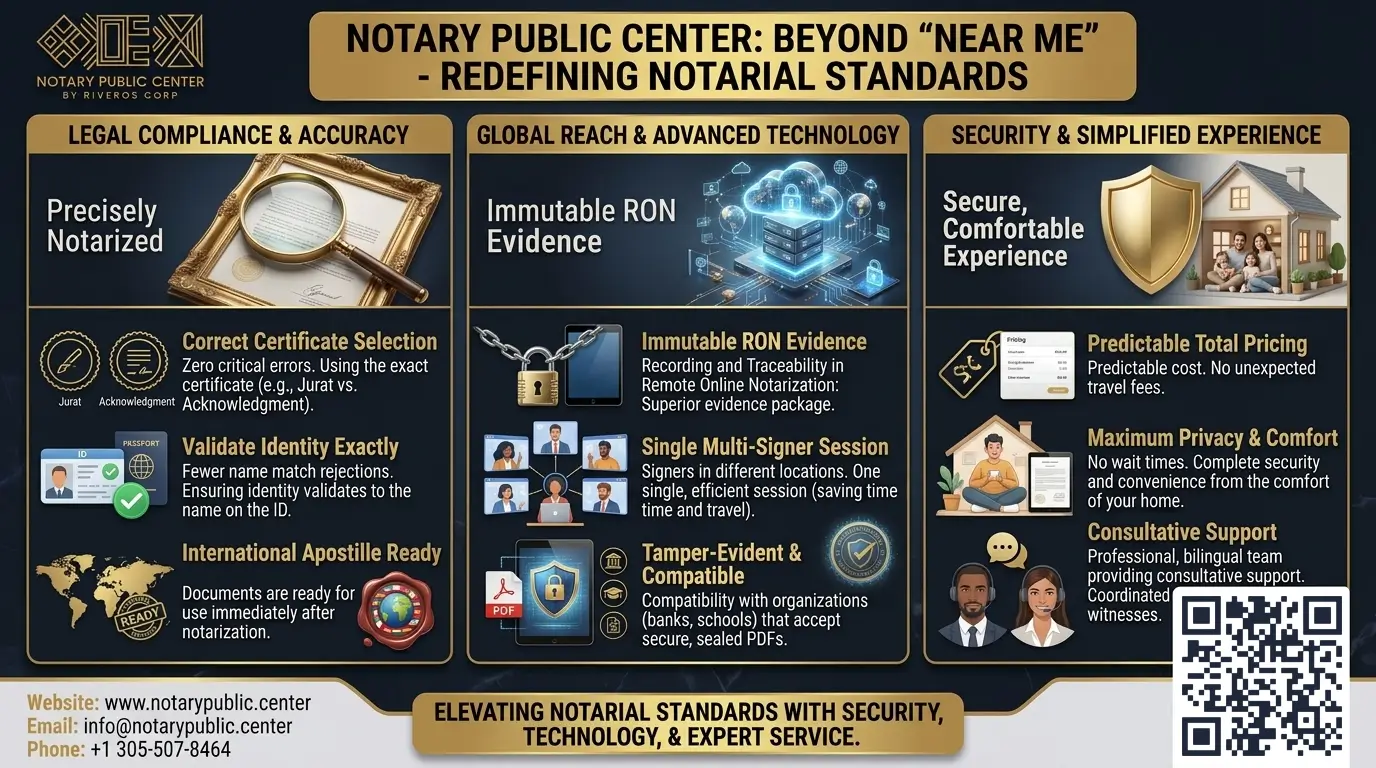
Tamper-evident protection. Every document we notarize online is sealed at the moment of notarization with a digital certificate and a tamper-evident hash. From that point forward, the file cannot be modified without detection: any post-notarization change automatically voids the signatures, breaks the seal, and will display a clear “modified/invalid” status in standard PDF signature panels. Our platform also preserves the original, signed version together with the recorded session and audit trail, so recipients can verify integrity instantly.
When to choose in-person vs. online (decision guide)
Choose in-person if:
The receiving office explicitly demands paper with a wet-ink signature.
A signer may struggle with tech, lacks credit history for KBA, or prefers a traditional setting.
The document will be recorded where electronic notarization is not yet integrated into the workflow.
Choose online if:
Signers are in different locations or on tight timelines.
The receiving party confirms it accepts RON notarizations.
You want a consolidated digital evidence package (recording + logs).
If you’re torn between methods, ask us. We’ll help you notarize a document the way the destination prefers.
What we can (and can’t) notarize
We routinely notarize: acknowledgments, jurats/affidavits, powers of attorney, travel consent letters, corporate resolutions, real-estate affidavits, and educational or employment forms. Some items require witnesses—we can coordinate those (in person or online) when permitted by Florida law.
What we can’t do: Notaries don’t draft legal advice and don’t validate content—we verify identity, willingness, and awareness; we don’t certify the truth of statements (that’s what an oath is for). Also, we can’t notarize vital records originals (birth, death, marriage certificates) or “certify copies” of such records; those come from vital records authorities. If you need those for overseas use, ask about our apostille service.
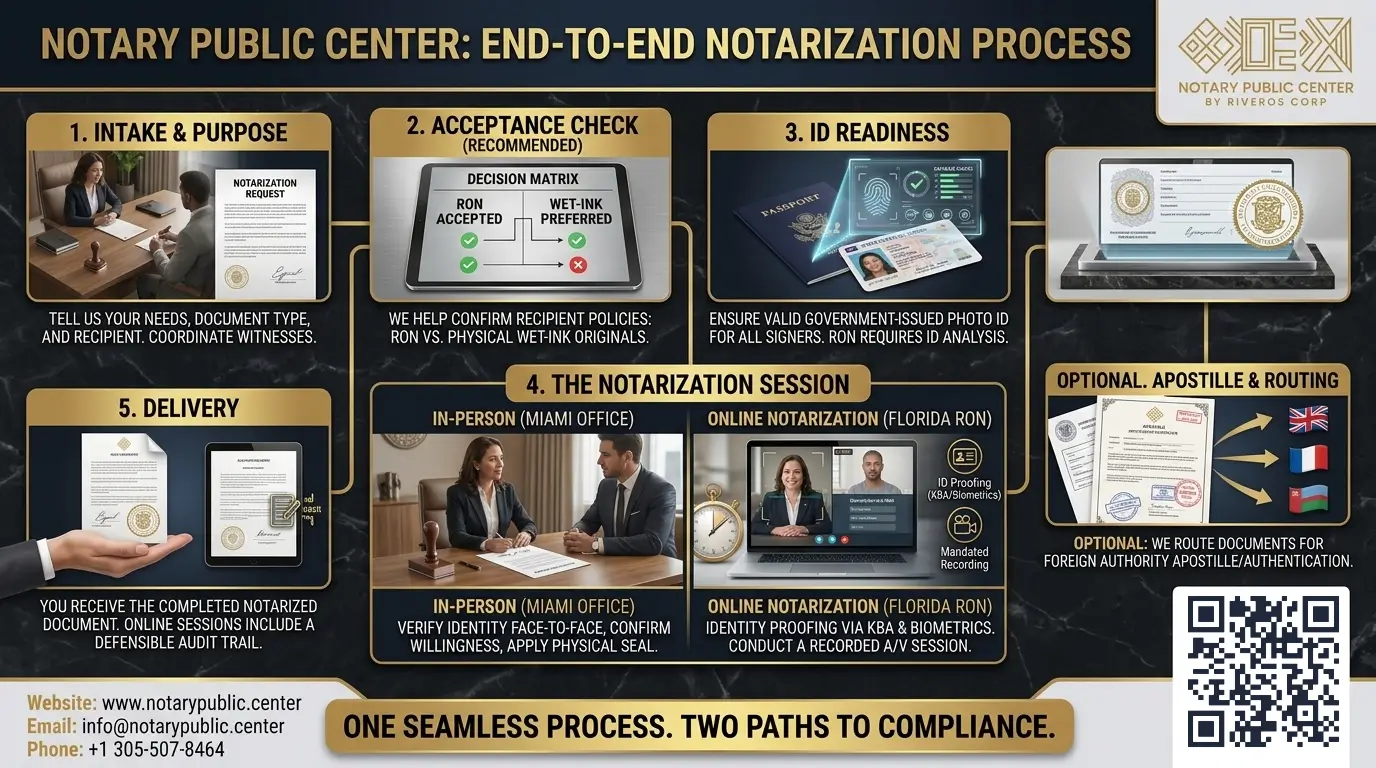
Notary Public Center end-to-end process to notarize a document (both methods)
Intake & purpose — Tell us what you need to notarize, who will receive it, and any special instructions (e.g., exact certificate wording).
Acceptance check (recommended) — We help you confirm whether the recipient will accept RON or requires in-person/wet-ink. Policies vary.
ID readiness — Ensure each signer has a valid government ID; for RON, the ID must pass credential analysis.
Session — In Miami for in-person, or online with biometrics + KBA + recorded video. Florida’s law defines the identity steps and requires recording.
Delivery — You receive the notarized document and, for online sessions, an evidence trail suitable for audit.
Optional — If a foreign authority asks for apostille/authentication on a notarized document, we route that too. Timeframes may vary.
Types of Notarization: Which One Does Your Document Need?
Not every notarization is the same, and using the wrong one is a frequent reason documents are rejected. The most common types are:
- Acknowledgment: the signer confirms they signed willingly. Used for deeds, powers of attorney, and many contracts.
- Jurat: the signer swears the contents are true and signs in front of the notary. Used for affidavits and sworn statements.
- Copy certification: the notary certifies that a copy is a true reproduction of an original document.
- Signature witnessing: the notary confirms the identity of the signer and witnesses the signature.
Before your appointment, check which certificate the receiving party requires. A document notarized with the wrong certificate may have to be redone, costing you a second trip.
Documents People Most Often Notarize
While almost any document can be notarized, some appear again and again: powers of attorney, affidavits and declarations, real estate and loan documents, parental travel authorizations for minors, business agreements and resolutions, and copies certified for use abroad. Many of these later require an apostille for international recognition, so getting the notarization right the first time protects every step that follows.
In-Person in Miami or Online by RON: What to Expect
An in-person notarization is ideal when you prefer face-to-face service or when the receiving party specifically requires a wet-ink seal. A Remote Online Notarization (RON) lets you connect with a commissioned Florida notary over secure video after an identity check, so you can complete the signing from anywhere. Both are legally valid; the right choice depends on your document, your deadline, and the preferences of whoever will receive it. For either path, bring a current government-issued photo ID, make sure the document is complete but unsigned, and confirm the exact spelling of names as they must appear.
Why Notary Public Center
Two clear paths: Miami in-person or online (Florida RON), so you can notarize a document without travel or delays.
Compliant technology: We operate on a Florida-listed RON platform and follow standards for providers and recordings.
Robust ID proofing: KBA + biometrics + credential analysis + recording—aligned with Florida statutes and rules.
Practical guidance: We help you check acceptance with the receiving party so your notarization works the first time.
Bilingual, business-friendly: Clear instructions, tight coordination, and templates tuned for common use cases.
Ready to notarize a document the right way—without surprises? Contact Notary Public Center. Choose in-person at our Miami office or online (RON) with biometrics, recorded video, and KBA. We’ll help you confirm acceptance at your destination and deliver a clean, compliant notarization.
FAQ
1) Is an online notarization valid outside Florida?
Often, yes. Most states (47 + DC) authorize remote e-notarization, and many recognize out-of-state notarial acts that follow the law where performed. But procedures vary, so always confirm with your recipient before you notarize a document online.
2) How long does it take?
It depends on participants, documents, and scheduling. Online sessions are often faster, but timeframes may vary—especially if a recipient wants specific wording or extra witnesses.
3) What if the receiving party wants a paper original?
We can arrange in-person notarization in Miami for wet-ink signatures, or provide guidance for printing and presenting an electronically notarized document where permitted. Always ask the recipient what they prefer.
Legal Notice
The information contained in this publication is provided for general informational purposes only and does not constitute legal advice. Reading or using this content does not create and is not intended to create an attorney-client relationship. No reader or user should act or refrain from acting based on the information presented herein without first consulting an attorney duly licensed to practice law in their jurisdiction.