
Yes, affidavits absolutely need to be notarized to hold any legal validity. By definition, an affidavit is a written statement made under oath; without a duly commissioned notary public administering that oath and witnessing your signature, the document is merely a piece of paper that will be rejected by courts, banks, and government agencies.
When submitting critical documents, precision is not optional. A single error in the notarial certificate or failing to follow state-specific protocol can result in your affidavit being dismissed, causing costly delays. At Notary Public Center, our specialists ensure your affidavits are executed flawlessly, whether through our secure Remote Online Notarization (RON) platform or via our in-person services.
At Notary Public Center, we help you pick the right path, prepare a clean, readable statement, and notarize it either in our Miami office or online with robust identity proofing.
What Exactly is an Affidavit and Why is Notarization Mandatory?
An affidavit is a formal, written declaration of facts that the «affiant» (the person making the statement) swears or affirms to be true. Because courts and administrative bodies rely on these documents as evidence, they require a high level of authentication.
This is where the notarization process becomes mandatory. The notarization required for an affidavit is called a jurat. During a jurat, the notary public must:
Positively identify the signer using an approved, unexpired government ID.
Administer a verbal oath or affirmation where the signer swears under penalty of perjury that the contents of the document are true.
Witness the signer signing the document in real-time.
Apply the statutory notarial certificate, signature, and official seal.
If any of these steps are bypassed—for instance, if you try to submit a self-signed affidavit without an official notary seal—the receiving agency will invalidate the filing.
When notarization is typically required (or strongly expected)
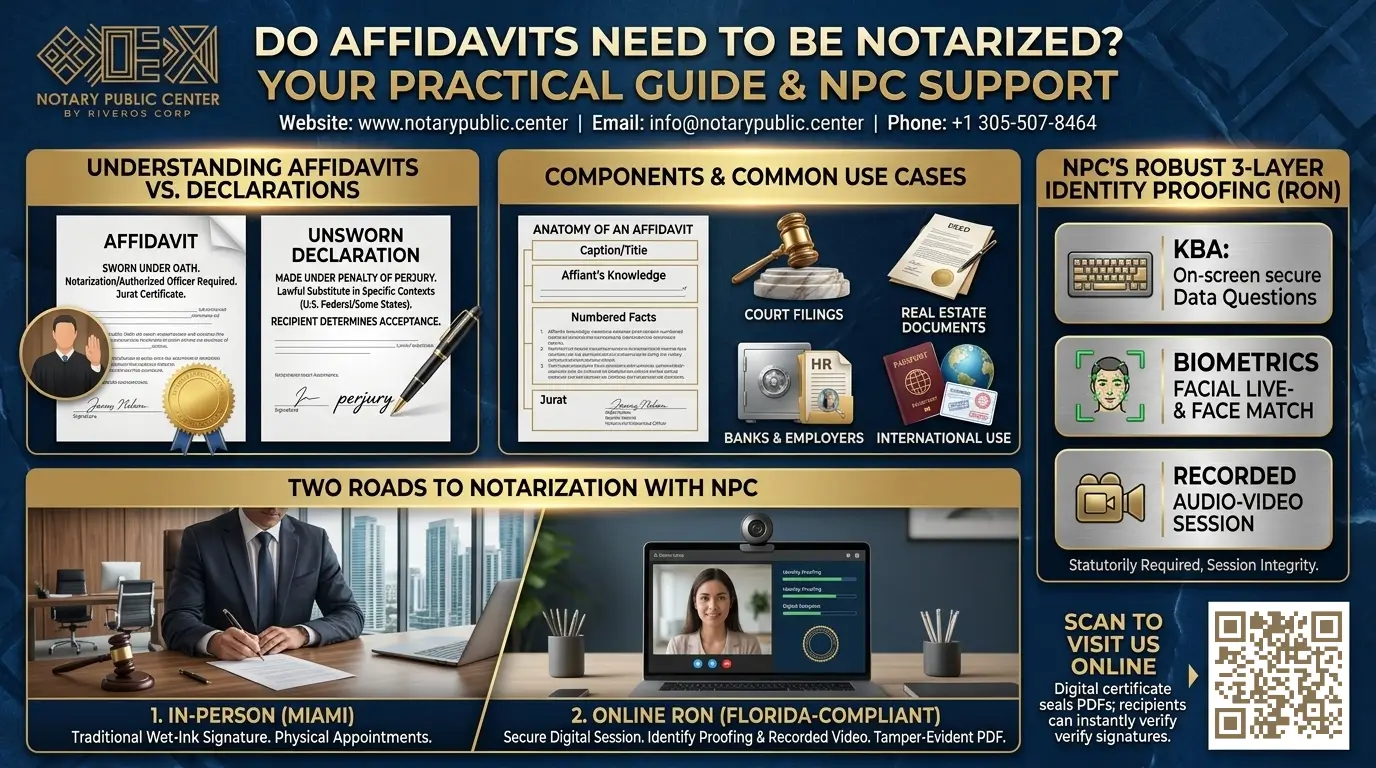
Court filings in many state courts when a “sworn affidavit” is requested by rule or order. (Some courts will accept an unsworn declaration; others won’t—always verify.)
Real estate and recording offices that demand notarized documents or acknowledgments for recordation.
Banks, insurers, and employers that use notarization to verify identity and deter fraud in claims or HR processes.
International uses where a foreign authority expects notarization and possibly an apostille later.
These are policy-driven environments. Even if a law permits a declaration, the recipient can still insist on notarization as a matter of internal protocol. That is why the safest workflow is to confirm acceptance first.
Jurat vs. acknowledgment (which one does your affidavit need?)
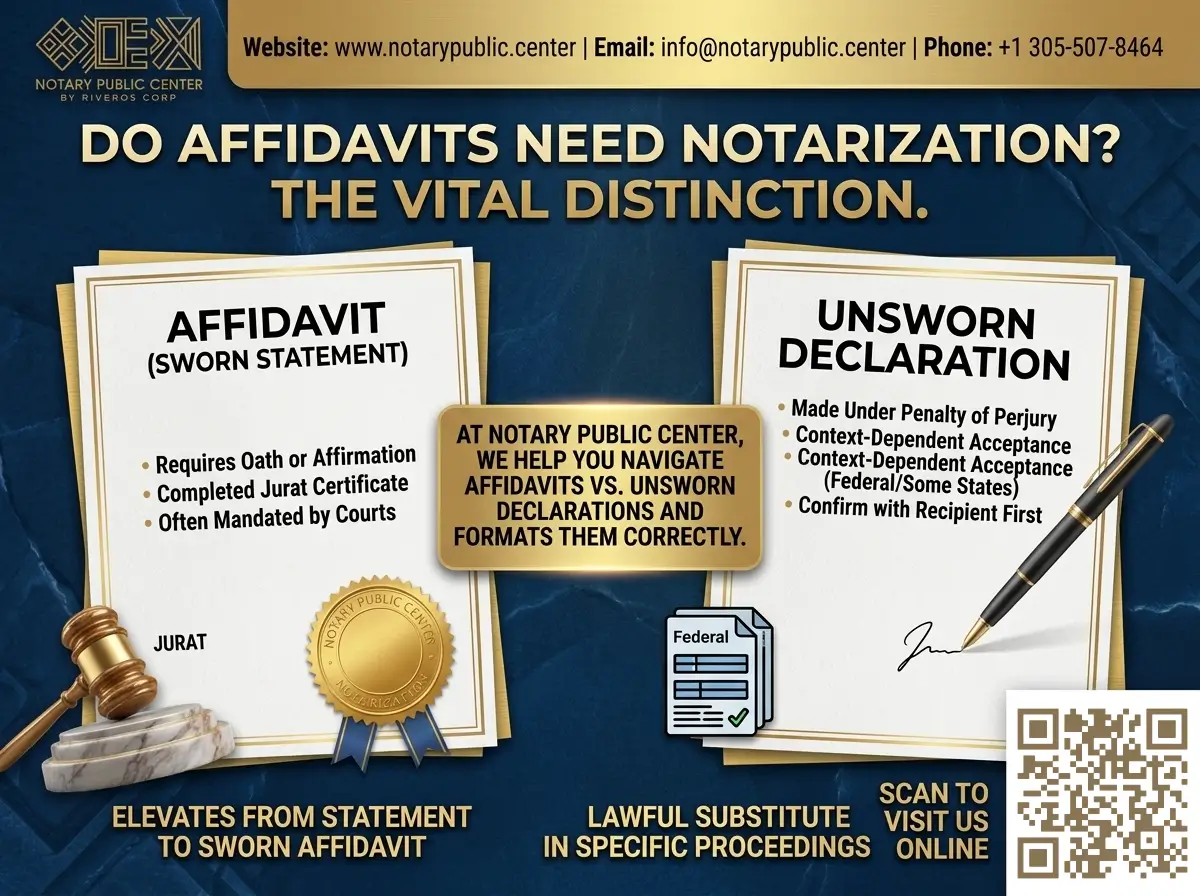
Jurat = you swear or affirm the contents are true in the notary’s presence; you sign in front of the notary; the certificate says you were sworn. This is classic for affidavits.
Acknowledgment = you acknowledge you signed the document voluntarily; swearing to the truth is not part of it. Some “affidavit-labeled” forms actually only need an acknowledgment, but most genuine affidavits call for a jurat.
If your form is ambiguous, we’ll help you read the notarial block correctly and choose the certificate that fits the document’s purpose and the recipient’s rule.
Can Notary Public Center also draft an affidavit?
Yes—in specific, non-legal-advice scenarios. We regularly draft plain-English affidavits for routine uses (e.g., residence, name discrepancy, travel consent, employment facts) based on your facts and the recipient’s checklist. Where legal interpretation is required, coordinate with your attorney and format the affidavit to their direction. Then we notarize it in person or online. (We never provide individualized legal advice.)
Two ways to notarize with us
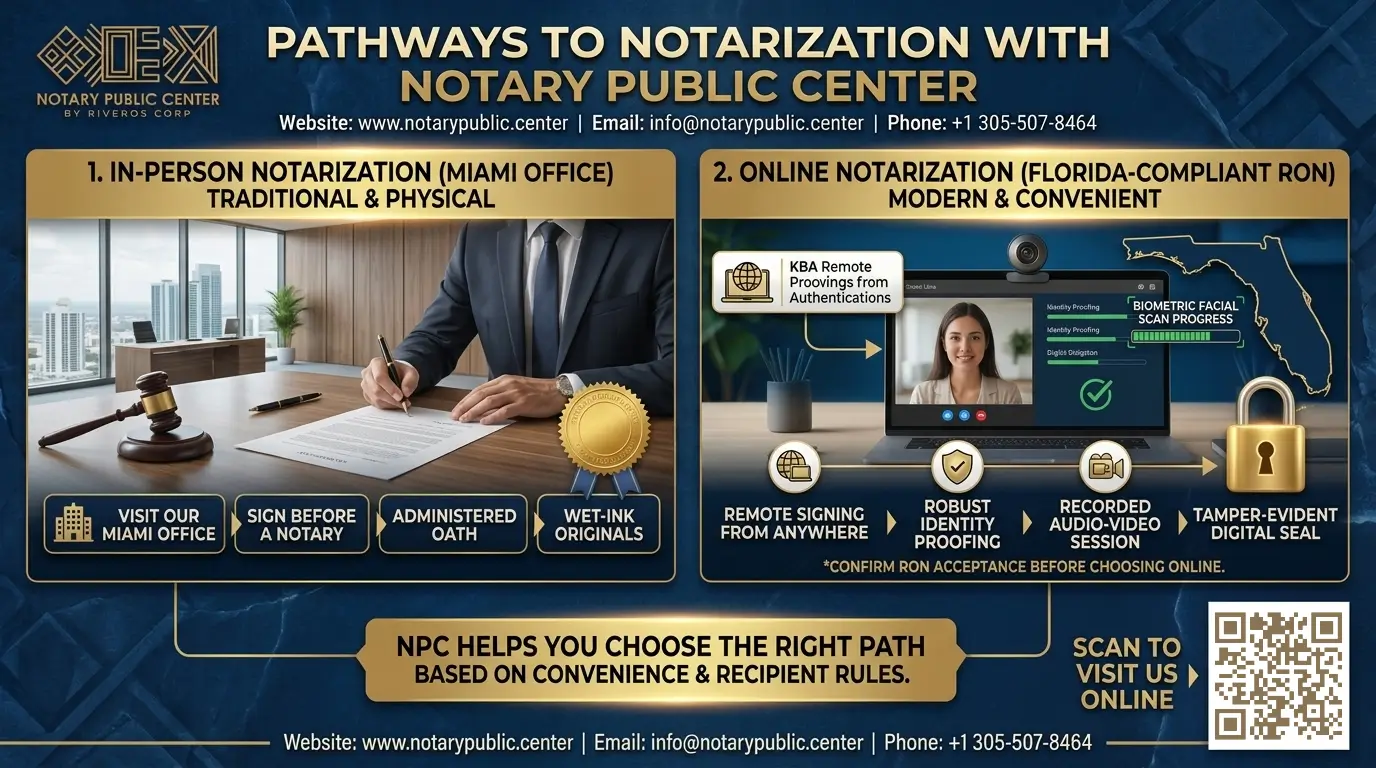
1) In-person notarization (Miami)
Visit our Miami office to sign before a notary. We check your ID, administer the oath or affirmation, make sure the notarial certificate fits the document, and apply seal and signature. This is ideal when the recipient requires wet-ink originals or your signer prefers a traditional setting.
Timing: Appointments are available; timeframes may vary.
2) Online notarization (RON, Florida-compliant)
If travel is tough—or signers are in different places—we can notarize your affidavit online. Under Florida law, an online notarization performed by a Florida online notary is deemed performed in Florida and must include identity proofing and a recorded two-way audio-video session. We use a Florida-listed provider and follow the program’s technical and security standards.
Our three identity layers online
KBA (knowledge-based authentication) with time-limited questions tied to your SSN/credit data;
Biometric live-ness & face match;
Recorded audio-video of the entire session (statutorily required). If identity proofing fails, the notary may not proceed online; we’ll switch you to in-person.
Tamper-evident protection. After an e-notarization, your PDF is sealed with a digital certificate and tamper-evident hash. Any change after signing breaks the seal and marks signatures invalid in standard PDF viewers—so recipients can spot alterations immediately. (We also retain the recording and audit trail under program rules.)
Acceptance varies. RON is now authorized in many states, but rules differ across courts, recorders, and private institutions. We recommend confirming with your recipient before choosing RON for an affidavit.
Common Types of Affidavits That Require a Notary
Practically every type of sworn statement requires a notary public. Our team frequently processes:
Affidavits of Support: Used for immigration and visa sponsorships.
Financial Affidavits: Required during divorce proceedings or estate settlements.
Affidavits of Identity or Name Change: Used to prove who you are when discrepancies exist in official records.
Affidavits of Domicile: Requested by banks and brokers to release assets after a person passes away.
Affidavits of Service: Confirming that legal documents were properly delivered to another party.
Important Requirements Before You See a Notary
To ensure a smooth and successful notarization, you must prepare accordingly. If you are scheduling a session with Notary Public Center, keep these vital rules in mind:
1. Do Not Sign the Document in Advance
Because an affidavit requires a jurat, the notary must witness you signing the document. If you bring an already signed affidavit, the notary will require you to sign it again in their presence, which can cause formatting issues or invalidate the form.
2. Fill in All Blank Spaces
A notary cannot notarize a document that contains incomplete sections or blank spaces, as this presents a high risk for fraud (someone could alter the document after the notarization). You must fill out all factual information before the notary administers the oath.
3. Bring Acceptable Identification
You must present a valid, unexpired government-issued photo ID. Common acceptable forms include a U.S. driver’s license, state ID, or a U.S. passport. If you are an international client, a valid foreign passport is generally acceptable, depending on state laws.

Why Notary Public Center
-
Two ways to sign: notarize in person (Miami) or online (Florida RON).
-
Robust online identity checks: biometrics, recorded video, and KBA—with a tamper-evident, verifiable result.
-
Smart drafting help: for routine matters we’ll draft a clean affidavit or declaration and coordinate with your attorney when appropriate.
-
Acceptance first: we help you confirm what the receiving party wants so you don’t redo the paperwork.
Have an affidavit to prepare—and need it done right the first time? Contact Notary Public Center. We’ll help you decide whether a notarized affidavit fits the rules, draft the wording when appropriate, and notarize in Miami or online with full identity safeguards.
FAQ
Can a notary public draft my affidavit for me?
No. A notary public who is not an attorney cannot draft legal documents, choose the type of notarial certificate you need, or provide legal guidance. You must have your document prepared beforehand, and our experts will handle the accurate execution of the signature and seal.
Does an affidavit expire?
The notarization itself does not expire; it simply proves that on a specific date, you appeared, took an oath, and signed the document. However, the receiving agency (like a court or bank) might have rules about how «recent» the affidavit must be to be accepted.
What happens if I already signed the affidavit before my appointment?
Because affidavits require a jurat, the notary must witness the signature. If you signed it early, the notary will ask you to sign the document again in their presence so they can legally administer the oath.
Can I get an affidavit notarized online?
Yes. Through Remote Online Notarization (RON), you can have your affidavit notarized digitally via a secure audiovisual conference. Notary Public Center provides fully compliant RON services.
Can a notary refuse to notarize an affidavit?
Yes. A notary must refuse the service if the signer lacks valid identification, appears coerced, does not understand the document, or if the document contains blank spaces.
Legal Notice
The information contained in this publication is provided for general informational purposes only and does not constitute legal advice. Reading or using this content does not create and is not intended to create an attorney-client relationship. No reader or user should act or refrain from acting based on the information presented herein without first consulting an attorney duly licensed to practice law in their jurisdiction.