
Can a Family Member Notarize a Document? Key Tips to Keep in Mind
If you are wondering, “Can a family member notarize a document?”, here are some important tips that explain why it’s not a good idea and what you should do instead.
1. Impartiality Matters
Notarization requires neutrality. If your spouse, parent, or sibling notarizes your document, their personal relationship with you could create a conflict of interest. Most states explicitly prohibit this, and your document may be rejected.
2. Risk of Rejection
Courts, government agencies, and banks often reject documents notarized by relatives. That means wasted time, delays, and additional costs to fix the issue.
3. Legal Consequences
Improper notarization can cause legal problems. A document notarized by a family member may be considered invalid, and in some cases, the notary could face penalties.
4. Better Alternatives Exist
Instead of taking the risk, use a professional notary service. At Notary Public Center, we guarantee:
- Valid, impartial notarization.
- Online and in-person options for your convenience.
- Step-by-step support so you avoid mistakes and delays.
5. Save Time and Stress
Getting it right the first time saves more than just money—it saves you the stress of redoing paperwork. That’s why relying on an experienced notary like Notary Public Center is always the safest choice.

The Short Answer: Usually No
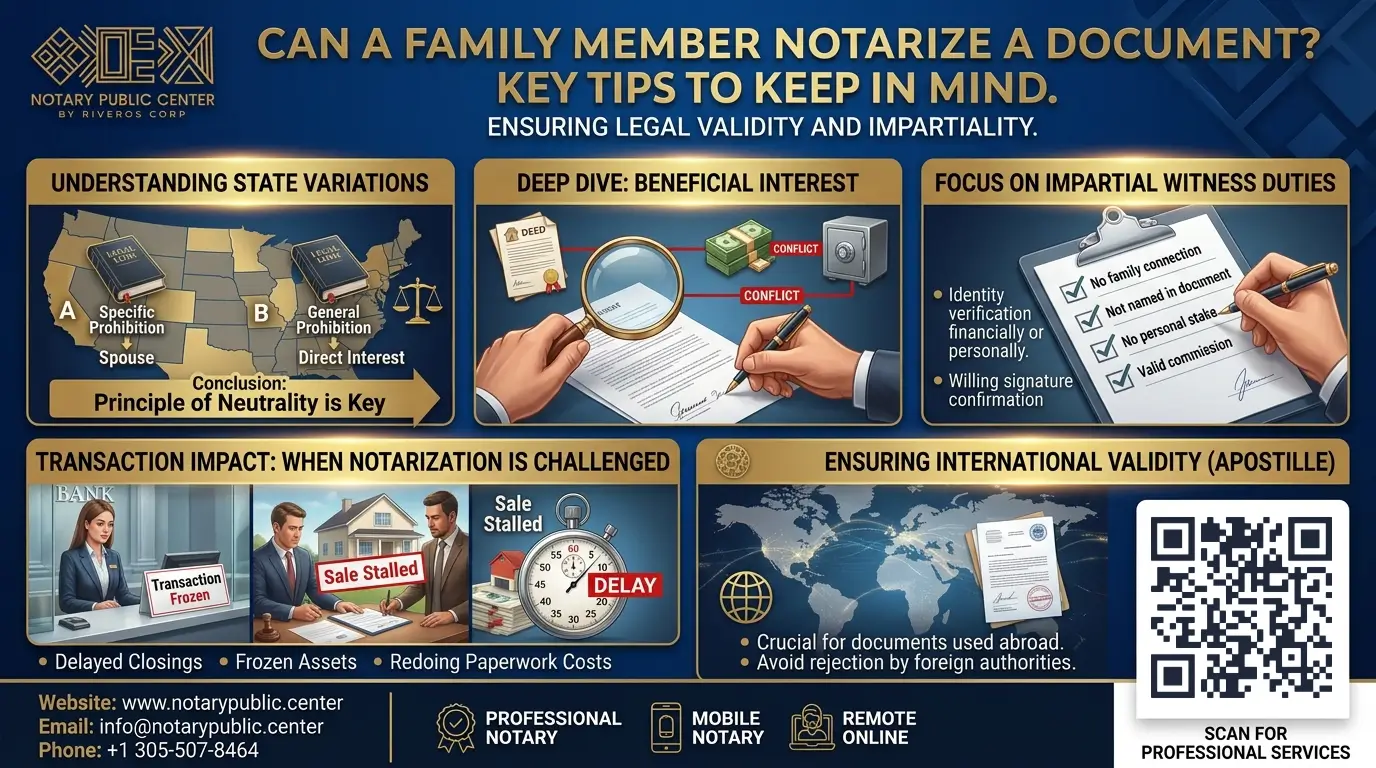
Can a family member notarize a document? In most situations, the answer is no—and even where it is not strictly forbidden, it is strongly discouraged. The reason is simple: a notary’s core duty is to be an impartial witness. When the notary is your spouse, parent, child, or sibling, that impartiality is compromised, and the notarization can be challenged or rejected. Many states either directly prohibit notarizing for close relatives or bar a notary from acting whenever they have a personal or financial interest in the transaction. Because rules vary by state, understanding the principle behind them matters more than memorizing a single law.
Why Impartiality Is the Heart of Notarization
A notarization exists to protect against fraud and coercion. The notary confirms the signer’s identity, verifies they are signing willingly, and witnesses the signature. If the notary stands to benefit from the document—or is emotionally tied to the signer—those protections weaken. A court or receiving agency may reasonably ask whether the signer was truly acting freely, or whether the notary looked the other way. This is why the concept of a «disinterested» notary is central: the notary must have no beneficial interest and no close relationship that could bias the act.
Financial or Beneficial Interest: The Bright Line
Almost every state draws a hard line at beneficial interest. A notary cannot notarize a document from which they will gain financially or personally. So even in states without an explicit «no relatives» rule, a family member almost always does have an interest—inheritance under a will, a share in a property deed, or a benefit under a power of attorney. That interest alone is usually enough to disqualify them, regardless of the family relationship. When in doubt, assume that any personal stake in the outcome makes the notarization improper.
Which Relationships Cause Problems?
The closer the relationship, the higher the risk. The relationships most likely to invalidate a notarization include:
- Spouses—the most commonly prohibited, because marital finances are typically intertwined.
- Parents and children—frequent in estate and property documents where inheritance is involved.
- Siblings—often problematic when they share ownership or family assets.
- In-laws and other close relatives—risky whenever a benefit or shared interest exists.
Even if your state’s statute is silent on a specific relationship, the beneficial-interest rule usually fills the gap.
What Happens If a Family Member Notarizes Anyway?
An improper notarization can carry real consequences. The document may be declared invalid, forcing you to redo it—sometimes after a deadline has passed or a transaction has closed. Worse, if the notarization is challenged in court, it can undermine the entire agreement, delay probate, stall a real estate closing, or invite allegations of fraud. The notary themselves can face disciplinary action, fines, or loss of their commission. A notarization is meant to make a document stronger; an improper one can make it a liability.
Common Scenarios Where This Comes Up
Families most often run into this question with high-stakes documents: a power of attorney naming a relative as agent, a deed transferring property between family members, a will or estate document, or a parental travel authorization for a minor. These are precisely the documents where impartiality matters most, and precisely where a family notarization is most likely to be questioned later. The higher the stakes, the more important it is to use a neutral notary.
What to Do Instead
The solution is straightforward: use an independent, commissioned notary with no relationship to you and no stake in the document. You have several convenient options:
- A professional notary service that verifies identity and applies the correct notarial certificate.
- A mobile notary who travels to you when signers cannot easily meet in one place.
- Remote Online Notarization (RON), where a commissioned notary connects with you over secure video after an identity check—ideal when family members are in different cities or countries.
Each of these keeps the notarization impartial and defensible. To plan your signing, explore our notary public services or see how to notarize a document in person or online.
How Notary Public Center Helps
Notary Public Center provides the neutral, professional notarization that family members cannot. We verify identity, confirm the signer is acting willingly, apply the correct certificate for your document, and offer both in-person and Remote Online Notarization so distance is never an obstacle. If your document will later be used abroad, we can also guide you toward the apostille step so the whole process is handled correctly from signature to international acceptance.

What «Disinterested Witness» Means and Why It Protects You
Notarization exists to give a document credibility that a private signature cannot. A notary acts as a disinterested, impartial official who confirms the signer’s identity and willingness, then certifies that the act took place properly. When a family member serves as the notary, that impartiality is compromised in appearance even if the notarization is technically allowed in a given state. The whole point of the safeguard is that a neutral third party stood between the signer and the transaction—so anything that undercuts that neutrality also undercuts the document’s strength if it is ever challenged.
How a Challenged Notarization Can Unravel a Transaction
The real cost of an improper notarization usually appears later, not at the signing table. A bank, court, title company, or foreign authority that questions the notarization can reject the document, freeze a transaction, or demand that everything be re-executed. In disputes over wills, deeds, or powers of attorney, an opposing party will look closely at who notarized the document and whether that person had anything to gain. A notarization performed by a relative gives them an easy argument that the process was not neutral. Using an independent notary from the start removes that vulnerability and keeps the focus on the document itself. When the stakes are high, the small cost of an independent notary is far lower than the cost of redoing a rejected transaction.
State-by-State Differences You Should Know
Notary rules are set at the state level, so the exact wording varies. A handful of states explicitly prohibit notarizing for a spouse or immediate family member by name. Many others take an indirect approach: they do not list relatives at all, but they forbid a notary from acting whenever the notary is a party to the document or has a direct financial or beneficial interest in it. In practice, both approaches reach the same result for most family situations, because a close relative usually does have some interest in the outcome. A few states are more permissive on paper, allowing a relative to notarize as long as the notary receives no benefit—but relying on that narrow allowance is risky, because a receiving party in another state or country may still reject the document. When a document will cross state lines or go abroad, the safest choice is always a fully independent notary.
How to Make Sure Your Notary Is Truly Impartial
Protecting your document is easy when you know what to look for. Before you sign, confirm that the notary:
- Has no family relationship to any signer on the document.
- Is not named anywhere in the document as a party, beneficiary, or agent.
- Will gain nothing financially or personally from the transaction.
- Holds a current, valid commission in the correct state.
- Uses the proper notarial certificate (acknowledgment, jurat, or copy certification) for your document.
If any of these checks fail, the notarization could be challenged later—so it is worth confirming them at the outset rather than discovering a problem when the document is already in use.
Peace of Mind Is Worth the Extra Step
It can feel convenient to ask a relative who happens to be a notary, especially when a deadline is close. But the entire value of a notarization lies in its credibility: a document notarized by an impartial professional is far harder to dispute than one notarized by someone with a personal stake. Choosing a neutral notary is not a formality—it is the difference between a document that stands up to scrutiny and one that invites it. For any important signing, the small extra step of using an independent notary is the surest way to protect the outcome you are working toward.
Final Advice
While it may sound easy to ask a family member, notarization is a legal process that must be impartial. Always work with a licensed notary to ensure your documents are accepted everywhere.
Notary Public Center is here to help you complete your notarization quickly, correctly, and stress-free.
Frequently Asked Questions
Can my spouse notarize a document for me?
Generally no. Spouses almost always share a financial interest, and many states prohibit a notary from acting for a spouse. Even where it is not explicitly banned, it is strongly discouraged because it undermines the notary’s impartiality.
Is it illegal for a family member to notarize a document?
It depends on the state, but even where it is not expressly illegal, it is usually improper if the notary has any beneficial interest or a close relationship with the signer. An improper notarization can be declared invalid.
What makes a notarization 'improper' in these cases?
A notary must be a disinterested, impartial witness. If they are closely related to the signer or stand to gain from the document, that conflict of interest can invalidate the notarization.
What is the safest alternative?
Use an independent commissioned notary with no relationship to you and no stake in the document. A professional, mobile, or Remote Online Notarization keeps the act neutral and legally defensible.
The information contained in this publication is provided for general informational purposes only and does not constitute legal advice. Reading or using this content does not create and is not intended to create an attorney-client relationship. No reader or user should act or refrain from acting based on the information presented herein without first consulting an attorney duly licensed to practice law in their jurisdiction.