
What is a notary public? In the United States, a notary public is an impartial, state-commissioned official who verifies a signer’s identity, administers oaths or takes acknowledgments, and completes the required notarial certificate. The process helps deter fraud and creates reliable evidence of document execution, but it does not validate the document’s legal content or replace legal advice.
Notary Public Center handles eligible Florida notarizations online and in person in Miami. Before the appointment, we help confirm whether the receiving party accepts Remote Online Notarization, requires wet-ink signatures or witnesses, and whether the document may need an apostille or another authentication step for use abroad.
What Is a Notary Public in the United States?
A notary public is an impartial official commissioned under state law to perform authorized notarial acts.
Core Roles and Duties of a Notary Public
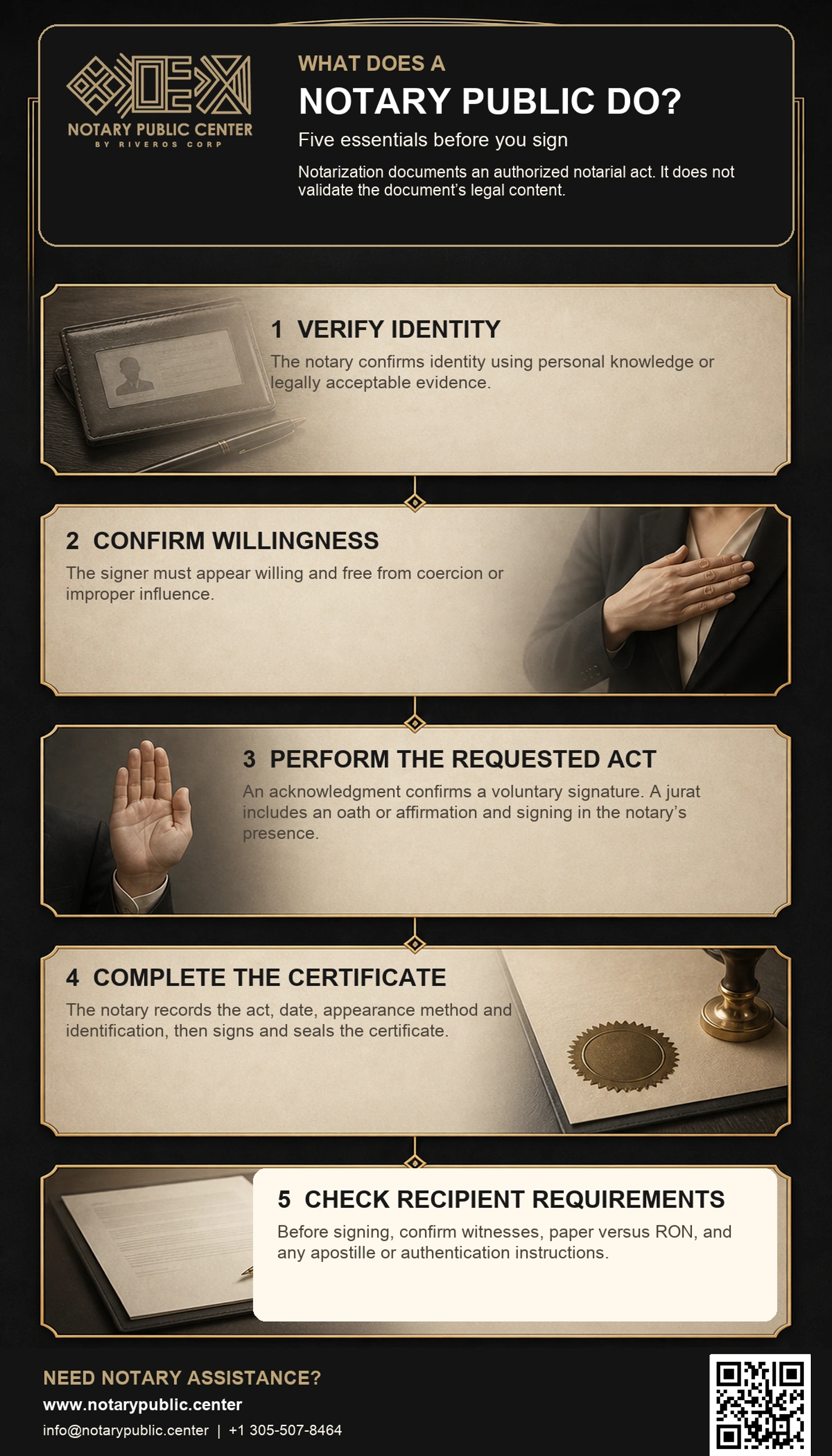
Depending on the requested act and applicable law, a notary may:
- Identify the signer through personal knowledge or legally acceptable evidence of identity.
- Confirm that the signer is acting willingly and appears able to understand the nature of the transaction.
- Administer an oath or affirmation when the requested act requires one.
- Complete the notarial certificate and apply the required signature and seal.
- Remain impartial and avoid prohibited conflicts of interest.
A U.S. notary public is not the equivalent of a civil-law notario. Unless separately licensed as an attorney, a notary cannot provide individualized legal advice, draft legal instruments as an attorney, or decide which notarial act a signer should request.
When do you actually need a notary public?
You may need a notary when a document, receiving institution, government office, court, lender, foreign authority, or transaction requires an acknowledgment, jurat, oath, or another authorized notarial act. Common examples include powers of attorney, affidavits, consent letters, certain real-estate documents, business records, and documents intended for use abroad.
Not every important document must be notarized, and notarization alone does not make a document legally enforceable. Before scheduling, share the recipient’s instructions with Notary Public Center so we can help identify whether witnesses, electronic notarization, or a paper original may be required.
Acknowledgment and jurat: the main certificates you may encounter
Acknowledgment
For an acknowledgment, the signer confirms to the notary that the signature was made voluntarily for the purposes stated in the document. Depending on the document and applicable law, the signature may have been made before the appearance.
Jurat or sworn statement
For a jurat, the signer swears or affirms that the statement is true and signs in the notary’s presence. A jurat is commonly used for affidavits and other sworn statements.
Who selects the certificate? The signer, document issuer, receiving institution, or a licensed attorney must determine whether an acknowledgment, jurat, or another act is required. We can explain procedural differences, but we cannot choose the act for the signer or provide legal advice.
Florida notarization: in person or online
In-person notarization in Miami
For an in-person appointment, bring the complete document and acceptable identification. We verify identity, perform the notarial act requested by the signer, complete the certificate, and apply the Florida notarial seal. This route may be appropriate when a recipient requires wet-ink signatures or when the document or signer is not eligible for RON.
Remote Online Notarization (RON)
For a Florida online notarization, the online notary must be physically located in Florida. The signer may be elsewhere but must consent to the act being performed by a Florida notary under Florida law. The notarization takes place through live two-way audio-video communication and the session is recorded as required.
Identity verification may require remote presentation of an approved government credential, credential analysis, and a legally compliant identity-proofing method. If the required identity checks cannot be completed, the online notarization cannot proceed and an in-person alternative may be necessary.
Tamper-evident electronic records. The electronic seal and digital certificate are designed to make later alterations detectable. A modification after notarization may affect digital-signature validation or recipient acceptance, so the final notarized file should not be edited.
Acceptance matters: RON acceptance depends on the document, receiving party, jurisdiction, and transaction. Confirm the recipient’s requirements before choosing online notarization.
Identification: what to prepare
Acceptable identification depends on Florida law, the type of notarization, and the RON provider’s verification process. A current government-issued photo credential is commonly used, but personal knowledge or credible-witness procedures may apply in qualifying in-person situations. Send the identification details in advance if you are unsure whether the credential can be accepted.
For RON, the platform must complete the legally required credential analysis and identity proofing. If the available data is insufficient or the verification fails, the online notary may not complete the act.
Witnesses: when additional people may be required
Some documents require one or more witnesses in addition to notarization. The number, qualifications, independence, and method of appearance depend on the document and applicable law.
Florida permits remote witnessing in qualifying electronic transactions, but additional safeguards apply. A remote witness must satisfy the required identity-verification process and confirm that the witness resides and is physically located in the United States or a U.S. territory during the signing. Certain estate-planning, health-care, and power-of-attorney documents have additional conditions.
Vital records: an important Florida limitation
A Florida notary cannot attest a copy of a vital record—such as a birth, death, or marriage certificate—or another public record when an official certified copy is available from the records custodian. The correct document must be requested from the appropriate vital-records office, clerk, or issuing authority.
If an official certified record will be used abroad, Notary Public Center can review the issuing authority, destination, and available apostille or authentication route.
How notarization fits into the apostille process
If a document will be used abroad, the receiving authority may require an apostille or another form of authentication. The correct process depends on the document, the issuing or notarizing state, the destination country, and the recipient’s instructions.
- Private documents: a properly completed notarial certificate may be authenticated by the competent authority in the state where the notary is commissioned.
- Public records: the authentication normally follows the signature and seal of the issuing public official rather than a notarization of a photocopy.
- Non-Convention destinations: an authentication certificate and possible consular legalization may be required instead of an apostille.
For eligible Florida documents, the Florida Department of State is the competent authority for state apostilles. For a paper apostille request involving a Florida notarization, the document must contain a complete notarial statement and the notary’s original signature, stamp, and seal. Photocopies are generally not accepted for this process.
Online or paper: choosing the appropriate route
RON may be useful when the signers are in different locations, the recipient accepts electronic notarization, and the signer can complete identity verification. An in-person appointment may be preferable when the recipient requires wet ink, the document is not eligible for RON, witnesses must be physically present, or the signer cannot complete the online identity checks.
If the recipient’s instructions are unclear, request written confirmation before signing. Acceptance is determined by the receiving party, not by the notary.
Why a notary may refuse to proceed
A notary must remain impartial and follow state law. The notarization may have to stop when:
- The signer’s identity cannot be established.
- The signer appears unwilling, coerced, or unable to understand the nature of the transaction.
- The document is incomplete or the requested notarial act has not been identified.
- A prohibited conflict of interest exists.
- The requested act would violate applicable law.
Recordkeeping, privacy, and electronic security
RON sessions and electronic journals are retained and made available according to Florida law and the authorized provider’s security and privacy procedures. Access may also be required in response to subpoenas, court orders, authorized investigations, or other lawful requests.
Do not send sensitive documents through an unapproved channel. Ask which secure method should be used before transmitting identification or personal records.
How to prepare for your appointment
- Recipient instructions: provide any written instructions so we can review whether RON, paper execution, or specific certificate wording is required.
- Requested act: confirm with the document issuer, recipient, or attorney which notarial act is required; we can explain the procedural differences.
- Witnesses: provide any witness instructions so we can identify the available appointment options.
- International use: provide the destination country and the recipient’s written instructions.
Common mistakes to avoid
- Signing too early: some acts require the signature to occur in the notary’s presence.
- Leaving the requested act undecided: the notary cannot select the certificate as legal advice.
- Using mismatched names: differences between the document and identification may prevent completion.
- Assuming every recipient accepts RON: confirm acceptance before scheduling.
- Trying to notarize a vital-record photocopy: obtain the official certified copy from the records custodian.
Why choose Notary Public Center
- Online and in-person options: eligible Florida notarizations through RON or at our Miami office.
- Recipient-first preparation: we encourage confirmation of paper, RON, witness, and certificate requirements before signing.
- International-document experience: we review whether a Florida apostille or another authentication route may apply.
- Bilingual assistance: service is available in English and Spanish.
- Procedural review: we check the required notarial elements and flag issues that could cause a document to be returned for correction.
Request notary assistance
Need help determining whether your document can be notarized online or should be completed in person? Contact Notary Public Center before signing. We will review the procedural requirements, confirm the available service options, and help you prepare for the notarization.
1. What is a notary public, in simple terms?
A notary public is an impartial official commissioned by a state to perform authorized notarial acts. Depending on the act, the notary may verify identity, administer an oath or acknowledgment, complete a certificate, and apply an official signature and seal.
2. Can a notary public give legal advice or choose my certificate?
A notary who is not a licensed attorney cannot provide legal advice, draft documents as an attorney, or decide which notarial act you should request. The signer, document issuer, receiving institution, or an attorney must provide that instruction.
3. Does notarization make a document legally binding?
No. Notarization documents the performance of a particular notarial act; it does not validate the document’s contents or automatically make an agreement enforceable. Questions about legal effect should be directed to a qualified attorney.
4. What forms of identification may be accepted?
Acceptable identification depends on applicable law and the type of notarization. A current government-issued photo credential is commonly used. RON also requires compliant credential analysis and identity proofing. Contact us before the appointment if you are unsure about your ID.
5. Can I notarize a document online instead of in person?
Eligible documents may be notarized through Florida Remote Online Notarization. The Florida online notary must be physically located in Florida, the signer must complete the required identity verification, and the receiving party must accept the electronic notarization.
6. Can a notarized document receive an apostille?
A properly notarized document may qualify for an apostille when the notarial certificate, signature, and seal meet the requirements of the competent authority. The correct route depends on the notarizing state, the document type, the destination country, and the receiving authority’s instructions.
Legal notice
This publication provides general information and does not constitute legal advice or create an attorney-client relationship. Requirements vary by jurisdiction, document, transaction, and receiving authority. Consult a qualified attorney when legal advice is required.