Where can I get a POA notarized? Depending on the document and applicable law, you may use an in-person notary or a qualified remote online notary. Before booking, confirm the signing requirements, witnesses and intended use of the power of attorney.
Notary Public Center offers in-person notarization in Miami and remote online notarization when the document and participants qualify. The available option depends on more than convenience. Some powers and witnessing arrangements require additional legal review.
Bring the final document and the receiving institution’s instructions to the service consultation. A notary performs the required notarial act; the notary does not decide which powers you should grant. An authorized attorney can advise on the document’s legal content.
Where can I get a POA notarized in person?
An in-person appointment places the signer before the notary at the same physical location. Depending on availability, notarial services may be offered by a dedicated office, a bank or another authorized provider. Ask whether that provider handles your document.
A bank’s decision not to provide a notarization service is different from its later review of a completed POA. The first concerns an appointment; the second concerns whether someone may act under the document. Do not assume one decision resolves the other.
For a Miami appointment with Notary Public Center, confirm availability, location and any witness arrangements before traveling. If you need assistance at another location, ask whether that service is available for your circumstances. Avoid assuming that every appointment includes travel or witnesses.
What does notarization establish?
A power of attorney allows an agent to act for a principal within the authority granted. The principal is the person giving authority. The agent, sometimes called the attorney-in-fact, is not necessarily a lawyer.
Notarization documents a specified act, such as the principal’s acknowledgment of a signature. It does not establish that every clause is suitable, that the agent will act properly or that a proposed transaction is lawful.
Our guide to a power of attorney and the notary’s role explains this distinction. If your question concerns legal authority, durability or the choice of agent, resolve it with counsel before scheduling the signing.
Florida signing and witness requirements
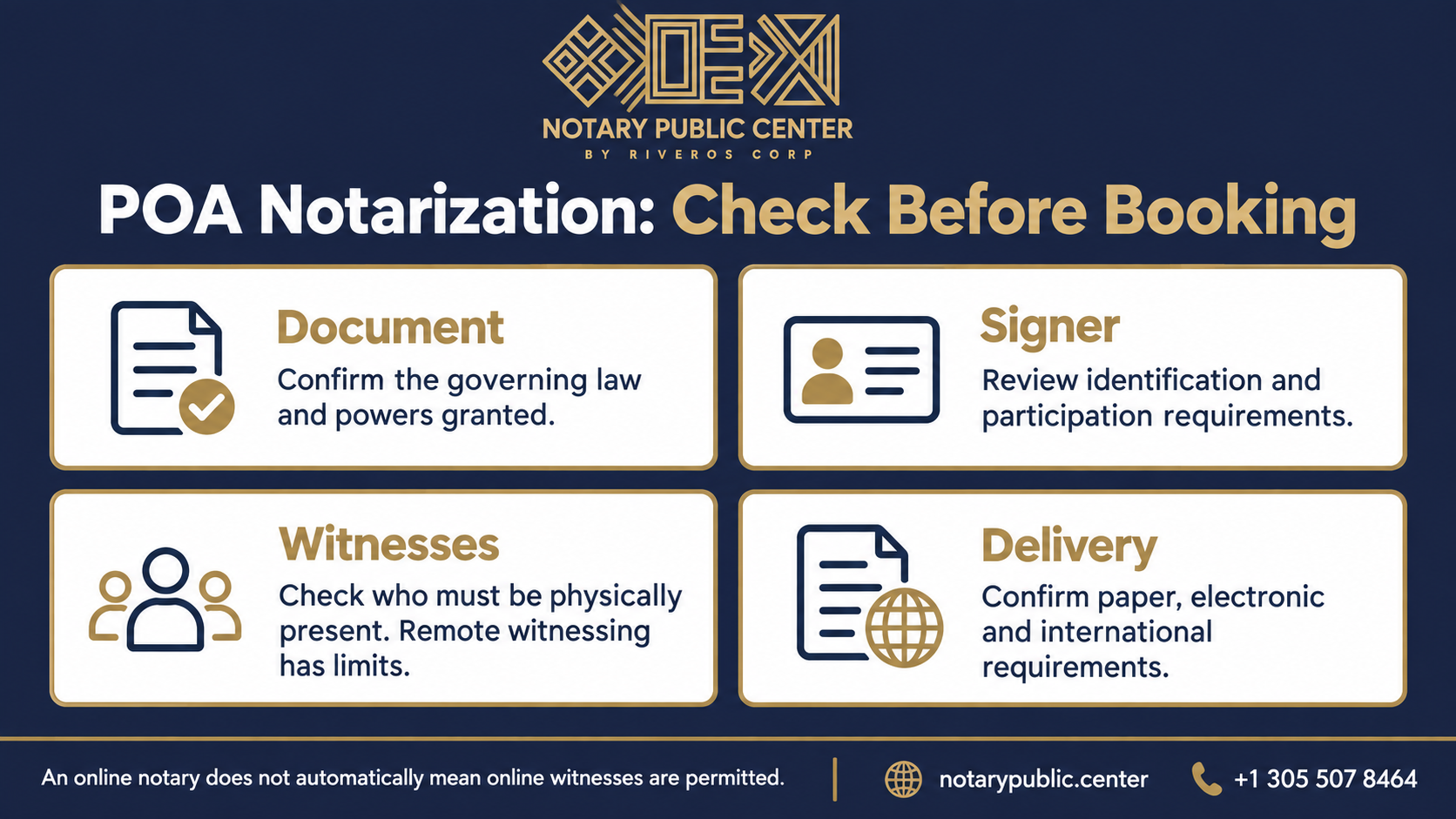
For a POA governed by Florida’s general execution rule, section 709.2105 requires the principal’s signature, two subscribing witnesses and an acknowledgment before a notary or another authorized officer. Special documents and recognition rules can involve additional considerations.
The witnesses and notary perform different functions. A notarial seal does not replace missing witness signatures. Likewise, the presence of witnesses does not remove the need for the required acknowledgment.
Share the full document before arranging the participants. The applicable requirements may depend on where it was prepared, where the principal is domiciled and what authority it grants. A general statement that “all powers work the same way” is unreliable.
Health care documents need their own review
A Florida designation of a health care surrogate follows section 765.202. It calls for two subscribing adult witnesses, excludes the designated surrogate as a witness and requires at least one witness who is neither the principal’s spouse nor blood relative.
That provision does not impose the same notarization requirement as the general financial POA rule. Therefore, do not treat every document called a “medical power of attorney” as identical. Confirm its governing law and the actual instrument involved.
Can I get a POA notarized online?
Remote online notarization, often called RON, uses a qualifying audiovisual process. The signer appears before an authorized online notary through that process. Sending a scan or joining an ordinary video call is not enough.
Under Florida’s online notarization rules, the Florida online notary must be physically in the state. A principal may be elsewhere when the applicable conditions are satisfied. The required identification and recorded session remain part of the act.
The statute permits identification through personal knowledge or the prescribed alternative process. It does not impose the same combination of knowledge questions and biometric checks on every signer. Eligibility should be assessed for the actual person and service platform.
Remote witnesses are a separate question
An online notary and an online witness are different roles. A document may involve a remote notary while witnesses remain physically beside the principal. That arrangement differs from having everyone appear from separate locations.
Section 117.285 regulates supervised electronic witnessing. It includes identity and location requirements for remote witnesses. Certain instruments also trigger additional safeguards when fewer than two witnesses are physically present with the principal.
For those instruments, vulnerability and specified answers can require physical witnessing. The service must assess the applicable conditions before arranging a session. Convenience or a recipient’s willingness to accept a PDF does not remove statutory safeguards.
Special powers can require physical witnesses
Section 709.2202 addresses specified authority, including certain gifts, trust actions and beneficiary changes. It requires separate signed or initialed authorization for the listed powers, subject to the statute’s conditions.
For a principal domiciled in Florida at execution, remote witnessing by a witness outside the principal’s physical presence does not effectively grant those listed powers. This restriction concerns witnessing, so the proposed arrangement needs careful review rather than a blanket promise of online availability.
Compare appointment options before choosing
| Option | What it involves | What to confirm |
|---|---|---|
| In-person appointment | Signer and notary at the same location | Identification, witnesses and complete document |
| Remote online notary | Qualifying audiovisual appearance | Eligibility, identification and electronic document requirements |
| Remote notary with physical witnesses | Notary online; witnesses beside the principal | Document-specific rules and supported arrangements |
| Remote witnesses | Witnesses appear through permitted technology | Statutory restrictions, location and vulnerability safeguards |
The appropriate choice depends on the legal requirements as well as the intended submission. Read our related explanation of online power of attorney notarization when preparing questions for your appointment.
Identification and communication
Ask which identification can be accepted before the appointment. Not every document described as a government ID meets every applicable rule. In addition, the online process may need information or technical capabilities that differ from an in-person appearance.
The notary also needs to communicate with the signer and carry out the required act. If language assistance or an accommodation is needed, raise it early. The arrangement must allow the notary to satisfy the relevant obligations.
Do not ask another person to complete identity checks while pretending to be the signer. If a person cannot pass the available process, discuss lawful alternatives. A difficult verification should not be solved by changing the participant’s identity information.
Capacity, willingness and the principal's participation
The principal must participate as required for the document and notarial act. A relative’s wish to obtain authority does not replace the principal’s decision. A notary cannot use a stamp to resolve concerns about coercion or understanding.
Florida’s prohibited-acts rules address circumstances in which a notary must not proceed. If there are concerns about the signer’s condition, raise them before booking and seek appropriate legal advice.
A durable power can continue through later incapacity when legally effective, but durability does not make a new signing valid after capacity has been lost. If someone cannot sign physically, special procedures may apply. Do not substitute an informal family signature.
Should I sign the document before the appointment?
Ask for instructions that match the document and act. An acknowledgment can involve a signature made earlier, provided the required appearance and acknowledgment occur. Other acts require signing in the notary’s presence.
A POA can also have separate witness requirements. Therefore, the fact that an acknowledgment may cover an existing signature does not cure an improperly witnessed execution. Arrange the complete signing rather than treating the notarial certificate in isolation.
Provide a finished document for review. If its powers, names or instructions need legal changes, obtain them from the appropriate source first. The appointment is not a substitute for deciding what the document should authorize.
Electronic files, records and paper copies
A completed online notarization produces an electronic document with the required signatures and certificate. Tamper-evident features help reveal later changes, but their display depends on the file and software. They should not be described as an absolute guarantee against alteration.
Keep the original electronic file in the form supplied. Printing and scanning it can remove the ability to inspect embedded signatures. A printed PDF is not automatically equivalent to an originally executed paper document.
The notary or service provider also maintains required records. Access to a recording or journal depends on applicable law and procedures; it is not necessarily an automatic delivery with every appointment. Ask about lawful access if a recipient requests supporting information.
What if a bank or another recipient raises concerns?
Obtain the specific concern in writing when possible. The issue may involve authority, execution, identity, document format or a missing supporting record. Another notarization will not necessarily address the actual problem.
Florida section 709.2119 addresses reliance on powers of attorney and certain supporting requests. Related law also governs acceptance and rejection. A recipient’s internal preference does not automatically override applicable legal duties.
For a disputed refusal, consult an attorney about the document and the recipient’s stated reasons. A notary can address the notarial work within its proper scope. The notary cannot guarantee that an institution will approve the underlying transaction.
Using a notarized power of attorney abroad
A foreign recipient may require an apostille, another authentication route or a translation. Determine the requirements for the country and intended transaction before arranging the signing. The contents of the power may also require advice from a qualified professional in that jurisdiction.
An apostille authenticates a public document’s origin within its scope. It does not confirm that the granted powers are legally sufficient for every foreign transaction. The notarial certificate and the complete instrument must remain associated as required.
For Florida documents, the Department of State’s apostille guidance explains its service. Confirm the acceptable format of an electronic notarization before assuming that an ordinary printout can be apostilled.
What to discuss with Notary Public Center
Share the document type, intended recipient, signer’s location and deadline. Mention any witnesses, accessibility needs or international use. This information allows the team to assess available service arrangements and identify questions needing legal review.
The agreed scope should distinguish notarization from witness coordination, translation, authentication and delivery. Those services are not interchangeable. Availability and timing depend on the participants and any outside authority involved.
If a certificate appears incomplete after delivery, contact the notary rather than editing it yourself. A correction may require additional action or a new appearance. Preserve the original document and explain the issue accurately.
Frequently asked questions about POA notarization
Where can I get a POA notarized if my bank will not do it?
You can ask another authorized notary or contact Notary Public Center about an available appointment. First clarify whether the bank declined to provide notarization or refused to accept an existing POA. Those are different issues and may require different responses.
Can a notary choose the powers in my document?
A notary who is not an authorized attorney should not provide legal advice about which powers to grant. Obtain the final document from an appropriate legal source. The notary can then assess the requested notarial service.
Are online witnesses allowed for every Florida POA?
No. Florida law includes restrictions for particular powers and safeguards for certain instruments and vulnerable adults. A Florida-domiciled principal’s specified powers under section 709.2202 cannot be effectively granted through the remote witnessing described there.
Does a printed online POA count as a paper original?
Not automatically. Printing can remove access to electronic signature validation. Confirm the required format with the receiving institution and, if relevant, the authentication authority. Preserve the original electronic file while reviewing the available options.
Does notarization guarantee that my POA will be accepted?
No. Acceptance can depend on legal authority, execution, supporting records and the proposed transaction. Applicable law can also limit a recipient’s refusal. Seek legal advice about a disputed rejection instead of assuming another stamp will resolve it.
Discuss your POA with Notary Public Center
If you need a POA notarized, contact Notary Public Center about in-person service in Miami or an eligible online appointment. Share the final document and the instructions for its intended use.
Request information on WhatsApp at +1 305 507 8464. Confirm the participants, witness arrangement and delivery format before booking.
This article provides general information and is not legal advice. Reading it does not create an attorney-client relationship. Consult an authorized attorney about the powers, execution requirements and legal effect of your document.