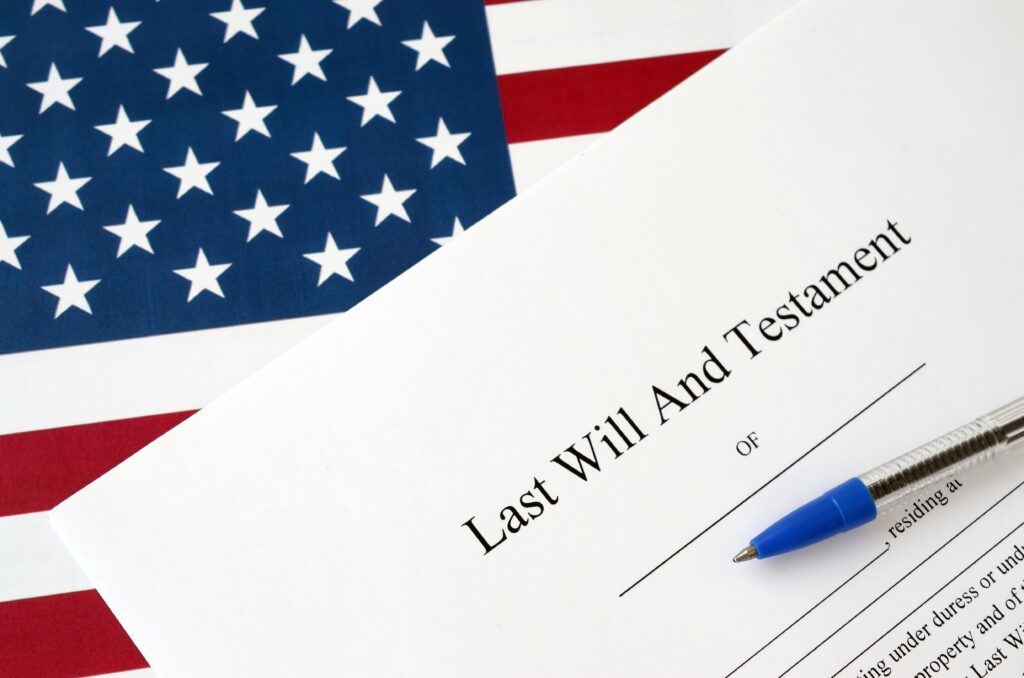
If you are looking to execute last wills online, the most critical factor is ensuring your document meets strict state requirements for legal validity. Drafting a will digitally is only the first part of the equation; proper notarization, identity safeguarding, and witnessing are what make it a legally binding instrument and minimize the risk of future probate disputes.
At Notary Public Center, we specialize in the secure, legally compliant notarization of estate planning documents. Through Florida’s Remote Online Notarization (RON) laws, we help you finalize your last will and testament from the comfort of your home while ensuring every statutory requirement is meticulously met.
Florida Requirements for Validating Last Wills Online
To ensure your digital estate documents hold up in court, Florida law mandates several strict requirements for electronic wills:
Testamentary Capacity:
The testator (the person making the will) must be of sound mind and acting voluntarily.
Two Qualified Witnesses:
The document must be signed in the presence of at least two witnesses. Under RON regulations, these witnesses can be present virtually, but they must hear and see the testator sign.
Supervised Notarization:
An authorized Florida Remote Online Notary must supervise the entire signing process, administer the oaths, and affix their electronic seal.
Vulnerable Adult Safeguards:
Florida law requires specific identity and capacity safeguards to ensure the testator is not an exploited vulnerable adult when executing the document online.
DIY Platforms vs. Notary Public Center Execution
| Feature | Automated DIY Platforms | Notary Public Center |
| Legal Execution | You must find your own notary and witnesses. | We provide the authorized online notary platform. |
| Witness Coordination | Left entirely to you. | We guide the witness integration during the session. |
| Risk Mitigation | High risk of improper signing sequence. | Supervised process to minimize the risk of invalidation. |
| Identity Safeguards | Basic email/password checks. | Strict KBA (Knowledge-Based Authentication) and ID analysis. |
Our Streamlined Online Execution Workflow
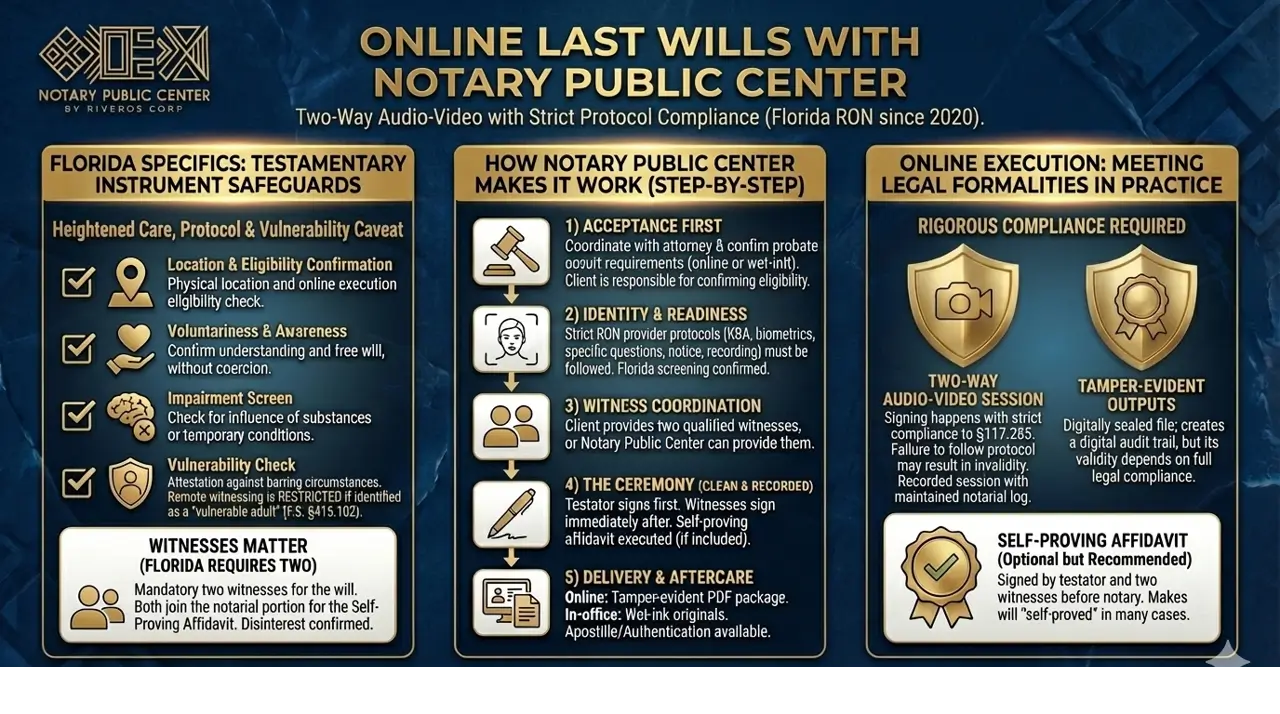
To guarantee a seamless and compliant experience, Notary Public Center utilizes a strict, non-redundant workflow for finalizing your online will. Every step has a distinct purpose, culminating in the proper legal execution of your document:
Document Upload & Pre-Screening
You provide the drafted will. We review the document’s formatting to ensure it is compatible with our secure RON platform and contains the correct notarial blocks for Florida law.
Identity Proofing (Safeguards)
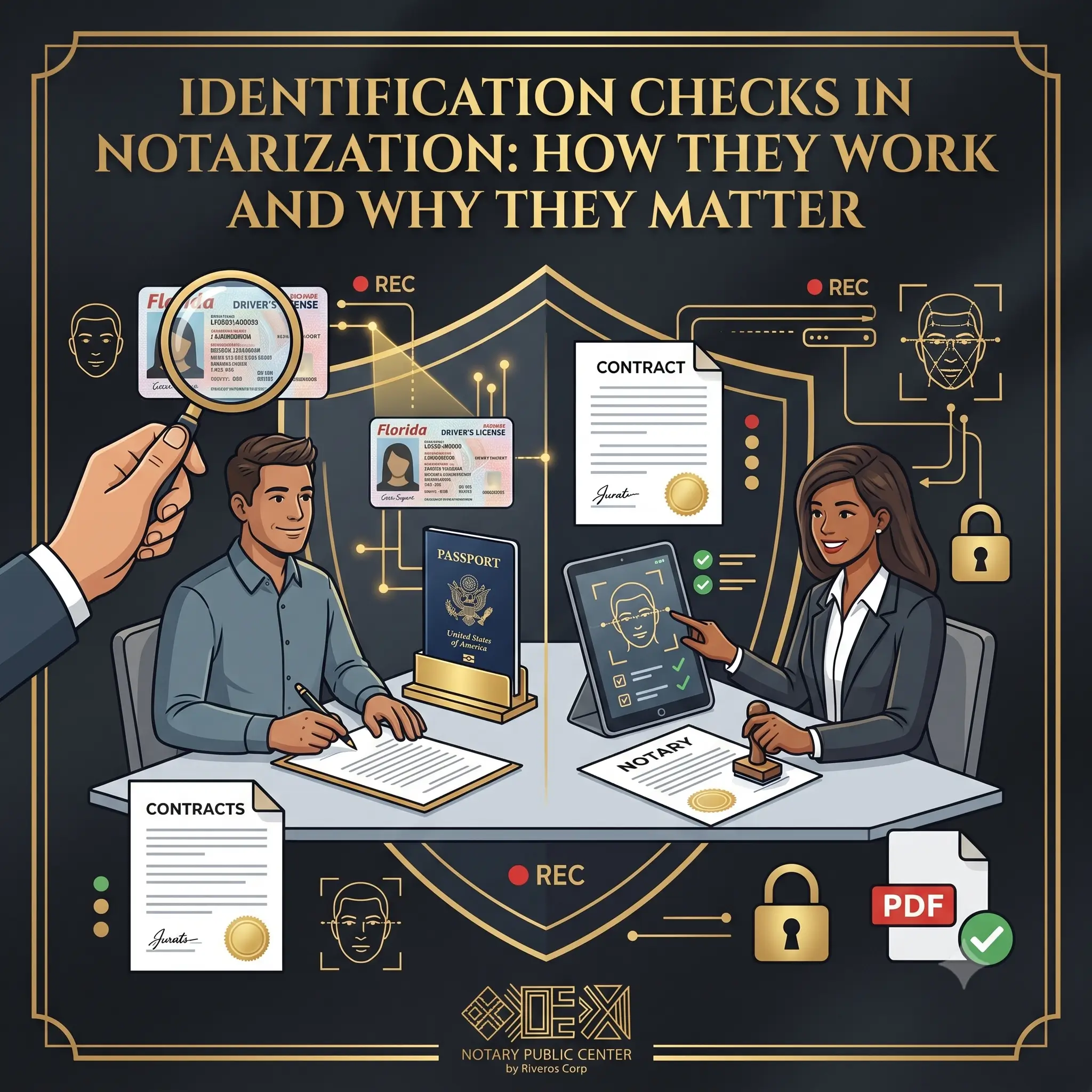
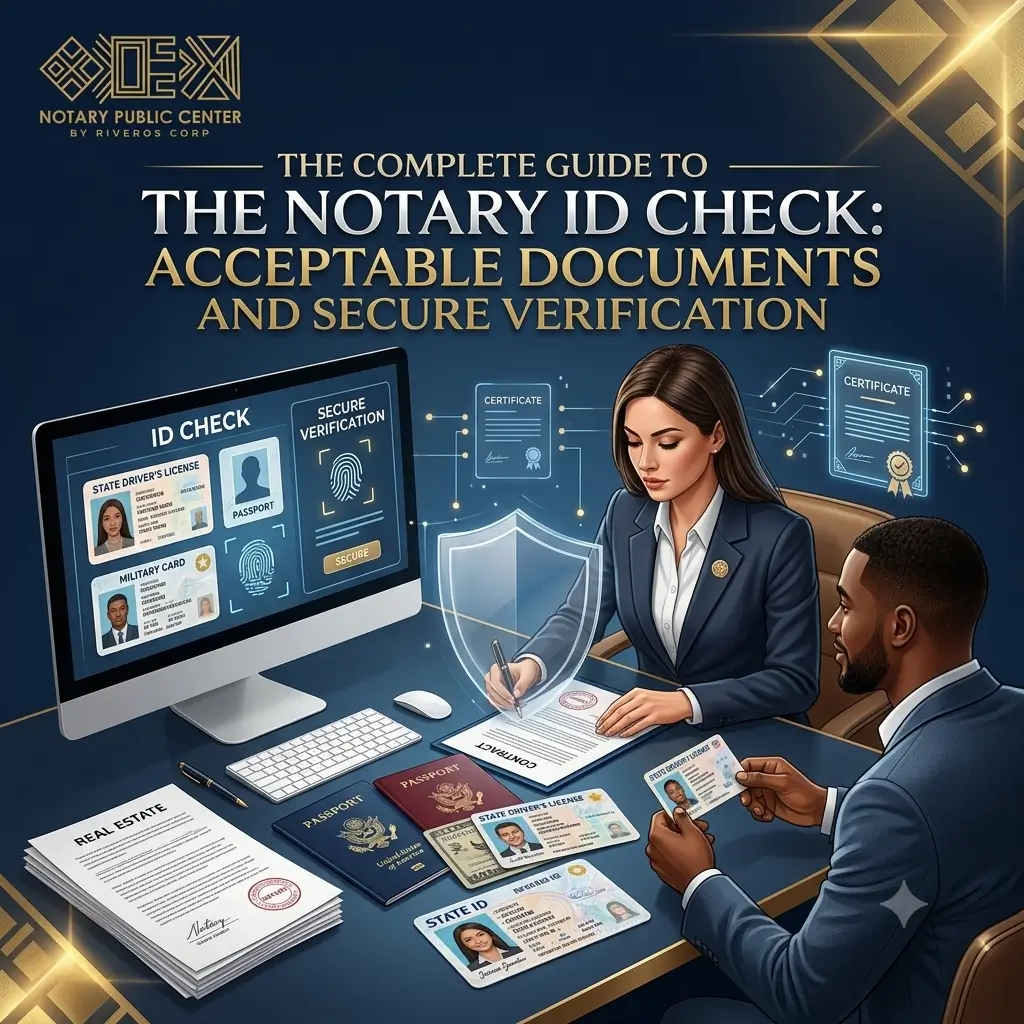
You and your witnesses undergo rigorous identity verification, including credential analysis of your government-issued IDs and Knowledge-Based Authentication (KBA) questions.
The Virtual Signing Ceremony
The testator, the two witnesses, and our commissioned Notary Public connect in a recorded, secure audio-video session. Oaths are administered, and the document is electronically signed in the correct statutory sequence.
Final Step: Notarial Execution & Digital Delivery
Once all signatures are captured, the Notary Public affixes their official electronic seal and digital certificate, rendering the document tamper-evident. The finalized, legally binding will is then securely delivered to you for your permanent records.
Do not leave your family’s future to chance with unverified DIY execution. Let Notary Public Center handle the legal formalities of your digital will so you can have total peace of mind.
Online vs. in-office: how to choose
Choose online if your attorney and court accept it and your witnesses are ready to join remotely. You’ll benefit from faster scheduling, recorded evidence, and tamper-evident outputs.
Choose in-office if a court, custodian, or your counsel requires wet-ink or if a signer cannot pass online identity proofing. We still apply the Florida instrument screening and seat two witnesses in the room.
Either way, our focus is the same: correct formalities, complete records, and a file that probate can use without hesitation.
What we check (so you don’t have to sign twice)
Names: exact spellings as on IDs (accents, hyphens, suffixes, and middle names).
Certificate type: jurat wording for the self-proving affidavit; correct venue and date.
Witness presence: that each witness sees the testator sign/acknowledge and sees the other witness sign.
Capacity & voluntariness: we ask the additional Florida questions on the record.
Document hygiene: consistent pagination, exhibits (if any), and final seals.
“Self-proved” wills and why they save time
A self-proved will includes a notarized affidavit signed by the testator and both witnesses stating that the will was executed properly. Because this affidavit is notarized (with the testator’s oath and witnesses’ oaths), Florida probate courts can usually accept the will without calling witnesses to testify later. That’s a major convenience for families, especially when witnesses move or become difficult to reach.
When you choose last wills online with Notary Public Center, we build the self-proving step into the ceremony (subject to your attorney’s plan and court preferences).
Privacy, security, and data handling
Recorded session: protects you against claims of improper execution.
Tamper-evident files: any change triggers “modified/invalid” flags in standard viewers.
Limited data use: we retain what the law requires for notarial records and security; we do not sell your data.
Seal control: only commissioned notaries control electronic seals and signatures.
International angles: when your estate touches other countries
Your will itself is typically used in Florida probate, not abroad. But related sworn statements (affidavits of heirship, asset letters, certified copies) sometimes need to travel for banking or property matters. We will:
We will leverage our specialized expertise (via our partner brand Apostille de la Haya) to confirm whether the destination is a Hague Apostille country or requires consular legalization, ensuring your documents travel seamlessly.
Decide whether the apostille should attach to the translator’s notarized statement (for translated documents) or to the base affidavit.
Assemble, file, and return the apostilled packet. Timeframes may vary.
Common mistakes we prevent in online will signings
No witnesses or only one witness for the will. Florida requires two.
Witnesses who can’t actually see the signing online (camera off or out of frame). We enforce visibility rules.
Skipping the Florida instrument questions. We ask and record them as part of identity/eligibility screening.
Wrong notarial certificate on the self-proving affidavit (acknowledgment instead of jurat). We use the correct jurat with oaths.
Name/ID mismatches on the affidavit or will. We align names to IDs across all pages.
Unclear roles (beneficiary acting as witness where disinterest is required by counsel). We follow your attorney’s direction and court norms.
Apostille path. Discover how avoid it!
Ready to execute your last will online the right way—two witnesses, Florida instrument safeguards, and a self-proving affidavit that eases probate? Contact Notary Public Center. We’ll coordinate with your attorney, verify acceptance, run multi-layer identity checks, and deliver a recorded, tamper-evident signing—or host you in office if wet-ink is required. Timeframes may vary.
FAQ
When E-Notarization Applies to Your Will (State-by-State Overview)
Not every state treats electronic wills the same way, and the rules change quickly. Before you rely on last wills online execution, confirm where e-wills and Remote Online Notarization (RON) actually apply:
- States with electronic wills statutes: Florida, Nevada, Indiana, Arizona, and several others have adopted laws that explicitly recognize electronic wills executed and notarized through an approved RON platform, provided the statutory witnessing and identity-proofing steps are followed.
- States that allow RON but not e-wills specifically: Some states authorize Remote Online Notarization for general documents (powers of attorney, affidavits, deeds) but have not extended that authorization to testamentary instruments. In those states, a will may still need traditional in-person, wet-ink execution even if other documents can be notarized remotely.
- States that have not adopted e-wills: If your state has no electronic wills statute, a will signed and notarized online may face a higher risk of challenge in probate, even if the underlying RON session was properly conducted.
- Cross-state and snowbird situations: If you split time between states, ask which state’s law will govern probate. Florida residency at the time of signing, and Florida notarization, generally supports validity under Florida’s statute, but a document meant for probate in a different state should be checked against that state’s requirements too.
Because these rules vary and are updated periodically by state legislatures, we always confirm current statutory requirements before scheduling your signing ceremony, and we coordinate with your attorney whenever the plan involves property or probate outside Florida.
Legal Validity: What Actually Makes an Online Will Enforceable
Legal validity for a will executed via last wills online notarization does not come from the technology alone. Courts look at the same core elements they always have, just executed through a supervised digital process:
- Proper execution sequence: the testator signs first, in view of both witnesses, who then sign in view of the testator and each other, all within the same recorded session.
- A valid notarial certificate: the jurat language, notary commission details, and county/venue information must match Florida statutory requirements exactly, or the certificate can be challenged.
- Contemporaneous identity verification: credential analysis and knowledge-based authentication create a verifiable record that the signer was who they claimed to be, which strengthens the will against future capacity or fraud challenges.
- An unbroken audio-video record: Florida law requires the recording to be retained; a gap or interruption in that record can become the basis for a probate objection.
When these elements are documented correctly, a will executed through last wills online notarization carries the same weight in Florida probate court as one signed in a lawyer’s office. For a broader look at how online notary services work across the U.S., see our full RON overview, and for related estate paperwork such as powers of attorney, see how to execute a power of attorney online.
Choosing Between a Notarize App and a Full-Service RON Provider
Many people searching for last wills online notarization first try a generic notarize app before realizing that estate documents carry higher stakes than a routine affidavit. A standalone app can confirm identity and apply a seal, but it typically will not verify testamentary capacity questions, coordinate two compliant witnesses, or check that your specific document meets Florida’s electronic wills statute. Notary Public Center layers those estate-specific safeguards on top of the same RON technology, which is why we recommend a full-service session rather than a generic app for any last wills online execution.
Ready to execute your last will online the right way—two witnesses, Florida instrument safeguards, and a self-proving affidavit that eases probate? Contact Notary Public Center. We’ll coordinate with your attorney, verify acceptance, run multi-layer identity checks, and deliver a recorded, tamper-evident signing—or host you in office if wet-ink is required. Timeframes may vary.
1. Are last wills online legally recognized in Florida?
Yes. Under Florida law (specifically concerning Electronic Wills and Remote Online Notarization), a digital will is fully valid and legally binding, provided it is executed, witnessed, and notarized according to strict state statutes.
2. Can I use my own witnesses for an online will?
Yes, you can provide your own witnesses. However, they must also pass the required identity proofing (KBA and ID analysis) to join the secure remote notarization session. We will coordinate their participation during the signing ceremony.
3. What happens if an online will is improperly notarized?
If the notarial certificate is flawed, the witnesses were not virtually present in the correct manner, or the identity safeguards were bypassed, the probate court can invalidate the will. Using Notary Public Center ensures the procedure is executed flawlessly to minimize this risk.
4. Is the online signing session recorded?
Yes. Florida law requires that the entire audio-video communication of the Remote Online Notarization session be recorded and securely retained by the notary, adding an extra layer of security and proof of testamentary capacity.
5. Does Notary Public Center draft the will for me?
No. Notary Public Center focuses exclusively on the legal execution and notarization of the document. You must have your will already drafted (by an attorney or a legal drafting service) before we perform the online signing ceremony.
The information contained in this publication is provided for general informational purposes only and does not constitute legal advice. Reading or using this content does not create and is not intended to create an attorney-client relationship. No reader or user should act or refrain from acting based on the information presented herein without first consulting an attorney duly licensed to practice law in their jurisdiction.