An apostille FL request starts with a document you need to use outside the United States. You may have a birth certificate, a school transcript, or a power of attorney. Before anyone submits it, the document’s origin and the destination’s requirements need to match the proposed authentication route.
Notary Public Center reviews Florida documents, coordinates notarization when appropriate, and manages apostille submissions and delivery. The Florida Department of State issues the certificate. The receiving institution then decides whether the document meets its requirements for the intended transaction.
The six issues below explain what affects a Florida apostille request. They also show where a document review can identify a problem before it reaches the state office.
Apostille FL: what the certificate actually confirms
An apostille authenticates the signature of a public official or notary, that person’s capacity, and the relevant seal or stamp. It supports the use of a public document abroad when the Hague Apostille Convention applies between the countries involved.
However, authentication does not establish that every statement in a document is true. It also does not decide whether a foreign court, school, bank, or government agency accepts the document for a particular purpose. That institution may still require a translation, a particular record format, or other supporting material.
For example, an apostille on a notarized power of attorney authenticates the notarial signature. It does not confirm that the powers granted satisfy the destination’s law. A lawyer familiar with that transaction may need to review the document’s wording separately.
1. Apostille FL and the destination's requirements
The destination country affects the type of authentication a document needs. Where the Convention applies, an apostille replaces the traditional diplomatic or consular legalization requirement for covered public documents. For other destinations, a different authentication and legalization route may apply.
The receiving institution’s written instructions matter as well. A university may ask for a transcript signed by a particular school official. Meanwhile, a foreign registry may require a specific version of a civil record. Knowing the country alone does not answer those questions.
When requesting a review, explain where you will use the document and which institution will receive it. Include any instructions that institution supplied. This gives the reviewer a basis for assessing the document instead of assuming that every foreign recipient follows the same rules.
Acceptance remains a separate question
Some recipients require a recent certified record even when an older document could qualify for authentication. Others specify how a translation must accompany the document. Those conditions belong to the receiving institution and may differ between transactions in the same country.
Therefore, a service provider cannot promise acceptance merely because the state can issue an apostille. The review should distinguish the state’s authentication requirements from the recipient’s requirements for using the document.
2. Which authority handles an apostille FL request?
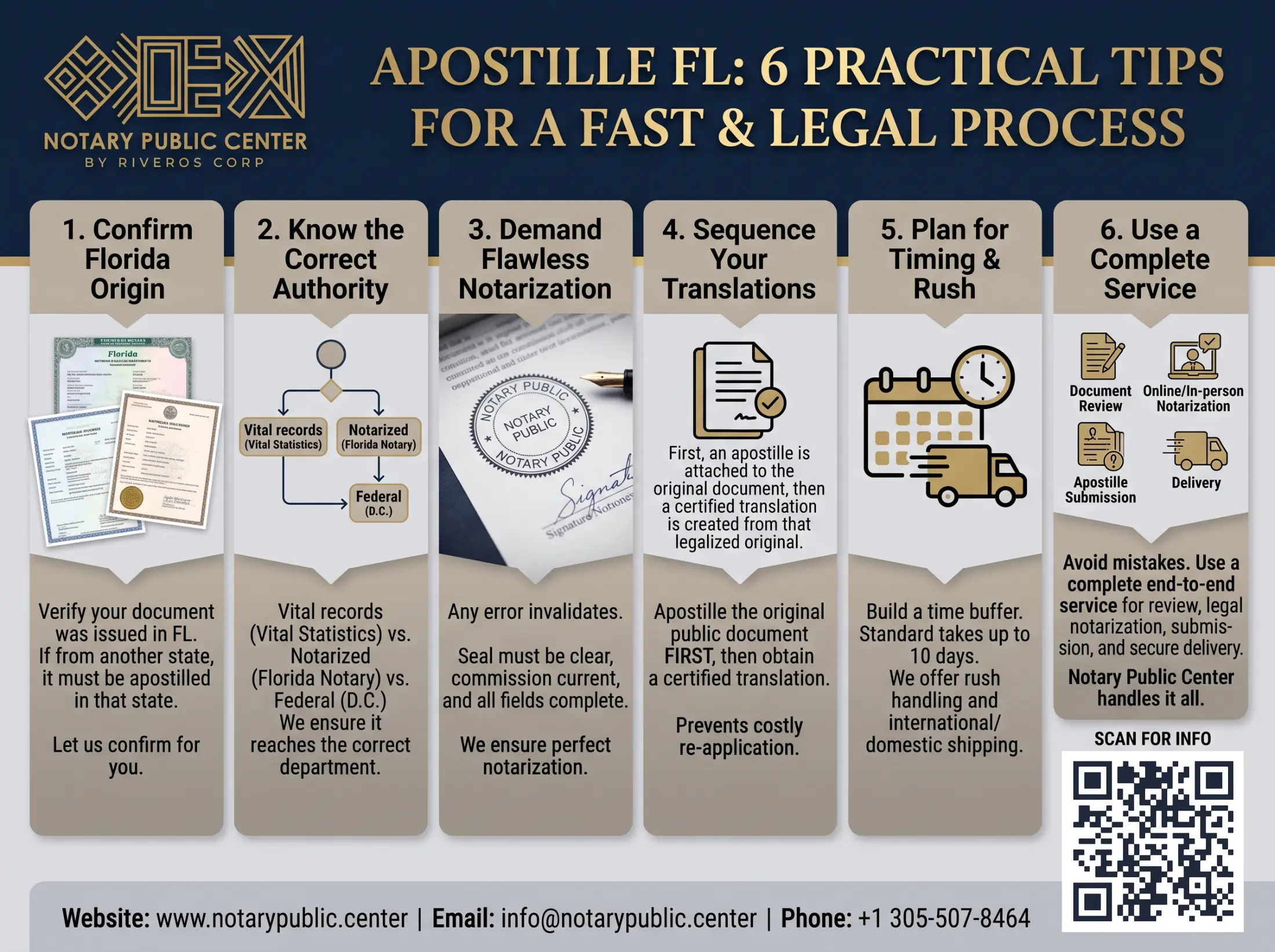
The Florida Secretary of State is Florida’s competent authority for apostilles. The Department of State’s Division of Corporations handles this work in Tallahassee. A Florida notary can perform an authorized notarial act, but cannot issue the state apostille.
The relevant authority depends on the official signature or certification that needs authentication. Florida public records and documents bearing a qualifying Florida notarization generally follow the Florida route. A public record from another state ordinarily requires that state’s authentication authority.
Federal documents follow a separate route. For example, an FBI background check falls within the federal authentication process. Living in Florida or sending the document from a Florida address does not convert it into a Florida state record.
Our overview of federal document authentication explains that distinction. Identifying the authority early helps avoid preparing a submission for an office that cannot authenticate the relevant signature.
3. Document versions and certified records
An original, an agency-certified copy, and a personal photocopy serve different purposes. A scan may help with an initial review. However, it does not automatically replace the document the issuing authority needs for authentication.
For Florida birth and death records, the state accepts qualifying records bearing the State Registrar’s signature. These may come from the Bureau of Vital Statistics or a county health department. Marriage and dissolution records have their own accepted issuing channels.
A Florida notary cannot turn a photocopy of a government-held public record into the issuing agency’s certified copy. This restriction matters for birth certificates, marriage records, and other public records. Adding a notary stamp to the wrong copy does not solve the underlying problem.
If you lack the required version, you will need to obtain it from the appropriate record holder. Notary Public Center can review the version you provide and explain what kind of document the authentication route requires.
School and business documents need their own review
School documents do not all follow the vital-record route. A transcript may require a school official’s signature and an appropriate notarial statement. The requirements can differ between public and private institutions, so a generic photocopy review is insufficient.
Business records also vary. An official certificate of status differs from a resolution signed by company officers. The first carries an official certification; the second may need notarization of a signature. The document’s label alone does not identify the right preparation.
4. Notarization before a Florida apostille
Some private documents need a notarial act before the state can authenticate the notary’s signature. Examples include certain affidavits, authorization letters, and powers of attorney. The required act depends on the document and the applicable instructions.
A complete notarial certificate matters. Missing information, an incomplete seal, or a problem with the commission on the signing date can affect the submission. A notary should address any defect in their own work through the proper process; a client should not alter the certificate.
Notary Public Center offers in-person and online notarization services. Suitability for a particular international transaction requires review, including the document format and the recipient’s requirements. An online appointment does not by itself establish that every later authentication step will accept the resulting format.
For more context, see our explanation of what notarization covers. It helps separate identity and signature formalities from questions about the legal effect of the underlying document.
Legal wording requires separate attention
A notarial act does not supply missing legal provisions or decide which powers a person should grant. For example, a foreign property transaction may call for language specific to that transaction. The signer should resolve those questions with qualified counsel before execution.
This distinction also affects timing. If the wording needs revision after signing, the document may require another execution and notarial act. Reviewing the intended use before the appointment can reduce avoidable repeat work.
5. Translations and apostille FL documents
The receiving institution determines whether it needs a translation and what qualifications or certification it expects. Some recipients require a translation of the underlying record and its apostille. Others set additional requirements for the translator’s statement.
As a result, there is no universal order that works for every destination. The review should establish which document or signature needs authentication and which material needs translation. A translation of a record and an apostille on a translator’s notarized signature address different things.
The Florida Department of State does not provide translation services. Also, the person translating a document cannot notarize their own translation. If a translator’s statement requires notarization, another authorized notary must perform that act.
Notary Public Center coordinates translation when the file requires it. The scope should reflect the recipient’s instructions, including any requirement to translate the attached authentication certificate.
6. Apostille FL timing and delivery
The total time depends on document readiness, state processing, and delivery. A missing certified record or a notarial defect can add work before the state even receives the request. International shipping and the recipient’s submission schedule add separate constraints.
The Florida Department of State does not offer expedited services. It offers walk-in service and states that most walk-in requests may finish while the requester waits. That statement does not guarantee completion for every document or a delivery date abroad.
Private courier arrangements may affect transportation or submission logistics. They do not create a state-guaranteed priority service. Any proposed timeline should distinguish the provider’s handling from the authority’s decision and the carrier’s delivery.
If you face a school, immigration, or transaction deadline, disclose it during the initial review. The service team can assess the available arrangements and explain uncertainties. Avoid treating a preliminary estimate as a confirmed completion date.
Originals, tracking, and return arrangements
Documents need a clear return destination, especially when the requester and recipient live in different countries. The service scope should identify who receives the completed file and whether onward international shipping forms part of the arrangement.
Keeping a reference copy helps document what you submitted. However, that copy does not replace an original or an agency-certified record if the recipient requires one. Tracking also helps follow a shipment, although it cannot eliminate the risk of delay or loss.
After the state issues the apostille
The completed document may still need translation or delivery to the foreign recipient. Keep the apostille attached to the document and avoid altering the assembly. If something appears inconsistent, request a review before forwarding the file.
The apostille concerns the official or notarial signature, so its named signer may differ from the person named in the underlying record. A review should check the relevant signature and certification rather than assume both documents must name the applicant in the same way.
Next, confirm the receiving institution’s submission format. A reference scan may support communication, but some transactions require the physical authenticated document. Keeping the recipient’s instructions with the file helps everyone understand what remains outstanding.
How Notary Public Center handles the review
Notary Public Center reviews the document’s origin, the destination, and the recipient’s instructions before coordinating the applicable services. Depending on the file, those services may include notarization, apostille submission, translation, and domestic or international delivery.
The review can identify missing certification, a document that belongs with another authority, or a question for the receiving institution. It can also establish what you need to provide before the service proceeds. The state retains control over issuance, and the recipient retains control over acceptance.
Visit Notary Public Center to discuss your documents. You can also call +1 305 507 8464 or contact the team through WhatsApp. Mention the document type, destination, and any deadline so the review addresses your actual situation.
Apostille FL: frequently asked questions
Who issues an apostille FL certificate?
The Florida Department of State issues Florida apostilles through its Division of Corporations. Notaries and private service providers cannot issue that state certificate. Federal documents require review under the federal authentication route.
Can a Florida notary apostille my document?
No. A notary performs an authorized notarial act when the document requires one. The Department of State then authenticates the qualifying notarial signature through the apostille process. These are separate functions.
Which Florida documents can qualify?
Qualifying documents include appropriate certified vital records and certain notarized documents. School and business documents have their own preparation requirements. The document’s origin, signature, and certification determine its route.
How long does the process take?
Timing depends on the document, state processing, and shipping. Florida does not offer expedited state service. Walk-in availability and private delivery arrangements do not guarantee a completion date for every file.
Can Notary Public Center manage the request?
Yes. The team reviews the documents and coordinates the applicable submission, notarization, translation, and delivery services. The authority decides whether to issue the certificate, and the receiving institution decides whether to accept the file.
Scope of this information
The information contained in this publication is provided for general informational purposes only and does not constitute legal advice. Reading or using this content does not create and is not intended to create an attorney-client relationship. No reader or user should act or refrain from acting based on the information presented herein without first consulting an attorney duly licensed to practice law in their jurisdiction.