

By the Compliance Officers Regulatory Team
Introduction
A fincen filing—officially known as a Beneficial Ownership Information (BOI) report—is a mandatory federal submission required by the U.S. Department of the Treasury to identify the individuals who ultimately own or control a company. Mandated by the Corporate Transparency Act (CTA), this filing aims to combat money laundering, tax fraud, and illicit financial activities across the United States.
While the initial mass-filing deadline passed on January 1, 2025, the enforcement phase is now in full effect in 2026. Today, any newly formed business, or any existing business experiencing a change in ownership details, faces strict 30-day reporting windows. Failing to comply with these federal mandates no longer results in a warning—it triggers severe civil and criminal penalties, including fines of $500 per day.
Navigating the Financial Crimes Enforcement Network (FinCEN) portal and interpreting federal definitions of «substantial control» can be overwhelming for business owners. At Compliance Officers, we specialize in corporate due diligence and federal reporting. We manage your FinCEN submissions accurately and promptly, ensuring your business remains fully compliant while you focus on your operations.
What is the FinCEN BOI Filing?
The Corporate Transparency Act introduced a historic shift in how businesses report their structures to the federal government. Previously, only state governments collected basic incorporation data. Now, the federal government requires a detailed look «behind the curtain» of every registered entity.
A fincen filing requires reporting companies to submit personal, identifiable information about their «Beneficial Owners.» A beneficial owner is legally defined as any individual who:
-
Directly or indirectly owns or controls at least 25% of the ownership interests of the company.
-
Exercises substantial control over the reporting company (such as a CEO, President, or senior officer), even if they hold zero ownership shares.
The filing must include the owner’s full legal name, date of birth, current residential address, and an image of a government-issued ID (like a U.S. passport or driver’s license).
Who Must Submit a FinCEN Filing in 2026?
The rule applies to a broad category known as «Reporting Companies.» If your business falls into this category, you are legally obligated to file.
-
Domestic Reporting Companies: Any corporation, Limited Liability Company (LLC), Limited Partnership (LP), or other entity created by the filing of a document with a Secretary of State or any similar office under the law of a U.S. state or Indian tribe.
-
Foreign Reporting Companies: Any foreign company registered to do business in any U.S. state or tribal jurisdiction by filing a document with a Secretary of State.
Are There Any Exemptions?
Yes, FinCEN lists 23 specific exemptions. Most of these apply to highly regulated entities that already report to the government, such as publicly traded companies, banks, credit unions, and tax-exempt nonprofits.
There is also an exemption for «Large Operating Companies»—defined strictly as entities with more than 20 full-time U.S. employees, a physical office in the U.S., and over $5 million in gross receipts reported on their previous year’s federal tax return. However, identifying whether your company truly qualifies for an exemption requires expert due diligence. Claiming an exemption incorrectly triggers immediate non-compliance penalties.
Who is a Beneficial Owner?
A beneficial owner is someone who owns or controls at least 25% of the entity or has significant influence over its operations. Foreign entities must accurately identify these individuals when preparing their FinCEN filing.
Example: A Canadian tech startup with a U.S. sales office had to report two co-founders who held equal ownership and voting rights. Misidentifying them could have led to compliance issues.
Strict 2026 Deadlines: Ongoing Compliance
A common misconception is that the fincen filing was a one-time event that ended in 2025. In 2026, ongoing compliance is the primary focus of federal auditors. The deadlines are now rolling and highly time-sensitive:
-
Newly Formed Companies (Created in 2025 or 2026): Must submit their initial BOI report within 30 calendar days of receiving actual or public notice that their company creation or registration is effective.
-
Updates and Changes: This is where most businesses fail. If there is any change to the information previously reported about the company or its beneficial owners, you must file an updated report within 30 calendar days of the change.
Examples of triggers for a 30-day update include:
-
A beneficial owner legally changes their name (e.g., due to marriage).
-
A beneficial owner moves to a new residential address.
-
The passport or driver’s license previously submitted to FinCEN expires and is renewed.
-
The company hires a new CEO or changes its ownership structure.
How to Avoid Mistakes in FinCEN Filing
Common pitfalls include:
-
Missing Beneficial Owners: Make sure to identify everyone who meets the criteria.
-
Outdated Information: Double-check that all data is current and accurate.
-
Misunderstanding Exemptions: Confirm whether your foreign entity is required to file.
In 2023, a European import firm mistakenly believed they were exempt. With help from a compliance advisor, they corrected the error just before the deadline and avoided significant penalties.
The Severe Risks of DIY FinCEN Filing
Many business owners attempt to handle their fincen filing themselves to save a minor administrative fee, only to realize that federal compliance is unforgiving.
Here is why a «Do It Yourself» approach is a massive liability in 2026:
-
Crushing Financial Penalties: Willfully providing false information or failing to report complete information within the 30-day window can result in civil penalties of $500 for every single day that the violation continues.
-
Criminal Prosecution: Beyond daily fines, willful non-compliance can lead to criminal penalties, including up to $10,000 in fines and up to two years of imprisonment.
-
Misinterpreting «Substantial Control»: Business owners frequently fail to list non-equity executives who hold «substantial control.» If FinCEN audits your structure and finds an unlisted senior officer, your filing is considered fraudulent.
-
Missed Update Windows: Keeping track of every expiring passport or address change among your partners is a logistical nightmare. Missing a 30-day update window instantly places your company in bad standing with the federal government.
Why Use a Professional for FinCEN Filing?
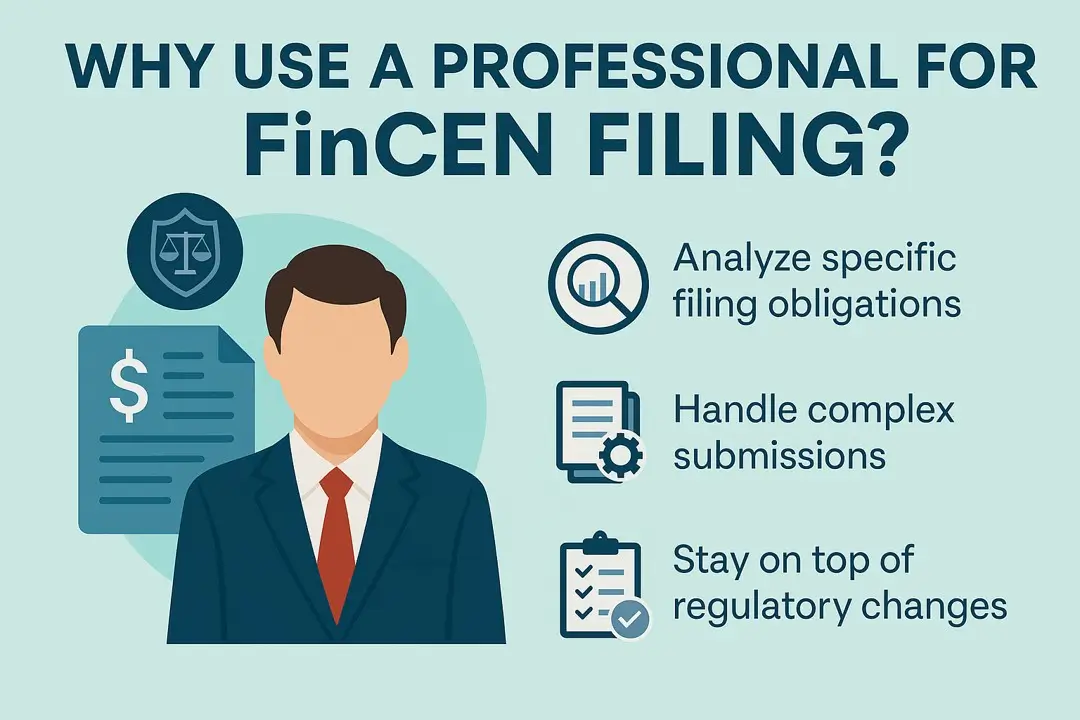
FinCEN regulations can be tricky. A professional can:
-
Analyze your business’s specific filing obligations.
-
Handle complex submissions.
-
Stay on top of regulatory changes.
At Compliance Officers, our regulatory experts are highly trained to guide you through the entire FinCEN filing process. We’ve successfully assisted companies from over 15 countries in complying with BOI regulations, minimizing legal risks and ensuring timely submissions.
Partnering with us is the most reliable way to file correctly and avoid costly errors.
Support for Foreign Entities
For foreign entities, FinCEN filing can feel overwhelming. Compliance Officers offers tailored support:
-
Clarifying requirements based on your home country.
-
Ensuring beneficial owners are correctly identified.
-
Simplifying the entire filing process.
No matter the size or jurisdiction of your business, our team delivers customized strategies that ensure accuracy and peace of mind.
Why FinCEN Filing is a Must-Do
Submitting your BOI report isn’t just about checking a box—it’s about protecting your business’s reputation and legal standing in the U.S. With the 2025 updates, getting it right (and on time) is more important than ever.
How Compliance Officers Protects Your Business
Do not gamble with federal mandates. At Compliance Officers, we serve as your dedicated corporate compliance shield. We take the burden of FinCEN reporting entirely off your shoulders.
Our comprehensive BOI filing service includes:
-
Corporate Due Diligence: We analyze your corporate structure to accurately identify all beneficial owners and individuals with substantial control, ensuring no one is overlooked.
-
Exemption Analysis: Our specialists determine with certainty if your business qualifies for any of the 23 federal exemptions.
-
Flawless Submission: We gather all required documentation and execute the fincen filing accurately through the secure federal portal.
-
Ongoing Update Monitoring: We establish communication protocols to help track life events (expiring IDs, address changes) so your 30-day update filings are submitted seamlessly, keeping you permanently compliant.
Protect your business from $500 daily fines and federal scrutiny. Contact Compliance Officers today to secure your FinCEN BOI reporting with precision and peace of mind.
Frequently Asked Questions (FAQs)
1. Is the FinCEN filing an annual requirement like a state report?
No. Unlike state annual reports or franchise taxes, the BOI report is not an annual filing. It is an initial filing followed by mandatory update filings. You only need to file again if there is a change to the company’s information or a beneficial owner’s information (such as a new address or renewed ID).
2. Does a sole proprietorship have to complete a FinCEN filing?
It depends on how the business was created. If you operate as a sole proprietor using just your name and never filed creation documents (like Articles of Organization) with a Secretary of State, you are generally not a reporting company. However, if you filed to create a Single-Member LLC, you must file a BOI report.
3. Who is considered a "Company Applicant"?
For companies created on or after January 1, 2024, the filing must also include the «Company Applicant.» This is the individual who directly filed the document that created the entity, as well as the individual who was primarily responsible for directing the filing (often a corporate service provider or paralegal).
4. Is the information submitted in the FinCEN filing available to the public?
No. The Beneficial Ownership Secure System (BOSS) database is highly secure and not accessible to the general public. FinCEN only shares this data with authorized government agencies, law enforcement, and, in specific cases, financial institutions conducting customer due diligence.
5. What should I do if I missed the January 2025 deadline?
If your company existed prior to 2024 and you missed the January 1, 2025 deadline, you are already accruing non-compliance liabilities. You must file immediately. Utilizing a professional service like Compliance Officers ensures your late submission is handled correctly and efficiently to mitigate further federal scrutiny.
Legal Disclaimer:
This article is provided solely for informational purposes and does not constitute legal advice or establish an attorney-client relationship. The information herein should not be relied upon as legal counsel. In accordance with guidelines recognized by the United States Supreme Court, you should consult a licensed attorney in your jurisdiction for specific advice applicable to your particular legal situation.