Updated August 13, 2026
Regulatory update — current as of August 2026
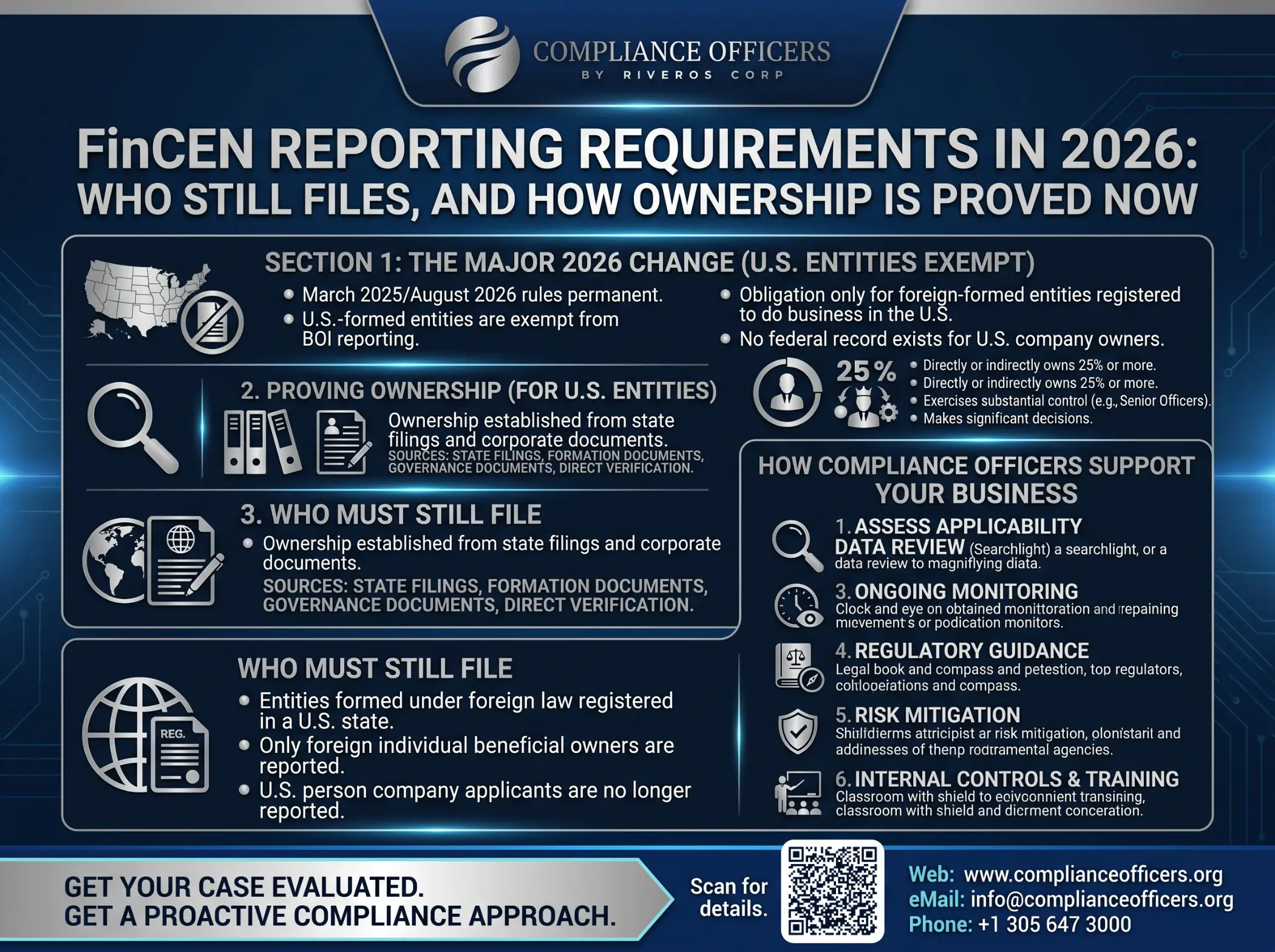
On March 26, 2025, FinCEN issued an interim final rule that redefined who must file a BOI report. Entities created in the United States are now exempt from reporting beneficial ownership information.
The requirement applies only to entities formed under the law of a foreign country that have registered to do business in a U.S. state or tribal jurisdiction. Those foreign reporting companies are also not required to report beneficial owners who are U.S. persons.
On August 11, 2026, FinCEN issued the final rule that makes this framework permanent. It takes effect on its publication in the Federal Register on August 14, 2026, and it goes further than the interim rule in three ways: reporting companies no longer submit information about U.S. person company applicants; U.S. persons are exempt from updating information already provided in connection with a FinCEN identifier; and FinCEN has stated that it will delete previously reported U.S.-person information from the beneficial ownership database.
What remains is narrow. Entities formed under the law of a foreign country and registered to do business in a U.S. state or tribal jurisdiction still report, and they report the beneficial owners who are foreign individuals. For everyone else the practical consequence is that there is no longer a federal record of who owns a U.S. company: when a bank, a buyer or a counterparty needs that answer, it has to be established from state filings and corporate documents rather than looked up.
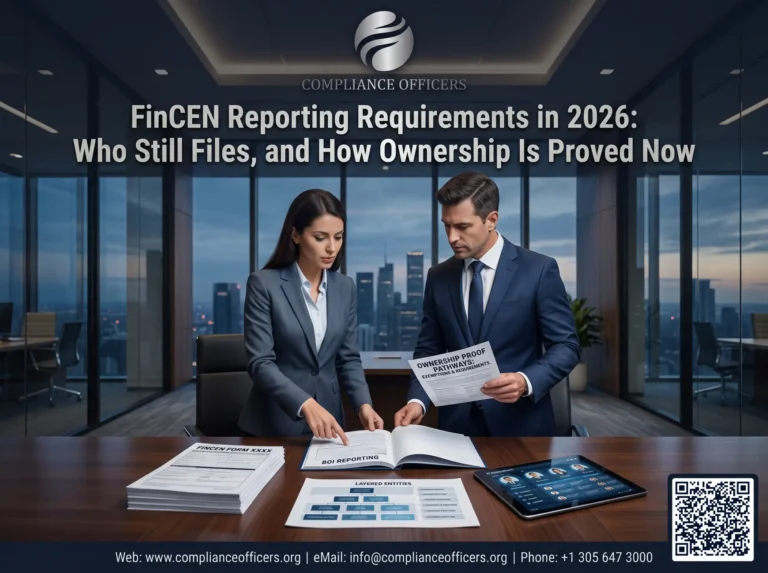
The U.S. Treasury Department’s Financial Crimes Enforcement Network (FinCEN) reshaped corporate transparency regulation in 2025. On March 26 of that year, an interim final rule exempted every entity created in the United States from Beneficial Ownership Information (BOI) reporting under the Corporate Transparency Act (CTA), leaving the obligation with foreign-formed companies registered to do business in the U.S. Understanding which side of that line your business falls on is what avoids both unnecessary filings and genuine penalties.
This article explores the 2025 FinCEN reporting requirements and explains how Compliance Officers can help small businesses and corporations stay compliant and avoid legal risks.
What Is the BOI Report?
The Beneficial Ownership Information (BOI) report is a new disclosure requirement designed to increase transparency in business ownership and combat illicit financial activity. Companies must report the identities of individuals who:
Own at least 25% of the company,
Exercise substantial control over the entity,
Or hold significant influence over its decisions.
FinCEN uses this data to detect and deter money laundering, terrorist financing, tax evasion, and other financial crimes.
Who Must Report to FinCEN?
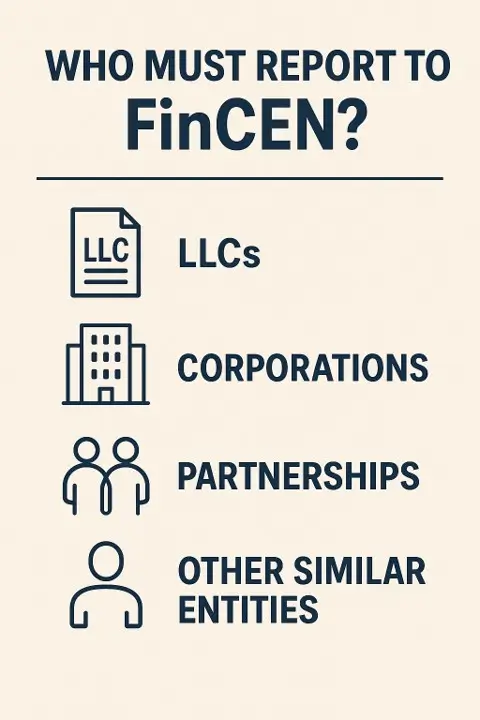
Under the rules in force since March 26, 2025, the obligation applies only to entities formed under the law of a foreign country that have registered to do business in a U.S. state or tribal jurisdiction. Companies created in the United States are exempt, regardless of size or revenue. This includes:
Limited Liability Companies (LLCs) — exempt
Corporations, S-Corps and C-Corps — exempt
Limited Partnerships (LPs) — exempt
Business trusts and similar entities — exempt
A foreign reporting company also does not report beneficial owners who are U.S. persons, and those individuals are not required to provide their information to it.
Exemptions
Some entities are exempt from BOI reporting, including:
Publicly traded companies
Regulated financial institutions (e.g., banks, insurance companies)
Large operating companies with more than 20 full-time employees, over $5 million in annual revenue, and a physical office in the U.S.
Who Is a Beneficial Owner?
A beneficial owner is any individual who:
Directly or indirectly owns 25% or more of the reporting company,
Exercises substantial control over the entity (e.g., CEO, CFO, or senior officers),
Makes significant decisions about finances or operations.
BOI Reporting Deadlines, Current as of 2026
These apply only to foreign-formed entities registered to do business in the United States. Companies created in the U.S. are exempt and have no deadline to meet.
Registered before March 26, 2025: the initial report was due April 25, 2025.
Registered on or after March 26, 2025: 30 calendar days from the notice that the registration is effective.
Updates or corrections: 30 calendar days from the change.
Penalties for Non-Compliance
Failing to report, or reporting false information, can result in:
Civil penalties of up to roughly $606 per day for ongoing violations — the statutory $500 adjusted for inflation, current as of 2026
Criminal penalties: fines up to $10,000 and up to 2 years in prison
Recent Updates to FinCEN BOI Rules
On March 26, 2025, FinCEN issued an interim final rule that did far more than clarify definitions. It:
Removed the BOI reporting requirement for every entity created in the United States
Limited the obligation to entities formed under foreign law that have registered to do business in a U.S. state or tribal jurisdiction
Exempted foreign reporting companies from reporting beneficial owners who are U.S. persons
Reset the deadlines: April 25, 2025 for companies already registered, and 30 calendar days from the effective-registration notice for those registered afterwards
FinCEN opened a comment period and then finalized the rule: the final rule was issued on August 11, 2026 and takes effect on its publication in the Federal Register on August 14, 2026, so the framework above is now permanent.
Common Mistakes in BOI Reporting
Companies often face issues such as:
Misidentifying beneficial owners
Using outdated or incorrect ID documents
Missing filing deadlines
Assuming exemption without verification
Working with compliance experts can prevent costly errors.
How Compliance Officers Help Businesses Meet FinCEN Requirements
Compliance Officers play a pivotal role in helping businesses fulfill their FinCEN obligations. Their responsibilities include:
1. Assessing Applicability
They determine whether your entity must file a BOI report and which individuals qualify as beneficial owners.
2. Data Review and Risk Identification
They help evaluate your internal records to ensure all required information is accurate and up to date. Any risks related to missing or inconsistent ownership documentation are flagged early.
3. Ongoing Monitoring
They stay informed about updates to FinCEN rules and ensure your company adapts to changes in compliance obligations.
4. Regulatory Guidance
They interpret complex legal language into actionable requirements, guiding your company through what must be documented, stored, or disclosed.
5. Risk Mitigation
By identifying compliance gaps, they help you reduce exposure to fines, reputational harm, or criminal liability.
6. Internal Controls and Training
They support your team with documentation protocols and employee awareness on what needs to be monitored and updated regularly.
Why Small Businesses Need Compliance Support
For many small businesses, navigating federal compliance can be overwhelming. Professional assistance provides:
Peace of mind knowing you’re compliant
Protection against penalties and legal risk
A proactive approach to changing regulations
FinCEN reporting requirements: what the BOI report is
The Beneficial Ownership Information (BOI) report is a filing created under the Corporate Transparency Act (CTA) and administered by the U.S. Treasury’s Financial Crimes Enforcement Network, or FinCEN. Its purpose is to increase transparency around who ultimately owns and controls companies, making it harder to use shell entities for money laundering, fraud, or sanctions evasion.
A BOI report identifies the company’s beneficial owners—the individuals who ultimately own or control it—along with company details and, in some cases, the company applicants who created it. Because the rules around who must file have changed significantly, understanding the current framework matters more than ever. At Compliance Officers we help businesses determine whether they have a filing obligation today and prepare the report correctly.
Important: the rules changed in 2025 and became permanent in 2026
FinCEN’s BOI requirements went through major changes during 2025. Following a series of court decisions and rulemaking, FinCEN issued an interim final rule that narrowed the scope of who must file, shifting the focus away from U.S. domestic companies and toward certain foreign reporting companies registered to do business in the United States. Deadlines and definitions were adjusted as part of these updates.
Because this area has been unusually fluid—with rules paused, revised, and reinstated at different points—you should always confirm your current obligation before assuming you must (or must not) file. Relying on outdated guidance is the single biggest risk here. A brief compliance review tells you exactly where you stand under the rules in effect now.
Those changes are no longer provisional. The final rule issued on August 11, 2026 adopts the interim framework as final, ends the reporting of U.S. person company applicants, and relieves U.S. persons of updating information tied to a FinCEN identifier.
Who is a «beneficial owner»?
Under the CTA framework, a beneficial owner is generally an individual who either:
- Exercises substantial control over the company—such as senior officers or those with authority over important decisions; or
- Owns or controls at least 25% of the ownership interests of the company.
A single company can have several beneficial owners under these tests. For each one, the report typically requires full legal name, date of birth, residential address, and an identifying number from an acceptable document such as a passport or driver’s license, along with an image of that document. Identifying every person who meets the control or ownership thresholds is where many companies need guidance. Where a company falls outside the reporting rules but a bank or counterparty still asks who owns it, the question stops being a filing and becomes beneficial ownership verification.
What information goes into a BOI report
A complete BOI filing generally includes three categories of information:
- Company information: legal name, any trade names, principal U.S. address, jurisdiction of formation or registration, and taxpayer identification number.
- Beneficial owner information: the identifying details described above for each beneficial owner.
- Company applicant information: for entities within scope, details of the individuals who filed to create or register the company.
Accuracy is essential. Errors, omissions, or outdated ownership details can create compliance exposure, and any change in beneficial ownership generally has to be reported through an updated filing within the required timeframe.
Why penalties make getting this right worthwhile
The Corporate Transparency Act carries meaningful consequences for willful failures to report or for providing false information, including civil and potentially criminal penalties. Even setting penalties aside, an inaccurate or missed filing can complicate banking relationships, financing, and transactions that increasingly ask for verified ownership information.
The challenge is that «getting it right» now means navigating rules that shifted during 2025. That is precisely why a professional review is valuable: it confirms whether you are in scope today, identifies your beneficial owners correctly, and ensures any required report is filed accurately and on time.
What we do now that most companies have no report to file
The filing question is settled for the overwhelming majority of U.S. businesses: there is nothing to file and nothing to keep updated. What did not go away is the question the report was meant to answer. A bank still asks who owns the company before it funds an account, a buyer asks before it signs, and lenders, insurers and counterparties ask before they take on exposure. The difference is that none of them can be pointed at a federal filing anymore — and none of them could read it even when it existed.
That is the work we handle:
- Confirming whether your entity falls inside the residual reporting scope — formed under foreign law and registered to do business in a U.S. state or tribal jurisdiction — and filing correctly if it does.
- Establishing the ownership and control chain of a U.S. entity from state filings, formation and governance documents and direct verification, rather than from a self-reported form.
- Producing an ownership record a bank, a buyer or a compliance department can actually accept, including the layered cases where one entity owns another.
- Screening the individuals and entities identified against sanctions lists — a separate obligation that applies to every U.S. business and that none of these changes touched.
Companies reach us from both directions: those told by a bank to produce ownership information they have never had to assemble, and those checking a U.S. counterparty before committing money. Contact us to have your case evaluated.
Keeping your BOI information up to date
A BOI report is not always a one-and-done filing. When a company is within scope, changes to its beneficial ownership or to the reported details generally must be reflected through an updated filing within the required timeframe. Common triggers include a new owner crossing the 25% threshold, a change in who exercises substantial control, a beneficial owner moving to a new address, or the renewal of an identifying document. Because these updates carry their own deadlines, it helps to treat beneficial ownership as something you monitor rather than file once and forget. Building a simple internal process—reviewing ownership at each major corporate change and at least annually—keeps you from missing an update that could create exposure. Compliance Officers can help you set up that review cadence, so that if your obligations change with the evolving rules, or your ownership structure shifts, your filings stay accurate and current. That same ownership record is what a bank tests against its customer due diligence requirements when it onboards or refreshes an account.
Frequently Asked Questions
What is a FinCEN BOI report?
It is the Beneficial Ownership Information report required under the Corporate Transparency Act and administered by FinCEN. It identifies the individuals who ultimately own or control a company, to improve transparency and prevent financial crime.
Did the FinCEN BOI requirements change in 2025?
Yes. During 2025, following court decisions and rulemaking, FinCEN issued an interim final rule that narrowed the scope—shifting focus toward certain foreign reporting companies—and adjusted deadlines. Because the rules have been fluid, you should confirm your current obligation before assuming you must or must not file.
Who counts as a beneficial owner?
Generally, an individual who exercises substantial control over the company or who owns or controls at least 25% of its ownership interests. A company can have multiple beneficial owners under these tests.
What are the penalties for not filing?
The Corporate Transparency Act provides for civil and potentially criminal penalties for willful failures to report or for false information. Inaccurate or missed filings can also complicate banking and financing.
How can Compliance Officers help with my BOI report?
We determine whether your entity currently has a filing obligation, identify your beneficial owners, gather and verify the required information, and prepare and file an accurate report. Contact us to confirm your current status and evaluate your case.
Conclusion
The FinCEN BOI reporting requirements mark a significant shift in business transparency. Understanding who must file, what data is required, and when to file is essential to staying compliant.
Partnering with Compliance Officers ensures your business meets its obligations confidently and efficiently.
Legal Disclaimer:
This article is provided for informational purposes only and does not constitute legal advice. The content herein is not intended to substitute professional legal consultation. For specific guidance regarding your individual circumstances, please consult directly with a qualified attorney licensed to practice in your jurisdiction.