
If you’re planning a wedding abroad—or an immigration, adoption, or court procedure—you may be asked for an unmarried certificate. In the U.S., there isn’t a single federal document. Instead, states, counties, and even cities issue various forms: single status statements, letters of no record, or certificates of non-impediment. At Notary Public Center, we obtain the official certificate where it’s issued; where it isn’t, we draft and notarize a Single Status Affidavit that satisfies most destinations—then guide you on apostille if required. (We notarize online or in person.)
What is an “unmarried certificate” (and what are its U.S. equivalents)?
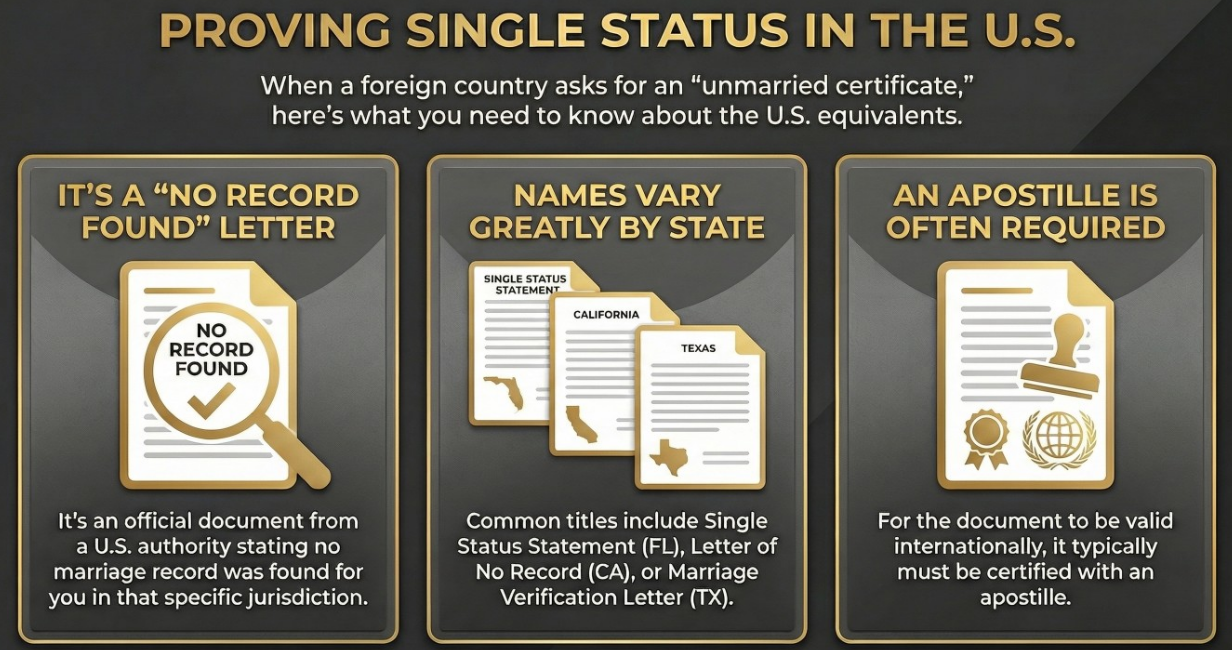
In plain terms, an unmarried certificate is documentation from a competent authority stating that no marriage record for you was found in the specified jurisdiction and time window. Terminology varies:
Single Status Statement / Not Found statement (state vital records offices like Florida).
Letter of No Record (county recorder/clerks in California such as San Diego or Santa Clara).
Marriage verification letter (state-level check in Texas; if negative, it functions as a single-status letter).
These are search results certifications: they don’t “prove a negative” nationwide but confirm no marriage is recorded where the search was performed. Many foreign registrars accept them, often with an apostille. Requirements vary—always confirm with the receiving office.
Who issues it? State vs. county vs. city (with real examples)
Florida — state-level
Florida’s Bureau of Vital Statistics offers a marriage search/single status statement (including a version aligned for apostille/authentication). The program instructs applicants to consult the foreign consulate for exact wording and confirms that apostille/notarial certification depends on whether the destination is a Hague member.
California — county-level
In California, you usually request a Letter of No Record from the county recorder/clerk. For example, San Diego County describes it as issuing a letter when, after searching, no marriage record exists; Santa Clara County provides similar guidance and accepts in-person/by-mail requests.
Texas — state verification
Texas Vital Statistics and the Secretary of State explain that verification letters can serve as a “single-status letter” when no marriage record is found, which certain countries accept. (Available for specific year ranges.)
Takeaway: the right office depends on where you live or where marriage records are held. We check your facts and route the request to the correct level so your document is accepted the first time.
Where no certificate exists: the Single Status Affidavit (we draft + notarize)
Some U.S. states or counties do not issue an unmarried certificate at all—or the issuing office requires residency or in-person appearance you can’t make. In those cases, the usual substitute is a Single Status Affidavit (a sworn statement that you are not currently married and free to wed), signed before a notary public. Many foreign registrars accept this affidavit—especially once it’s apostilled—when an official certificate isn’t available locally. (Always verify with the destination registry, embassy, or court.)
At Notary Public Center we:
Draft the affidavit in clear, accepted wording (and bilingual if needed), tailored to the foreign authority’s template when provided.
Notarize it in person (Miami) or online via Florida Remote Online Notarization (RON) with KBA, credential analysis, optional biometrics, and a recorded session—then produce a tamper-evident PDF for your records.
If the destination requires it, we handle the full legalization chain: Apostille for Hague countries or State Authentication + U.S. Department of State + Embassy Legalization for non-Hague countries. (we have to check first the country)
When is an affidavit enough—and when do you need an official search letter?
If your locality issues an unmarried certificate (Florida state-level; California counties; Texas verification) and your destination prefers an official letter, we pursue the letter route first.
If your destination accepts a notarized affidavit (some do), or if your state/county does not issue any certificate, we use the Single Status Affidavit path and align the wording to the receiving authority’s checklist.
If you’re on a deadline, we can begin with the affidavit so you can book the venue, while we confirm whether the jurisdiction will also accept an official letter later.
Information you’ll typically need (and why it matters)
Whether we’re ordering an official letter or drafting an affidavit, expect to provide:
Full legal name(s) (including prior names/maiden names).
Date and place of birth.
Current address and residency
Date ranges to search: Crucial: Most foreign authorities require the certificate to cover from your 18th birthday (or date of divorce) up to the present day. If the search ends months ago, the embassy might reject it as outdated..
Proof of identity (passport/ID); for RON you must pass KBA and credential analysis during a recorded session.
Destination country and authority (registry, court, consulate), so we know whether they request apostille or authentication.
- Many countries requiring a Single Status Affidavit also require an FBI Background Check for residency or marriage visas. Our Compliance Officers division can handle your digital fingerprinting and apostille for this record simultaneously.
Bring as much detail as you can; it helps us pinpoint the right office and minimize back-and-forth.
Will you need an apostille?
f the document will be used in a Hague Apostille country, you’ll almost certainly need an apostille on the issuing official’s signature: for a state or county letter, the state’s competent authority apostilles that official’s signature; for a notarized affidavit, the apostille is placed on the notary’s signature. If the destination is not a Hague country, you’ll need authentication (and often consular legalization). Through our specialized partner, Apostille de la Haya, we manage this entire lifecycle—from standard apostilles to complex embassy legalizations—aligning the route strictly to the country of use.
Note: Apostille units generally require original documents, not scans. If you plan to submit digitally at first, we can still obtain the physical originals and then scan them for your records after apostille—your destination’s final step may still require the paper original.
Our two service tracks (pick the one your destination prefers)
Track A — Official unmarried certificate (search letter)
Intake & acceptance check — We confirm which office issues the document for your case (state/county/city) and whether the destination will accept that format.
Record search & issuance — We file the request with the proper office:
Florida DOH (state search/single status statement).
California county Letter of No Record (e.g., San Diego, Santa Clara).
Texas verification letter as single-status letter (state-level).
Apostille (if required) — We route the physical original for apostille/authentication. Timeframes may vary.
Delivery — We return the original and, on request, a scan.
Track B — Single Status Affidavit (when no certificate is available or practical)
Drafting — We prepare a destination-ready affidavit (English or bilingual) that matches the foreign registry’s expectations.
Notarization — In person (Miami) or online (RON) with KBA, credential analysis, biometrics, and recorded video; the result is a tamper-evident PDF or a wet-ink paper.
Apostille (if required) — We apostille the notary’s signature at the state level. Timeframes may vary.
Delivery — Original back to you + optional scan.
If you’re unsure which track to choose, we’ll contact the receiving authority and get a clear answer before we start.
Common mistakes (and how we keep you clear)
Requesting the wrong office. Asking the state when your county issues the letter—or vice versa—wastes weeks. We route to the correct level (e.g., Florida state, California county).
Assuming a single national certificate exists. It doesn’t; the U.S. is decentralized. We explain what’s available in your jurisdiction.
Using a photocopy for apostille. Apostille offices require originals. We work in physical originals and can scan after issuance.
Bringing a non-notarized affidavit to a country that wants a government letter. We check acceptance first to avoid surprises.
Pre-signing an affidavit that needs a jurat. If it’s a sworn statement, sign during the notarization (in person or online live).
Step-by-step with Notary Public Center
Tell us your destination (country, registry/court/consulate), your residency, and your timeline.
We verify availability of an official unmarried certificate at the state/county/city level in your case and confirm acceptance with the destination.
Choose Track A or B (certificate vs. affidavit) based on what the destination will accept.
Identity & session (if affidavit): notarize in Miami or online (RON) with KBA + credential analysis + recorded video; biometrics available.
Apostille/authentication (if needed): we route the physical documents appropriately. Timeframes vary.
Delivery + guidance: originals returned; scan available on request; instructions for presenting the file abroad.

Why choose Notary Public Center
One team, two paths: we obtain official certificates where they exist, and we draft + notarize Single Status Affidavits (online or in person) where they don’t.
Online or Miami: Florida-compliant RON (KBA, credential analysis, biometrics, recorded session, tamper-evident PDF) or classic wet-ink notarization at our office.
Apostille-ready packages: we prepare physical originals and route apostille/authentication in line with your destination’s rules. Timeframes vary by office.
Clarity and compliance: we align with official guidance from Florida DOH, California counties, and Texas agencies on what each can issue.
Need an unmarried certificate fast—or a Single Status Affidavit that your destination will accept? Contact Notary Public Center. We’ll secure the official certificate where issued (state/county/city) or draft and notarize your affidavit online or in Miami, then route apostille/authentication if required. One team, end-to-end.
FAQ
1) Is an “unmarried certificate” the same everywhere in the U.S.?
No. The U.S. has no national certificate. Florida issues a state-level single status/not found statement; several California counties issue Letters of No Record; NYC issues a Certificate of Non-Impediment; Texas provides verification letters that can function as a single-status letter. Requirements and wording differ.
2) I live in a place that doesn’t issue a certificate. What do I submit?
We prepare a Single Status Affidavit and notarize it (Miami or online RON). Many countries accept this, especially with an apostille. We verify acceptance with your destination first.
3) How long does this take?
It depends on the issuing office, mailing or courier options, and seasonal volume. We’ll give you a practical window after intake; timeframes may vary.
The information contained in this publication is provided for general informational purposes only and does not constitute legal advice. Reading or using this content does not create and is not intended to create an attorney-client relationship. No reader or user should act or refrain from acting based on the information presented herein without first consulting an attorney duly licensed to practice law in their jurisdiction.