
If you’re opening a U.S. operation, one of the first questions is what is EIN and whether you need one now or later. In short, an EIN is a nine-digit number the IRS uses to identify your business for tax purposes—essential for payroll, banking, merchant accounts, certain filings and many KYC checks. While the IRS ultimately issues the number, the quality of your application data determines whether your EIN works smoothly for all the places you’ll use it. Riveros Corp helps founders and managers—with or without SSN—structure a clean, compliant file and submit it to the IRS so you avoid costly rework.
What an EIN is (and isn’t)
An Employer Identification Number is a unique federal Taxpayer Identification Number for entities such as corporations, LLCs, partnerships, estates and trusts. Agencies, banks and counterparties rely on it to match your entity to tax records and information returns. It is not a business license, and it does not by itself grant immigration, work authorization, or tax classification; it’s simply the federal identifier tied to your entity data on file with the IRS.
Just as important, an EIN differs from a Social Security Number (SSN) or Individual Taxpayer Identification Number (ITIN)—those identify people. The EIN identifies the entity. When we prepare your application, we also help match your intended federal tax classification (e.g., disregarded entity, partnership, C-corp, S-corp eligibility) to the uses you have in mind, so your number won’t collide with later filings or banking checks. (Classification elections are separate processes; we align your data so you can make those decisions at the right time.)
Who needs an EIN?
The IRS lists common triggers for needing an EIN: having employees, operating as a corporation or partnership, filing certain excise, employment or alcohol/tobacco/firearms tax returns, or administering estates and trusts. Even single-member LLCs and sole proprietors often obtain an EIN to open bank accounts, run payroll, or issue/receive information returns. Riveros Corp clarifies whether your expected activities or counterparties will require one now or can wait—always with your receiving institution’s practices in mind.
The “responsible party” (and why it matters for acceptance)
Every EIN application must name a responsible party—a real person who owns or controls the entity and manages its funds and assets. The IRS requires a person, not another company, and asks for that person’s taxpayer ID. Selecting and documenting this role correctly is pivotal: it’s the point of contact for IRS letters and a key anchor for bank KYC. Riveros Corp reviews ownership/control and helps you document a qualified responsible party so your record aligns with IRS policy and downstream checks.
With or without Social Security Number: how Riveros Corp supports applicants
Not every founder has a Social Security Number. That by itself does not make you ineligible for an EIN. What changes is how your data is validated and which channels the IRS will accept for the application. We focus on three things:
Ensuring your responsible party meets IRS criteria and presents acceptable identification data.
Making sure the entity’s legal name, U.S. address, and formation facts reconcile across records that banks, payment processors and platforms will check.
Packaging your request to minimize back-and-forth so your downstream tasks (banking, payroll, marketplace onboarding) accelerate once the EIN arrives.
Because this terrain evolves, our team monitors IRS guidance and the practical requirements of receiving institutions—so you don’t have to chase forum threads or outdated blogs.
Why quality beats “speed at any cost”
It’s tempting to rush the application just to “get a number.” But inconsistencies—wrong entity name control, an unqualified responsible party, or mismatched mailing details—can spiral into holds at banks, tax-account mismatches, and repeated calls with customer support. Moreover, the internet is full of paid ads imitating official IRS pages and charging fees for what the IRS itself issues for free; some even harvest sensitive data. Riveros Corp keeps you on official .gov rails and shields your file from common pitfalls—because a fast but wrong EIN is slower than doing it right once.
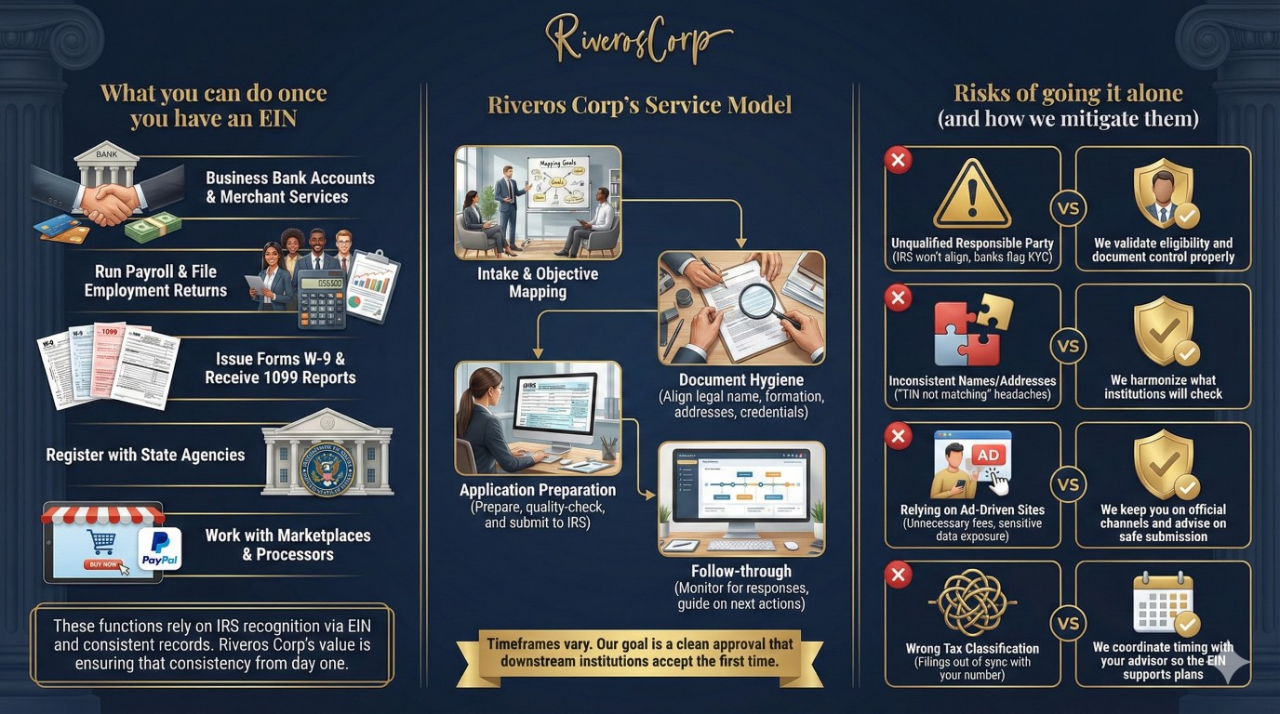
What you can do once you have an EIN
Open business bank accounts and merchant services under the entity’s name.
Run payroll and file employment returns if/when you have staff.
Issue Forms W-9 and receive 1099 reports under the entity’s TIN.
Register with state agencies for sales/payroll (as required by your activities).
Work with marketplaces and processors that require an entity TIN for onboarding.
These functions all rely on the IRS recognizing your entity via its EIN and on your records being internally consistent. Riveros Corp’s value is ensuring that consistency from day one. (For background on W-9/1099 relationships, see the IRS-based explanations widely referenced in financial education resources.)
Riveros Corp’s service model
You asked for help—not a how-to. Here’s what we focus on, instead of giving you a step-by-step checklist to try alone:
Intake & objective mapping — We translate your goal (banking, payroll, marketplace, grants, foreign investment) into the right entity identity footprint.
Document hygiene — We align legal name, formation details, addresses, and responsible-party credentials so your file passes both IRS and bank scrutiny.
Application preparation — We prepare and quality-check the request, then submit to the IRS through the appropriate channel. (We do not disclose internal workflows publicly; that’s how we keep quality consistent.)
Follow-through — We monitor for responses and guide you on next actions once the EIN posts to your record.
Timeframes can vary based on seasonality and your profile. Our goal is a clean approval that downstream institutions accept the first time.
Risks of going it alone (and how we mitigate them)
Unqualified responsible party ⇒ IRS won’t align the record; banks may flag KYC. We validate eligibility and document control properly.
Inconsistent names/addresses ⇒ “TIN not matching” headaches later. We harmonize what institutions will check.
Relying on ad-driven sites ⇒ paying unnecessary fees or exposing sensitive data. We keep you on the IRS’s official channels and advise on safe submission.
Wrong tax classification assumptions ⇒ filings or elections out of sync with your number. We coordinate timing with your advisor so the EIN supports—not sabotages—your plans.
Special profiles we support
Non-U.S. founders launching a U.S. LLC or corporation for e-commerce, SaaS, consulting or investment purposes. If you need to present your new company’s documents abroad, our partner Apostille de la Haya can obtain de apostille fory your Articles of Incorporation and EIN letter for international validity.
Single-member LLCs needing an EIN for banking or vendor onboarding even without employees.
Holding and SPV structures where clarity around controlling individuals and mailing addresses prevents KYC delays.
Trusts and estates that require EINs for administration and reporting.
Nonprofits at early stages that need an EIN before their exemption process.
In each case, Riveros Corp keeps the focus on acceptance: the right data, in the right place, in the format your counterparties expect.
Data security, privacy, and professionalism
Your EIN request involves sensitive personal and business information. Riveros Corp:
Uses secure channels for document exchange and signature.
Limits access to your data within our team strictly to what’s needed to prepare and submit your request.
Never sells or shares your information for marketing.
Provides clear instructions on what to retain and how to store critical IRS correspondence once your number is assigned.
Timelines, variability, and realistic expectations
EIN issuance and subsequent usage depend on IRS workloads, mailing logistics, holiday calendars and, for some profiles, additional verification. There is no single “magic number of days.” We set realistic windows, keep you posted on movement, and prepare you for the next steps with banks, processors and payroll providers once your number is in hand. Timeframes may vary.

Why choose Riveros Corp
Acceptance-first: we optimize for the institutions that must accept your number—banks, payroll, marketplaces—not just the IRS.
With or without SSN: deep experience assembling qualified requests for both profiles, including clear responsible-party support.
Secure handling: professional data safeguards and controlled workflows.
End-to-end: from intake to IRS submission and post-issuance guidance, without publishing a DIY “how-to” that leaves you exposed.
Ready to move from “what is EIN” to “my EIN is ready and accepted”? Contact Riveros Corp. We’ll map your goals, prepare a compliant application—with or without SSN—and submit to the IRS, while aligning your record for banking, payroll and platform onboarding. No guesswork, no risky shortcuts. Timeframes may vary.
FAQ
1) Is the EIN the same as a business license?
No. It’s a federal tax identifier used by the IRS and institutions; it doesn’t replace registrations, licenses or permits.
2) Do I need employees to get an EIN?
No. While the name implies “Employer,” you do not need to hire staff to obtain one. Single-member LLCs and sole proprietors frequently need an EIN strictly for banking purposes, compliance, or to keep their personal SSN private.
3) I don’t have an SSN. Can I still get an EIN?
Yes, eligible applicants without SSN can still obtain an EIN when the request names a qualified responsible party and uses the proper submission channel. Riveros Corp handles those nuances.
The information contained in this publication is provided for general informational purposes only and does not constitute legal advice. Reading or using this content does not create and is not intended to create an attorney-client relationship. No reader or user should act or refrain from acting based on the information presented herein without first consulting an attorney duly licensed to practice law in their jurisdiction. Riveros Corp is a business consulting firm, not a law firm.