
Needing a certificate of non marriage to marry abroad or complete immigration and civil procedures can be confusing in the United States. Unlike countries with one national registry, U.S. marriage records are state and county-based—so the exact document you need (an official certificate vs. a sworn affidavit) depends on the issuing jurisdiction and the receiving country’s rules. At Notary Public Center, we obtain the certificate of non marriage where available, or draft and notarize a single status affidavit when that’s the correct path—and we also handle the apostille or authentication so your document is accepted overseas.
What a “certificate of non marriage” is—and what it isn’t
A certificate of non marriage (also called certificate of no marriage record, certificate of no impediment, or a letter of no record) is an official statement from a government office confirming it has no marriage record for a named person within its jurisdiction for the period searched. This is not a guarantee that the person has never married anywhere in the world; it only certifies no record found in the specific database(s) searched. That scope-limitation is why some U.S. areas don’t issue such certificates and instead rely on a sworn affidavit from the applicant.
Examples of official options (by jurisdiction)
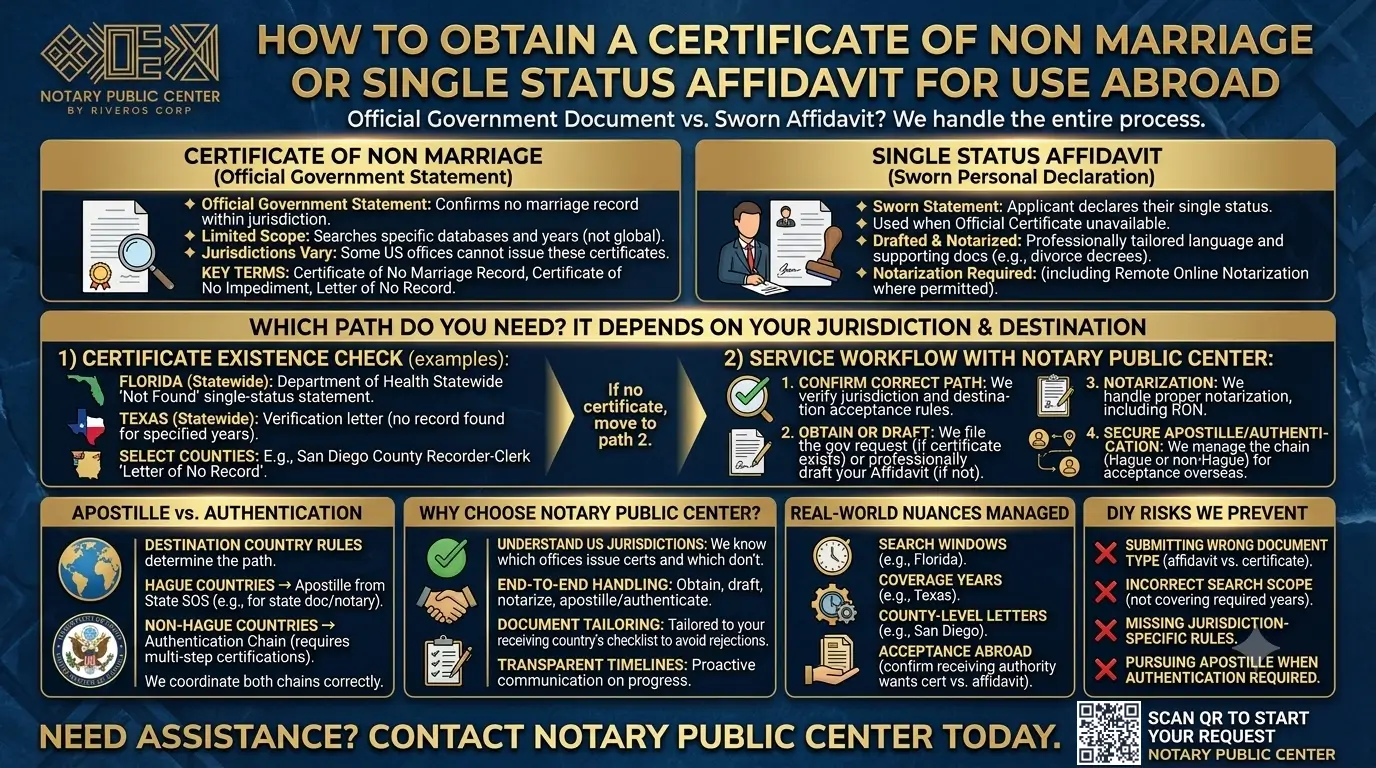
Florida (statewide): the Department of Health can search all 67 counties and issue an official “Not Found” single-status statement for specified years.
Texas: the state can issue a verification letter (no record of marriage/divorce found for covered years). Some foreign authorities accept it as a “single-status letter.”
San Diego County, CA: the Recorder-Clerk may issue a Letter of No Record after a certificate search.
When an official certificate isn’t available, the standard solution is a Single Status Affidavit (you declare you’re not currently married). We draft it, have it properly notarized, and then apostilled as required by your destination authority. (See “Apostille vs. authentication” below.)
Why this varies across the U.S.
The United States has decentralized vital records. Marriage licenses are issued and recorded at the county/city level (or state vital records, depending on the state). Many clerks can certify copies of marriage records or issue a “no record” letter when a search finds nothing; others do not provide single-status certifications and direct applicants to use a sworn affidavit instead. Knowing which office can issue which document is the key to doing this right the first time.
How we help (Notary Public Center): obtain, draft, notarize, apostille
1) We confirm the correct path for your state and destination
Tell us where you reside or where the search must be run (e.g., California vs. Florida statewide), and where you will use the document. We verify whether an official certificate of non marriage exists for that jurisdiction or whether a single status affidavit is the appropriate path. Florida can issue a statewide “Not Found” statement; Texas can issue verification letters for certain years.
2) If your state/county issues a certificate, we obtain it for you
We prepare the application, file it with the City/County Clerk or Vital Records authority, and coordinate any ID and search-year requirements. Examples: Florida uses a DH form to run a statewide search and produce an official “Not Found” letter.
3) If your area doesn’t issue certificates, we draft the affidavit
We draft a Single Status Affidavit tailored to your destination’s format and legal phrasing, then handle notarization (including remote online notarization where permitted) so it’s ready for apostille/authentication. U.S. embassies/consulates abroad often notarize single-status affidavits for citizens needing to marry in that country.
4) We secure the apostille (or authentication) correctly
Hague country → Apostille by the Secretary of State (if state document/notary) or the U.S. Department of State (if federal).
Non-Hague country → Authentication certificate (multi-step chain).
We manage the entire chain so your document is recognized where you’ll present it. Timeframes may vary by office and season.
When a certificate exists vs. when an affidavit is required
Jurisdictions that issue a certificate/letter
Florida: Single Status Statement (“No Record Found”) after a statewide search.
Texas: Verification letter can serve as single-status letter for some foreign destinations.
Select counties (e.g., San Diego, CA): Letter of No Record upon a failed record search.
Jurisdictions that don’t issue a single-status certificate
Many counties and states do not provide any blanket “never married” proof, because no single database can verify every place and time. In these areas, you use a Single Status Affidavit, sworn before a notary. We draft the language your receiving country expects and guide you on supporting documents (e.g., divorce decrees if previously married).
Apostille vs. authentication: which one do you need?
Your destination country determines the certificate type:
Apostille — For countries that are parties to the 1961 Hague Convention.
Authentication — For countries not in the Convention (often followed by consular legalization).
We route the chain correctly, whether the base document is a government certificate (e.g., Florida “Not Found”) or a notarized affidavit.
Step-by-step: your project with Notary Public Center
Intake & plan — We confirm the issuing office, search scope (years, counties/statewide), and the destination country’s acceptance rules.
Document route —
If certificate available: we file your request with the City/County Clerk/Vital Records (e.g., Florida DH Single Status request).
If no certificate: we draft a Single Status Affidavit, arrange notarization, then proceed to apostille.
Apostille/authentication — We coordinate with the Secretary of State (state apostille) or U.S. Department of State (federal/authentication) as applicable. Timeframes may vary with workload and holidays.
Delivery & guidance — You receive the certificate/affidavit with clear instructions for presentation and verification in your destination.
Real-world nuances we manage for you
Search windows (Florida): the Single Status Statement ; we set expectations with your receiving authority.
Coverage years (Texas): verification letters cover specific year ranges; we align the search period with your case.
County-level letters (e.g., San Diego): a Letter of No Record is issued after a search request, not as a standalone claim. We handle the request correctly.
Acceptance abroad: some countries prefer an official certificate if available; others routinely accept a notarized affidavit + apostille. We confirm which the receiving authority wants before filing.
Risks of DIY (and how we prevent them)
Submitting the wrong document type (affidavit instead of certificate, or vice versa).
Requesting a search that doesn’t cover the years your authority needs.
Missing jurisdiction-specific rules
Pursuing an apostille when your country actually requires authentication.
Our process starts with compliance discovery to avoid rejections and repeat filings.
Our apostille scope
Pre-review of your certificate/affidavit for apostille eligibility.
Correct chain of certification (e.g., county → state SOS; notarized affidavit → state SOS; or federal).
Hague vs. non-Hague routing (apostille vs. authentication).
Final delivery with instructions your recipient can follow.

Why choose Notary Public Center
We understand which U.S. offices actually issue a certificate of non marriage and which require a single status affidavit instead.
We handle end-to-end: obtain, draft, notarize, and apostille/authenticate.
We tailor the document to your receiving country’s checklist before we file, reducing back-and-forth.
Transparent timelines (which may vary by office and season) and proactive communication.
Need a certificate of non marriage (or a notarized single status affidavit) that will be accepted abroad? Contact Notary Public Center. We obtain the right document for your jurisdiction and handle the apostille/authentication so you can move forward with confidence.
FAQ
What a Certificate of Non Marriage Is Used For
A certificate of non marriage —also called a single status affidavit, certificate of no marriage record, or certificate of no impediment— is used to prove that you are legally free to marry. Foreign governments and civil registries frequently require it before allowing a foreign national to marry abroad, and it also appears in some immigration and civil procedures.
The challenge in the United States is that, unlike many countries, there is no single federal «proof of being single.» Marriage records are kept at the state or county level, which means the correct document and the correct issuing office depend entirely on your situation and the country that is requesting it. Getting this match right is the key to avoiding rejection.
Single Status Affidavit vs. Certificate of No Marriage Record
There are two main ways to document that you are unmarried, and they are not interchangeable. A certificate of no marriage record is issued by a state or county office and states that no marriage record was found for you in that jurisdiction. A single status affidavit is a sworn statement you sign before a notary, declaring that you are not currently married.
Some countries accept one, some accept the other, and some require both — often notarized and then apostilled for international use. Because the requirements vary so much by destination, confirming exactly what the receiving country will accept before you begin is essential to avoid preparing the wrong document.
How to Obtain and Apostille It, Step by Step
- Confirm the destination’s requirements: find out whether they want a no-record certificate, a single status affidavit, or both.
- Identify the correct office: determine which state or county issues the document for your situation.
- Obtain or draft the document: request the no-record certificate or prepare and notarize the affidavit.
- Notarize if required: a single status affidavit must be signed before a notary.
- Add an apostille: required for the document to be accepted in Hague Convention countries.
- Translate if needed: when the destination country requires it.
Because several offices and steps can be involved, a single wrong turn — the wrong document or the wrong office — can send you back to the start.
Common Mistakes to Avoid
- Preparing a single status affidavit when the country wanted a no-record certificate, or vice versa.
- Requesting the document from the wrong state or county.
- Forgetting the apostille for international use.
- Overlooking a required translation.
- Not checking the destination country’s recency requirements for the document.
Each of these mistakes costs time you may not have when a wedding date or filing deadline is approaching. Confirming the requirements up front prevents all of them.
1. Is a certificate of non marriage the same as a Single Status Affidavit?
Yes. In the United States, the government does not issue a national «Certificate of Non Marriage.» Instead, the equivalent and universally accepted document is a Single Status Affidavit, which is a sworn statement made by you, notarized by a commissioned professional, and subsequently apostilled.
2. How long is my certificate valid for international use?
Validity periods are determined by the country where you intend to get married, not by the U.S. government. However, most foreign authorities require the certificate and its accompanying apostille to be no older than 3 to 6 months at the time of the wedding ceremony.
3. Do I always need an apostille for this document?
Yes, if you are getting married in a country that is a member of the Hague Apostille Convention. An apostille is the official certification that validates the notary’s signature, making your certificate legally binding abroad. Without it, foreign authorities will reject your paperwork.
4. Can I use any local notary to sign my certificate?
While any commissioned notary can technically notarize a signature, very few understand the strict formatting required for a document that will be sent for an apostille. A missing county listing, an improper jurat, or a misplaced stamp by an inexperienced notary will cause the Secretary of State to reject your document entirely.
5. What if I am divorced; can I still get this certificate?
Yes. However, the document will reflect your status as legally divorced and free to remarry, rather than «never married.» You must declare your precise marital history accurately. Our team assists in properly executing affidavits that reflect your legal status according to state laws.
Legal Notice
The information contained in this publication is provided for general informational purposes only and does not constitute legal advice. Reading or using this content does not create and is not intended to create an attorney-client relationship. No reader or user should act or refrain from acting based on the information presented herein without first consulting an attorney duly licensed to practice law in their jurisdiction.