Notary Public Center · American Notary
Marriage Officiant Service in Miami-Dade and Broward: Planning a Florida Ceremony
Published
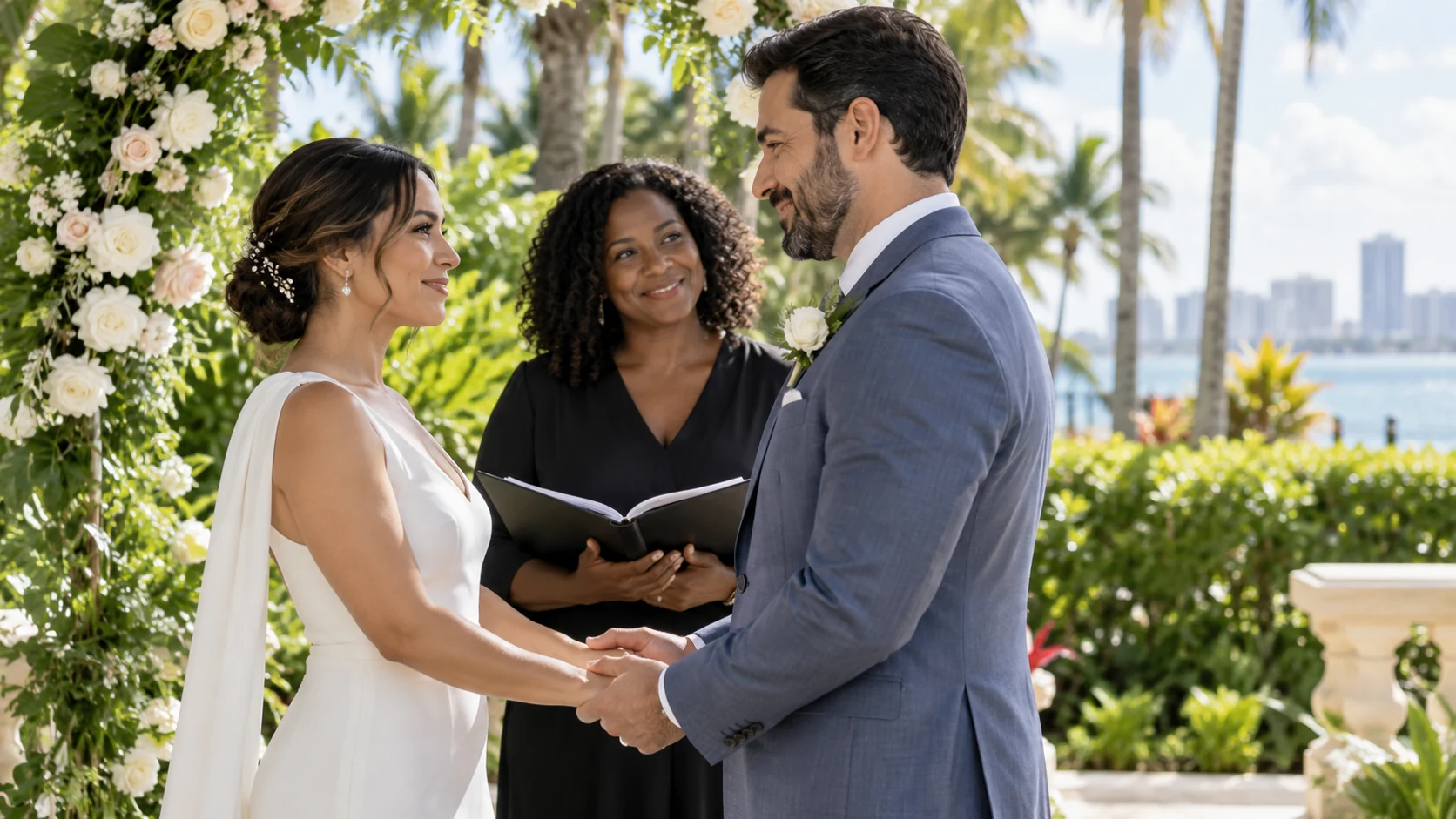
A marriage officiant service helps a couple arrange the person who will solemnize their marriage ceremony. In Miami-Dade and Broward, couples need a valid Florida marriage license and an officiant authorized under Florida law. The ceremony must take place while the license is effective and before it expires.
Florida notaries public are among the people authorized to solemnize marriage. Notary Public Center can discuss an in-person ceremony and coordinate the details with the couple. The clerk issues the license and records it after the ceremony; the officiant does not replace the clerk’s licensing process.
What a marriage officiant does in Florida
An officiant conducts the ceremony and completes the required portion of the marriage license after the couple marries. Florida law identifies people who may solemnize marriages, including Florida notaries public, judicial officers, clerks and qualifying clergy. Authorization depends on the person’s status under the law.
The ceremony is the occasion when the couple makes the commitments required for marriage. Couples may also choose personal words, readings or a setting that reflects their preferences. Discuss the proposed ceremony with the officiant in advance so everyone understands the plan.
Afterward, the completed license is returned to the issuing clerk for recording. The clerk’s instructions explain how the document should be completed and returned. Couples should confirm those instructions and retain the information they need to request a certified marriage record if one is needed later.
An officiant can explain the service they provide, but legal questions about eligibility, immigration, name changes or the effect of marriage belong with the relevant authority or a qualified attorney. A ceremony provider cannot guarantee the outcome of a separate government process.
Obtain a Florida marriage license first
The couple must obtain a valid marriage license before the ceremony. The clerk of the circuit court handles applications and determines whether the applicants meet the requirements. Contact the clerk in the county where you plan to apply for current instructions, identification requirements and appointment availability.
A license issued in Florida can be used for a ceremony within the state. The marriage must be solemnized on or after the effective date and before the expiration date shown on the license. Florida law generally provides that a marriage license is valid for a limited period after issuance, so check the dates printed on the actual document.
The effective date may depend on the applicants’ circumstances. Florida law includes a waiting period for certain applicants and exceptions, including provisions for nonresidents and qualifying premarital preparation. The clerk can explain how the rules apply to your application and what documentation it requires.
Do not schedule the ceremony based on an assumed effective date. Confirm the dates when the clerk issues the license and share them with the officiant. If a proposed date falls outside the valid period, contact the clerk about the available options before making plans.
Miami-Dade and Broward: which clerk should you contact?
Miami-Dade and Broward each have a clerk’s office that handles marriage licenses. Each office provides its own application instructions, locations and appointment information. Start with the office where you intend to apply, especially if one or both applicants live outside the county or are visiting Florida.
The Florida license may be used for an eligible ceremony elsewhere in the state. A couple applying through one county and holding the ceremony in another should confirm the return instructions with the issuing clerk. The license and its completed certificate belong to the issuing process even when the event is held in a different county.
If either applicant was previously married, the clerk may ask for information about the end of the previous marriage. Identification, age and other eligibility requirements also apply. Requirements can depend on the applicant’s circumstances, so check with the clerk instead of relying on a list prepared for someone else.
When planning around travel, allow room for the licensing process and any applicable waiting period. A ceremony appointment does not itself establish eligibility or cause a license to become effective. The clerk makes the licensing decision under Florida law.
Choosing an officiant and ceremony setting
Ask whether the person who will conduct the ceremony is authorized in Florida and available at the desired location. Florida notaries can solemnize marriages within the state under the law. Confirm the service area, date, time and any venue requirements with the provider before making arrangements.
The setting may be a private residence, a venue or another location where the ceremony can be held with the appropriate permission. Public locations and venues may have their own rules. The couple is responsible for confirming access, reservations and any permissions required for the setting.
Discuss the style of the ceremony. Some couples want a brief civil ceremony; others want time for personal vows or a reading. The officiant can explain what coordination is available and how the couple’s preferences fit the service. Avoid assuming that a venue’s event coordinator also acts as an authorized officiant.
If a language preference or accessibility need matters to either participant, raise it before the appointment. This gives the provider an opportunity to discuss arrangements. Any interpretation or accommodation should support each participant’s ability to understand and participate in the ceremony.
Preparing the details with your officiant
Provide the officiant with the ceremony date, location and a way to contact the couple. Share the license information as requested and bring the original license to the ceremony unless the issuing clerk and officiant provide different instructions. Check the names and dates on the license before the event.
Discuss who will attend, whether the venue has a schedule and how the parties will identify themselves. If there are special requests, such as a reading or a change in the order of events, raise them in advance. The officiant can explain what is included in the agreed service.
A Florida marriage ceremony and a remote online notarization are distinct services. Do not assume that a video meeting with a notary can replace an in-person marriage ceremony or satisfy requirements in another jurisdiction. Confirm the ceremony arrangements with the officiant and the licensing authority.
Plan for possible changes as well. If weather, travel or access to a venue becomes an issue, contact the officiant and venue promptly. A new date still must fall within the license’s effective and expiration dates. If it does not, consult the issuing clerk about what to do next.
Witnesses, guests and participants
A couple may invite family or friends, but guests do not take the place of the authorized officiant. Florida clerk instructions should be checked for the specific ceremony and license. Broward’s clerk states that witnesses are not required for its civil marriage ceremonies, although they are recommended.
Do not assume that a rule for a clerk’s civil ceremony automatically answers every question about a private ceremony or a document to be used outside Florida. If a recipient abroad expects witness information or another formality, ask that recipient and a qualified adviser before the event.
The couple should decide how guests will participate and communicate those plans with the officiant. A reading, a short introduction or personal vows can be discussed as part of the ceremony. Ask the service provider what it can accommodate at the chosen location.
If an interpreter is involved, discuss the arrangement in advance and check whether the clerk or officiant has particular requirements. The goal is for the participants to understand what they are doing and for the ceremony and documentation to comply with applicable rules.
What happens after the ceremony?
The officiant completes and signs the marriage certificate section of the license and returns the document as directed by the issuing clerk. Florida law provides a return deadline; the parties should follow the instructions supplied with their license. The clerk records the completed license and maintains the official record.
Ask the issuing clerk how to obtain a certified copy and when it will be available. A ceremony keepsake is not necessarily the same document as a certified record issued by the clerk. The appropriate record depends on the institution requesting it and the purpose for which it will be used.
Check the information on the certified record when you receive it. If you notice an error, contact the clerk for its correction procedure. The officiant may be able to provide information about the ceremony, but the official record is controlled by the recording authority.
Keep the record in a safe place. A bank, government office or foreign authority may ask for a certified copy rather than an informal photocopy. Confirm the recipient’s current requirements before submitting any personal records.
Using a Florida marriage record abroad
A couple planning to use a marriage record outside the United States should ask the receiving authority which document it requires. It may request a certified copy issued by the clerk, a translation, an apostille or other authentication. The requirements depend on the destination and the intended use.
An apostille authenticates the origin of a qualifying public document for use under the applicable convention. It does not prove the truth of every statement in the record or guarantee that the receiving authority will accept the document for a particular purpose.
The ceremony, recording and authentication are separate stages. A service provider can discuss coordination, but the clerk and the competent authentication authority control their own processes. Confirm the correct issuing authority and recipient requirements before ordering additional documents.
For related information, read our guides to notary services and notarization options. If a question concerns recognition of a marriage abroad, a qualified professional familiar with the destination can advise on the facts.
Common planning questions
A frequent misunderstanding is assuming that booking an officiant also secures the marriage license. The couple must complete the clerk’s application process and receive a license that is effective for the ceremony date. The officiant can then perform the ceremony within the limits of the law and the agreed service.
Another is confusing the license with the certified record requested after the event. The completed license is returned for recording. If a third party later requests proof of marriage, ask that party exactly which record it needs and obtain it from the appropriate issuing office.
Couples should also check the location of the ceremony. A Florida notary’s authority does not automatically extend to an event in another state or country. A Florida license is intended for use in Florida, and destination requirements elsewhere must be checked separately.
Finally, verify names, dates and instructions before the event. Small administrative details can matter when the record is later used for a change of name, an application or an international matter. The relevant agency determines what it will accept.
Plan a ceremony with Notary Public Center
Notary Public Center can discuss a marriage officiant service in Miami-Dade or Broward, subject to availability and the applicable requirements. The team can review the location and ceremony preferences and explain what information it needs to coordinate the appointment.
For further reading, see mobile notary services and in-person notarization in Miami. Visit Notary Public Center, call +1 305-507-8464 or contact the team through WhatsApp.

Tell us about your document
Ask Notary Public Center about notarization options.
Frequently asked questions
Who can officiate a marriage in Florida?
Florida law authorizes certain people, including Florida notaries public, judicial officers, clerks and qualifying clergy. Confirm that your chosen officiant is authorized and available for your ceremony.
Do we need a marriage license before the ceremony?
Yes. Obtain a Florida marriage license through the clerk and schedule the ceremony on or after its effective date and before its expiration date.
Can a license from one Florida county be used in another?
A Florida marriage license may be used for a ceremony within Florida. Confirm the return instructions with the clerk that issued the license.
Are witnesses required at a civil ceremony?
Broward’s clerk says witnesses are not required for its civil marriage ceremonies, although they are recommended. Check the instructions for your particular ceremony and any recipient’s separate requirements.
How do we obtain proof of marriage after the ceremony?
The completed license is returned to the issuing clerk for recording. Ask that clerk how to obtain a certified copy and confirm which record the recipient requires.
This article provides general information and is not legal advice. Consult a licensed attorney about your circumstances.
Notary Public Center · Contact
Tell us about your document
Ask Notary Public Center about notarization options.
Contact form

Professional background
Security consultant accredited by Colombia’s Superintendencia de Vigilancia y Seguridad Privada; forensic fingerprint examiner. A business administrator with a specialization in finance, he brings more than 27 years of experience protecting people, valuables and infrastructure. His career includes administrative and financial management at McKinsey & Company in Colombia and executive roles at multinational companies. As Partner and Senior Consultant at Compliance Officers, he applies that experience to background screening, due diligence and compliance.