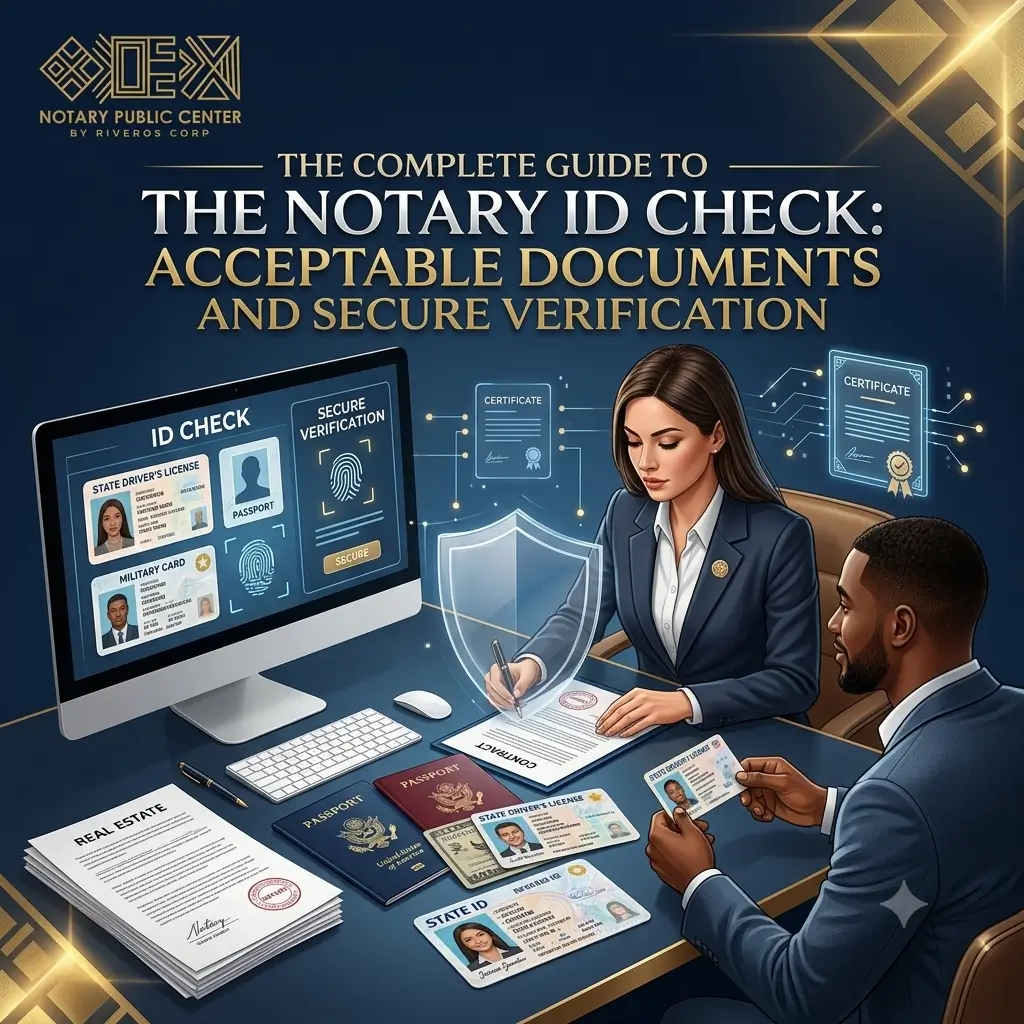
An ID check is the mandatory, legally required process where a notary public verifies the identity of a signer before executing a notarial act. To pass an ID check for notarization, you generally need a current, government-issued photo ID containing your signature, such as a state driver’s license or a U.S. passport. Failing to provide acceptable identification will result in an immediate refusal of service, as improper verification can lead to fraud, rejected documents, and severe legal consequences.
Whether you are signing closing documents for real estate, executing a power of attorney, or preparing vital records for an international apostille, identity verification is the foundational pillar of the process. At Notary Public Center, our specialists conduct rigorous, compliant identity verifications for both in-person and Remote Online Notarization (RON). We ensure that every ID check meets strict state statutes, protecting your transactions from future legal challenges.
What Constitutes a Valid ID Check?
The primary purpose of a notary public is to serve as an impartial witness to deter fraud. To fulfill this duty, the notary must be absolutely certain that the person signing the document is exactly who they claim to be.
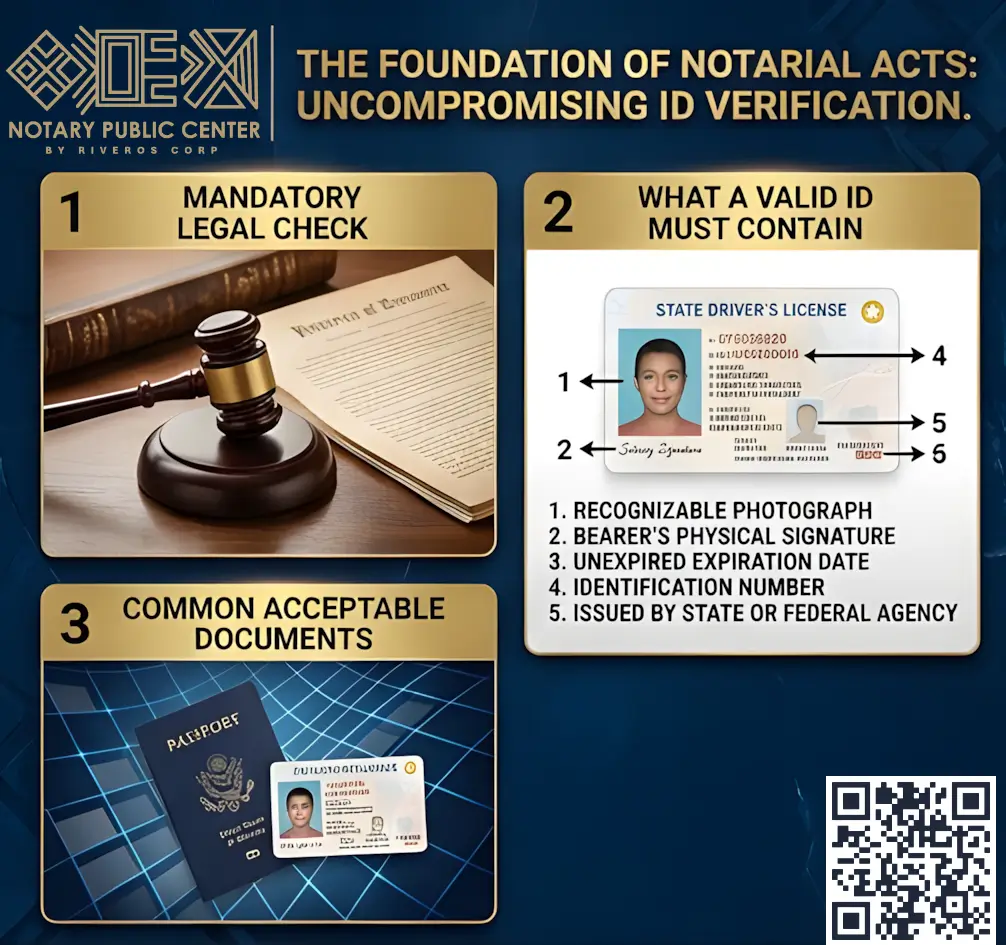
A standard physical ID check requires the notary to inspect a credential that meets specific state-mandated criteria. While laws vary slightly from state to state (such as Florida versus New York), an acceptable ID generally must include:
A recognizable photograph of the bearer.
The bearer’s physical signature.
An expiration date (the ID must typically be current and unexpired).
An identification number.
Issuance by a state or federal government agency.
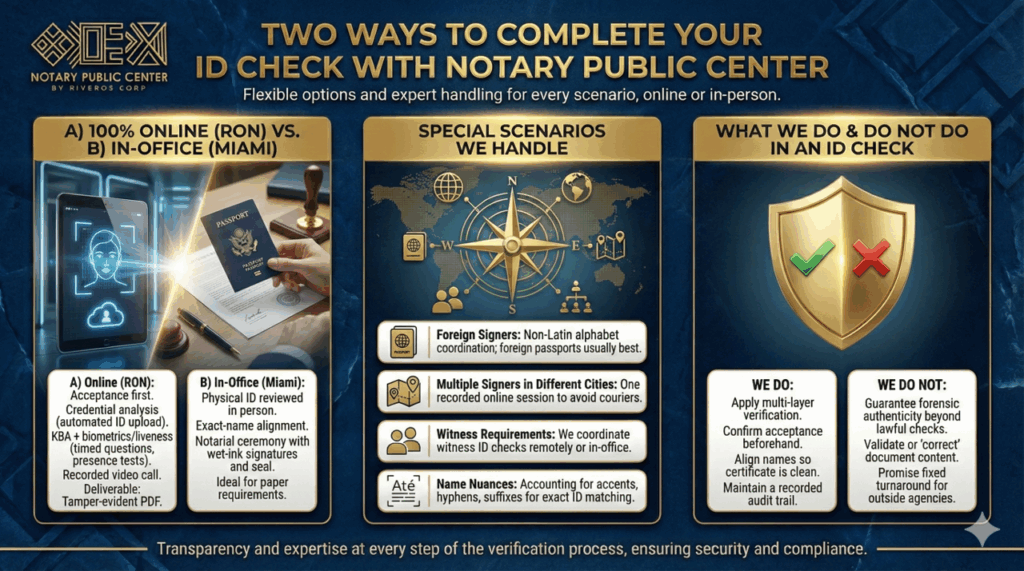
“Not only passport or driver’s license”: special scenarios we handle
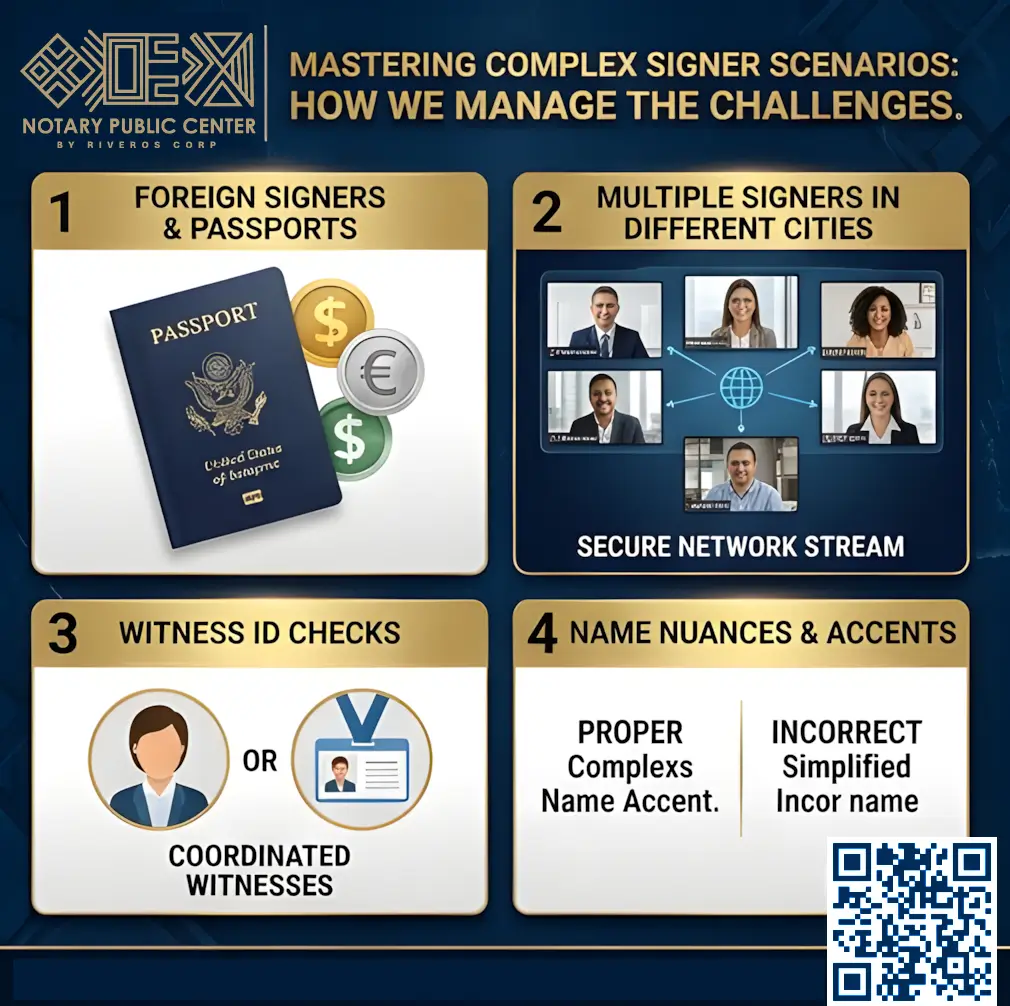
Foreign signers — A foreign passport is usually best. If your national ID uses a non-Latin alphabet, we coordinate the most acceptable alternative for your recipient.
Multiple signers in different cities — Online we place everyone in the same recorded session (if allowed), so you avoid couriers and repeat visits.
Witness requirements — If your document needs one or two witnesses, we coordinate witness ID checks as well (remotely where permitted or in office).
Name nuances — We account for accents, hyphens, suffixes, and middle names so the notarial certificate matches your ID exactly.
What we can and cannot do within an ID check
We do
Apply multi-layer verification and notarial best practices.
Confirm acceptance with the receiving institution before you sign.
Align names and data so the notarial certificate is clean.
Maintain a recorded audit trail and notarial log, as required.
We do not
Guarantee the absolute authenticity of an ID beyond lawful checks; we do diligence, not forensic certification.
Validate or “correct” the content of your document (that’s not what an ID check does).
Promise fixed turnaround for outside agencies—timeframes can vary.
The Digital Evolution: How an Online ID Check Works (RON)
With the rise of Remote Online Notarization (RON), the traditional in-person ID check has evolved into a highly secure, multi-layered digital verification process. When you use Notary Public Center’s RON services, the digital ID check involves two advanced security protocols:
Credential Analysis: You will be prompted to capture high-resolution images of the front and back of your government-issued ID using your smartphone or webcam. Advanced software analyzes the ID’s security features (such as micro-printing and barcodes) to detect tampering or forgery.
Knowledge-Based Authentication (KBA): You must answer a series of dynamically generated questions based on your public and financial history (e.g., «Which of these addresses did you live at in 2018?»). You typically have a strict time limit (often two minutes) to answer these questions correctly.
Only after successfully passing both the credential analysis and the KBA will you be connected to our commissioned notary via secure audiovisual technology.
Our service flow
Intake & acceptance check
Tell us who will receive your document and where it will be used. We confirm RON vs. paper, witnesses, certificate type (jurat vs. acknowledgment), and any template language.ID check
Online (credential analysis + KBA + biometrics + recorded call) or in office (physical ID review).Notarization
Jurat when you must swear/affirm and sign during the session.
Acknowledgment when you acknowledge a prior signature.
Delivery
Tamper-evident PDF (online) or wet-ink original (in office).Apostille/authentication (optional)
We assemble the filing and manage return through our seamless integration with Apostille de la Haya. Timeframes may vary.
What If My ID Is Expired?
A common issue arises when a signer’s primary ID has recently expired. In some states, an ID can be accepted if it was issued within the last five years, even if it is currently expired. However, relying on an expired ID is risky and highly dependent on strict local statutes.
If you lack a valid ID, the alternative is utilizing Credible Identifying Witnesses. Under this method, one or two impartial individuals (who possess valid IDs) must swear an oath or affirmation before the notary, attesting to your identity. These witnesses cannot have a financial interest in the document being signed. Our experts at Notary Public Center can guide you through the credible witness protocol to ensure your notarization remains fully compliant if your primary ID is unavailable.
How the ID check supports apostille
An apostille authenticates the signature and capacity of the notary or public official—not the content of your document. Still, authorities and recipients expect the notarization underneath the apostille to be solid. When identity proofing is weak, the entire packet can be questioned. A robust ID check avoids:
Name mismatches between document and ID (including accents, hyphens, and middle names).
Doubts about in-person presence during an online ceremony.
Reprocessing at the competent authority due to incomplete or inconsistent signer data.
In short, a clean ID check is the fastest way to an apostille that is accepted the first time.
The Risks of Inadequate Identity Verification
Attempting a «DIY» approach by using untrained personnel or informal channels for an ID check is a massive liability. If a document is notarized without a rigorous, legally compliant identity verification, the notarial act can be invalidated in court.
For international matters, if a document requires an apostille, the Secretary of State will review the notary’s credentials and compliance. Any irregularity in the notarization process—rooted in a faulty ID check—will result in the document being rejected, causing weeks of delays for your visa, marriage, or corporate filing.
Trust Notary Public Center for Secure Verification
Do not leave your legal and corporate documents vulnerable to technicalities. At Notary Public Center, our commissioned notaries and administrative specialists are rigorously trained in the latest identity verification protocols, both physical and digital. We verify, record, and execute your documents flawlessly so they are accepted by courts, lenders, and foreign governments without question.
Ensure your documents are processed with maximum security and compliance. Contact Notary Public Center today to schedule your secure notarization appointment.
FAQ
What is the most reliable ID for a notary ID check?
A current U.S. State Driver’s License or a valid U.S. Passport are the most reliable and universally accepted forms of identification for notarization in the United States. They contain all the requisite security features, a photograph, and a signature.
Can a notary accept a photocopy of an ID?
No. A notary public must visually inspect the original, physical ID card or passport. Photocopies, scanned images, or standard digital photos of an ID on a smartphone are generally not acceptable for an in-person ID check.
Does an ID check involve a credit check?
No. A standard in-person ID check only involves visual inspection of your physical ID. For Remote Online Notarization (RON), Knowledge-Based Authentication (KBA) uses data from public records and credit bureaus to generate identity questions, but this is an identity verification tool, not a credit check, and it does not affect your credit score.
Can a non-U.S. citizen get a document notarized?
Yes, absolutely. Non-U.S. citizens can pass a notary ID check by presenting a valid, unexpired foreign passport. Depending on the state where the notarization occurs, the passport may need to include a USCIS stamp, or the signer may need to present a valid Permanent Resident Card.
Why was my ID rejected by a notary?
A notary is legally obligated to reject an ID if it appears altered, if the photograph does not resemble the signer, if the signature on the ID does not match the signature made on the document, or if the ID is expired (beyond the state’s grace period, if any). If the notary has any reasonable doubt about the signer’s identity, they must refuse service.
The information contained in this publication is provided for general informational purposes only and does not constitute legal advice. Reading or using this content does not create and is not intended to create an attorney-client relationship. No reader or user should act or refrain from acting based on the information presented herein without first consulting an attorney duly licensed to practice law in their jurisdiction.