If you are frantically searching for an «apostille near me», you should know right away that a local corner-store notary or shipping center cannot issue an apostille. In the United States, apostilles are exclusively issued by state governments (the Secretary of State) or the federal government (the U.S. Department of State). Instead of wasting time driving to local shops that act as expensive and inexperienced middlemen, your fastest and safest option is to use a specialized, nationwide processing agency.
At APOSTILLE DE LA HAYA, we bypass the limitations of local geography. Whether you live in a rural town, a major city, or even outside the United States, our specialists handle the complex bureaucratic legwork for you. You simply send us your documents, and we ensure they are perfectly authenticated at the state or federal level, returning them to your doorstep ready for international use.
What “apostille near me” really means (quality > proximity)
The shop around the corner can be convenient. But with apostilles, distance is secondary to competence, completeness, and destination acceptance. You don’t win points for walking to a counter if the clerk later rejects your packet because a name doesn’t match ID, the wrong notarial block was used, or the office needed a long-form vital record.
When we say quality, we mean:
Starting with the country of use and the receiver’s checklist (apostille for Hague countries; authentication/legalization for non-Hague).
Delivering originals or certified copies the authority recognizes (no scans, no self-made “certified” copies).
Using the correct notarial certificate (jurat vs. acknowledgment) and aligning names exactly as on ID.
Packaging for the receiver’s preferred format (paper apostille vs. electronic where accepted) and providing clear verification instructions.
In short, apostille near me should translate to apostille done right—wherever the competent authority happens to be.
The Myth of the «Apostille Near Me»
When people need a document legalized for international use—such as getting married abroad, claiming an inheritance, or applying for dual citizenship—they naturally look for a local solution. However, this relies on a fundamental misunderstanding of what an apostille actually is.
Notarization vs. Apostille
A local Notary Public can verify your identity and witness your signature on a document like a Power of Attorney. This is called notarization. An apostille, on the other hand, is a specialized certificate governed by the Hague Convention. It authenticates the notary’s signature and commission (or a state official’s signature, like a county clerk). Because it authenticates a lower-level official, only a higher-level government authority—specifically the Secretary of State—has the legal power to issue it.
When you walk into a local shop asking for an apostille, they will likely just notarize it and offer to mail it to the state for you, charging a markup without actually knowing the specific international requirements of your destination country.
Why Geography Doesn’t Matter for Vital Records
The concept of an «apostille near me» completely falls apart when dealing with vital records like birth certificates, marriage certificates, and death certificates.
In the United States, an apostille can only be issued by the state that originated the document.
Example 1: If you live in Miami, Florida, but were born in Austin, Texas, a Florida Secretary of State cannot apostille your birth certificate. The document must be sent to Texas.
Example 2: If you need an FBI Background Check apostilled, no state can do it. It must go to the U.S. Department of State in Washington, D.C.
Because documents must travel to their specific state of origin, finding a local agency near your current house offers absolutely zero advantage. You need an agency with nationwide reach and specific jurisdictional knowledge.
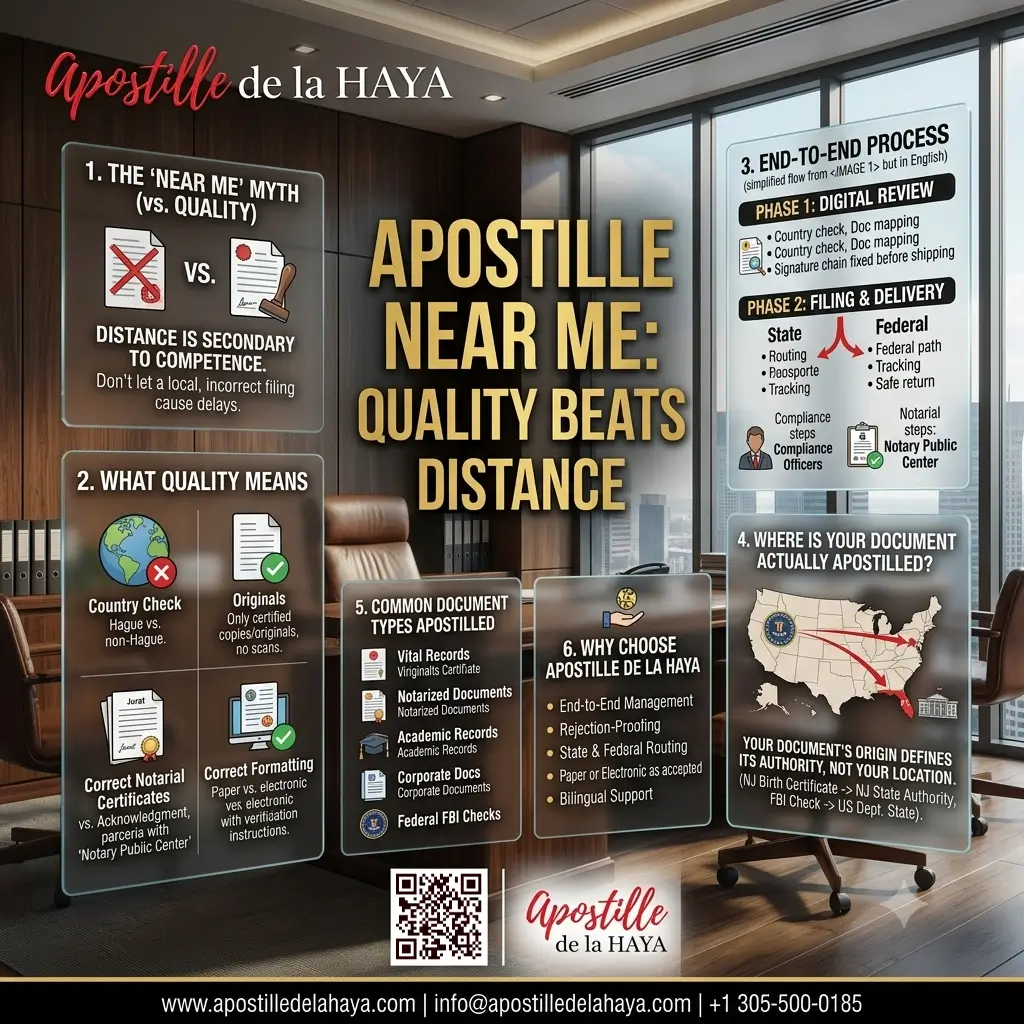
Our end-to-end process (so your file is accepted the first time)
Phase 1 — Digital review: acceptance before action
Country check: Hague vs. non-Hague defines apostille vs. authentication/legalization.
Document mapping: notarized private paper, vital record, court/administrative, academic, corporate, or federal.
Signature chain: we confirm the signer (notary/registrar/official) is recognized by the issuing authority; we fix gaps before shipping.
Format & verification: paper apostille or, where validly available, electronic—with clear instructions for the receiver on how to verify.
Output: a concise checklist of originals to provide and any wording/witness requirements. Timeframes may vary by office and season.
Phase 2 — Filing, tracking, and delivery
State path: we present documents to the relevant Secretary of State/competent authority.
Federal path: we file with the federal authentications office for federal documents.
Delivery: we return your apostilled original and, if you wish, a scan for your records. If the receiver expects to verify online, we include verification pointers.
Where is your document actually apostilled? (It is not always near you)
Here is the detail most «apostille near me» searches miss: the office that issues your apostille is fixed by law, not by your location. A birth certificate issued in New Jersey can only be apostilled by New Jersey’s competent authority, no matter where in the country you live today. A document notarized in Florida goes to the Florida Department of State in Tallahassee — we explain that route in our guide to the Florida state apostille. And federal documents, like an FBI background check, are apostilled exclusively by the U.S. Department of State in Washington, D.C.
That is why the nearest storefront is rarely the answer: your document may need to travel to another state anyway. What you actually need is a service that knows exactly which authority is competent for each document and manages the shipping, filing, and tracking for you — wherever you are. If you are starting from scratch, our guide on which copies of documents can be apostilled will save you a rejected filing, and if your case involves a birth certificate, see how to apostille a U.S. birth certificate step by step.
The same logic applies to academic records, corporate certificates, and court documents: each one has a single competent authority, and identifying it correctly on day one is what keeps your timeline short and your filing accepted on the first attempt. It is the difference between a two-week turnaround and a document bouncing between offices for months while your deadline abroad expires.
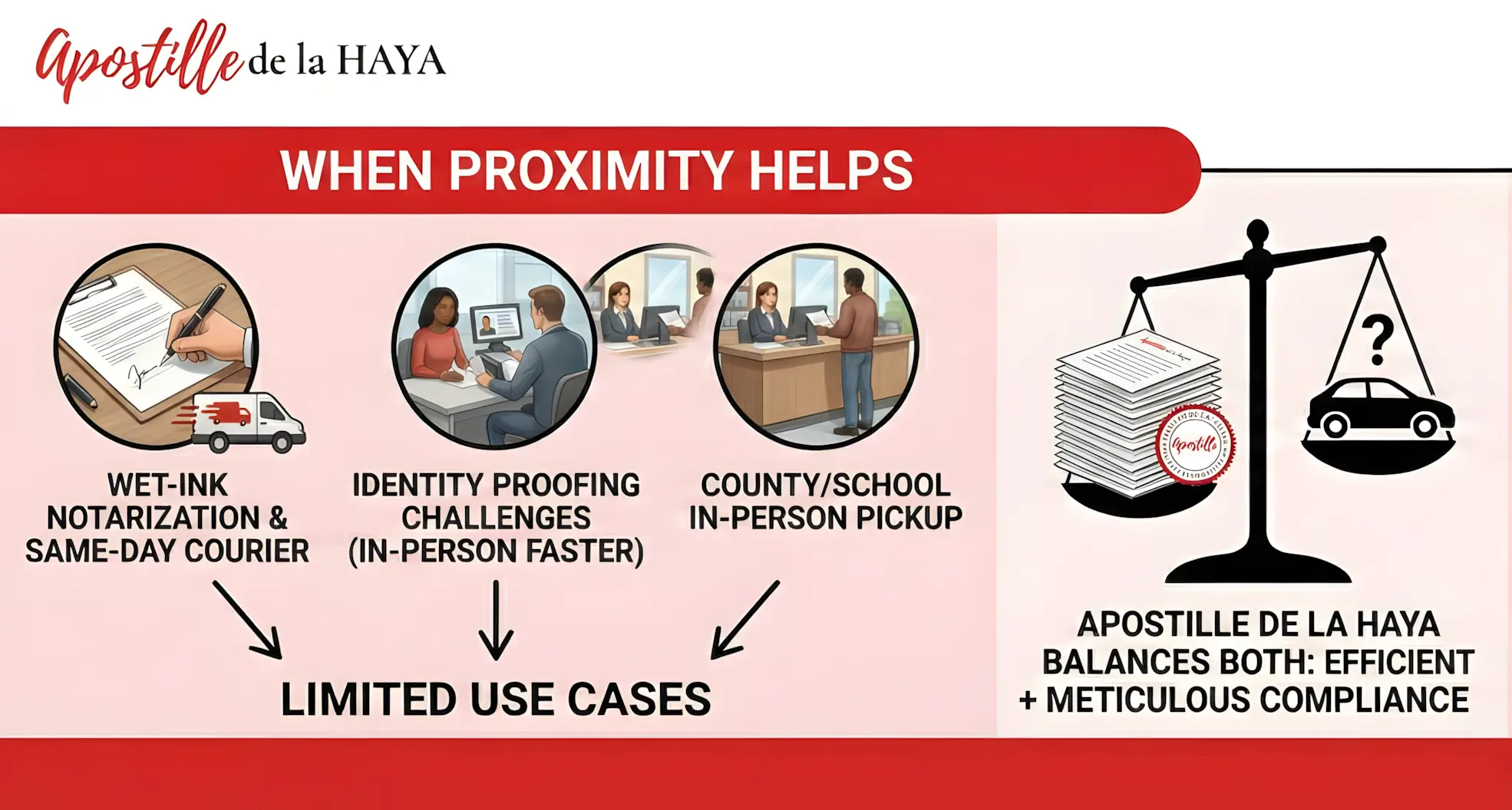
Remote vs. local: when proximity truly matters
Proximity helps when:
You need a wet-ink notarization and same-day courier.
A signer struggles with online identity proofing and in-person is faster.
A county clerk or school registrar requires an in-person pickup.
Otherwise, quality beats proximity. A carefully prepared packet, sent to the right competent authority with the right signatures and certificates, is more valuable than a short drive to the wrong counter. APOSTILLE DE LA HAYA balances both: efficient logistics plus meticulous compliance.
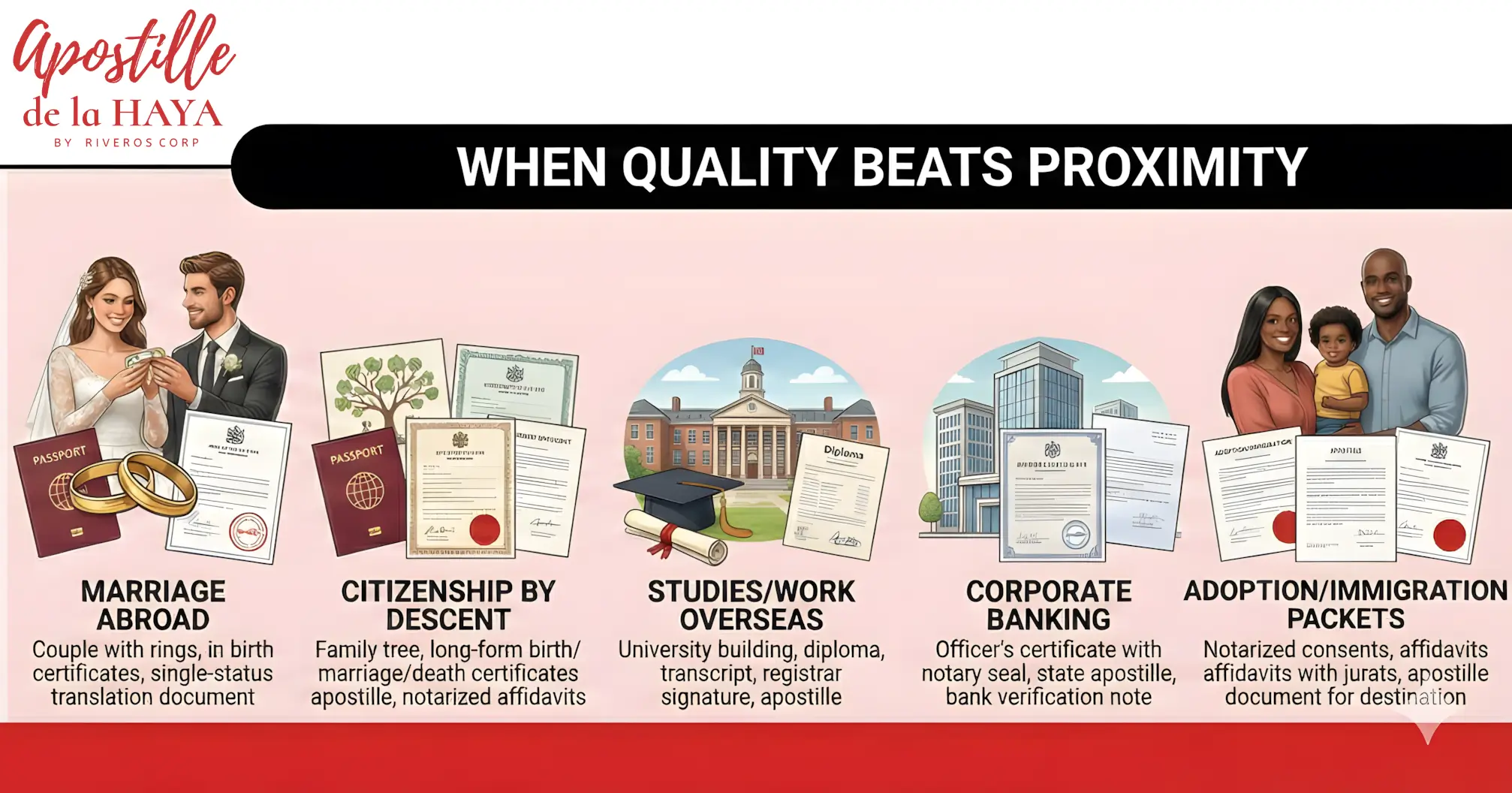
Example use cases we handle (daily)
Marriage abroad: apostilled birth certificates and, where required, a single-status proof (state certificate or notarized affidavit); translation planned up front.
Citizenship by descent: long-form birth/marriage/death certificates, plus notarized name-variance affidavits; all routed for apostille.
Studies or work overseas: diploma + transcript over the registrar’s signature; sometimes a notarized registrar statement first, then apostille.
Corporate banking: officer’s certificate notarized, followed by state apostille; verification notes for the bank’s compliance team.
Adoption/immigration packets: notarized consents and affidavits with correct jurats, then apostille per destination.
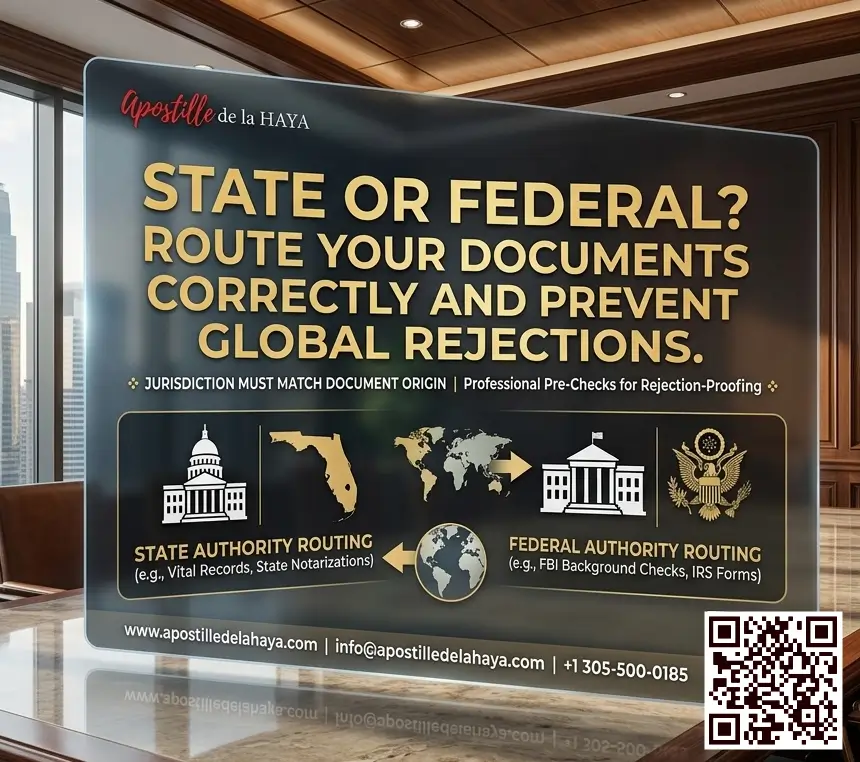
State vs. Federal Apostilles: Understanding the Difference
To ensure your paperwork is accepted abroad, it must be routed to the correct government jurisdiction.
State-Level Apostilles
Documents issued by a state court, a local health department, or notarized by a state-commissioned notary must be apostilled by the Secretary of State in the exact state where the document originated. You cannot apostille a Florida birth certificate in New York. Common state documents include birth certificates, marriage licenses, divorce decrees, death certificates, power of attorney documents, diplomas, university transcripts, and Articles of Incorporation.
Federal-Level Apostilles
Documents issued by a U.S. federal agency cannot be apostilled at the state level. They must be authenticated directly by the U.S. Department of State — Office of Authentications in Washington, D.C. Common federal documents include FBI criminal record checks, IRS forms (such as Form 6166 or the 147C letter), Certificates of Naturalization, and FDA export certificates.
Why the Apostille Often Happens in a Different State Than You
The phrase «apostille near me» assumes the apostille is issued wherever you are. In reality, an apostille must come from the authority that has jurisdiction over the document, which is frequently not the state where you live. A birth certificate is apostilled by the state that issued it; a federal document, such as an FBI background check, is apostilled only by the U.S. Department of State. So a client in Florida may need a document authenticated in Texas, California, or Washington, D.C., depending entirely on where the record originated—not on the nearest office to their home.
Why choose APOSTILLE DE LA HAYA
End-to-end management: pre-check, document prep, vital-record procurement, filing, tracking, and safe return.
Rejection-proofing: correct notarial certificates, exact name/ID alignment, and destination-driven packaging.
State & federal routing: we send each document to the right competent authority—no dead ends.
Paper or electronic, as accepted: we follow receiver preferences and include verification instructions.
Bilingual support: English/Spanish guidance for families and companies navigating international procedures.
Ready to turn apostille near me into apostille done right? Contact APOSTILLE DE LA HAYA. We’ll confirm the route (Hague vs. non-Hague), obtain any needed certified originals, perfect your notarial language, file with the proper authority, and return your apostilled original—with clear verification for the receiver. Timeframes may vary.
FAQ
1. Can a local Notary Public issue an apostille?
No. A Notary Public can only witness signatures and verify identities. An apostille is a government-issued certificate that authenticates the notary’s signature, and it can only be issued by the Secretary of State or the U.S. Department of State.
2. I found a place near me offering apostille services. What do they actually do?
Most local shops simply act as a mailing service. They will notarize your document and then mail it to the state government on your behalf. They rarely have the specialized knowledge to verify if your document meets international requirements, often leading to rejections and lost fees.
3) Can you apostille a photocopy of my vital record?
No. Your birth certificate must be apostilled in the state where it was issued. If you were born in New York but live in California, the document must be processed by the New York Secretary of State.
4. How long does the apostille process take?
Processing times vary entirely by jurisdiction. Some states process documents in a few days, while others take several weeks. Federal documents (like FBI checks) processed in Washington, D.C. can take 10 to 12 weeks. Using experts ensures your document isn’t rejected, preventing you from having to restart the waiting period.
5. How does Apostille de la Haya process my documents if I am not near your office?
Our service is fully optimized for remote processing. You consult with our team online or over the phone, send your original documents to our processing center via a secure, tracked courier, and we handle all the government legwork. We then ship the finalized apostille directly back to you, anywhere in the world.
The information contained in this publication is provided for general informational purposes only and does not constitute legal advice. Reading or using this content does not create and is not intended to create an attorney-client relationship. No reader or user should act or refrain from acting based on the information presented herein without first consulting an attorney duly licensed to practice law in their jurisdiction.