Yes, certain copies of documents can receive an apostille, provided they are properly notarized as «certified true copies» by a commissioned notary public. However, not all paperwork qualifies for this process; while you can easily apostille a copy of a passport or a university diploma, state-issued vital records (like birth or marriage certificates) strictly require original certified copies from the government.
Consequently, guessing which documents can be copied and how they must be notarized is a recipe for rejection by the Secretary of State. A single error in the notarial wording on your photocopy will cause your application to be denied, delaying your international plans for weeks. At APOSTILLE DE LA HAYA, our specialists eliminate this risk by managing the entire authentication and apostille process for you, ensuring your paperwork meets all strict government requirements on the very first try.see why in Apostille Near Me: why quality beats distance.
Understanding the Rules for Copies of Documents
When presenting documents to a foreign government, they need undeniable proof of authenticity. While submitting original documents is the standard, many foreign agencies will accept authenticated photocopies, especially for documents that are difficult or impossible to replace.
Therefore, the government does not simply apostille a plain piece of paper. The apostille is actually authenticating the signature and seal of the public official (usually a notary public) who certified that the photocopy is a true, accurate, and unaltered reproduction of the original document.
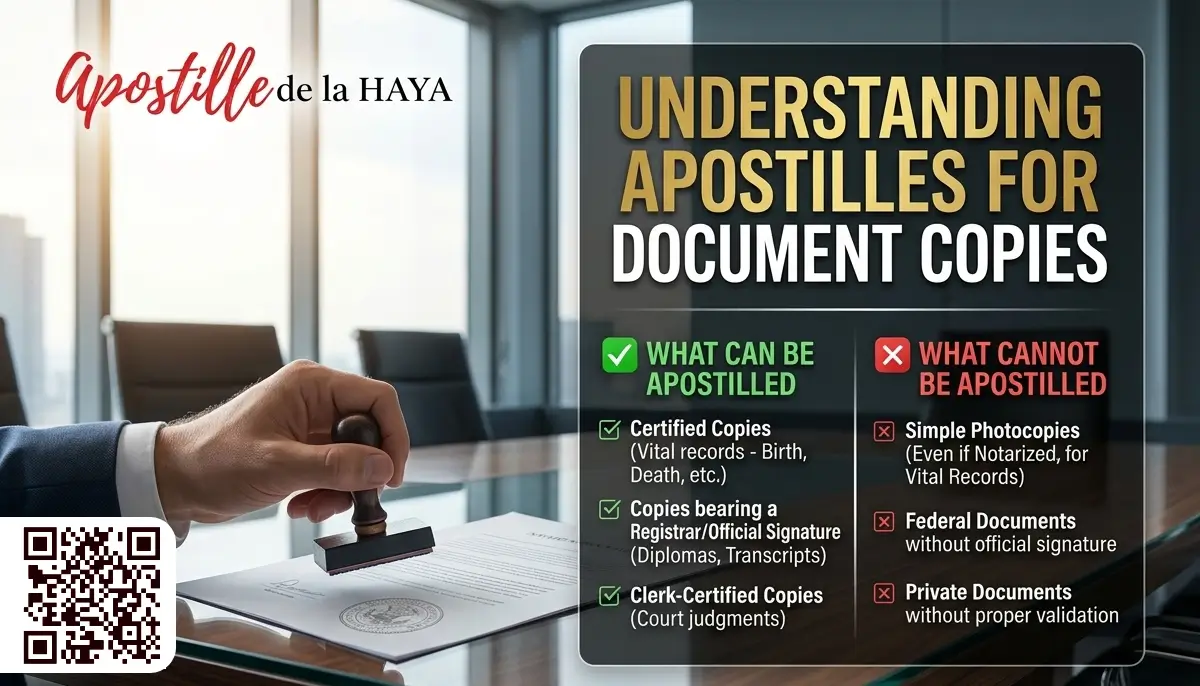
Which Copies of Documents CAN Be Apostilled?
The general rule is that privately issued documents and certain federal identity documents can be copy-certified. Specifically, you can usually process apostilles for copies of the following:
Passports and Driver’s Licenses
You should never mail your original U.S. passport overseas unless absolutely necessary. Instead, you can make a high-quality color photocopy of the identification page of your passport or driver’s license. A notary public can then perform a «copy certification» on that document, which makes it eligible for a state apostille.
Academic Diplomas and Transcripts
Universities often issue only one original diploma. For this reason, students moving abroad for work or further education frequently need to apostille copies of documents related to their academics. A photocopy of a diploma or transcript can be notarized and subsequently apostilled, satisfying the requirements of most foreign ministries of education.
Corporate and Business Documents
Businesses engaging in international trade frequently use copies of documents. Articles of incorporation, bylaws, and business licenses can often be copy-certified, depending on the issuing state’s regulations, to facilitate global operations without losing the original corporate records.
Which Documents Cannot Be Copy-Certified?
It is crucial to understand that certain documents are federally or state-mandated to be originals. Unfortunately, attempting to copy-certify these will result in an automatic rejection.
Vital Records: Birth certificates, death certificates, and marriage licenses cannot be photocopied and notarized. You must obtain an official, certified original from the state’s Department of Health or County Clerk to get an apostille.
Court Documents: Divorce decrees, probate records, and police clearances must bear the original stamp and signature of the court clerk or issuing agency.
FBI Background Checks: These federal documents must be the official PDF or physical copy issued directly by the FBI or an approved channeler.
The Exact Process for Certifying a Copy
To prepare copies of documents for an apostille, a strict sequence must be followed:
Original is Presented: The original document must be physically present.
Copy is Made: A clear, complete photocopy is produced.
Notarial Certificate: The notary attaches a specific «Copy Certification» jurat or acknowledgment, stating they have compared the copy to the original and found it to be accurate.
State Authentication: The notarized copy is then submitted to the Secretary of State for the apostille.
Federal documents without the right signature
If you have a copy of a federal record (for example, a scan of an FBI background check) that lacks the required federal signature, it cannot be apostilled. Note: If you need to obtain a new, valid FBI Background Check, our partner Compliance Officers can assist with the official fingerprinting and retrieval process.. It must go through the federal authentications office under the appropriate procedure. We route federal vs. state paths for you.

Certified Copy vs. Notarized Copy: Why the Source Matters
The single biggest mistake we see is confusing a certified copy with a notarized copy — they are not interchangeable, and an apostille authority will reject the wrong one. A certified copy is issued directly by the government agency that holds the original record (a vital records office, a court, a state agency); a notary simply confirms the copy matches what was presented, but does not certify the record itself. For most vital records — birth, marriage, death certificates — only a certified copy from the issuing agency can be apostilled. A notary’s «true copy» stamp on a personal photocopy of the same document generally cannot, no matter how official it looks. If you are apostilling a vital record, see our guide to certified birth certificate copies for apostille for the specifics.
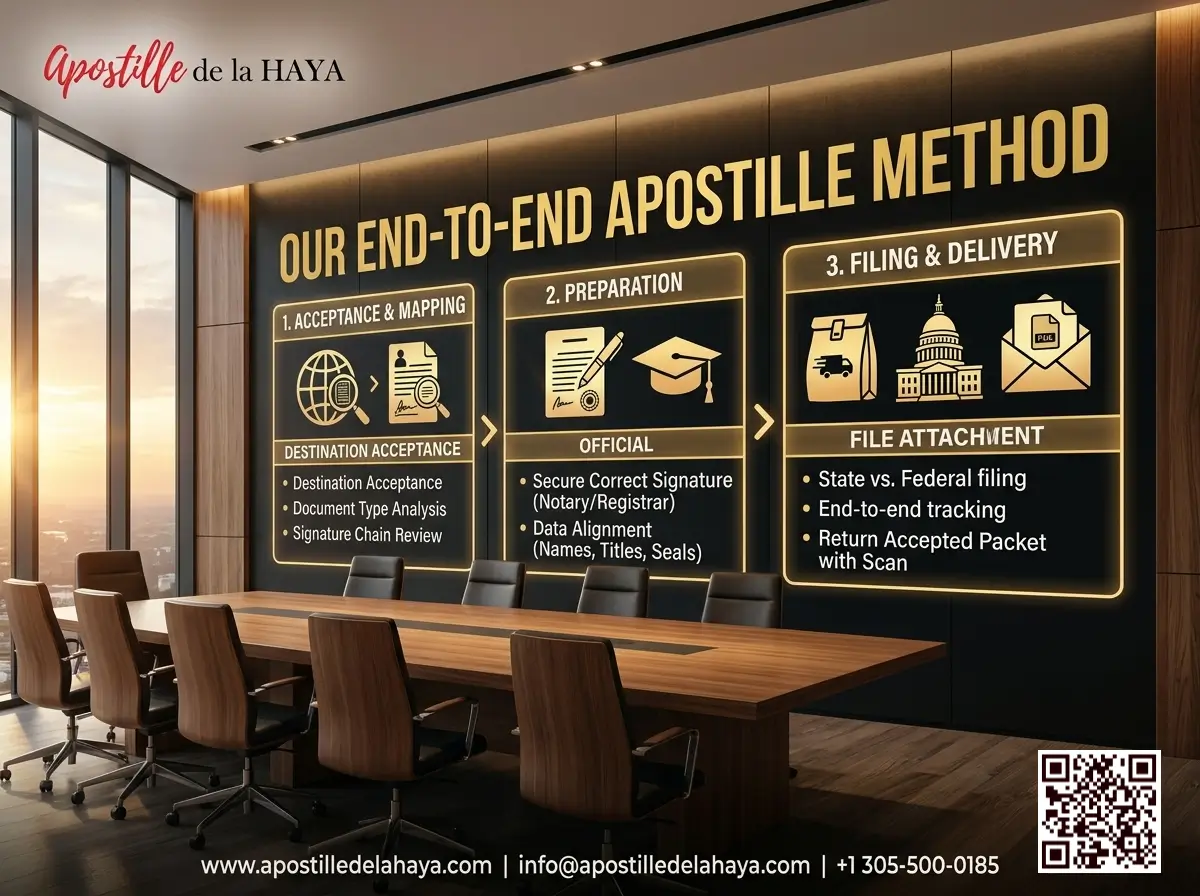
Our end-to-end method (quality over proximity)
Searching “apostille near me” is natural, but acceptance beats distance. Here’s how APOSTILLE DE LA HAYA keeps copies moving without rework:
Phase 1 — Acceptance & mapping
Country of use: Hague vs. non-Hague dictates apostille vs. authentication/legalization.
Document type: vital record, academic, court/admin, corporate, private notarized.
Signature chain: registrar vs. notary vs. official; we fix gaps before filing.
Phase 2 — Preparation
Copies of documents: we secure the registrar or notary signature your state recognizes (e.g., registrar-certified transcript, notary copy-certification affidavit).
Vital records: we obtain certified originals from the issuing office; no photocopies.
Name hygiene: we align names (accents, hyphens, middle names) with IDs and school/business records to prevent kickbacks.
Phase 3 — Filing & delivery
State apostille: filed with the appropriate Secretary of State/competent authority.
Federal authentication/apostille: filed with the U.S. Department of State when required.
Return: we ship your apostilled original, and—if helpful—provide a scan for your records. Timeframes may vary by office load and season.
Why choose APOSTILLE DE LA HAYA
Acceptance-first: we contact the receiver and align format, signature, and translation rules before filing.
Copies, done right: registrar signatures, notarized copy certifications, and custodian affidavits—whichever your state and receiver accept.
Vital records: we obtain certified originals from the right office, then apostille; no wasted attempts on photocopies.
Paper/electronic savvy: we support paper and e-Apostille (where validly available), with clear verification instructions.
End-to-end logistics: filing, tracking, and safe return of your apostilled packet. Timeframes may vary.
Ready to turn copies of documents into accepted apostilles—without retries? Contact APOSTILLE DE LA HAYA. We’ll confirm destination rules, secure the right registrar/notary signatures, obtain certified originals when required, and file with the proper authority. Then we return your apostilled documents with plain-English verification steps for the receiver.

How Apostille de la Haya Streamlines Your Process
Do not let bureaucratic confusion jeopardize your international visa, business deal, or real estate transaction. Instead, trust the experts who navigate these complexities daily.
At Apostille de la Haya, we know exactly which copies of documents can be apostilled and the precise state-mandated wording required to certify them. Our specialists handle everything from reviewing your documents to securing the final Hague apostille, offering you a frictionless, done-for-you experience. Contact Apostille de la Haya today to get your documents authenticated quickly and correctly.
Can I apostille a plain photocopy of my passport?
No, a plain photocopy holds no legal weight. To clarify, the copy must first be properly notarized by a commissioned notary public through a process called «copy certification» before it can be submitted to the state for an apostille.
Can a notary certify a copy of a birth certificate?
In almost all U.S. states, no. Generally, vital records like birth, marriage, and death certificates cannot be copy-certified by a notary. You must order a new, original certified copy directly from the state or county office that issued it to receive an apostille.
Do I need to send the original document to get a copy apostilled?
It depends on the document and the state’s laws. Often, you can have the document copy-certified by a local notary in your presence and then send that notarized copy to our specialists at Apostille de la Haya for the final state authentication.
How long does it take to apostille copies of documents?
Processing times vary wildly depending on the specific Secretary of State’s current backlog. However, by using Apostille de la Haya, we utilize expedited channels wherever available to ensure your paperwork is processed as rapidly as government regulations allow.
What happens if the notary makes a mistake on the copy?
The Secretary of State’s office rigorously inspects the notarial block. If the notary uses incorrect wording, an expired stamp, or certifies a document they are not legally allowed to (like a vital record), the state will reject the document outright, and you will have to restart the entire process.
FAQ
The information contained in this publication is provided for general informational purposes only and does not constitute legal advice. Reading or using this content does not create and is not intended to create an attorney-client relationship. No reader or user should act or refrain from acting based on the information presented herein without first consulting an attorney duly licensed to practice law in their jurisdiction.