If you’re searching for “apostille certificates”, you probably need to present a U.S. certificate — like a birth, marriage, diploma, or legal record — in another country. For it to be accepted abroad, it must be apostilled according to the Hague Convention of 1961.
In this article, we’ll explain what apostille certificates are, which documents can be apostilled, and how Apostille de La Haya makes the process easy from start to finish — no matter where you are.
What Is an Apostille Certificate?
An apostille certificate is an official authentication issued by a Secretary of State in the U.S. It certifies the origin of a public document so it can be legally used in foreign countries that are members of the Hague Apostille Convention.
The apostille does not validate the content of the document, only its origin and the authority of the official (or notary) who signed it.
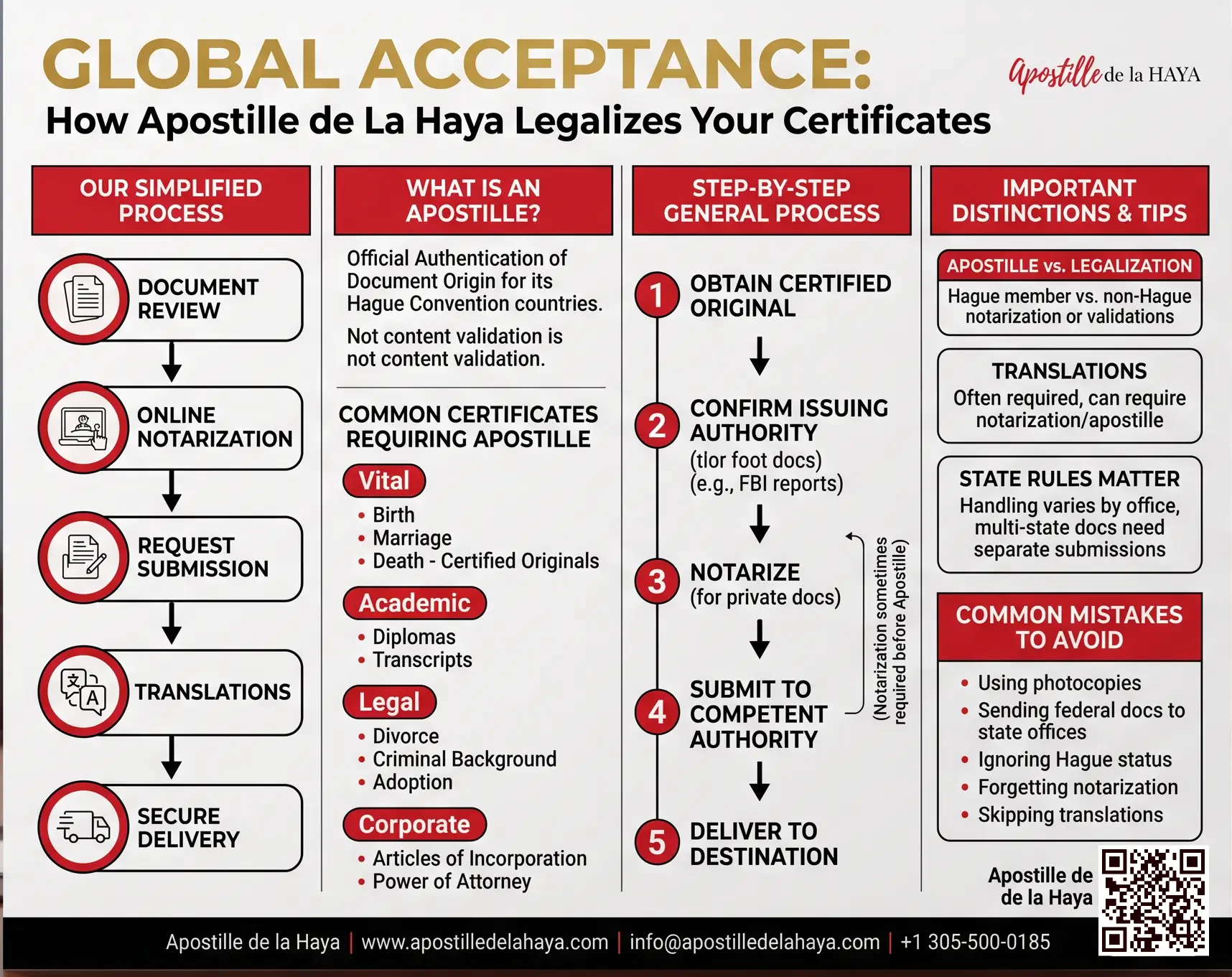
Common Certificates That Require Apostille
Depending on the purpose and destination country, the most common certificates that may require an apostille include:
Vital Records
- Birth certificates
- Marriage certificates
- Death certificates
(Must be certified originals issued by state or county agencies)
Academic Certificates
- High school diplomas
- College degrees
- School transcripts
(May require notarization first)
Legal Certificates
- Divorce decrees
- Criminal background checks (e.g. FBI, FDLE)
- Adoption records
- Name change certificates
Corporate or Business Certificates
- Articles of incorporation
- Good standing certificates
- Power of attorney for international use
- Notarized business contracts
How Apostille de La Haya Helps You Apostille Certificates
At Apostille de La Haya, we simplify the entire process of obtaining an apostille for your certificates. Here’s how we help:
Document Review
We verify if your certificate is valid for apostille, and guide you if notarization or a certified copy is needed.
Online Notarization
If your certificate requires notarization, we offer secure online notarization with identity verification — no in-person meeting needed.
Apostille Request Submission
We prepare and submit all required forms and fees to the correct Secretary of State, managing every step.
Translations
If the document needs to be submitted in another language, we provide translations.
Fast, Secure Delivery
We return the completed apostille certificate to you by domestic or international shipping, with tracking included.
How the Apostille Process Works, Step by Step
Getting a certificate apostilled follows a clear sequence. Skipping or rushing any step is the most common reason documents get rejected abroad:
- Obtain a certified original. A photocopy is almost never accepted. Vital records must be certified originals issued by the state or county; academic records usually need to be signed or sealed by the registrar and sometimes notarized first.
- Confirm the issuing authority. State-issued documents are apostilled by the Secretary of State of the state where they were issued. Federal documents (like an FBI report) are apostilled only by the U.S. Department of State.
- Notarize when required. Private documents — powers of attorney, affidavits, company records, translations — must be notarized before a Secretary of State can apostille them.
- Submit for the apostille. The competent authority attaches the apostille certificate, authenticating the signature and seal on your document.
- Deliver to the destination country. Once apostilled, your certificate is ready to be legally used in any Hague Convention member state.
Because requirements differ by document type and by state, a single formatting error can send the whole package back and cost you weeks.
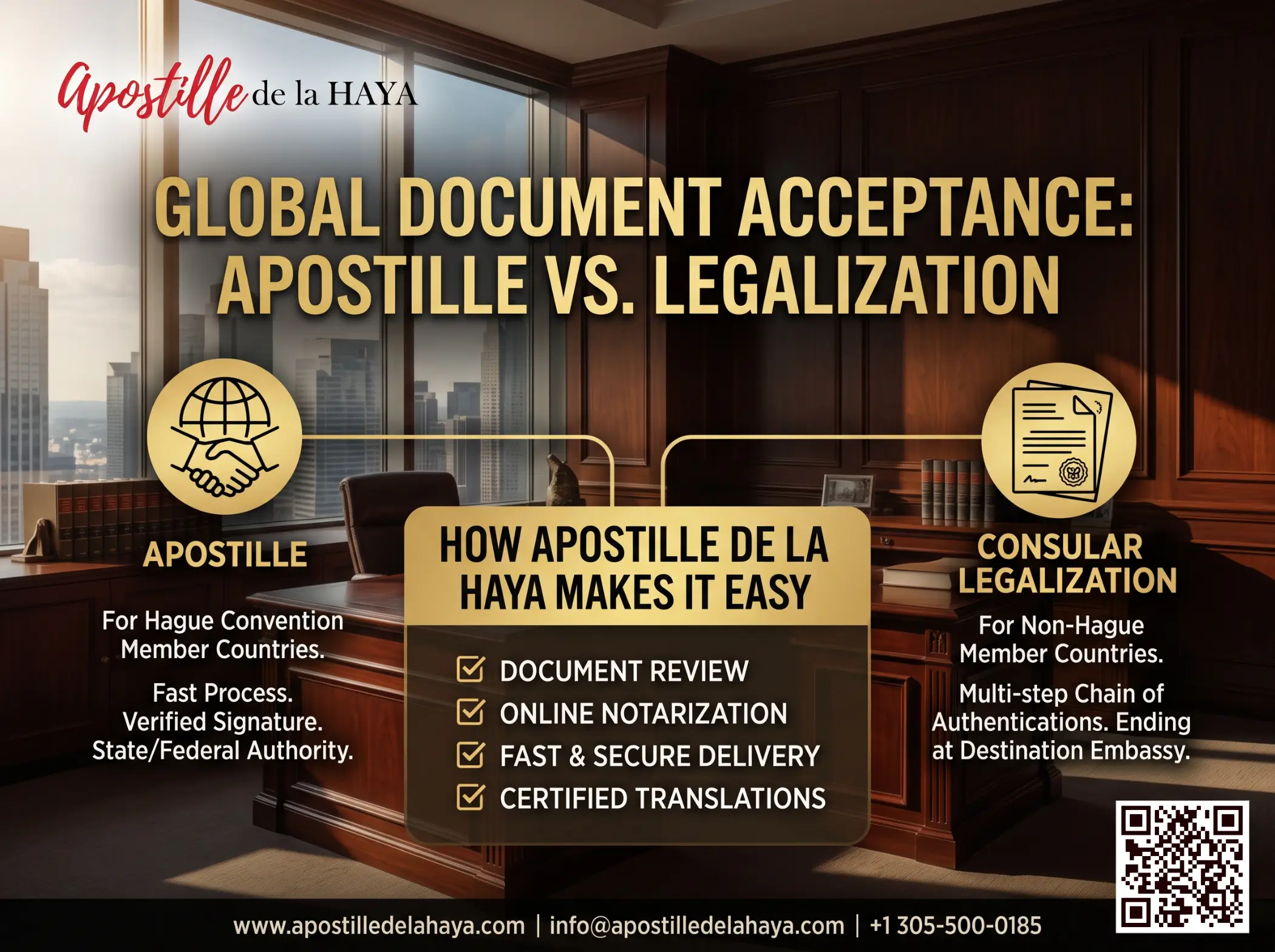
Apostille vs. Legalization: Know Which One You Need
An apostille only works between countries that are members of the 1961 Hague Apostille Convention. If your document is going to a country that is not a member, you cannot use an apostille — you need consular legalization instead, a longer chain of authentications ending at the destination country’s embassy or consulate.
Confirming the destination country’s status before you start is essential. Many people pay for an apostille only to learn their target country requires full legalization, forcing them to restart the process. Checking this first saves time, money, and stress.
Do You Also Need a Translation?
Many countries will not accept a U.S. certificate — even a perfectly apostilled one — unless it comes with an official translation into the local language. In some jurisdictions the translation itself must also be notarized and apostilled, which adds another layer to the process.
Requirements vary widely: some consulates accept a certified translation done in the U.S., while others demand a sworn translator in the destination country. Clarifying the exact translation rules up front prevents your document from being rejected at the counter.
Common Mistakes That Delay an Apostille
These are the errors we see most often — and each one is avoidable:
- Using a plain photocopy instead of a certified original or properly notarized copy.
- Sending a state document to the wrong authority — for example, trying to apostille a federal document at a state office.
- Ignoring the destination country’s Hague status, which determines whether you need an apostille or legalization.
- Forgetting the notarization step for private documents.
- Skipping the translation requirement until the document is already rejected abroad.
A short review before submission catches these issues while they are still easy to fix.
Business and Legal Documents That Often Need an Apostille
Beyond vital and academic records, a large share of apostille requests involve corporate and legal paperwork. If you are doing business, buying property, or handling legal matters abroad, you may need to apostille documents such as:
- Powers of attorney used to authorize someone to act on your behalf in another country.
- Company formation documents — articles of incorporation, certificates of good standing, and corporate bylaws.
- Commercial contracts and agreements that must be recognized by a foreign counterparty or court.
- Affidavits and declarations, including single-status affidavits required for an international marriage.
- Court orders and judgments, such as divorce decrees or adoption records.
Most of these are private documents, which means they must be notarized before a Secretary of State will attach the apostille. Getting the notarization right the first time keeps the process moving.
Why State Rules Make a Difference
There is no single nationwide apostille counter. Each U.S. state authenticates the documents it issues, and every Secretary of State office has its own submission format, processing times, and acceptable proof of notarization. A document issued in Florida is handled differently from one issued in New York or California.
This matters when your documents originate in more than one state — a diploma from one state and a birth certificate from another may each require a separate submission to a different authority. Knowing which office is competent for each document avoids the frustrating loop of packages returned for being sent to the wrong place.
What to Prepare Before You Start
You can save days by gathering the right information before submitting anything:
- The destination country and confirmation that it is a Hague Convention member.
- The purpose of the document (immigration, study, marriage, business), since some consulates have extra requirements.
- Whether a certified original or a notarized copy is needed for each certificate.
- Whether an official translation is required, and in which country it must be produced.
- Your deadline, so processing time can be planned with a safe margin.
Having these answers ready turns a confusing, multi-office errand into a single organized request.
How Long Does the Whole Process Take?
There is no single answer, because timing depends on three variables: the state or federal authority handling your document, whether the paperwork needs notarization or translation first, and the delivery method to the destination country. A clean, single-state request can move quickly, while multi-document or federal requests naturally take longer.
The biggest delays are almost always self-inflicted: missing certifications, documents sent to the wrong office, or a translation requirement discovered too late. When each step is prepared correctly from the start, the process is far more predictable — which is exactly why planning ahead of any hard deadline is worth it.
Getting Your Apostilled Document Delivered
Once your certificate has been apostilled, it still has to reach the person, institution, or authority that requested it — often in another country. Depending on the destination, you may need secure international shipping, and some authorities require the physical apostille rather than a scan.
If the receiving party accepts electronic apostilles (e-Apostilles), delivery can be faster; if not, the original must travel safely to its destination. Coordinating delivery as part of the process — not as an afterthought — means your document arrives on time and in the exact format the recipient will accept.
Why Handle Your Apostille With Apostille de La Haya
Apostille rules change from state to state and from country to country, and a small mistake means starting over. Apostille de La Haya manages the entire process for you: we review your certificate, confirm the correct competent authority, arrange notarization and translation when needed, obtain the apostille, and deliver the finished document — wherever you are in the world.
Instead of guessing which office to visit or which form to file, you get one clear point of contact who knows exactly what each destination country requires. That is the difference between a document accepted on the first try and weeks of avoidable delays.
Who Commonly Needs Apostille Certificates
Apostille certificates come up in far more situations than most people expect. You are likely to need one if you are:
- Applying for dual citizenship or a foreign passport, where birth and marriage certificates must be recognized abroad.
- Getting married in another country, which usually requires an apostilled single-status affidavit and birth certificate.
- Studying or validating a degree overseas, where diplomas and transcripts need authentication.
- Working or obtaining a professional license abroad, often requiring an apostilled background check and credentials.
- Opening a company or signing contracts internationally, where corporate documents and powers of attorney must be apostilled.
- Handling inheritance, property, or adoption matters that cross borders.
In each case, the apostille is what turns a valid U.S. document into one a foreign authority will actually accept.
Conclusion
Apostille certificates are essential when using U.S. documents abroad. The process can be confusing, but Apostille de La Haya makes it easy — handling everything from document review to apostille issuance and delivery.
Need to apostille your certificate? Contact Apostille de La Haya today and let our expert team guide you step by step.
Frequently Asked Questions
Does an apostille validate the content of my certificate?
No. An apostille only authenticates the origin of the document and the authority of the official or notary who signed it. It does not certify that the content is true or accurate.
Can I apostille a photocopy of my certificate?
Generally no. Vital records must be certified originals; other documents usually need to be notarized first. A plain photocopy is almost always rejected.
How long is an apostille valid?
An apostille does not expire, but many foreign authorities only accept certificates issued within the last 3 to 6 months, so timing still matters.
What if my destination country is not part of the Hague Convention?
Then an apostille will not be accepted. You will need consular legalization instead, which is a longer process ending at the destination country’s embassy or consulate.
Do I need to be in the U.S. to get my certificate apostilled?
No. Apostille de La Haya can handle the process on your behalf and deliver the apostilled document to you internationally.
The information contained in this publication is provided for general informational purposes only and does not constitute legal advice. Reading or using this content does not create and is not intended to create an attorney-client relationship. No reader or user should act or refrain from acting based on the information presented herein without first consulting an attorney duly licensed to practice law in their jurisdiction.