
If you are looking to understand the meaning of an affidavit, you likely need a statement that agencies, banks, schools, or courts will accept—without sending you back to redo it. In simple terms, an affidavit is a written, signed, and sworn statement of facts. You (the affiant) swear or affirm the truth in the notary’s presence, and the notary completes a jurat noting the oath/affirmation. At Notary Public Center, we keep it practical: we can draft the text in some cases, confirm the exact certificate your receiver expects, and notarize either in person in Miami or online through a recorded RON session.
Affidavits meaning (and what an affidavit is not)
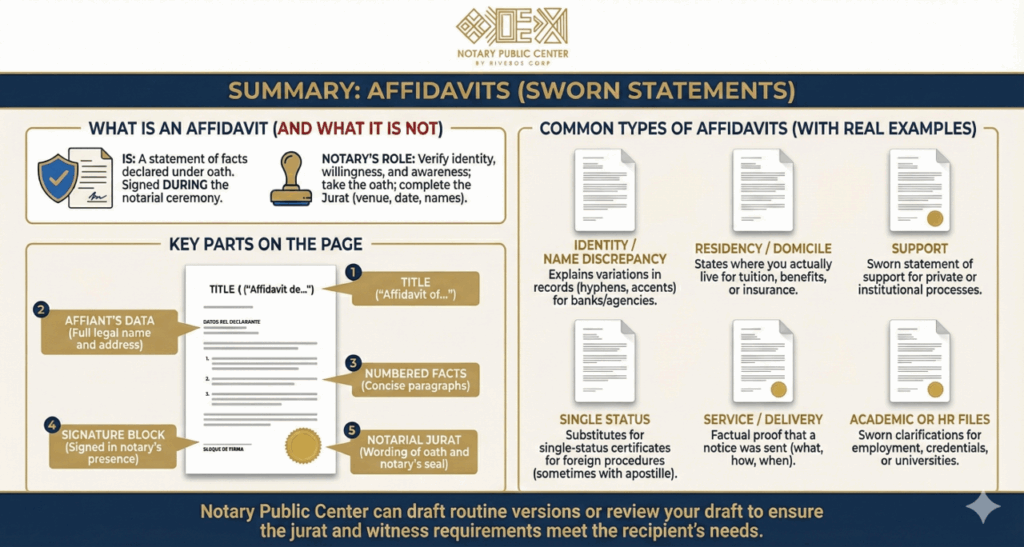
An affidavit is a statement of facts you declare to be true under oath or affirmation. You sign during the notarial ceremony.
The notary’s job is to verify identity, willingness, and awareness, give the oath/affirmation, and complete the jurat (venue, date, names).
An affidavit is not a contract, not legal advice, and not a guarantee the facts are correct; it is your sworn testimony in writing.
Key parts you’ll see on the page
Title: “Affidavit of ___” (Residency, Name Discrepancy, Support, etc.)
Affiant’s data: full legal name and address.
Numbered facts: concise paragraphs.
Signature block: to be signed in the notary’s presence.
Notarial jurat: wording that shows the oath/affirmation took place and includes the notary’s seal.
Common types of affidavits (with real-world examples)
We routinely support these scenarios and more. Your receiver’s rules come first; we tailor the wording accordingly.
Affidavit of Identity / Name Discrepancy
When your name appears slightly differently across records (hyphens, accents, middle names). The affidavit explains the variation so banks, schools, or agencies can reconcile files.Affidavit of Residency / Domicile
Used for tuition, in-state benefits, insurance, or employer files. It states where you actually live and since when; some receivers ask for supporting documents.Affidavit of Support (non-immigrant administrative uses)
Certain private or institutional processes ask for a sworn statement of support. We keep the scope narrow and consistent with what the recipient expects.Affidavit of Single Status / No Marriage (where no certificate exists)
Some U.S. states don’t issue a formal “single-status certificate.” In those cases, a sworn affidavit often substitutes for foreign marriage procedures—sometimes followed by an apostille.Affidavit of Service / Delivery
For proving that you served or delivered notices under a policy or contract. The content is factual: what was sent, how, and when.Affidavit for Academic or HR Files
Employment onboarding, credential verifications, or university requirements sometimes ask for sworn clarifications.
Notary Public Center can draft routine versions in some cases or review your draft to ensure the jurat and witness requirements match what the receiver wants.
Affidavit vs. acknowledgment: the notarial certificate matters
The notarial certificate tied to your signature controls acceptance:
Jurat (affidavit): you swear/affirm the truth and sign during the session. The notary administers the oath and completes the jurat.
Acknowledgment: you acknowledge a signature you made earlier—commonly used for deeds or powers of attorney, not for affidavits.
Using the wrong certificate is a top reason documents get rejected. We check this before you sign so you don’t lose time.
How notarization works with Notary Public Center (in person or online)
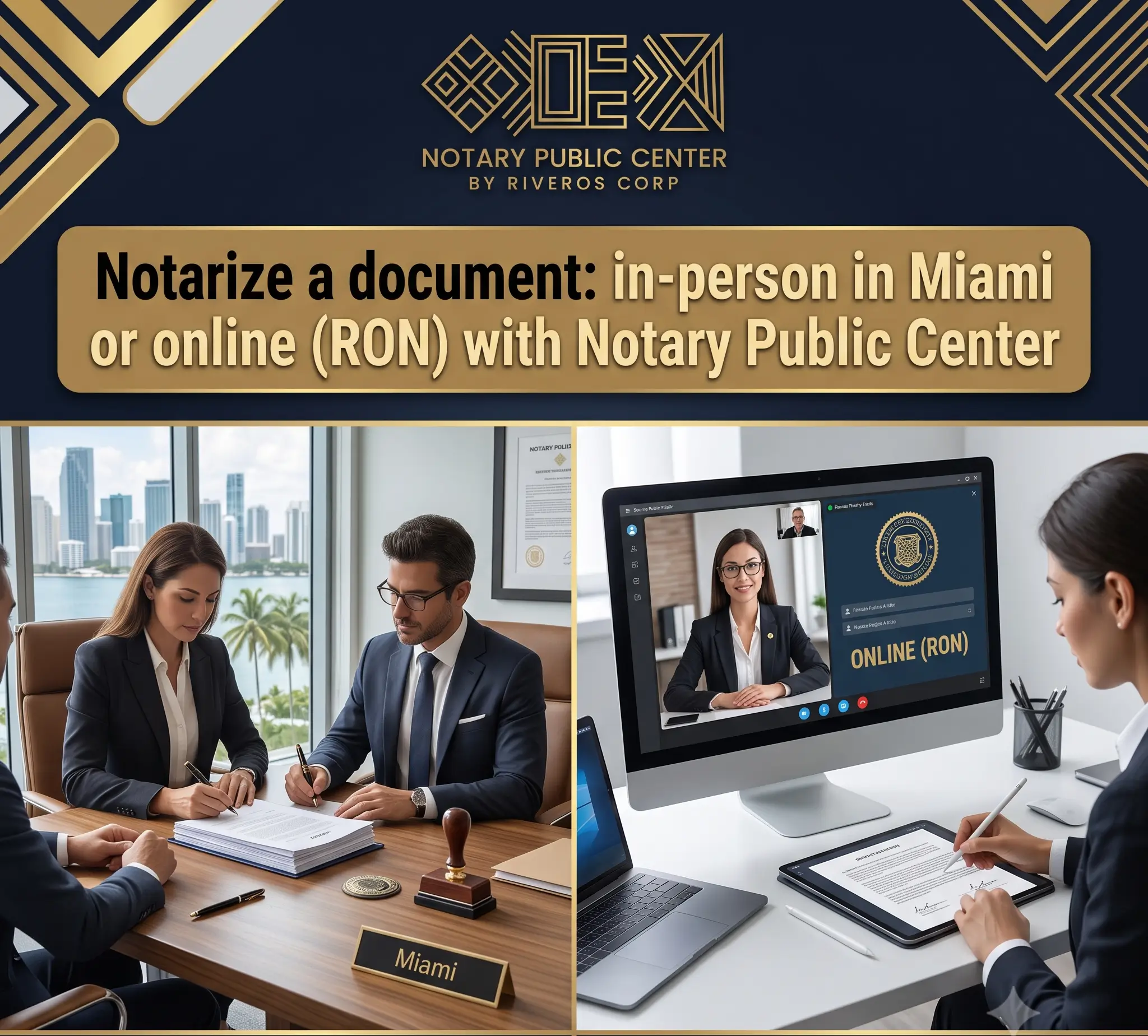
In-person (Miami)
Bring a current, government-issued ID (passport or driver’s license recommended).
We check identity, ensure you understand and willingly sign, administer the oath, and have you sign in our presence.
You leave with a paper original bearing our seal.
Online (Remote Online Notarization, RON)
We first confirm your recipient accepts online notarization (most do; some still require wet-ink).
Identity proofing includes credential analysis of your ID, KBA timed questions, biometrics/liveness, and a recorded two-way video call.
You take the oath and sign digitally in the session; we issue a tamper-evident PDF.
Any later change to the file makes the signature show as invalid/modified in standard PDF viewers.
Timeframes may vary by scheduling, holidays, or follow-up steps your receiver requires.
Drafting help (in some cases) vs. legal advice
We provide practical drafting support for routine affidavits—clear titles, precise facts, correct jurat—so the notarial piece is beyond question. However, we do not provide legal advice or represent you in court. For complex disputes or legal strategies, bring language from your attorney; we’ll make sure the notarial ceremony and certificate fit the requirements.
Acceptance first:
We begin by asking:
Who will receive your affidavit (bank, school, court clerk, consulate, foreign office)?
Do they require wet-ink or accept RON?
Do they need witnesses, special venue language, or a specific jurat template?
Will the affidavit be used outside the U.S. and need an apostille?
By aligning to the receiver at the start, you avoid re-signing, shipping twice, or scrambling for addenda later.
International use: apostille for affidavits
If your affidavit will be presented in a Hague Apostille Convention country, the state issues an apostille over the notary’s signature. For non-Hague destinations, the route is authentication (and often consular legalization).
Through our specialized division, Apostille de la Haya, we ensure your affidavit is properly authenticated for international use. We can:
:
Validate whether your destination requires apostille or authentication.
Ensure your jurat and names match the ID and the recipient’s template.
File with the competent authority and return the apostilled original.
Coordinate translations and clarify whether the apostille attaches to the base affidavit or the translator’s notarized statement.
Timeframes may vary by office load and season.
Errors we prevent (so you don’t sign twice)
Wrong certificate (acknowledgment used for an affidavit) → rejection. We apply a jurat.
Pre-signing an affidavit before the session → invalid. Affidavits must be signed during the notarization.
Name/ID mismatches (missing middle names, accents, hyphens) → delays. We align the text with your ID.
Over-promising language (“guarantees,” legal conclusions) → pushback. We keep statements factual and within your personal knowledge.
Skipping acceptance checks → repeat shipping/signing. We confirm RON vs. paper and special wording before the ceremony.
Step-by-step with Notary Public Center
Intake & acceptance check: tell us the recipient and country of use. We confirm certificate type, witnesses, and format (paper vs. online).
Drafting or review (some cases): we draft a clear, concise affidavit or review your version for jurat accuracy and name alignment.
Notarization: in Miami (wet-ink) or online (RON with recording, KBA, credential analysis, and biometrics).
Delivery: paper original or tamper-evident PDF.
Apostille/authentication (optional): we assemble the filing and manage return. Timeframes may vary.
Practical examples of “affidavits meaning” in everyday life
Bank asks for proof of address: A “Residency Affidavit” with simple, numbered facts and references to supporting documents.
University needs a name link: “Name Discrepancy Affidavit” connecting “María-José García” with “Maria J Garcia” in prior records.
Starting a process abroad: “Single-Status Affidavit” where your state does not issue a certificate; later we route the apostille.
Corporate onboarding: “Affidavit of Identity” to reconcile a director’s passport name with historical filings. (Note: For comprehensive vetting, we also assist with FBI Background Checks through our partner brand, Compliance Officers).
In all cases, the notarial jurat and identity steps guard the integrity of your statement.
Quality checklist (copy/paste for your prep)
Exact legal name as on your ID (include middle names/accents/hyphens).
Correct venue (State/County) and date for the jurat.
Numbered facts: short, factual, within your personal knowledge.
Attachments labeled (Exhibit A, B) if your receiver expects them.
Witnesses confirmed (if required).
Recipient’s format: RON vs. wet-ink, and any template language.
International use? Ask if an apostille is required and where it should attach.

Why choose Notary Public Center
Acceptance-first: we build your affidavit to the receiver’s rules—certificate, witnesses, and format.
Two modes: Miami in-person or online with multi-layer identity proofing and a recorded ceremony.
Drafting help (some cases): practical, clear language that keeps your statement factual and compliant.
Apostille ready: when your affidavit travels abroad, we manage the apostille/authentication chain.
Bilingual support: English/Spanish guidance for families, students, and businesses.
Need a clear answer to affidavits meaning—and a document that your recipient will actually accept? Contact Notary Public Center. We’ll confirm requirements, draft (in some cases), and notarize your affidavit in person or online, then help with apostille if needed. Timeframes may vary.
FAQ
1) Is an affidavit the same as a sworn declaration?
Functionally similar, but an affidavit includes a jurat with a notary-administered oath/affirmation. Some jurisdictions accept “unsworn declarations” under statute; your receiver decides. We’ll confirm their preference.
2) Can you help draft my affidavit?
Yes, in some cases. We can assist with drafting routine affidavits (like residency or name discrepancies) to ensure the jurat and format meet requirements. However, we do not provide legal advice for complex legal matters.
3) Do you notarize online?
Absolutely. We offer Remote Online Notarization (RON) where we verify your identity and notarize your document via a secure, recorded video session, or other ID verification procedures fully valid in the U.S.
The information contained in this publication is provided for general informational purposes only and does not constitute legal advice. Reading or using this content does not create and is not intended to create an attorney-client relationship. No reader or user should act or refrain from acting based on the information presented herein without first consulting an attorney duly licensed to practice law in their jurisdiction.