When structuring a business in the United States, obtaining your Employer Identification Number (EIN) is merely the first step. However, when it is time to open a corporate bank account, secure business financing, or expand your operations internationally, simply knowing your nine-digit number is never enough. Financial institutions and foreign governments will require official Proof of EIN to verify your company’s legitimacy and tax status.
Providing proper proof is a strict compliance requirement to prevent fraud and money laundering. An unofficial screenshot or a self-drafted document will be immediately rejected. You must provide specific, IRS-issued documentation. If you have lost your original notice or require an internationally valid version, retrieving it from the Internal Revenue Service (IRS) can be a complex and time-consuming bureaucratic ordeal.
At Riveros Corp, our specialists handle the complete corporate compliance process for your U.S. entity. Whether you need to retrieve official IRS verification letters or require an Apostille for your tax documents to be used abroad, we secure your paperwork accurately and efficiently, allowing you to focus on growing your business.
What Documents Are Accepted as Proof of EIN?
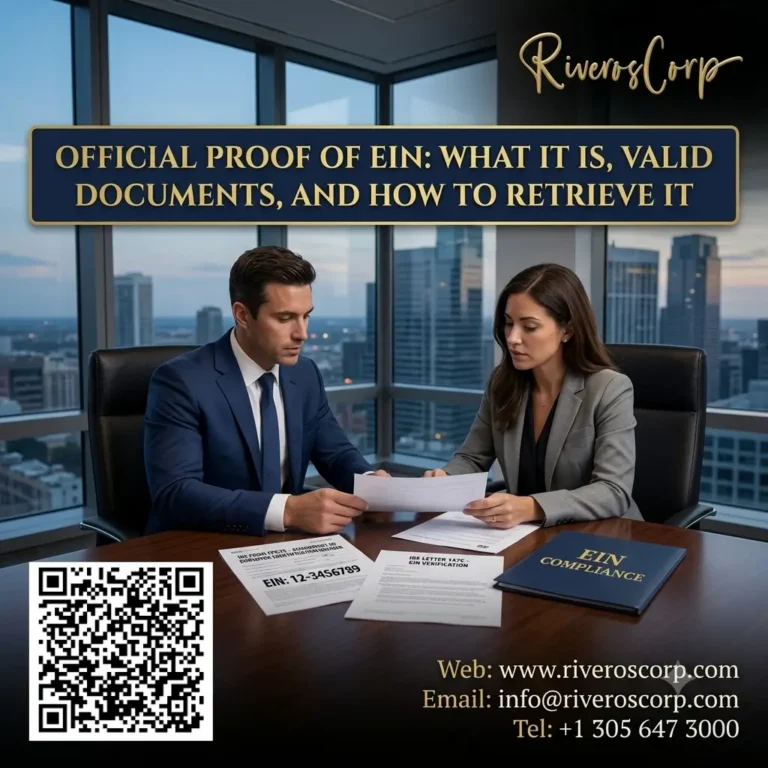
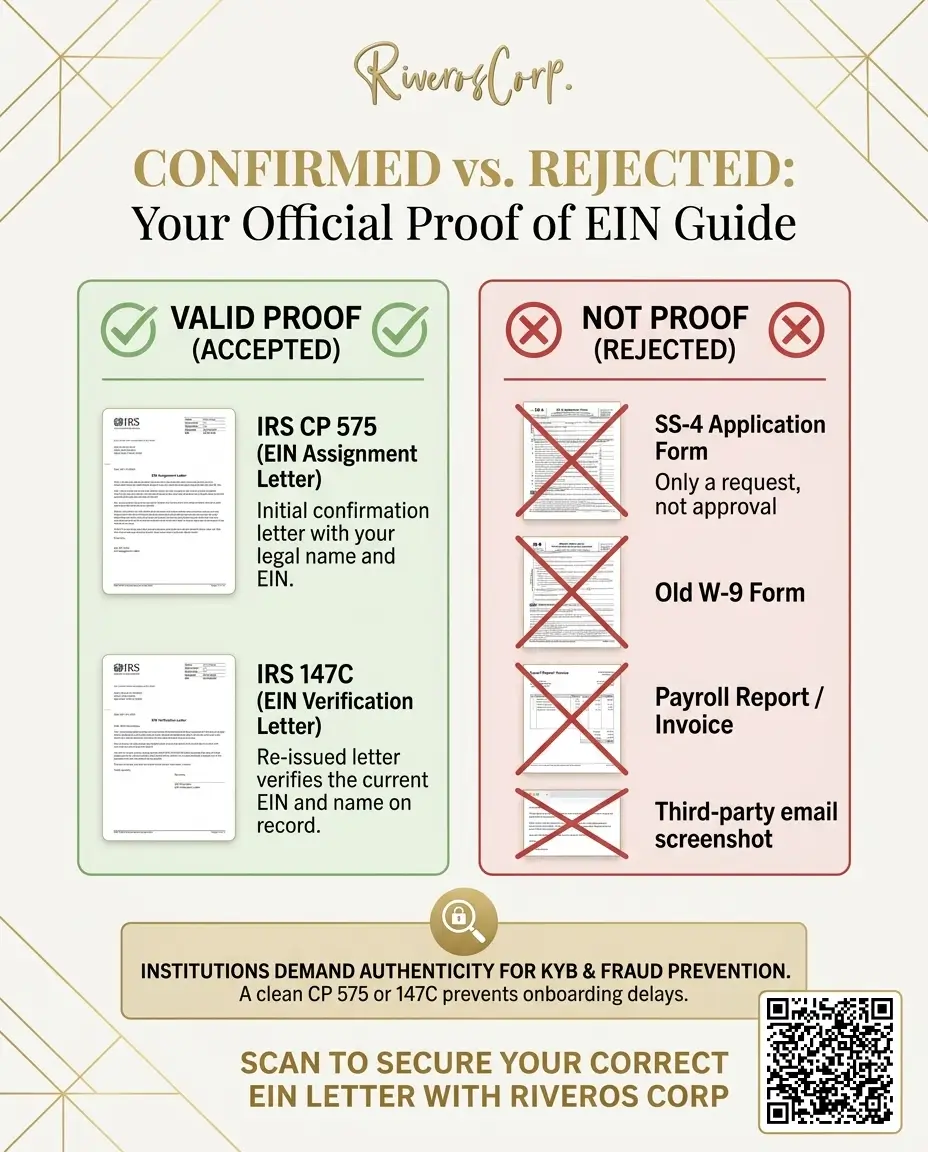
Not every tax-related paper qualifies as official verification. The IRS issues specific documents that banks, vendors, and foreign entities recognize as legitimate Proof of EIN. The three most common and widely accepted forms are:
1. IRS Form CP575 (The Original Confirmation Letter)
The CP575 is the official assignment letter mailed by the IRS to the business address immediately after the EIN is approved. This is the ultimate proof of your tax ID. However, the IRS only issues the CP575 once. If it is lost, damaged, or discarded, you cannot request a duplicate of this specific form.
2. IRS Letter 147C (EIN Verification Letter)
If you no longer have your CP575, the acceptable alternative is the 147C Letter. This is an official verification document generated by the IRS upon request. It serves the exact same legal purpose as the CP575 and is accepted by all major U.S. banks and institutions as formal Proof of EIN.
3. Filed and Stamped Business Tax Returns
In some instances, financial institutions may accept a formally filed business tax return (such as Form 1120 or 1065) that clearly displays your EIN. However, the return must usually be signed or accompanied by proof of filing, making it less ideal for newly formed companies that have not yet filed taxes.
Why Is Official Proof of EIN Required?
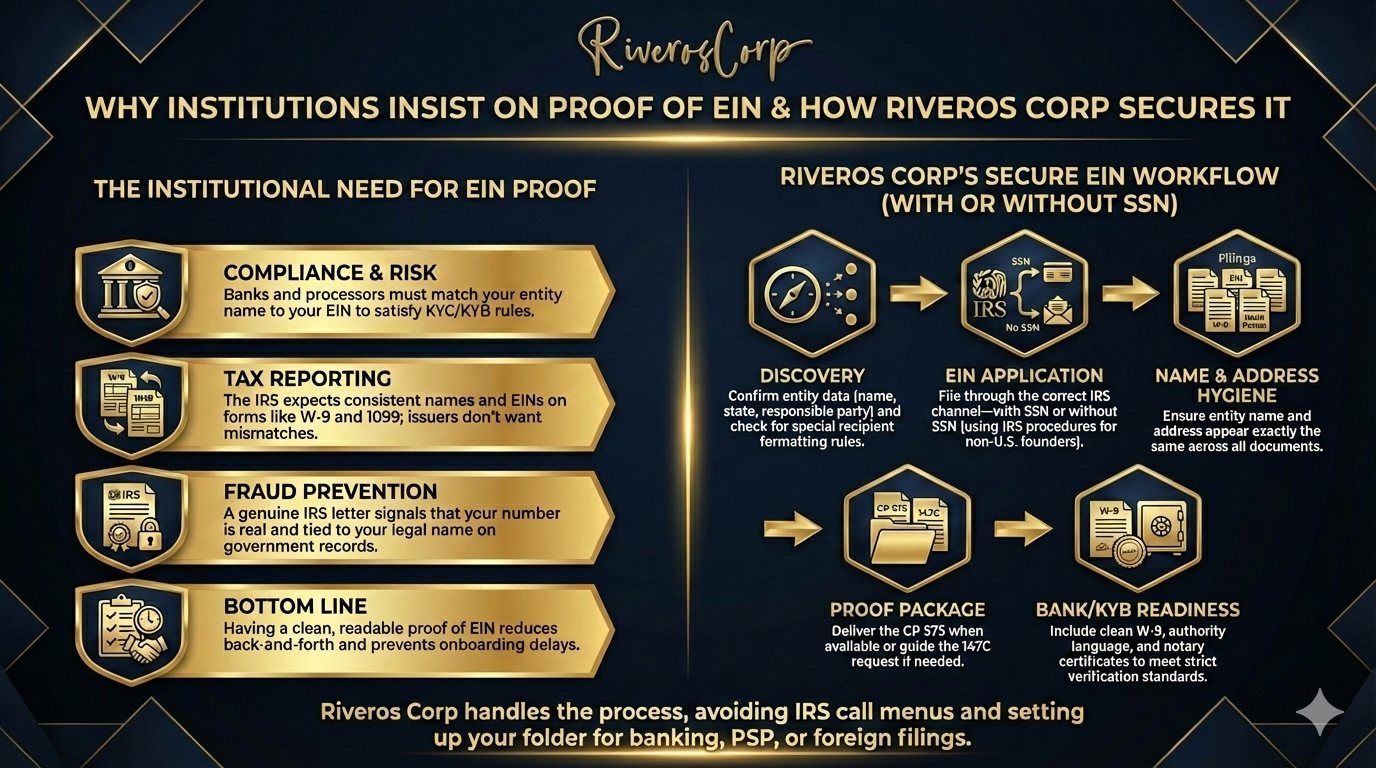
In today’s strictly regulated financial environment, verbal or unverified claims regarding corporate identity are unacceptable. You will be required to present your official EIN letter in several critical scenarios:
Opening Corporate Bank Accounts: Under strict «Know Your Customer» (KYC) laws, U.S. banks must verify your corporate tax ID before allowing you to deposit funds or process transactions.
Applying for Business Loans or Credit: Lenders require official IRS documents to underwrite business credit and report to commercial credit bureaus.
Vendor and Merchant Accounts: Payment processors (like Stripe or PayPal) and major suppliers require proof to fulfill their own tax reporting obligations (such as issuing 1099 forms).
International Expansion: If your U.S. company is entering into a joint venture overseas or opening a subsidiary, foreign governments will demand proof of your U.S. tax status.
The Risks of the «Do It Yourself» (DIY) Retrieval Process
Many business owners who lose their CP575 attempt to navigate the IRS system independently to request a 147C Letter. This DIY approach often leads to severe delays and frustration, jeopardizing business deals and banking setups.
Hours of Hold Time: Contacting the IRS Business & Specialty Tax Line often involves enduring hold times that exceed several hours, with a high chance of the call dropping before speaking to an agent.
Strict Security Verification: The IRS agent will ask complex security questions regarding your corporate structure, formation date, and tax history. Answering incorrectly will result in immediate denial of the request.
Antiquated Delivery Methods: The IRS does not email the 147C Letter. They will only send it via standard mail (which takes weeks) or via a secure, dedicated fax line. Most modern businesses do not possess the necessary physical fax infrastructure to receive IRS documents securely.
Handling IRS bureaucracy without corporate expertise is a drain on your resources. It requires specific knowledge of how the agency operates to retrieve documents promptly.
How Riveros Corp secures your EIN (with or without SSN)
We’ve helped hundreds of founders—U.S.-based and international—obtain EINs correctly and deliver a proof of EIN package that works with banks and platforms.
Our acceptance-first workflow
Discovery: We confirm your entity data (name, formation state, responsible party, U.S. mailing address strategy), and whether any recipient (bank/PSP/landlord) has special formatting rules.
EIN application: We file your EIN through the correct IRS channel—with SSN or without SSN (using the procedures the IRS allows for non-U.S. founders).
Name and address hygiene: We make sure your entity name and address appear exactly the same across formation filings, EIN, W-9, and your bank onboarding forms.
Proof package: We deliver the CP 575 when available or guide the 147C request if the CP 575 was never issued or is missing.
Bank/KYB readiness: We include a clean W-9, authority language, and, if needed, officer or manager certificates processed directly through our Notary Public Center. This ensures your internal documents meet strict verification standards before they ever reach the bank. Timeframes may vary.
You don’t need to figure out IRS call menus or wonder which letter is acceptable—we do it for you and set up your folder for the next step (banking, PSP, or foreign filings).
If you lost your proof of EIN
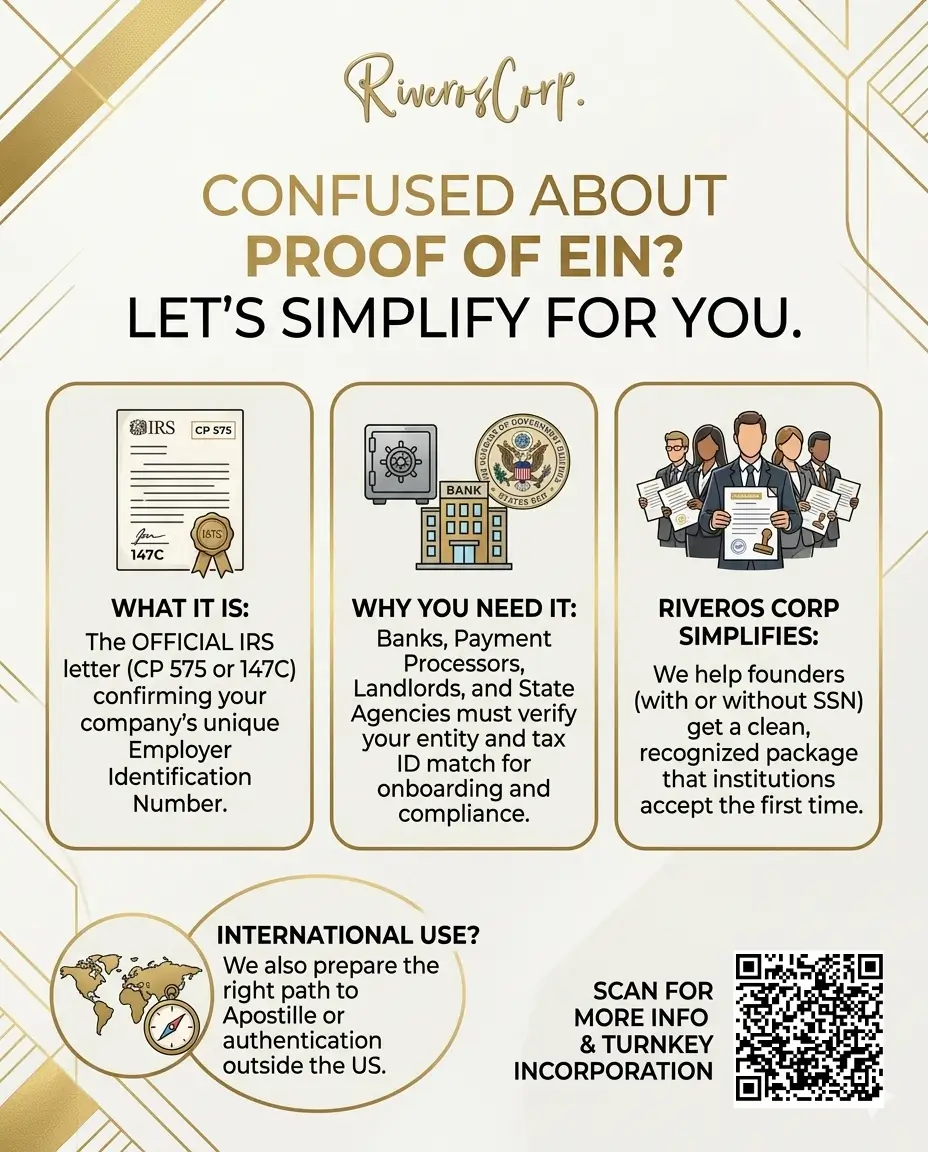
It happens. The IRS can issue a 147C EIN Verification Letter after a quick identity check for the responsible party or authorized representative. Riveros Corp will guide you through the authorization steps and help you collect the 147C so you have a fresh proof of EIN to present.
International Use: When Your Proof of EIN Needs an Apostille
If you need to present your Proof of EIN to a foreign government, bank, or notary outside of the United States, a standard CP575 or 147C Letter will not be accepted. The document must be authenticated through an Apostille (for countries under the Hague Convention) or through embassy legalization.
Apostilling IRS documents is highly specialized. The U.S. Department of State will not apostille a standard computer-generated CP575. You must obtain a manually signed certification or a highly specific verified copy from the IRS before the authentication process can even begin. Attempting this independently often results in rejected applications and months of lost time.
Proof of EIN in context: how it fits your formation and compliance kit
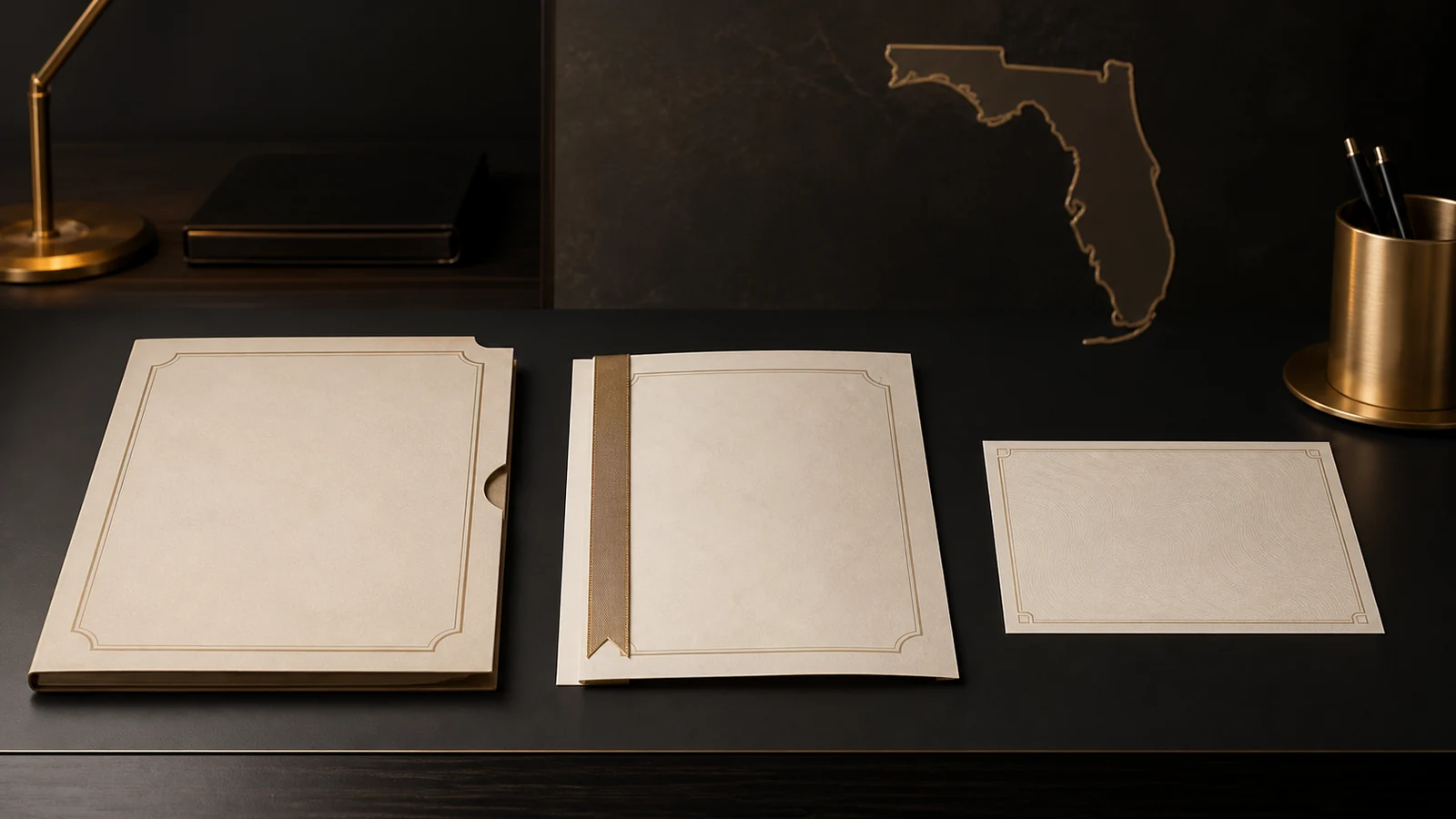
Your proof of EIN is one tile in a small mosaic. For frictionless onboarding, your folder should include:
Articles/Articles of Organization (or Incorporation) — filed with the state.
Bylaws or Operating Agreement — the governance rules banks ask to see.
EIN proof — CP 575 or 147C.
W-9 — matched to the EIN and legal name.
Authority certificates — manager/member or officer letters confirming who can open accounts and sign.
Certificate of Status/Good Standing — often needed by banks or foreign counterparties.
Riveros Corp prepares the entire package as part of our turnkey incorporation service, so your documents “speak the same language.”
Common mistakes we prevent
Using the SS-4 as proof: It’s only an application. Institutions want the CP 575 or 147C.
Name mismatches: “ABC LLC” vs. “A.B.C., LLC” can trigger KYB flags. We standardize the name and address everywhere.
Wrong letter for foreign use: Some destinations won’t rely on the IRS letter alone. We pivot to state certificates or a notarized officer affidavit plus apostille.
Waiting to request a 147C: If the CP 575 was lost, we request the 147C before bank appointments to avoid rescheduling.
Rushing apostille without a plan: We confirm how the foreign recipient prefers the proof—apostille on a state certificate vs. on a notarized affidavit referencing the EIN—so your first submission is accepted.
Secure Your Corporate Documents with Riveros Corp
Your company’s foundational documents are too important to leave to chance or long IRS wait times. Do not let missing paperwork delay your bank account opening or international expansion.
At Riveros Corp, we streamline the process of corporate document retrieval. Our team understands the precise protocols required to interact with federal agencies. We can efficiently retrieve your official Proof of EIN and, if required for international use, manage the complex federal Apostille process on your behalf. Ensure your corporate compliance is handled with precision. Contact Riveros Corp today and let our specialists secure your essential business documentation.
Need proof of EIN that banks and agencies will accept—plus the right apostille strategy for foreign use? Contact Riveros Corp. We’ll secure your EIN, deliver the IRS letter (CP 575 or 147C), align your documents for onboarding, and handle any notarization and apostille your case requires. Let’s get it right the first time.
FAQ
1. What is an IRS 147C Letter?
The 147C Letter is an official document generated by the Internal Revenue Service used to verify a company’s Employer Identification Number (EIN). It is the standard replacement document requested when the original CP575 letter has been lost or misplaced.
2. Can I download my Proof of EIN online?
No. The IRS does not provide an online portal to simply download or print a CP575 or a 147C Letter. You must undergo a formal verification process over the phone or via authorized representatives, and the document must be mailed or faxed by the agency.
3. Is my state-issued Articles of Organization proof of my EIN?
No. State documents (like Articles of Incorporation or LLC formation certificates) are issued by the state government and do not prove your federal tax status. Proof of EIN must come directly from the federal government (the IRS).
4. Can I use a W-9 form as official Proof of EIN?
No. A W-9 is a self-certified form that you fill out yourself to provide your tax ID to a third party. Because it is not generated or certified directly by the IRS, banks, lenders, and foreign governments will not accept a W-9 as official, federally issued Proof of EIN. You must provide an IRS-issued document like a CP575 or a 147C Letter.
5. How does Riveros Corp help retrieve my lost EIN document?
Our team manages the corporate compliance and bureaucratic navigation required to retrieve your documents. We ensure that all security verifications are handled accurately and manage the complex logistics of receiving and authenticating the documents for your domestic or international needs.
The information contained in this publication is provided for general informational purposes only and does not constitute legal advice. Reading or using this content does not create and is not intended to create an attorney-client relationship. No reader or user should act or refrain from acting based on the information presented herein without first consulting an attorney duly licensed to practice law in their jurisdiction.