
When someone asks for proof of business registration, they usually want an official, state-verified document showing that your company exists and remains in good standing. In the United States, that “single source of truth” is the Certificate of Good Standing, issued by the state where your entity is formed (or registered as a foreign entity). This certificate is accepted by banks, card processors, marketplaces, landlords, large customers—and, with an apostille, by many foreign authorities as well.
Riveros Corp. makes the process simple: we request the certificate from the correct state, verify that your filings and fees are current, and—if you’ll present the document outside the U.S.—we obtain the apostille. All you do is tell us who will receive the file and where it will be used. Timeframes may vary.
What counts as proof of business registration?
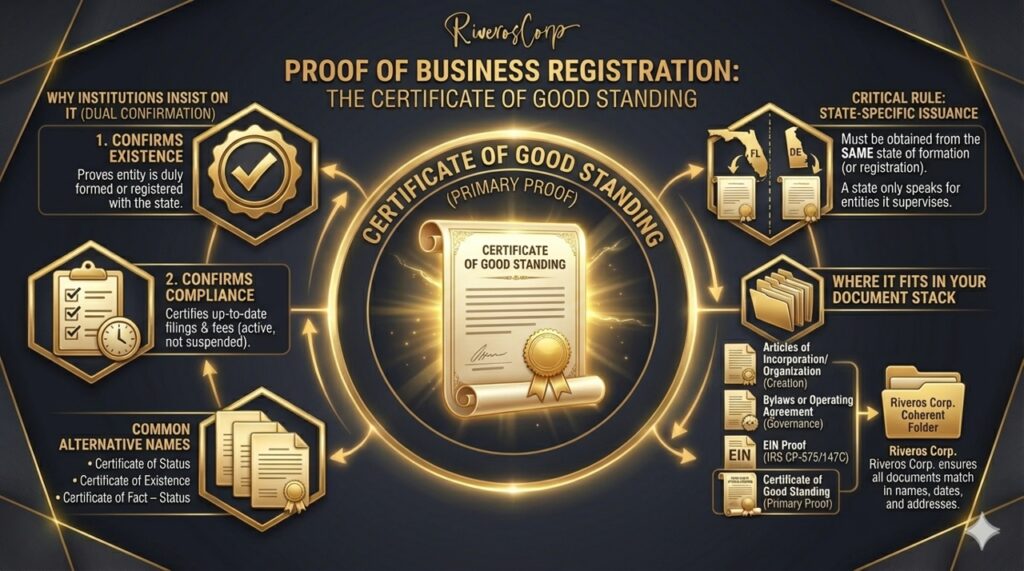
The most persuasive proof of business registration in the U.S. is a Certificate of Good Standing issued by the Secretary of State (or equivalent agency) of your formation state. Depending on the jurisdiction, the certificate’s name may vary:
Certificate of Good Standing
Certificate of Status
Certificate of Existence
Certificate of Fact – Status
Regardless of the label, the content is similar: your legal name, entity type (LLC/corporation), formation date or registration date, and a statement that the entity is authorized to do business and current on its statutory obligations at the time of issuance.
Important: This certificate is state-specific. If you formed in Florida, you obtain proof of business registration from Florida; if you’re a Delaware corporation, you obtain it from Delaware—not from another state.
Why do institutions insist on a Certificate of Good Standing?
Because the certificate does two things in a single page:
Confirms existence. It proves your entity is duly formed or registered with the state.
Confirms compliance. It certifies you are up to date on required filings and fees (annual report/franchise tax), so the entity is active—not suspended or dissolved.
Banks, payment processors, enterprise customers, and landlords use this proof of business registration to finish onboarding, open accounts, approve merchant profiles, or sign leases. Foreign registries and banks rely on it as the state’s official voice, and usually accept it once apostilled for countries under the Hague Convention.
Where the certificate fits in your document stack
Your proof package typically includes:
Articles of Incorporation/Organization (show how the entity was created)
Bylaws or Operating Agreement (governance rules)
EIN proof (IRS CP-575 or 147C)
Certificate of Good Standing (your primary proof of business registration)
Some recipients ask only for the certificate; others want the whole set. Riveros Corp. prepares a coherent folder so all documents match in names, dates, and addresses.
You must obtain proof in the same state of formation (or registration)
A state can only speak for entities it supervises. Therefore:
If your LLC was formed in Florida, Florida is the only state that can issue your Certificate of Status/Good Standing.
If your corporation was formed in Delaware but operates in California as a foreign corporation, you can obtain a Delaware Good Standing and, separately, a California Certificate of Status for your foreign registration—each proves status in that jurisdiction.
Riveros Corp. maps your footprint (domestic and foreign registrations) and orders the correct certificate(s) so the recipient gets exactly what they expect.
Domestic uses for proof of business registration
Banking/KYB: Opening corporate accounts often requires proving both business existence and owner integrity. While we handle the corporate proof here, our Compliance Officers division can assist with any required background checks for signers.
Payment processors & marketplaces: Underwriting and ongoing monitoring.
Leases & utilities: Landlords or providers verify your right to contract.
Insurance & grants: Carriers and agencies confirm active status before binding policies or awarding funds.
Government contracts: Procurement teams check that you are not suspended or administratively dissolved.
In every case, a fresh proof of business registration removes doubt and speeds approvals.
International use: apostille and legalization
When your proof will be used outside the U.S., recipients often require an apostille or authentication/legalization:
Hague Apostille: For countries participating in the Hague Apostille Convention, our specialized division Apostille de la Haya obtains the state-issued certificate and files it for apostille with the competent authority. The apostille authenticates the signature and capacity of the state officer who signed your certificate—not your underlying business details.
Non-Hague destinations: We follow the authentication path and, if the destination requires it, consular legalization.
Translations: Some authorities request a translation with a translator’s notarized statement. Through our Notary Public Center, we handle the precise notarization required and attach the apostille to the correct piece (translator statement or the state certificate), depending on the recipient’s rulebook. (Exceptions may apply)
Riveros Corp. confirms acceptance first, so you submit once. Timeframes may vary.
How Riveros Corp. gets your proof of business registration (step by step)
1) Acceptance-first intake
Tell us who will receive the document (bank, PSP, landlord, foreign registry) and where it will be used (U.S. or abroad). This determines whether you need just the state certificate, a notarized officer letter in addition, a translation, or an apostille.
2) Compliance check
A state won’t issue a Certificate of Good Standing if your entity is not compliant. We confirm and, if needed, help you file the annual report or resolve franchise tax issues before we order the certificate. This prevents rejections.
3) Ordering from the correct state
We request the certificate from the formation state (and any foreign-registration states requested by your recipient). Some states issue digital certificates with verification codes; others mail paper originals. We’ll select the format the recipient prefers.
4) Apostille or authentication (optional)
If the certificate will be used abroad, we route it to the competent authority for apostille or authentication/legalization, then coordinate delivery. We can add notarized translations when required. Timeframes may vary.
5) Delivery and storage
We send verifiable PDFs (when issued by the state) and ship originals securely. We also advise how to store the certificate for later reuse without damaging any stapled apostille packet.
Riveros Corp.: end-to-end support you can rely on
Formation and governance: We form your LLC or corporation, set up the registered agent, and draft bylaws/operating agreements.
EIN acquisition: We secure your EIN for founders with or without SSN and provide IRS proof (CP-575 or 147C).
Proof of business registration: We obtain your Certificate of Good Standing from the correct state—and from foreign-registration states if needed.
Apostille & legalization: We route state certificates through apostille or authentication/legalization, and coordinate translations.
Bank-ready packaging: We assemble a clear, consistent folder that institutions approve the first time. Timeframes may vary.

Need proof of business registration that banks, marketplaces, and foreign authorities will accept—without back-and-forth? Contact Riveros Corp. We’ll obtain your Certificate of Good Standing from the right state, align it with your other corporate documents, and, if required, secure the apostille (or authentication/legalization). We manage timelines, formats, and delivery so you can move forward. Timeframes may vary.
FAQ
What Exactly Is a Certificate of Good Standing?
A Certificate of Good Standing —sometimes called a Certificate of Existence or Certificate of Status depending on the state— is an official document issued by the state agency where your company is registered, usually the Secretary of State. It confirms that your business legally exists, was properly formed, and has kept up with its state requirements, such as annual reports and franchise taxes.
This is why it is considered the gold standard for proof of business registration. Unlike an internally generated document or a screenshot of a state website, a Certificate of Good Standing is issued and signed by the state itself, which is exactly the kind of authority that banks, investors, and foreign governments look for when they need to trust that your company is real and compliant.
Why a Screenshot or Formation Document Is Not Enough
Many owners assume that their Articles of Organization, an EIN letter, or a printout from the state’s business search is enough to prove registration. In practice, these documents only show that a company was formed at some point — they say nothing about whether it is currently active and compliant. A business can be formed and later fall out of good standing for missing a report or a fee.
A Certificate of Good Standing closes that gap. It reflects your company’s status as of the issue date, confirming not just that you registered but that you remain in compliance right now. That current, state-verified snapshot is precisely what serious counterparties require before they open an account, sign a contract, or approve a transaction.
When Will You Be Asked for Proof of Business Registration?
Requests for proof of business registration come up more often than most owners expect. Common situations include:
- Opening a business bank account or applying for a merchant account.
- Applying for financing, loans, or lines of credit.
- Registering to do business in another state (foreign qualification).
- Onboarding with marketplaces or payment processors.
- Signing contracts with enterprise clients or vendors who verify their partners.
- Expanding abroad, where foreign authorities and banks require an authenticated certificate.
In each of these cases, presenting the right document the first time saves you days of back-and-forth and avoids stalled deals.
Using Your Certificate Abroad: Why the Apostille Matters
If you plan to present your proof of business registration outside the United States, the Certificate of Good Standing usually needs an apostille. An apostille is a standardized certificate created by the Hague Convention of 1961 that authenticates the signature and seal on the document so that authorities in more than 120 member countries will accept it without further legalization.
Without the apostille, a foreign bank or government has no reliable way to confirm that your state-issued certificate is genuine. This is a frequent stumbling block for owners expanding internationally: they obtain the certificate but forget the authentication step, and the document gets rejected abroad. Handling both steps together avoids that delay entirely.
How to Obtain a Certificate of Good Standing
- Confirm the correct state: the certificate must come from the state where your company is registered.
- Verify your filings are current: outstanding annual reports or fees can prevent the state from issuing the certificate.
- Request the certificate from the state agency (typically the Secretary of State).
- Add an apostille if needed: required when the document will be used internationally.
- Deliver it where required: to the bank, marketplace, or foreign authority requesting it.
A single missed report or an outdated filing can hold up the entire process, which is why many owners prefer to have the request handled by a partner who verifies compliance first.
Common Mistakes That Delay Proof of Business Registration
- Submitting a formation document instead of a current Certificate of Good Standing.
- Requesting the certificate from the wrong state.
- Not realizing the company has fallen out of good standing due to a missed report or fee.
- Forgetting the apostille when the document will be used abroad.
- Waiting until the last minute, when processing times can jeopardize a deadline.
Each of these mistakes is avoidable with a little planning and the right guidance, turning a potential roadblock into a routine step.
1) What is the most widely accepted proof of business registration in the U.S.?
A Certificate of Good Standing (a.k.a. Certificate of Status/Existence) issued by your formation state.
2) Can I get proof of business registration from any state office?
No. You must obtain it from the same state where the company was formed or registered as a foreign entity. Other states can’t certify your status.
3) How long is a Certificate of Good Standing “valid”?
There’s no universal expiration, but recipients often require a certificate issued within the last 30–90 days. Ask your recipient; we’ll time the order accordingly. Timeframes may vary.
The information contained in this publication is provided for general informational purposes only and does not constitute legal advice. Reading or using this content does not create and is not intended to create an attorney-client relationship. No reader or user should act or refrain from acting based on the information presented herein without first consulting an attorney duly licensed to practice law in their jurisdiction.