
If you’ve been googling “apostillation meaning,” here’s the plain answer: the correct term is apostille. It’s an internationally recognized certificate that lets a public document issued in one Hague Convention country be used in another, without consular legalizations. In practice, the apostille authenticates the signature, capacity, and seal of the official who signed your document. At APOSTILLE DE LA HAYA, we combine document pre-check, vital-records procurement (via our Notary Public Center expertise), and apostille filing so your paperwork is accepted the first time—whether your document starts as a notarized private paper or as a government record.
“Apostillation” vs. apostille: clearing up the term
Let’s align language and law:
Apostille is the legal word used by the Hague Conference on Private International Law (HCCH) and by competent authorities around the world. The certificate format is standardized by the 1961 Convention.
“Apostillation” is a common search term or colloquial variant. We’ll use it here for SEO clarity, but your destination authority will look for the word apostille on the certificate.
Wherever you see “apostillation,” read “apostille.” The meaning is the same: one certificate, recognized by all Hague parties, that replaces older, multi-step legalizations.
What an apostille does—and does not do
What it does:
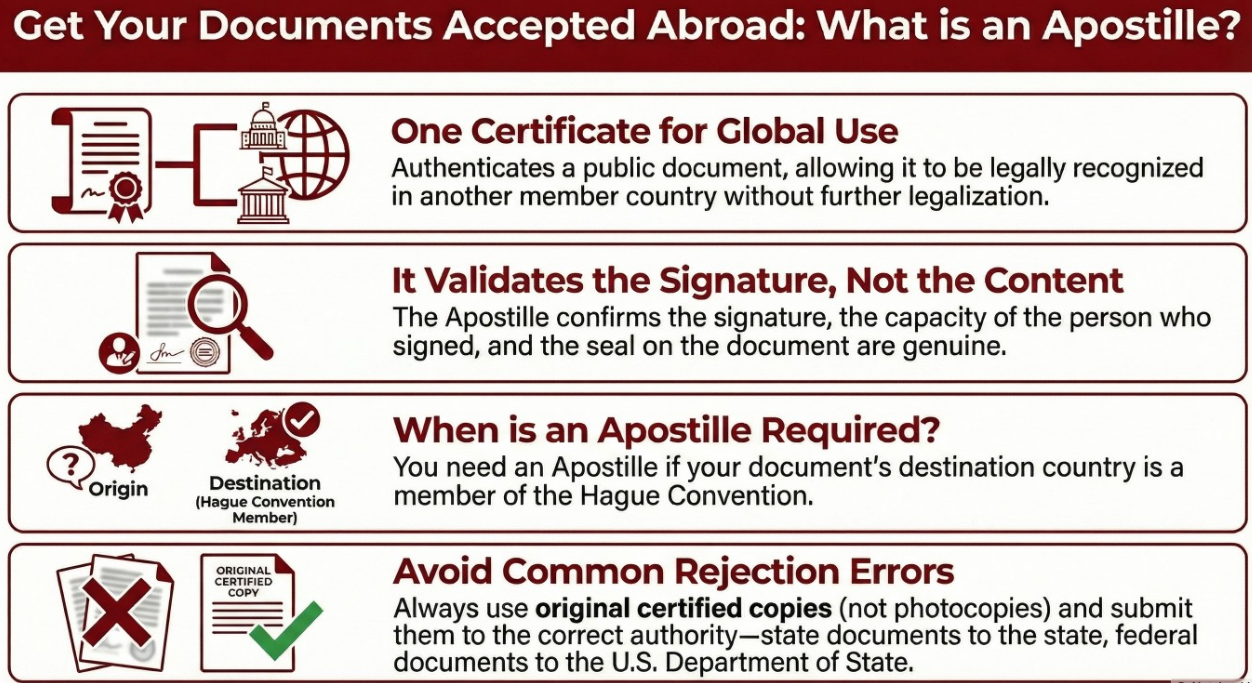
Confirms that the signature/seal on your document is genuine and that the signer held the stated capacity (notary, registrar, clerk, etc.).
Allows the document to be used in another Hague country without additional consular legalization.
What it doesn’t do:
It does not validate the content of the document or grant legal rights by itself.
It does not convert a non-public document into a public one; the underlying document must already be eligible for apostille under local law.
When do you need an apostille (vs. authentication)?
Use this rule of thumb:
If your destination is a member of the 1961 Hague Convention, you need an apostille.
If your destination is not a member, you need an authentication certificate, often followed by consular legalization. The U.S. Department of State emphasizes that the country of use determines the certificate.
For U.S. documents, authority is decentralized:
State or local documents (e.g., notarized documents, vital records, court papers): apostille from that state’s competent authority (usually the Secretary of State).
Federal documents (e.g., FBI checks, federal letters): apostille from the U.S. Department of State.
How APOSTILLE DE LA HAYA works your case
We design our service so you don’t bounce between offices or get rejected for avoidable errors. Here’s our two-phase model.
Phase 1 — Digital review: “can this be apostilled?”
Before we touch paper, we run a document triage:
Destination check. We confirm if your country of use is Hague (apostille) or non-Hague (authentication). We match the path to your use case—marriage abroad, dual citizenship, studies, banking, corporate filings, and more.
Document type mapping. We classify your document as:
Notarized private document (e.g., affidavit, power of attorney, consent letter), or
Public record (e.g., vital record, court record, state letter).
Signature chain. We verify that the signing official or notary is recognizable by the competent authority that will issue the apostille. If something is missing (wrong certificate, missing seal, unofficial copy), we fix it now.
Format decision. We advise whether a paper apostille or e-Apostille will suit the receiver and how they will verify it (e-Register, phone registry, etc.).
You’ll get a clear checklist of the exact originals we need and any wording/witness requirements. Timeframes may vary depending on offices and seasons.
Phase 2 — Physical issuance: filing, tracking, and return
When the file is ready, we manage the logistics:
State documents: we present to the state’s competent authority (usually the Secretary of State).
Federal documents: we route to the U.S. Department of State (with DS-4194 and required steps).
Delivery: we return the original apostilled packet and, if you need it, send a scan for your digital records. If your receiver accepts e-Apostilles, we provide verification instructions (e-Register lookup, etc.).
Vital records: we obtain the right originals, then apostille them
Apostilles on vital records (birth, marriage, death, divorce) require certified copies issued by the state or local vital records office where the event occurred. The federal government does not hold a national registry; you must go to the state/county/city that recorded the event.
How we help:
Source the correct office using the CDC/NCHS directory (“Where to Write for Vital Records”). We confirm eligibility, ID, and any long-form preference common in foreign procedures.
Order certified originals. Only original certified copies are apostillable—scans or notarized photocopies won’t work.
Submit for apostille. We file at the state level over the registrar’s signature.
Return & scan. We ship your physical original back safely and can provide digital scans for your files.
Tip: If you need a foreign birth/death record instead, the CDC suggests contacting the embassy/consulate of that country. We can coordinate with you so your foreign document is ready for the next step.
Notarized documents: from clean certificates to apostille
For private documents, the apostille authenticates the notary’s signature. Our job is to make the notarial part airtight:
We ensure the correct notarial certificate (acknowledgment vs. jurat).
For online signings, we can work with your existing Remote Online Notarization (RON) result if your receiver accepts e-notarized documents. If not, we’ll route a wet-ink notarization first. We recommend using Notary Public Center for high-stakes notarizations to ensure the certificate is accepted by the Competent Authority.
We check names, dates, venue, and witness lines so the Secretary of State doesn’t reject the packet on technicalities.
Examples: where “apostillation” shows up in real life
Marriage abroad. A registry asks for an apostilled single-status letter and an apostilled birth certificate. We obtain the vital record, draft or procure the single-status proof appropriate to your state/county, then route apostilles on both.
Citizenship by descent. A consulate wants long-form birth/marriage records and an apostilled affidavit explaining a name change. We source the long-forms, prepare the affidavit with the right notarial language, and file apostilles.
Corporate use. A foreign bank requests an apostilled officer’s certificate. We prep the notarial block, coordinate a notarization that the state will recognize, and secure the apostille—plus verification guidance for their compliance team.
Common pitfalls we prevent
Wrong certificate for the base doc. Affidavits usually need a jurat, not an acknowledgment; the wrong block can derail apostille.
Trying to apostille a photocopy. Competent authorities require originals (or official certified copies for public records).
Using a federal path for a state document (or vice versa). State-issued items go to the state; federal items go to the U.S. Department of State.
Quick glossary (share with stakeholders)
Apostille — A one-page certificate under the 1961 Hague Convention that authenticates the signature/seal on a public document for use in another member country.
Authentication — A certificate for use in non-Hague countries (often followed by consular legalization).
Competent Authority — The office that issues apostilles (e.g., a U.S. Secretary of State for state documents; U.S. Department of State for federal).
Vital records — Government records of birth, marriage, death, divorce; obtained from the state/county/city where the event occurred.

Why choose APOSTILLE DE LA HAYA
End-to-end management: from document vetting and vital-records procurement to apostille filing (paper or electronic) and return logistics.
Right path, first try: we match Hague vs. non-Hague routes and confirm receiver acceptance up front.
No surprises on originals: we only work with original certified public records and properly executed notarizations that competent authorities will accept.
Ready to turn “apostillation meaning” into documents accepted abroad? Contact APOSTILLE DE LA HAYA. We’ll obtain vital records, prepare or verify your notarized papers, and secure the apostille (or authentication) your destination requires—then return your originals and provide scans for your files.
FAQ
1) How do I get a birth or marriage certificate ready for apostille?
We obtain the certified original from the correct office in the state/county where the event occurred, then file for the apostille. The federal government doesn’t hold these records centrally.
2) Who decides if I need apostille vs. authentication?
Your country of use. The State Department notes: apostille for Hague countries; authentication for non-Hague.
3) Can an online-notarized document receive an apostille?
Yes. The apostille authenticates the notary’s signature, not the meeting format. That said, some receivers still prefer wet-ink. We confirm acceptance before filing.
The information contained in this publication is provided for general informational purposes only and does not constitute legal advice. Reading or using this content does not create and is not intended to create an attorney-client relationship. No reader or user should act or refrain from acting based on the information presented herein without first consulting an attorney duly licensed to practice law in their jurisdiction.