You have the document in your hands. It could be a university degree for a master’s program in Spain, a power of attorney for a business deal in Japan, or a birth certificate for securing dual citizenship in Italy. This single piece of paper is your key to an exciting new chapter. But then you hit a wall. The receiving institution abroad tells you the document must be «apostilled and notarized.»
For most people, this phrase is a confusing piece of bureaucratic jargon. What does it even mean? Aren’t they the same thing? Do you need one or the other, or both? The stress begins to mount. You envision endless paperwork, confusing government websites, and the terrifying possibility of rejection due to a small mistake.
As we navigate the interconnected world of July 2025, the need to validate documents across borders is more common than ever. If you’re feeling lost, you’ve come to the right place. This guide will not only clarify what it means to get a document apostille notarized, but also show you the most efficient, secure, and stress-free path to getting it done right the first time.
Notarization and Apostille: Demystifying the Critical Difference
The number one point of confusion is the distinction between a notary public’s seal and an apostille certificate. They are two separate layers of authentication, and understanding their roles is the first step to a successful process.
What is Notarization?
Think of notarization as the foundational step. A Notary Public is a state-licensed official who acts as an impartial witness to the signing of documents. Their primary functions are:
Verifying Identity: The notary confirms the identity of the person signing the document using valid photo identification.
Ensuring Willingness: They ensure that the signer is not being forced or coerced into the agreement.
Administering Oaths: For documents like affidavits, a notary can administer a legal oath.
When a document is notarized, the notary applies their stamp or seal and signature. This seal verifies the authenticity of the signature on the document at a local, state level. It tells officials within the United States that you are who you say you are and you signed the document willingly.
What is an Apostille?
An apostille, on the other hand, operates on an international level. It is a direct result of the 1961 Hague Convention, an international treaty created to simplify the cumbersome process of legalizing documents for use abroad.
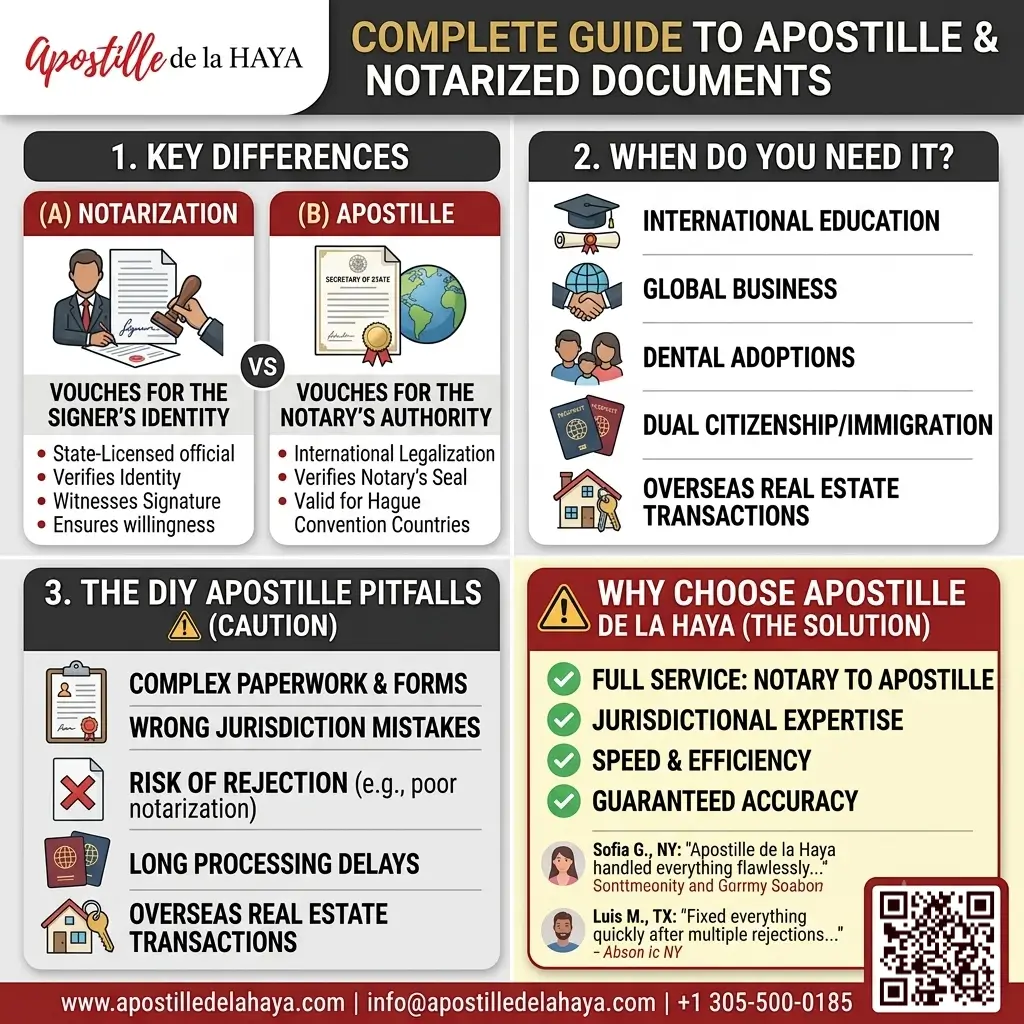
If notarization verifies your signature, an apostille verifies the notary’s authority.
When you get an apostille, a designated government body (usually the Secretary of State in the state where the notary is commissioned) attaches a certificate to your notarized document. This certificate, the apostille, confirms that the notary’s commission is valid and their seal is genuine.
In short:
Notary: Vouches for the signer’s identity.
Apostille: Vouches for the notary’s authority.
A country that is a member of the Hague Convention will accept an apostilled document without requiring any further legalization from their embassy or consulate. It’s an all-in-one international seal of approval.
When Do You Need an Apostille Notarized Document?
Now that the distinction is clear, when does this two-step process become necessary? You will almost always need an apostille notarized document when a private document or a public document that you must sign is intended for use in another country.
Here are some of the most common scenarios we see in 2025:
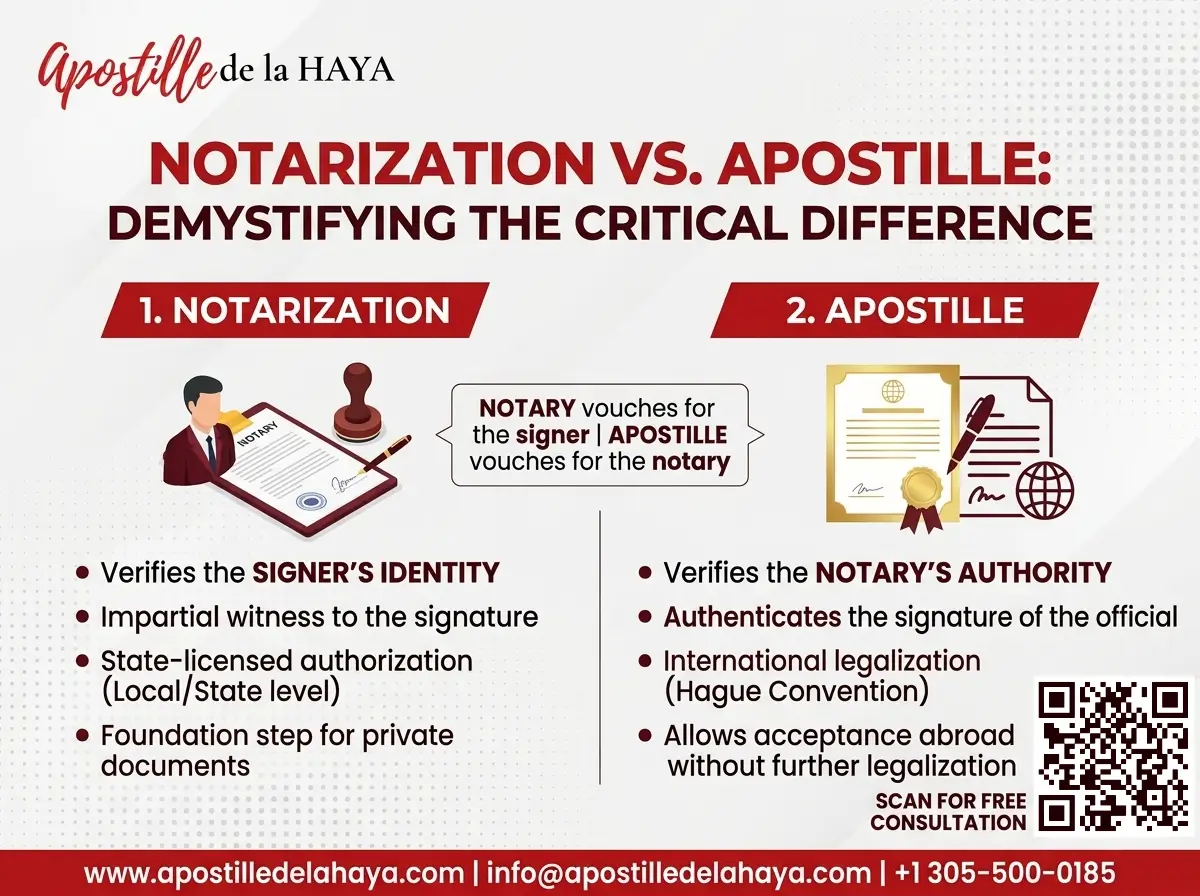
International Education: Applying to foreign universities with your transcripts, diplomas, and letters of recommendation.
Global Business: Executing powers of attorney, company bylaws, commercial invoices, or articles of incorporation for international subsidiaries.
Destination Weddings: Providing birth certificates, single-status affidavits, and other personal documents to foreign marriage authorities.
Dual Citizenship & Immigration: Submitting birth certificates, marriage certificates, or FBI background checks to foreign governments.
Overseas Real Estate Transactions: Signing deeds, mortgage documents, or sales agreements for property located abroad.
International Adoptions: Presenting legal paperwork, home studies, and personal documents to complete an adoption process.
If your document falls into any of these categories and is destined for a Hague Convention member country, you will need to have it notarized and then apostilled.
The DIY Apostille Process: A Path Fraught with Pitfalls
«Okay,» you might think, «I’ll just do it myself. How hard can it be?»
While technically possible, the do-it-yourself route is a minefield of potential errors, delays, and frustrations. The process is far from transparent, and a single misstep can send you back to square one, jeopardizing your deadlines.
Here’s what the typical DIY journey looks like:
Obtain the Correct Document: You need the original or a certified copy. A simple photocopy won’t work.
Find a Notary: You take your document to a local notary.
Potential Pitfall: The notarization must be perfect. If the notary uses the wrong wording, forgets to date it, or their seal is unclear, the Secretary of State will reject it.Identify the Competent Authority: Is it the Secretary of State? Which one? It must be the state where the notary is commissioned, not necessarily the state where the document originated or where you live now. Is it a federal document (like an FBI check)? If so, it has to go to the U.S. Department of State.
Potential Pitfall: Sending it to the wrong agency is a common and time-consuming mistake.Complete the Paperwork: You need to find the correct apostille request form, fill it out perfectly, calculate the correct fee, and include a pre-paid return envelope.
Potential Pitfall: An incomplete form or incorrect payment will lead to immediate rejection.Mail and Wait: You send your precious original document via mail and begin the waiting game. Current processing times in many states can be several weeks, not including mail transit time.
Potential Pitfall: The document could get lost in the mail, or the processing time could be far longer than you anticipated.
This process is stressful, opaque, and unforgiving. In 2025, with government agencies still facing backlogs, the risk of delay is higher than ever.
The Seamless Solution: Why Apostille de la Haya is Your Trusted Partner
This is where Apostille de la Haya steps in. We’ve transformed the confusing, multi-step ordeal into a single, streamlined service for any apostille notarized document you may need. More than just an apostille provider, we serve as your comprehensive document legalization partner. By identifying the biggest bottleneck—the disconnect between notarization and apostille—we designed our process to bridge that gap seamlessly.
We Handle Everything, from Notary to Apostille
Unlike other services that require you to bring them an already-notarized document (and hope it was done correctly), we manage the entire lifecycle.
Expert In-House Notarization: Our team includes experienced notaries who understand the precise requirements for an apostille. We ensure the notarization is flawless from the very beginning, eliminating the primary reason for rejection.
Jurisdictional Mastery: Don’t know which Secretary of State to send it to? Unsure if it’s a state or federal document? It doesn’t matter. We know.
Speed and Efficiency: We bypass common pitfalls and submit your documents correctly the first time, dramatically cutting down the overall turnaround time.
Guaranteed Accuracy: We review every detail and guarantee 100% correct paperwork.
Complete Peace of Mind: No confusing websites, no long waits on hold. We provide tracking and updates, and deliver your final document ready for international use.
About Our Expertise
Apostille de la Haya is led by a team with over 15 years of combined experience in notarization and international legalization. Our notaries and legalization experts are fully certified, insured, and continually trained to ensure every document meets strict international standards. We have successfully assisted thousands of clients worldwide, earning a reputation for trust and excellence.
What Our Clients Are Saying
«I needed to apostille notarized my university degree for a master’s program in Spain. Apostille de la Haya handled everything flawlessly and I received my document in less than a week. Absolutely stress-free!»
— Sofia G., New York
«We were in a rush to finalize an overseas real estate transaction. Apostille de la Haya’s expertise in apostille notarized documents saved us from missing our deadline. Professional and trustworthy.»
— Daniel T., California
«After struggling with the DIY process and facing multiple rejections, I turned to Apostille de la Haya. They fixed everything quickly and kept me updated at every step. Highly recommended!»
— Luis M., Texas
Mini-Case: International Adoption Success
A couple from Florida needed to apostille notarized several sensitive documents to complete an adoption process in Colombia. After failed attempts on their own, they turned to Apostille de la Haya. Our team handled notarization, state-level apostille, and document preparation in record time, allowing them to finalize the adoption without delays — and to bring their new baby home on schedule.
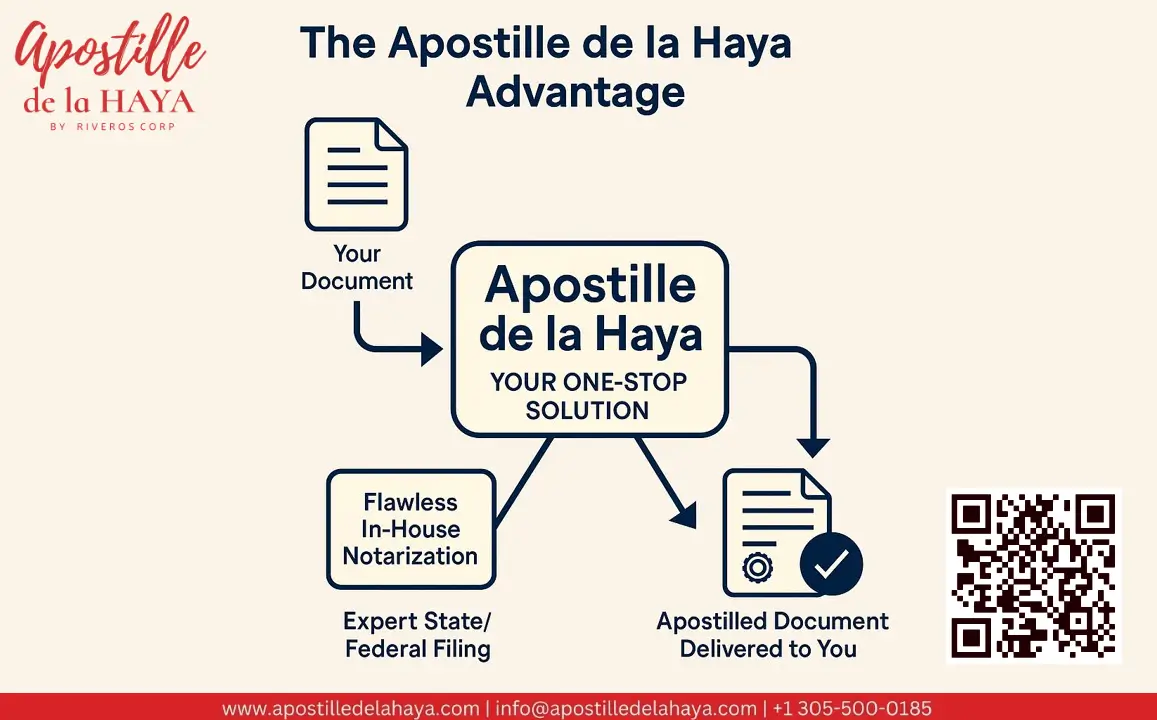
Our Simple, 3-Step Process
Contact Us & Send Your Document: We’ll consult with you and provide secure shipping instructions.
We Handle the Entire Process: Our experts notarize, prepare and submit all documents.
Receive Your Apostilled Document: Once completed, we return your finalized document via secure courier.
Don’t Let Bureaucracy Derail Your Plans
Your international ambitions—whether for education, business, or personal life—are too important to be left to chance. The apostille notarized requirement doesn’t have to be a source of stress.
By choosing Apostille de la Haya, you are choosing certainty. You are opting for a seamless, professional service that handles every complexity on your behalf. We provide the dual expertise in both notarization and apostille processing that ensures your documents are prepared perfectly, accepted globally, and delivered to you on time.
Ready to take the next step in your international journey with confidence?
Contact Apostille de la Haya today for a free consultation and let our experts handle the rest.
Transparency Note
This article was crafted by human experts, supported by advanced editorial tools (including AI) to ensure maximum clarity and accuracy.
Frequently Asked Questions (FAQ)
How long does the process take with Apostille de la Haya?
Timelines depend on the issuing authority and on the type of document. We confirm the expected timing before we start and keep you updated while the request is in process.
Can you apostille a document issued in a different state from where I live?
Absolutely. We handle documents from all 50 states and know exactly where to send them.
What is the difference between an Apostille and an Authentication/Legalization?
Apostilles are for Hague Convention countries. For others, authentication/legalization is needed. We handle both.
How much does it cost?
Pricing depends on the document type, issuing state, and service speed. Our fee includes notarization, government charges, and courier.
Legal Disclaimer
This article is provided for informational purposes only and does not constitute legal advice. The content herein is not intended to substitute professional legal consultation. For specific guidance regarding your individual circumstances, please consult directly with a qualified attorney licensed to practice in your jurisdiction.