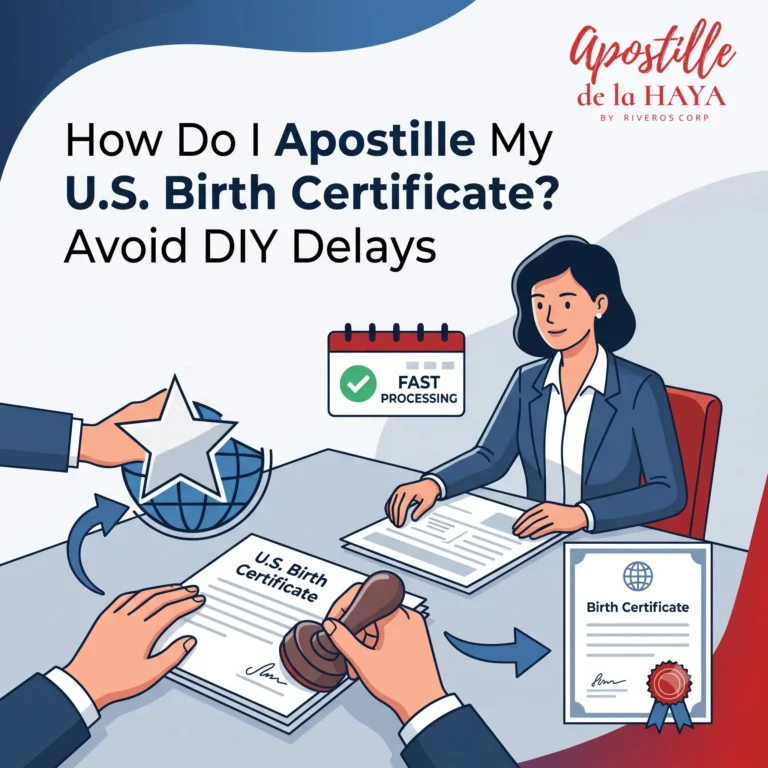
If you need to use your U.S. birth certificate in another country, and How Do I Apostille My U.S. Birth Certificate you’ll likely need an apostille to authenticate it. The apostille certifies that your document is legally valid and recognized internationally.
If you are planning to obtain dual citizenship, get married abroad, or apply for an international visa, you are likely asking yourself: how do I apostille my U.S. birth certificate? An apostille is a specialized certification that authenticates the origin of a public document so it can be legally recognized in countries that are members of the Hague Convention.
At Apostille de La Haya, we handle the entire apostille process for you, ensuring a fast and hassle-free experience. Whether you need an apostille for a birth certificate in Florida, California, Texas, or any other U.S. state, we take care of everything so you don’t have to deal with complicated paperwork or long wait times.
If you need to obtain your U.S. birth certificate before starting the apostille process, here’s a resource in Spanish that explains the steps clearly: Cómo obtener un Birth Certificate en USA (Spanish guide).
What Is an Apostille for a U.S. Birth Certificate?
An apostille is an official certification issued under The ague Convention of 1961, allowing documents to be legally recognized in other member countries. If you need to use your birth certificate abroad, an apostille ensures its validity.
At Apostille de la Haya, we handle the entire apostille process , making sure your document is properly certified and valid for international use.
In some cases, instead of a birth or marriage certificate, you may need a document that proves the absence of a prior marriage. This article explains the purpose and process of obtaining a Certificate of No Record of Marriage.
How Do I Apostille My U.S. Birth Certificate?
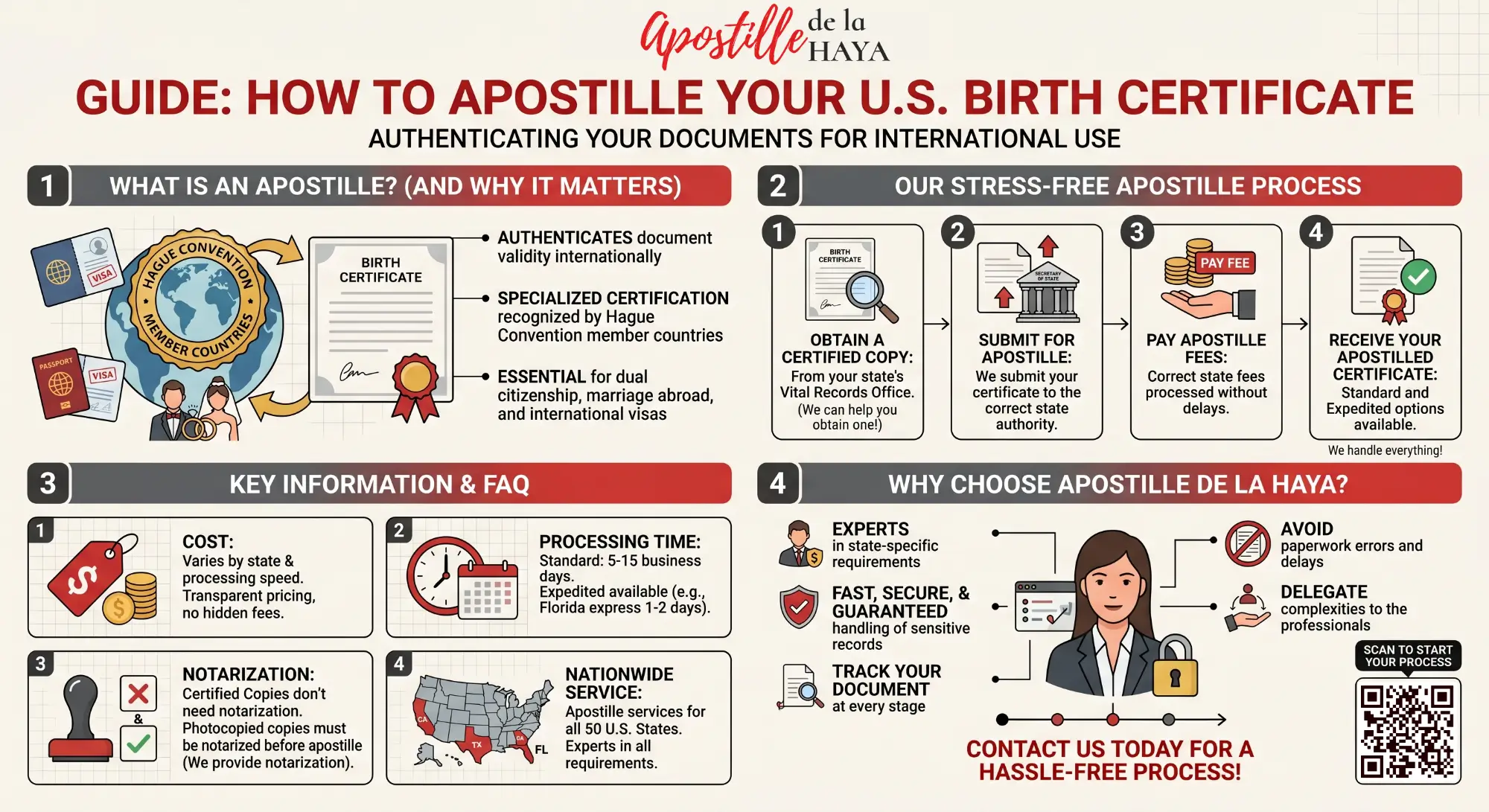
The process varies depending on where your birth certificate was issued. However, at Apostille de la Haya, we take care of the entire process for you, ensuring that everything is done correctly and efficiently.
1. Obtain a Certified Copy of Your Birth Certificate
Before you can apostille your U.S. birth certificate, you must obtain a certified copy from the Vital Records Office in the state where you were born.
If you don’t have a certified copy, Apostille de la Haya can assist you in obtaining one.
2. Submit Your Birth Certificate for Apostille
Once you have a certified copy, we handle the submission process for you.
State-Issued Birth Certificates: We submit your birth certificate to the Secretary of State in the state where it was issued.
3. Pay the Apostille Fee
Each state has different fees for apostille services. Apostille de la Haya ensures that your payment is processed correctly, avoiding delays.
4. Receive Your Apostilled Birth Certificate
Processing times vary by state, but we offer standard and expedited services to fit your needs.
At Apostille de la Haya, we make sure you receive your apostilled birth certificate as quickly as possible.
Where to Apostille a Birth Certificate in the U.S.?
Each state has a designated office that handles apostille services. Instead of navigating through complex state processes, let Apostille de la Haya handle the entire process for you.
We provide apostille services nationwide, including:
Florida: Florida Secretary of State – Apostille
California: California Secretary of State – Apostille
Texas: Texas Secretary of State – Apostille
If you’re unsure where to submit your birth certificate, Apostille de La Haya will guide you through the process.
How Much Does It Cost to Apostille a Birth Certificate?
- The cost of an apostille for a U.S. birth certificate depends on the state and processing speed.
At Apostille de la Haya, we offer affordable apostille services with transparent pricing and no hidden fees.
How Long Does It Take to Apostille a Birth Certificate?
Processing times depend on the state and service speed, standard processing: 5-15 business days.
If you need an apostille urgently, Apostille de la Haya offers fast-track services to get your document processed as quickly as possible.
Do I Need to Notarize My Birth Certificate Before Apostille?
No, a certified U.S. birth certificate does not need notarization before apostille. However, if you only have a photocopy, it must be notarized before apostille.
At Apostille de la Haya, we notarize documents and handle the apostille process for you.
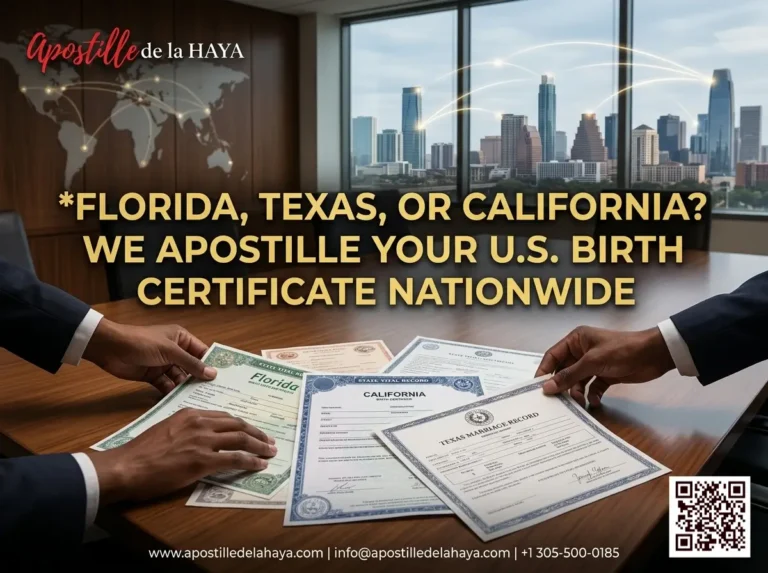
Apostille Services for Birth Certificates in Florida, Texas, California.
Each state has different rules for apostille processing.
At Apostille de la Haya, we are experts in the apostille requirements for all U.S. states, ensuring a smooth and error-free process. We apostille birth certificates nationwide, handling everything from document verification to final delivery.
In Florida, we can offer express apostille service within 1 to 2 business days in certain cases, ensuring a fast turnaround when you need it most. Additionally, each state has specific rules for apostille processing.
No matter which state your birth certificate was issued in, Apostille de la Haya handles the entire apostille process across the U.S. with a fast, secure, and reliable service.
Not all providers are authorized or reliable when it comes to handling sensitive documents. Learn exactly who can apostille a document in the USA and why Apostille de la Haya is a trusted choice for international document legalization: Who Can Apostille a Document in USA Why Trust Apostille de la Haya for Your Apostille Needs.
Apostille Your U.S. Birth Certificate with Apostille de La Haya
Getting an apostille for your U.S. birth certificate doesn’t have to be complicated. At Apostille de La Haya, we take care of everything for you.
We handle the entire apostille process from start to finish.
- Fast and secure processing with standard and expedited options.
- Certified and guaranteed authentication of your documents.
- Nationwide apostille services for all 50 states.
If you need an apostille for your U.S. birth certificate, Apostille de La Haya will take care of everything for you.
Delegate Your Apostille Needs to the Experts
Do not risk missing your critical international deadlines due to a paperwork error. An improperly authenticated birth certificate can ruin a real estate transaction, delay a visa approval, or pause a dual citizenship application indefinitely.
Leave the complexities of government processing to the professionals at Apostille de la Haya. Our team tracks your document at every stage, secures the necessary state authentications, and delivers a fully apostilled birth certificate ready for global use. Contact us today to start your process and guarantee the international validity of your vital records.
Contact us today and get your apostilled birth certificate hassle-free!

Sequencing: Apostille First, or Translation First?
A frequent question is whether to get the apostille first or the translation first. Some receiving authorities want the apostille issued first, then a translation that references the apostille page (dates, seals). Others want the birth certificate apostilled with the translation attached separately. A few request a translator’s notarized statement, which may itself need to be apostilled. Confirming the correct sequence before starting avoids doing the same work twice and having to redo a translation once the wrong order becomes clear.
Do You Also Need Your Birth Certificate Translated? Certified vs. Sworn vs. Standard
If your destination asks for your birth certificate translated and apostilled, know that «translated» is not one single standard. Matching the right type of translation to what your recipient actually requires is the fastest way to avoid a rejected submission and paying to redo the work.
Certified, sworn, or standard — know what they’re asking for
- Standard translation: conveys the meaning of the document. Fine for informal or internal use.
- Certified translation: adds a signed statement from the translator attesting to accuracy and completeness — frequently required by universities, USCIS, and many foreign registries.
- Sworn translation: produced by a translator officially authorized by a government or court. Common in civil-law countries such as Spain, Italy, and much of Latin America.
Ask your recipient — in writing — which of the three they require before you start. Rules change by recipient and by country.
When a non-certified translation is enough
Many private recipients (employers, agencies doing a preliminary review, some university offices) accept a clear, non-certified Spanish translation attached to the apostilled birth certificate. That is exactly what Apostille de la Haya prepares: a faithful rendering of names, places, dates, marginal notes, seals, and certificate numbers, formatted so a reviewer can compare the translation and the original line by line. Our translation is non-certified; if your destination explicitly requires a certified or sworn translation, we help you confirm that requirement so you use the correct channel and avoid rework.
Common scenarios that need both a translation and an apostille
- Marriage abroad: civil registries in many Hague countries want an apostilled birth certificate plus a Spanish translation.
- Dual citizenship: consulates often require a recent certified copy with apostille; translation rules vary by country.
- University admission: schools may ask for a translation for internal evaluation — sometimes non-certified is fine, sometimes not.
- Residency / immigration: authorities may demand apostille plus translation, and a specific order.
In every scenario, acceptance rules change by recipient. That is why we work acceptance-first: we confirm what your recipient accepts, then prepare the document — so it is accepted the first time. (For the order of steps, see the section above on whether to apostille first or translate first.)
State-issued, territory-issued, and consular birth certificates are not apostilled the same way
The single biggest source of confusion is where your birth certificate came from, because that determines which authority issues the apostille:
- State-issued certificates (the most common case) are apostilled by the Secretary of State of the state that issued them—not by the federal government. A certificate from Florida is apostilled in Florida, one from Texas in Texas, and so on.
- Certificates from U.S. territories such as Puerto Rico follow that territory’s own vital-records and apostille channel, which has its own timelines and requirements.
- Consular Reports of Birth Abroad (CRBA, Form FS-240)—issued when a U.S. citizen is born outside the country—are federal documents and must be apostilled by the U.S. Department of State in Washington, D.C., not by any state office.
Sending a state document to the federal office, or a federal one to a state office, is the classic mistake that gets a package returned weeks later. Confirming the issuing authority first is what keeps a birth-certificate apostille on schedule.
Hague vs. non-Hague countries: apostille or full legalization?
An apostille only works when the destination country is a member of the Hague Apostille Convention. For those countries, a single apostille certificate is all the authentication you need. If the country where you’ll use the birth certificate is not a member of the Convention, an apostille won’t be accepted—instead you need legalization, a longer chain that typically runs from the state authentication to the U.S. Department of State and finally to that country’s embassy or consulate.
Because the two paths look similar at the start but diverge completely, the destination country should be the very first thing you confirm. Choosing the wrong track means paying for and waiting on a certification the receiving authority will simply reject.
Why birth-certificate apostilles get rejected—and how to avoid it
Even when you use the right authority, apostille packages come back for a handful of predictable reasons. Knowing them in advance saves a full round-trip:
- A photocopy or hospital “souvenir” certificate instead of a certified copy issued by the state vital-records office. Only the certified copy can be apostilled.
- A certificate that is too old or worn, missing the current registrar’s signature or seal—many authorities want a recently issued certified copy.
- Name or date discrepancies between the certificate and your other documents, which trigger extra verification.
- The wrong receiving-country format, such as skipping a required certified translation or attaching it in the wrong order.
Every one of these is avoidable with a quick review before submission. That is exactly the step Apostille de La Haya handles for you—checking the document, the issuing authority, and the destination requirements so it clears on the first attempt instead of coming back weeks later.
Need your documents apostilled?
Apostille de La Haya handles your apostille from start to finish, avoiding the common mistakes that delay the process. Message us and we will review your document.
Talk to Apostille de La HayaFAQ
1. Can I use a photocopy to apostille my U.S. birth certificate?
No. State authorities will never issue an apostille on a standard photocopy or a notarized copy of a vital record. You must provide an original, certified copy issued by the state or county Department of Health or Vital Statistics. Our team can guide you on securing the correct certified copy if you do not have one.
2. Does the federal Department of State apostille birth certificates?
No. U.S. birth certificates are state-issued public documents. Therefore, they must be apostilled by the Secretary of State of the specific state where you were born. The federal U.S. Department of State only authenticates federally issued documents, such as FBI Background Checks.
3. What happens if my birth certificate is very old?
Many states will reject older birth certificates because the signature of the official who issued it is no longer on file, or the document lacks modern security features. In most cases, it is highly recommended (and sometimes mandatory) to obtain a newly issued certified copy before requesting the apostille.
4. How long does it take to get an apostille?
On Apostille de la Haya, we utilize streamlined processing and expert oversight to significantly reduce turnaround times and avoid the delays caused by preventable errors.
5. Why shouldn't I just mail the application myself?
Mailing the application yourself leaves you completely blind to the status of your document. If there is a minor discrepancy—like a missing fee or an unrecognized signature—the state will simply mail it back weeks later without fixing it. Trusting Apostille de la Haya ensures your document is audited beforehand, routed correctly, and returned to you successfully the first time.
The information contained in this publication is provided for general informational purposes only and does not constitute legal advice. Reading or using this content does not create and is not intended to create an attorney-client relationship. No reader or user should act or refrain from acting based on the information presented herein without first consulting an attorney duly licensed to practice law in their jurisdiction.