
If you’re searching for certified copies, chances are you need a birth, marriage, death, or divorce record to be accepted by a bank, university, court, consulate, or foreign civil registry. Here’s the central rule: for apostille or international filing, photocopies won’t cut it. You need certified copies—the kind issued by the record custodian with a fresh signature and seal.
At Notary Public Center, we make the process practical and reliable. We obtain certified copies of vital records nationwide (except New York & New Jersey), verify acceptance with your destination, and then route apostille or authentication/legalization so you can use the document abroad. If a related affidavit, translator statement, or corporate paper also needs notarization, we do that online or in person, and package everything for first-try acceptance.
What exactly is a “certified copy”?
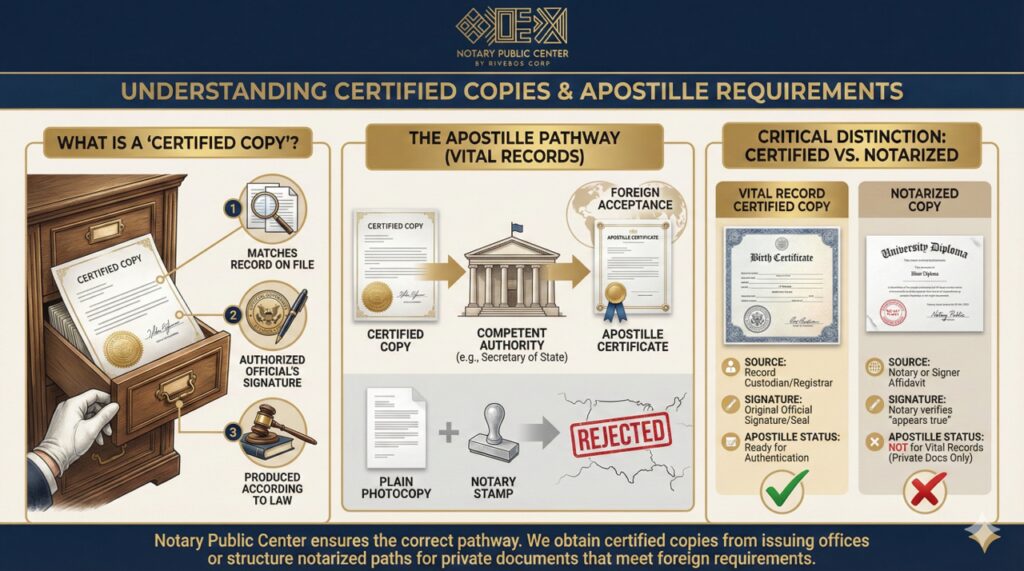
A certified copy is an official duplicate of a public record that carries the signature and seal of the record custodian—for vital records, that’s typically a state or county registrar (or a city clerk in some jurisdictions). The certification tells a receiving authority that:
The copy matches the record on file.
The person certifying (registrar/official) is authorized and their signature is on record with the state.
The copy was produced according to law, not just scanned at home.
Because a certified copy bears a public official’s signature, a Secretary of State can later authenticate that signature with an apostille (for Hague countries) or an authentication certificate (for non-Hague countries). This chain of signatures is exactly what foreign authorities expect.
Why only originals or certified copies qualify for apostille
An apostille does not evaluate the truth of the content. As emphasized by our specialized division Apostille de la Haya, it authenticates the signature and capacity of the public official who signed the document—e.g., a registrar or a notary. If a document is merely a photocopy without a recognized official signature, there’s nothing for the apostille office to validate.
For vital records, the accepted pathway is:
Obtain a certified copy issued by the correct office (state, county, or city).
Present that certified copy for apostille at the competent authority (usually the state Secretary of State).
If required by your destination, add translation and clarify whether the apostille should attach to the translator’s notarized declaration or remain on the record itself.
Trying to notarize a plain photocopy of a birth or marriage certificate and then seeking an apostille on the notary’s signature is usually rejected. Why? Because the apostille would authenticate the notary, not the registrar, and many foreign authorities require the registrar-signed certified copy instead.
Certified copies vs. notarized copies: what’s the difference?
This is a common point of confusion, so let’s make it crystal clear:
A certified copy (vital record) comes from the record custodian (registrar) with their original signature and seal. It’s purpose-built for apostille/authentication.
A notarized copy is typically a notary’s certification that a copy appears to be true (or a signer’s copy-certification-by-document-custodian affidavit). This may be acceptable for some private records (like diplomas or corporate documents) but is not a substitute for registrar-issued certified copies of vital records.
Notary Public Center will guide you to the correct route. For vital records, we obtain certified copies from the issuing office. For academic, corporate, or personal documents that don’t have a public custodian, we can structure a notarized path that the apostille office will recognize—often by notarizing the registrar’s signature (for transcripts) or a translator’s declaration.
Where we can obtain vital record certified copies (and where we cannot)
We cover all U.S. states for vital record certified copies except:
New York
New Jersey
If your record was issued in any other state, Notary Public Center can coordinate the request for a certified copy and then route apostille if the document will be used in a Hague country. For New York and New Jersey, we can still advise you on how to request the record directly from the issuing office and then help with apostille once you have the proper certified copy in hand.
Timeframes vary by state, record type, and season. We’ll give you a realistic window once we confirm the office and the year of the event.
Which vital records can we obtain as certified copies?
Birth certificates
Marriage certificates
Death certificates
Divorce certificates or divorce decrees (depending on the state, these may originate from a court clerk rather than a health department; we’ll route the correct source)
Every jurisdiction has its own rules for who may request the record (subject eligibility), what identification is required, and whether additional forms are needed. Notary Public Center manages these requirements and keeps your application aligned with apostille needs from the start.
Beyond vital records: certified copies of academic and corporate documents
While “certified copies” usually means vital records, many international filings also request school or corporate evidence:
Academic (diplomas, transcripts): Often the registrar must sign the document, and sometimes their signature is notarized before the state will apostille. We coordinate this sequence and confirm whether your destination prefers the apostille on the registrar’s notarized signature or on a notary’s certification that references the record.
Corporate (Articles, Certificates of Status/Good Standing, officer certificates): Certified copies may be issued by the Secretary of State. (If your company requires updates or reinstatement to obtain good standing, our partners at Riveros Corp. can assist with these corporate filings first).. If a notarial component is needed (e.g., an officer’s affidavit), we’ll notarize online or in office and then proceed to apostille.
We always start with the receiver’s rulebook so you sign once, in the right format.
How Notary Public Center’s end-to-end service works
1) Acceptance first
Tell us where the document will be used and who will receive it (consulate, foreign registry, university, bank). We verify whether your destination is in the Hague Apostille Convention and what format they accept (paper vs. electronic, original vs. translated). This single step prevents almost all rework.
2) Record retrieval (vital records: nationwide except NY & NJ)
We collect your data securely, confirm eligibility, and file the request with the correct issuing office for a certified copy. Each state’s formality is different; we handle those details and keep you informed. Timeframes may vary.
3) Translation and notarization (when required)
If your destination requires translation, we arrange the translator’s notarized statement. We can also notarize related affidavits that accompany your file. Notarization can be online (with credential analysis, KBA, biometrics/liveness, and a recorded video call) or in office (Miami) when a receiver insists on wet-ink.
4) Apostille or authentication/legalization
For Hague destinations, we file for apostille on the registrar’s signature (vital record) or on the notary’s signature (for notarized documents such as translations or affidavits). For non-Hague countries, we manage authentication and, where required, consular legalization (exceptions may apply). We also advise on e-Apostille acceptance if the state offers it.
5) Delivery and verification
We return your apostilled original and, if requested, a scan for your records. For paper apostilles, we keep the packet intact and provide simple instructions for the receiver to verify authenticity.
Online notarization for companion documents (fast and defensible)
Many international sets include supporting statements—for example, a parent’s affidavit, a single-status affidavit (when no state certificate exists), or a translator’s declaration. Notary Public Center performs online notarization (RON) with:
Credential analysis of your ID
KBA timed questions
Biometrics/liveness
A recorded two-way video call
A tamper-evident PDF whose signature shows modified/invalid if anyone alters it later
If a receiver demands paper, we schedule in-office notarization. Either way, we align names and dates and coordinate witnesses if required.
Typical scenarios we handle every week
Marriage abroad: apostille of birth certificates and single-status affidavits (when no state certificate exists), with translation as needed.
Dual citizenship and consular filings: certified copies of birth/marriage/death, plus registry-specific forms notarized and apostilled.
Education outside the U.S.: registrar-signed diplomas/transcripts with the correct notarization chain and apostille.
Banking and inheritance matters: death certificates and probate-related affidavits, structured to pass foreign checks.
In each case, we put certified copies at the center and build the rest of the file around them for acceptance.
What to expect: requirements and timelines
Every issuing office has specific eligibility, ID, and format rules. Some states print long-form vs. short-form certificates; others require exact name and date matches or document numbers. Shipping, holidays, and seasonal peaks also affect timing. We’ll give you a realistic window once we confirm the record and destination. Timeframes may vary.
Quick comparison: certified copies vs. photocopies vs. abstracts
Certified copies (vital records): Registrar’s original signature and seal; apostille-ready.
Photocopies or scans: Not official; not apostille-ready.
Abstracts or wallet cards: Convenient for local use but often rejected for apostille, since they may lack the registrar signature format the state can authenticate.
When in doubt, ask us. We’ll tell you which version the destination actually accepts.
Why choose Notary Public Center for certified copies and apostille
Nationwide coverage (except NY & NJ) for certified copies of vital records.
Acceptance-first: we build your file to meet the receiver’s exact rulebook.
Online & in-office notarization for supporting statements, with a recorded audit trail and tamper-evident PDFs.
End-to-end apostille/authentication with translation coordination.
Clear communication and realistic scheduling—because timeframes may vary.
Need certified copies that foreign authorities will actually accept? Contact Notary Public Center. We’ll obtain your vital records (nationwide except New York and New Jersey), structure any required notarization, and route your documents to apostille or authentication—with delivery options that fit your deadline. Let’s get it right the first time.
1) Can you obtain certified copies from every U.S. state?
We obtain certified copies from all states except New York and New Jersey. For NY and NJ, we’ll guide you on requesting the record directly and then handle the next steps (translation, notarization of supporting documents, and apostille/authentication).
2) Why won’t a notarized photocopy of my birth certificate work for apostille?
Because the apostille authenticates a public official’s signature (e.g., registrar). A photocopy signed by a notary authenticates the notary, not the registrar—and most foreign authorities require the registrar-signed certified copy.
3) How long does the process take?
It depends on the state office, season, shipping, and whether consular steps are required. We provide a realistic timeframe after intake. Timeframes may vary.
The information contained in this publication is provided for general informational purposes only and does not constitute legal advice. Reading or using this content does not create and is not intended to create an attorney-client relationship. No reader or user should act or refrain from acting based on the information presented herein without first consulting an attorney duly licensed to practice law in their jurisdiction.