If your search for Haya’s Agency concerns a document for use abroad, you may be looking for apostille assistance. The phrase alone does not identify a government office or establish what service your document needs. Therefore, the useful starting point is the document itself and the country where you plan to use it.
La Haya is the Spanish name for The Hague, the city associated with the 1961 Apostille Convention. Under that framework, designated authorities issue apostilles for eligible public documents. However, the Hague Conference does not operate a public counter that issues an apostille for every country.
Notary Public Center is a private service provider. We can assess the notarial and document support your file requires and discuss coordination with the appropriate certification authority. We do not issue government apostilles or guarantee a foreign institution’s decision. Clarifying those roles helps you choose the service that fits your request.
Haya’s Agency and the Hague Apostille Convention
The Apostille Convention replaces traditional legalization with an apostille for public documents within its scope. It applies between the relevant jurisdictions when the treaty relationship is in effect. Consequently, a general list of participating countries is only the beginning of a document review.
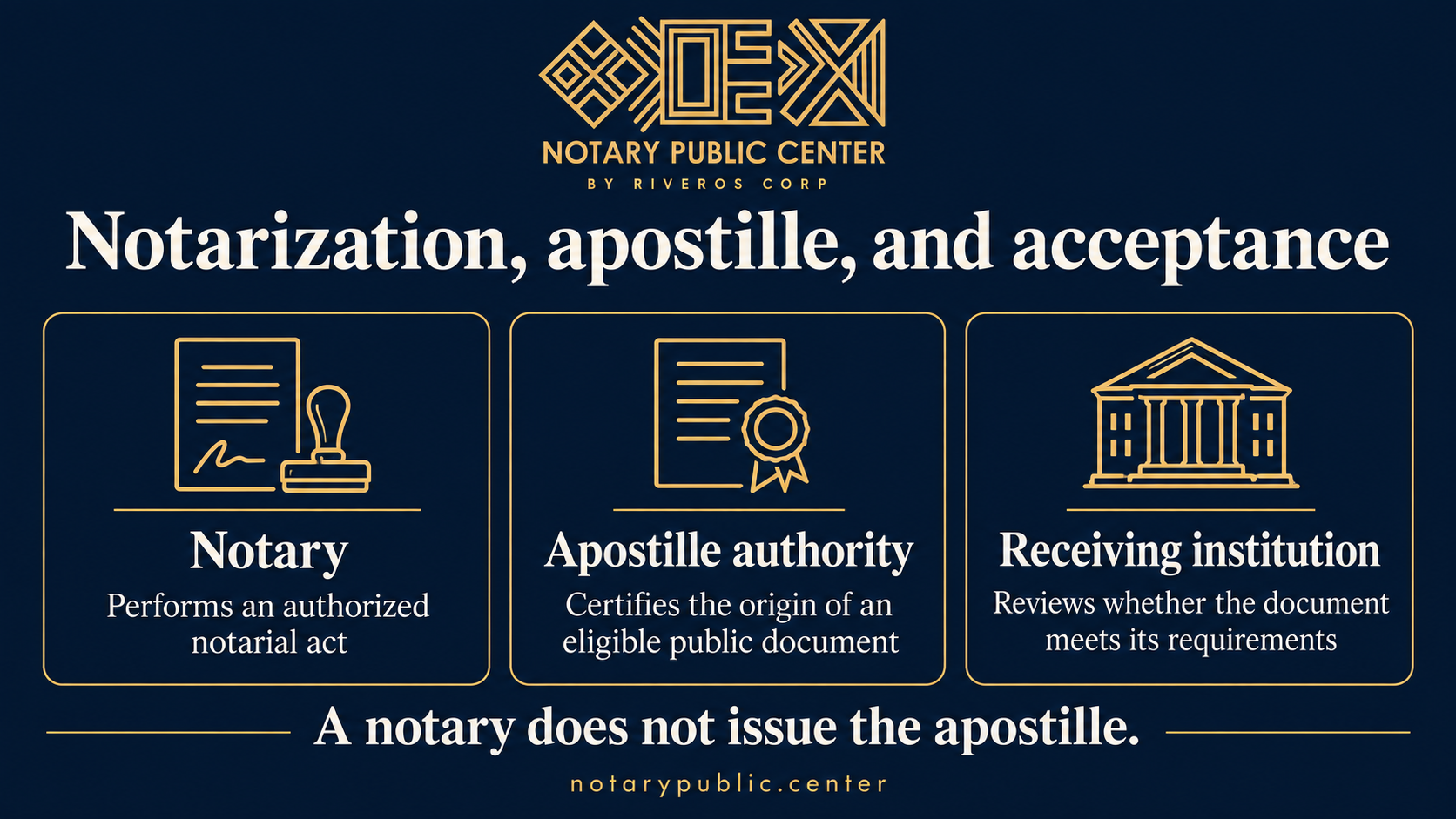
An apostille verifies the relevant signature, the signer’s official capacity, and any applicable seal or stamp. It does not certify the truth of every statement in the document. Nor does it decide whether the document meets a foreign authority’s substantive requirements.
For example, a university may still need a particular academic record or translation. A registry may require a specific certified copy. Those requirements remain separate from the apostille, even when the certificate satisfies the applicable authentication requirement.
Haya’s Agency: clarifying the service you need
A person asking about Haya’s Agency may need an apostille, a notarization, or both. However, these are different services. A notary performs an authorized notarial act; the competent apostille authority certifies the relevant public signature or seal.
The document may already carry an eligible public official’s certification. In that case, adding a notarization may be unnecessary or inappropriate. By contrast, a private statement may require a properly completed notarial certificate before the relevant authority can consider it.
Our explanation of what a U.S. notary does describes the role and its limits. The initial review should identify the act required rather than assume that every document needs another stamp.
Who issues apostilles in the United States?
The competent authority depends on the document’s origin and the signature involved. State-issued or state-notarized documents generally follow that jurisdiction’s designated route. The authority is often the secretary of state, although the official designation varies by jurisdiction.
Eligible federal agency documents follow the relevant federal service. Federal court clerks and deputy clerks can issue apostilles for documents from their courts. Therefore, a service provider should identify the actual issuer instead of treating every U.S. record as a state submission.
Where you live does not necessarily determine the route. For example, a person in Florida may hold a birth certificate from another state. The Florida address does not give a Florida authority jurisdiction over that other state’s registrar.
How this affects a Florida request
The Florida Secretary of State is the competent authority for Florida apostilles. Florida’s instructions distinguish its own records and notarizations from documents issued or notarized elsewhere. Consequently, the team should review the record’s origin before proposing a Florida submission.
Our Florida apostille guidance discusses those distinctions. A preliminary review can identify an apparent routing issue, but the authority decides whether the submitted document qualifies.
Haya’s Agency searches: identify the document first
The label “document” can cover very different records. A marriage certificate, a private authorization, and an official corporate certificate do not necessarily need the same preparation. The review should identify the issuing body and the version available.
- Vital records: birth, marriage, and death certificates may require a certified copy from the appropriate records office.
- Academic records: the school or university’s certification and the recipient’s instructions affect the file.
- Private instruments: powers of attorney, affidavits, and authorization letters may require particular signature or notarial formalities.
- Corporate records: a government-issued company certificate differs from a resolution signed by a company officer.
- Court records: the issuing court and the certification on the copy affect the applicable route.
These examples describe document families, not a promise that every copy qualifies. In particular, the recipient may need information that a short extract or informal copy does not contain. That question should be resolved before certification arrangements proceed.
When notarization belongs in the file
A notarization can concern an acknowledgment, an oath, or another act authorized by the notary’s jurisdiction. These acts have different requirements. For instance, an acknowledgment and an oath do not perform the same function simply because both involve a notary.
A document may already identify the required notarial act. If it does not, the signer may need instructions from the receiving institution or a qualified legal adviser. A notary’s commission does not authorize the notary to decide the legal effect of the document.
Likewise, notarization does not determine whether a power of attorney grants suitable authority. Our article on notarizing a power of attorney explains related signing concerns. Document preparation and legal advice should remain distinct from the notarial service.
Haya’s Agency and online notarization
Remote online notarization may be available for an eligible document and signer. However, availability depends on the notary’s governing rules, identity-verification requirements, and the circumstances of the transaction. An online appointment is not automatically suitable for every document intended for use abroad.
The authentication authority and receiving institution may also have format requirements. Therefore, confirm those requirements before choosing electronic signing simply for convenience. A digital notarization, a paper copy of an electronic record, and an electronic apostille are different things.
Notary Public Center can review the requested notarial service and discuss the available format. If the destination requires a different form, the team should identify that limitation before the session. The recipient’s instructions remain relevant after the notarial act is complete.
Apostille or consular legalization?
If the Apostille Convention does not apply to the intended use, a different authentication or legalization route may be necessary. That route can involve domestic authorities and the relevant foreign mission. However, its details depend on the destination and document.
A search for Haya’s Agency should therefore lead to a destination-specific review, rather than an assumption that an apostille solves every international request. Ask what the receiving institution has requested and whether it provided written instructions.
Using the correct terminology helps define the service. It also helps distinguish the government certificate from any translation, record retrieval, or delivery work. Those additional services may belong in the file, but an apostille does not perform them.
Problems worth resolving before submission
The most useful review identifies a specific issue and the information needed to resolve it. The following questions can prevent a request from proceeding on an incorrect assumption:
- Is the available record official? A household copy may lack the certification that the authority needs.
- Does the proposed office have jurisdiction? The issuer or notary’s jurisdiction matters more than the requester’s current address.
- Is the intended use clear? A destination and receiving institution help establish the required form of authentication.
- Are the signing requirements settled? Missing or unsuitable notarial wording can require further review.
- Does the recipient need a translation? Its language and certification rules may differ from those of another institution.
These questions are not predictions that every uncertain file will fail. Instead, they help identify what remains unresolved. A clear explanation of a document concern is more useful than a general promise of fast approval.
Haya’s Agency: assessing a private service provider
Clarify the provider’s actual name, role, and service scope. A commercial name containing “Haya” or “Hague” does not establish government affiliation. Notary Public Center provides private assistance; the competent public authority issues the apostille.
Also ask which parts of the request the proposed service covers. For example, reviewing an existing record is different from obtaining a replacement. Likewise, notarization, translation coordination, government submission, and delivery are separate parts of a possible service.
A useful assessment identifies the responsible party for each outstanding item. It should explain what the signer or requester must provide and what decisions remain with public authorities. This allows you to evaluate the proposed assistance against your actual need.
Timing and delivery expectations
The complete timeline can include obtaining the record, completing any required notarial act, government processing, and shipping. Consequently, a carrier’s delivery estimate does not establish when the authority will issue the certificate.
If a foreign appointment creates urgency, share that date before approving the service. The available route and outstanding document requirements may affect the assessment. However, a private deadline does not automatically create a government expedited service.
Return delivery also deserves attention, particularly when the requester lives abroad. Confirm the available destination and who will receive the documents. Tracked shipping provides shipment information, but it does not guarantee that the receiving institution will accept the file.
How Notary Public Center can help
Notary Public Center can review the document type, proposed notarial act, and destination instructions. The team can then discuss applicable notarization and document coordination within the agreed service scope.
You may need to obtain an eligible certified record or clarify a requirement with the receiving institution first. Where legal interpretation is necessary, consult a qualified lawyer. Those steps help distinguish a document service from decisions that a notary or administrative provider cannot make for you.
If you began with a Haya’s Agency search, bring the conversation back to the record and its intended use. Share the issuing jurisdiction, destination country, available copy, and written instructions. That information supports a concrete assessment of the service you need.
Haya’s Agency: common questions
Does the Hague Conference issue my apostille?
No. Designated competent authorities issue apostilles in the relevant jurisdiction. The Hague Conference provides treaty information, but its Permanent Bureau does not issue or verify individual apostille certificates. Identify the document’s issuer before choosing an office.
Is Notary Public Center a government agency?
No. Notary Public Center is a private service provider offering notarial and document support. The competent public authority issues the apostille. Therefore, service coordination should not be confused with authority to certify the government document.
Does every document need notarization before an apostille?
No. Some records already bear the appropriate public official’s certification. Other documents may need an authorized notarial act. However, adding a notarization does not automatically make an unsuitable copy eligible for an apostille.
Can I arrange assistance while outside Florida?
Contact the team to review the document, signer location, and requested service. Availability depends on the applicable rules and delivery arrangements. In particular, remote notarization and foreign acceptance require separate consideration.
Will an apostille guarantee acceptance abroad?
No. An apostille addresses the document’s origin within its legal scope. The receiving institution still evaluates its content, format, and supporting materials. Therefore, share its instructions during the initial review.
Discuss your document with Notary Public Center
Contact Notary Public Center with the document type, issuing jurisdiction, and destination. We can assess the notarial service and discuss the applicable document support.
Call +1 305 507 8464 or contact us on WhatsApp.
This article provides general information and does not constitute legal advice or create an attorney-client relationship. Confirm current requirements with the relevant authority and recipient. Consult a qualified lawyer when your document requires legal advice.