Oaths meaning in a legal document usually concerns a solemn commitment to tell the truth or perform a stated duty. An affirmation provides a nonreligious alternative. For a sworn statement before a Florida notary, the person must actually swear or affirm; a signature and stamp alone do not supply that act.
The distinction matters when a form requests an affidavit, a sworn verification or an acknowledgment. These terms describe different requirements. Some laws also permit an unsworn written declaration under penalty of perjury, but that option does not apply to every document.
Notary Public Center can discuss oaths and affirmations in Miami or through qualifying Florida remote online notarization. The team can also review related document and apostille coordination. The service begins with the receiving institution’s instructions and the applicable legal requirements.
Oaths meaning: a promise with legal consequences
An oath can concern the truth of testimony or a written statement. It can also concern the performance of official duties. In each setting, the governing law determines the required act and who may administer it.
For example, an affidavit usually presents facts that the signer swears or affirms are true. An oath of office concerns the responsibilities of a position. Those purposes differ, even though both involve a formal commitment.
The person making the statement remains responsible for its contents. A notary’s involvement does not establish that every fact is correct. Likewise, notarization does not turn an unsupported statement into proof that a court or agency must accept.
Why the actual oath or affirmation matters
The notary must administer the required act, and the person must respond to it. Merely watching someone sign a page does not establish that an oath occurred. The certificate should reflect the act actually performed.
If a document is already signed, explain that before the appointment. A jurat may require signing again during the notarial session. Do not assume that a past signature permits the notary to record an oath that never happened.
Oath and affirmation: the same effect under Florida law
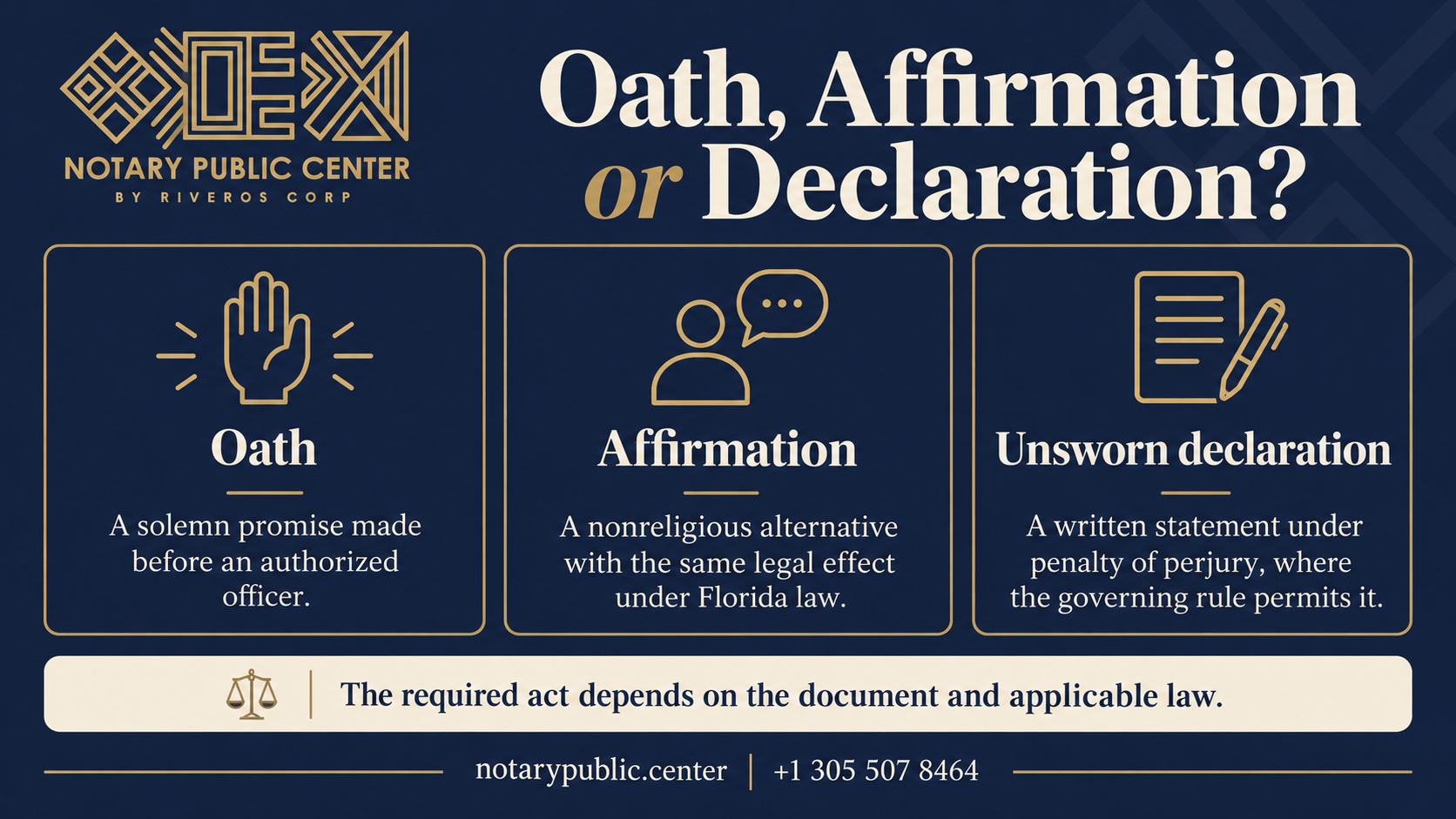
An affirmation lets a person make the required solemn commitment without religious language. Florida section 92.52 allows an affirmation to substitute when Florida law requires an oath in a proceeding.
Therefore, choosing an affirmation does not make the statement less serious. The person still undertakes the required obligation to be truthful. Religious preference should not be confused with whether the legal requirement applies.
Tell the notary if you prefer to affirm. Also provide any wording required by the court, agency or form. The ceremony and certificate must fit the governing requirement rather than an informal wording chosen for convenience.
Understand the statement before making the commitment
Read the document and resolve material uncertainties before the session. If a statement is incorrect, signing under oath does not cure it. Ask the preparer or qualified legal adviser to address the content before proceeding.
In addition, explain any language or communication needs in advance. The appointment must allow the required understanding and interaction. A rushed signature is not a substitute for a person knowingly making the statement.
Jurat and acknowledgment serve different purposes
A jurat records that the person swore or affirmed and signed as required before the authorized officer. An acknowledgment records acknowledgment of execution. The acknowledgment itself does not supply an oath about the truth of the document.
Florida section 117.03 expressly prohibits substituting an acknowledgment when an oath is required. A provider therefore cannot treat the two acts as interchangeable because one seems easier to arrange.
If the document does not identify the required act, obtain instructions from the receiving party or your attorney. A notary who is not an attorney cannot choose the legal effect you need. Our guide to a notarized application discusses this preparation.
When an unsworn declaration may be allowed
An unsworn declaration is a written statement made under penalty of perjury without the same administered oath. Where the governing law permits it, the declaration can serve a specified evidentiary or verification purpose.
Under 28 USC section 1746, qualifying declarations can substitute for certain written sworn statements required under federal law. The statute has exceptions, including depositions, oaths of office and certain oaths before specified officials.
Florida also addresses written verification in section 92.525. Its requirements must be considered in the relevant context. A general internet template does not establish that a particular filing qualifies.
A form's title may not settle the issue
A document called a declaration may still require notarization under its instructions. Conversely, a governing rule may permit an unsworn declaration for a particular purpose. Read the actual requirement instead of deciding from the title alone.
When the instructions are unclear, obtain clarification before signing. Legal questions about whether a substitute is authorized belong with qualified counsel. The service provider can then arrange the act identified for the document.
Compare the document requirements
| Term | What it involves | Question to resolve |
|---|---|---|
| Oath | A solemn commitment before an authorized officer | What statement or duty does the required oath cover? |
| Affirmation | A nonreligious form of the required commitment | What wording and certificate apply? |
| Jurat | A certificate recording the sworn or affirmed signing act | Does it accurately describe the completed session? |
| Acknowledgment | Acknowledgment of execution | Is this the act the document actually requires? |
| Unsworn declaration | A written statement under penalty of perjury where authorized | Does the governing rule permit it for this purpose? |
This comparison helps explain the vocabulary. It does not select an act for a specific legal transaction. Keep the recipient’s instructions with the document when asking for service.
The notary's role in a sworn statement
The notary establishes identity under the applicable rules, administers the oath or affirmation and completes the certificate. Florida law provides certificate requirements and statutory forms in section 117.05.
Identification does not always follow one universal method. The rules distinguish personal knowledge from other acceptable evidence. Remote notarization adds its own requirements, so the provider should review which process is available for the participant.
The notary also applies the required signature and seal. Our article on the stamp of notary public explains why the seal must be read with the certificate. Neither one guarantees the receiving institution’s decision.
Document preparation and legal advice
Notary Public Center can discuss administrative support using information and instructions supplied for the document. However, a notarial commission does not itself authorize legal advice or selecting legal provisions for a customer.
If an affidavit affects legal rights, a pending case or an immigration filing, obtain advice from a qualified professional about its content. Then provide the approved document and execution instructions for the notarial appointment.
In-person oaths and affirmations in Miami
An in-person appointment allows the signer and notary to complete the required act together. It may fit a recipient that requests a paper original or a transaction requiring physical participants. Explain any witness requirements before arranging the service.
Provide the complete document and the institution’s instructions. Also discuss identification requirements in advance. If a jurat is needed, follow the notary’s directions about signing during the session rather than arriving with assumptions about a prior signature.
The appointment’s duration depends on the document and participants. A provider can explain availability and the proposed service scope, but should not promise that every sworn document takes the same amount of time.
Oaths meaning in a remote online session
A qualifying Florida remote notarization can include an oath or affirmation through live audiovisual communication. The Florida online notary must be physically in Florida. The signer may be elsewhere, subject to the applicable conditions.
Section 117.265 addresses identity, recording and other online procedures. Depending on the permitted method, identity review may involve personal knowledge or the required combination of identification presentation, credential analysis and identity proofing.
Remote service cannot proceed merely because the signer has a camera and an ID. The notary must satisfy the applicable requirements. Our guide Can a document be notarized online? discusses the document and participant review.
Confirm the required delivery format
An electronic record should retain the signatures and security features needed for its intended use. Printing it or taking a screenshot can change what the recipient can verify. Confirm the required file or paper format before delivery.
Also distinguish legal recognition of the notarial act from the recipient’s document requirements. A valid online act does not guarantee that every office accepts every electronic submission. Resolve that question before relying on remote service.
Sworn documents for use abroad
An affidavit intended for another country may need an apostille or another authentication process. The route depends on the document’s origin, the destination and applicable rules. It should not be selected solely because the document contains an oath.
The HCCH Apostille Convention concerns authentication of public documents for qualifying international use. An apostille authenticates the relevant official signature, capacity and seal. It does not establish that the affidavit’s factual statements are true.
For a Florida-notarized private document, the relevant state authority handles the apostille request. Federal documents follow a different authority. Notary Public Center can discuss coordination with Apostille de la Haya when that service is needed.
Separate translation from notarization
A receiving institution may also require a translation. Ask which language, translator statement and format it accepts. A notary’s involvement with a translator’s declaration does not independently verify the translation’s accuracy.
Likewise, apostille and translation requirements can concern different parts of a packet. Provide the complete instructions so the proposed service addresses the relevant documents. Approval remains with the receiving authority.
Common problems to resolve before the appointment
Check for incomplete statements, inconsistent names and missing recipient instructions. These issues deserve review before anyone makes a sworn commitment. If a correction affects the substance, return to the preparer or legal adviser.
Another problem is confusing the notary with a witness required for the underlying transaction. The roles may differ. Explain who must attend and what capacity each person will have, especially when planning a remote session.
Finally, avoid promising facts that you cannot support. An oath or affirmation concerns your statement, while the notary’s certificate concerns the act performed. Keeping those responsibilities clear helps everyone understand what the resulting document shows.
Frequently asked questions about oaths
Is an affirmation equal to an oath in Florida?
Yes. Florida section 92.52 permits an affirmation when Florida law requires an oath in a proceeding. The affirmation provides a nonreligious form of the commitment. It does not reduce the obligation to be truthful or remove applicable legal consequences.
Can a notary administer an oath online?
Yes, when the act and participants meet Florida’s remote-notarization requirements. The Florida online notary must be in the state, and the session must follow the applicable identity, communication and recording rules. Confirm the document’s suitability and recipient requirements beforehand.
Does an acknowledgment satisfy a required oath?
No. Florida section 117.03 prohibits substituting an acknowledgment when an oath is required. The two acts serve different purposes. Obtain the correct instructions before the appointment if the document does not clearly state what is needed.
Can I use an unsworn declaration instead?
Sometimes, if the governing law or rule authorizes it. Federal section 1746 and Florida section 92.525 address particular circumstances and requirements. They do not make every document eligible for substitution. Ask qualified counsel when the applicable rule is uncertain.
Does an apostille prove that my sworn statement is true?
No. An apostille concerns the origin of the public document, including the relevant official signature, capacity and seal. The person making the statement remains responsible for its facts. The receiving institution determines how it evaluates the document.
Arrange an oath or affirmation with Notary Public Center
Contact Notary Public Center with your document type, recipient instructions and preferred appointment format. Mention witnesses, language needs and any intended use abroad so the service can be assessed accurately.
Request information by WhatsApp at +1 305 507 8464. The team can discuss the notarial service and related coordination. Legal advice about the statement or transaction should come from a qualified attorney.
This article provides general information and does not constitute legal advice. Reading it does not create an attorney-client relationship. Consult a qualified attorney about the rules and legal consequences applicable to your document.