
The primary LLC operating agreement purpose is to establish the internal rules, ownership percentages, and management procedures of your Limited Liability Company, legally separating your personal assets from your business liabilities. Without this critical internal document, your business is automatically governed by generic state default rules that may not align with your financial goals or corporate vision.
Many entrepreneurs mistakenly believe that simply filing Articles of Organization with the state is enough to run a compliant business. However, true corporate protection requires a customized operating agreement. Whether you are a solo entrepreneur or operating a multi-member venture, relying on downloaded templates can leave critical gaps in your corporate veil. At Riveros Corp, our corporate specialists ensure your agreement is flawlessly structured, professionally drafted, and properly legalized to safeguard your international and domestic business interests.
What is an LLC Operating Agreement?
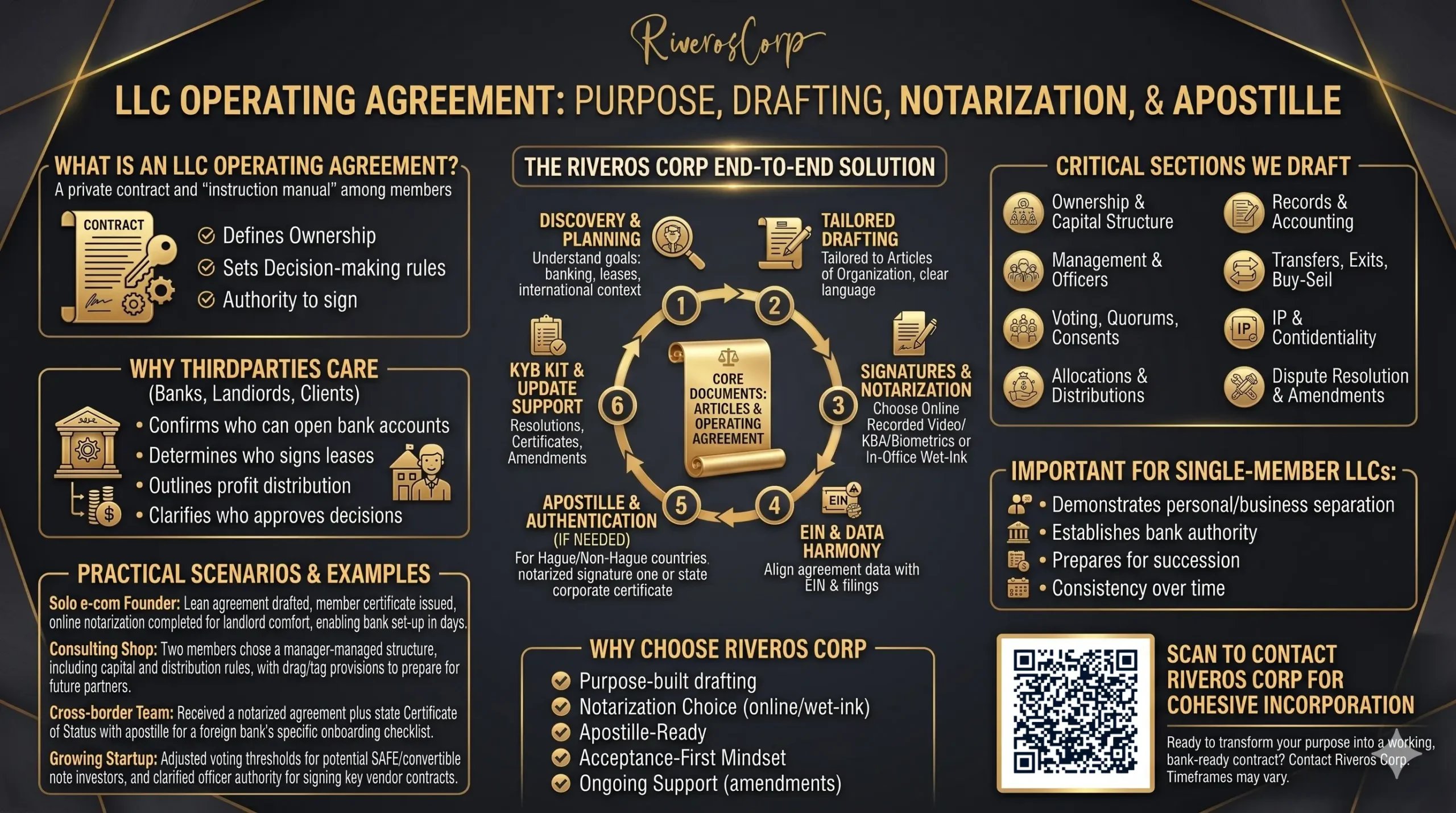
An operating agreement is a legally binding contract among the members (owners) of a Limited Liability Company. It outlines the financial and functional decisions of the business, including rules, regulations, and provisions.
Unlike the Articles of Organization, which are public records filed with the Secretary of State, the operating agreement is an internal document. It is kept on file at your principal place of business and is often requested by banks, investors, and legal authorities to verify who has the authority to act on behalf of the company.

The Core LLC Operating Agreement Purpose: 4 Key Reasons
Understanding the real-world value of this document is crucial for long-term business stability. Here are the four foundational purposes of an operating agreement:
1. Protecting Your Limited Liability Status
The most significant benefit of an LLC is the separation of personal and business assets. However, if your business is sued, courts will look for proof that your LLC is a legitimate, separate entity rather than just an alter-ego for your personal dealings. A formalized operating agreement serves as concrete evidence that you treat your business as an independent organization, preventing courts from «piercing the corporate veil» and holding you personally liable for business debts.
2. Overriding State Default Rules
If you do not have an operating agreement, your LLC is subject to the default statutes of the state where it was formed (e.g., Florida, Delaware, or Wyoming). These default rules dictate how profits are split and how the company is dissolved. For example, many states dictate that profits must be divided equally among members, regardless of who invested more capital. A custom agreement overrides these state defaults, allowing you to tailor the rules to your specific operational needs.
3. Clarifying Financial and Management Structures
Disputes over money and control can destroy a successful business. A well-crafted agreement clearly defines:
Initial capital contributions of each member.
How and when profits and losses will be distributed.
The management structure (Member-Managed vs. Manager-Managed).
Voting rights and decision-making protocols.
4. Structuring Member Transitions and Dissolution
What happens if a member wants to leave, retires, or unexpectedly passes away? Without a clear roadmap, these situations can trigger the mandatory dissolution of the LLC under state law. The operating agreement dictates the buyout processes, right of first refusal, and the exact steps required to smoothly transition ownership or close the business without catastrophic litigation.
Do Single-Member LLCs Really Need One?
A frequent question among solo entrepreneurs is whether a single-member LLC needs an operating agreement if there are no partners to argue with. The answer is a resounding yes.
For a single-member LLC, the primary LLC operating agreement purpose is to declare that the business is a separate entity from the owner for liability and tax purposes. Furthermore, banks, title companies, and lenders routinely require a copy of the operating agreement before opening a business bank account or issuing a commercial loan, regardless of how many members the LLC has.
Essential building blocks of a strong operating agreement
Ownership & capital structure
List members with precise percentages/units and capture initial contributions (cash, IP, equipment, services). Add rules for additional capital and remedies if a member misses a call.
Management and officer roles
Choose member-managed or manager-managed. Then define practical authority—who opens banks, signs leases, hires accountants, approves large purchases—so day-to-day work doesn’t stall.
Voting, quorums, and consents
Use clear thresholds. Routine operations may pass by majority, while acquisitions or equity changes might need supermajority or unanimity. Allow written consents and virtual meetings so distributed teams stay compliant.
Allocations and distributions
Tie economics to ownership (or customized waterfalls if needed), then spell out distribution timing subject to cash availability and legal constraints. This avoids end-of-year surprises.
Tax language (in sync with your CPA)
Name the partnership representative (for multi-member LLCs), and include election mechanics if your advisor recommends different treatment later. Riveros Corp ensures the agreement’s language matches your tax posture.
Transfers, exits, and buy-sell
Protect the cap table with rights of first refusal, tag/drag, valuation methods, and event triggers (death, disability, default). Fewer misunderstandings; faster decisions.
IP assignment and confidentiality
Make the LLC the owner of code, designs, brands, and domains. Add confidentiality so sensitive information stays protected as you scale.
Records, banking, and authority certificates
Codify recordkeeping and authorization to interact with banks and agencies. Riveros Corp also issues manager/member certificates and officer letters that banks recognize.
When to notarize—and when to apostille
Not all recipients demand notarization, but many prefer or require it. A bank may request notarized member signatures on the agreement; a landlord may ask for a manager certificate sworn before a notary. If the document (or a corporate certificate) must be recognized in a Hague country, an apostille may be required.
Notarization (online or in office): We coordinate Remote Online Notarization with credential analysis, KBA, biometrics/liveness, and a recorded ceremony that yields a tamper-evident PDF; or we host you in office for wet-ink when a recipient insists on paper.
Apostille: For international use, we typically apostille the notary’s signature (if the agreement was notarized) or apostille a state corporate certificate such as a Certificate of Status/Good Standing or a certified copy of Articles. We confirm which piece your foreign receiver wants before filing. Timeframes may vary.
How Riveros Corp delivers an end-to-end solution
1) Discovery and acceptance-first planning
We begin with your goals—banking, leases, vendors, investors, or cross-border filings. That context shapes management style, authority clauses, and whether we must notarize or apostille any part of the package.
2) Drafting the operating agreement
We tailor content to your Articles of Organization, member roster, and real decision flow. Our language is clear and practical, not boilerplate that confuses underwriters.
3) Signatures and notarization
We schedule signers, confirm receiver preferences, and conduct online or in-office notarization if required. You receive a defensible record with clean identity checks.
4) EIN and data harmony
We align agreement data with your EIN and filings so names and addresses match across institutions. This prevents “mismatch” delays during KYB.
5) Apostille or authentication (if needed)
If your agreement or corporate proof travels abroad, we obtain the apostille from the competent authority—or the authentication/legalization path for non-Hague countries. We also coordinate translations and decide whether the apostille should attach to the translator’s notarized statement or a state certificate.
6) Banking/KYB kit and ongoing updates
We prepare organizational resolutions, manager/member certificates, W-9, and authority letters. When membership or roles change, we draft amendments and keep the record synchronized.
Timeframes may vary depending on signer availability, state and IRS workloads, and destination requirements.
Practical examples Riveros Corp handles weekly
Solo e-commerce founder: lean agreement, member certificate, online notarization for landlord comfort, bank set-up in days.
Two-member consulting shop: manager-managed structure, capital and distribution rules, drag/tag to prepare for future partners.
Cross-border team: notarized agreement plus Certificate of Status with apostille for a foreign bank’s onboarding checklist.
Growing startup: voting thresholds adjusted for future SAFE/convertible note investors, officer authority clarified for vendor contracts.
Secure Your Corporate Structure with Riveros Corp
Drafting the foundational rules of your business should never be left to generic software or guesswork. Protecting your assets requires precision, experience, and a deep understanding of corporate compliance.
At Riveros Corp, our specialists manage the entire lifecycle of your corporate documentation. We do not just help you form your company; we ensure your operating agreement is meticulously structured to protect your liability status and align with your strategic goals. Furthermore, if your documents require international validity, our team seamlessly coordinates the notarization and apostille processes so your LLC is recognized globally.
Do not let state default rules dictate the future of your company. Contact the corporate specialists at Riveros Corp today to structure an operating agreement that truly protects your business.
Why choose Riveros Corp
Purpose-built drafting: an operating agreement aligned with your filings and how you truly operate.
Notarization your way: online (recorded, multi-layer identity proofing) or in-office wet-ink.
Apostille-ready: when the document must travel, we route apostille or authentication and coordinate translations.
Acceptance-first mindset: we produce a package banks and counterparties approve—not just a file you can print.
Ongoing support: amendments, new members, authority changes, and record hygiene as you scale.
Ready to transform llc operating agreement purpose from a question into a working, bank-ready contract? Contact Riveros Corp. We’ll draft your agreement, coordinate signing and notarization, and, if needed, obtain the apostille—all as part of a cohesive incorporation experience. Timeframes may vary.
FAQ
1. Is an LLC operating agreement legally required in all U.S. states?
No. While only a few states (such as New York, California, Missouri, Delaware, and Maine) legally mandate an operating agreement, having one is considered an essential business practice nationwide to protect your limited liability status and open corporate bank accounts.
2. Can an LLC operating agreement be amended later?
Yes. Your business will evolve, and your operating agreement should reflect those changes. It can be amended at any time, provided the changes are approved according to the voting rules established in the original agreement.
3. Do I need to file my operating agreement with the Secretary of State?
No. The operating agreement is an internal corporate document. Unlike your Articles of Organization, it does not need to be filed with any government agency, but it must be kept safe with your official company records.
4. Who needs to sign the LLC operating agreement?
All initial members (owners) of the LLC must sign the document to make it legally binding. If your LLC is manager-managed, the designated managers may also need to sign depending on the document’s structure.
5. What happens if my LLC does not have an operating agreement?
Without an operating agreement, your LLC must operate under the default corporate laws of your state. This means the state dictates how your profits are distributed, how management decisions are made, and how the company is dissolved, which may conflict with your actual business intentions.
The information contained in this publication is provided for general informational purposes only and does not constitute legal advice. Reading or using this content does not create and is not intended to create an attorney-client relationship. No reader or user should act or refrain from acting based on the information presented herein without first consulting an attorney duly licensed to practice law in their jurisdiction.