

The direct answer is yes: a foreigner can register a business in the USA without needing U.S. citizenship, a green card, or even a Social Security Number (SSN). The United States has one of the most welcoming corporate environments in the world for foreign investment, allowing non-residents to form and own 100% of a U.S. company from abroad.
However, while the law permits foreign ownership, the actual process of structuring the company, obtaining federal tax IDs, complying with strict transparency regulations, and opening a U.S. corporate bank account requires precise execution. Relying on generic information or automated «do-it-yourself» software often leads to critical structural errors, tax compliance failures, and rejected bank applications.
At Riveros Corp, our corporate specialists manage the entire lifecycle of your U.S. business formation, ensuring that your international venture is legally sound, fully compliant, and ready to operate globally.
Which Business Entity Should a Foreigner Choose?
One of the first and most crucial decisions you will make is choosing the correct legal structure. While U.S. citizens have multiple options, foreign entrepreneurs generally choose between two primary entity types:
1. Limited Liability Company (LLC)
The LLC is the most popular choice for foreign founders. It provides limited liability protection, meaning your personal assets are shielded from business debts and lawsuits. More importantly, LLCs offer «pass-through» taxation. This means the LLC itself does not pay corporate income taxes; instead, profits and losses are passed through to the owners (members), who report them on their personal tax returns. For non-resident aliens, a properly structured LLC can offer significant tax advantages, depending on whether the business is engaged in a U.S. Trade or Business (USTB).
2. C-Corporation (C-Corp)
A C-Corporation is a separate taxable entity. It pays corporate taxes on its profits, and if dividends are distributed to foreign shareholders, those dividends are subject to a withholding tax. While this «double taxation» sounds disadvantageous, a C-Corp is often the mandatory choice if you plan to seek venture capital funding in the U.S., issue stock options to employees, or eventually take the company public.
Why Foreigners Cannot Form an S-Corporation
It is essential to note that foreign non-residents cannot form or own shares in an S-Corporation. By law, S-Corps are restricted to U.S. citizens and resident aliens. Choosing the wrong entity type on your initial filings can lead to immediate rejection by the IRS.
Common Mistakes Foreigners Make When Registering a Business in the USA
1. Choosing the Wrong Business Structure
Many foreigners are unsure whether to form an LLC, Corporation, or Partnership. Selecting the wrong structure can affect taxes, liability, and compliance.
- How Riveros Corp helps: We evaluate your business goals and recommend the best entity type tailored to your needs.
2. Registering in the Wrong State
Not all states are equal when it comes to business regulations and taxes. Many foreigners assume Delaware or Nevada are always the best options, but that’s not always true.
- How Riveros Corp helps: We guide you in choosing the state that offers the best legal and financial advantages for your business model.
3. Not Obtaining an EIN (Employer Identification Number)
The EIN is essential for opening bank accounts, hiring employees, and filing taxes. Many foreigners forget or struggle to obtain it.
- How Riveros Corp helps: We handle the EIN application process directly with the IRS on your behalf.
4. Confusion About Visas and Immigration Status
Registering a business does not automatically give you a U.S. visa or work authorization. Many foreigners mistakenly believe otherwise.
- How Riveros Corp helps: While we don’t provide immigration services, we connect you with trusted attorneys and explain the clear differences between business ownership and work authorization.
5. Lack of a U.S. Address or Registered Agent
Foreigners often overlook the requirement for a registered agent or physical address in the U.S., which can lead to non-compliance.
- How Riveros Corp helps: We provide reliable registered agent services and mailing solutions so your business always meets state requirements.
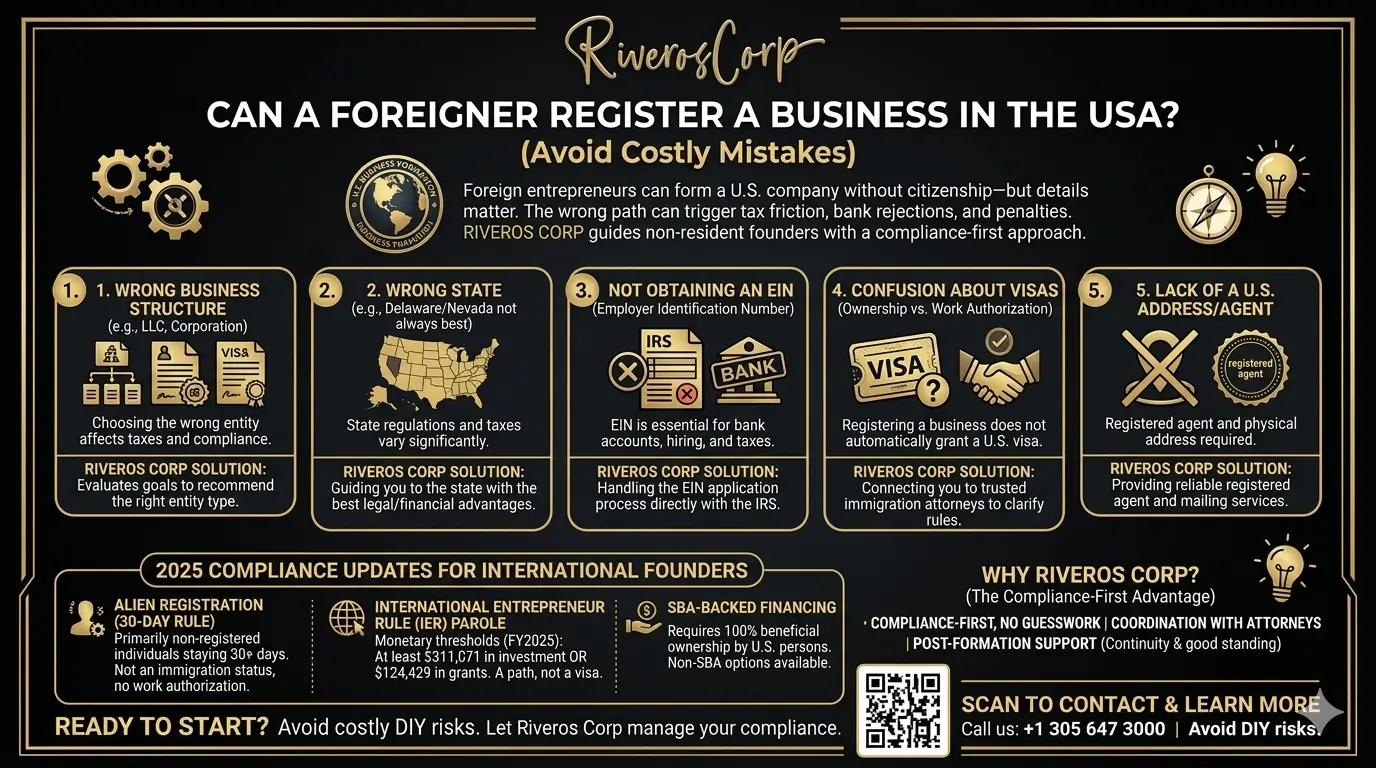
Compliance Notes for International Founders
Alien Registration (30-Day Rule) — Who It Applies To
Not everyone must newly “register.” Some foreign nationals are already registered through their I-94/I-94W record when they enter the United States. The 30-day registration requirement applies primarily to non-registered individuals who remain in the U.S. 30 days or longer during a given stay and who were not registered and fingerprinted (when required) at the visa stage. Registration is not an immigration status and does not grant work authorization. Our team clarifies whether this affects you and coordinates with trusted professionals where appropriate.
International Entrepreneur Rule (Updated Thresholds)
The International Entrepreneur Rule (IER) offers a parole pathway—not a visa—for founders who demonstrate substantial growth potential. As of FY2025, USCIS lists updated monetary thresholds, including at least $311,071 in qualified investment from qualifying U.S. investors within the last 18 months, or $124,429 in qualified government awards or grants. Alternative evidence can supplement partial funding. We help you understand whether IER complements your business strategy and how it fits with entity formation and hiring plans.
SBA-Backed Financing (Ownership Requirements)
If you plan to explore SBA-backed loans, be aware that 2025 policy requires 100% beneficial ownership by U.S. citizens, U.S. nationals, or lawful permanent residents. Many non-resident founders still access capital through non-SBA lenders or equity. We profile capital paths aligned with your structure and state while keeping documentation consistent with KYC/AML expectations.
5 Essential Requirements for Non-Residents to Form a U.S. Company
When asking, «Can a foreigner register a business in USA?», you must also ask how to do it correctly. Here are the five foundational steps:
1. Select the Right State for Incorporation
You do not have to form your company in the state where you plan to do business (unless you have a physical office or employees there). Foreigners often choose states with favorable corporate laws and no state income tax.
2. Appoint a U.S. Registered Agent
Every U.S. company must have a Registered Agent. This is an individual or authorized entity with a physical street address in the state of formation, responsible for receiving official legal and state correspondence during regular business hours. As a foreigner, you cannot act as your own registered agent unless you physically reside in that state.
3. Obtain an Employer Identification Number (EIN) Without an SSN
To open a bank account, hire employees, or pay taxes, your company needs an EIN from the Internal Revenue Service (IRS). U.S. residents can get this instantly online using their SSN. Foreigners without an SSN must apply using specific IRS forms (like Form SS-4). This manual process can take weeks and requires absolute accuracy to avoid long delays.
4. Draft the Corporate Documents
Filing the Articles of Organization (for an LLC) or Articles of Incorporation (for a C-Corp) only registers the business. You must also draft internal governance documents:
Operating Agreement: For LLCs, detailing ownership percentages, profit distribution, and management rules.
Corporate Bylaws: For C-Corps, establishing the board of directors, shareholder rights, and meeting rules. These documents are critical when proving ownership to international banks and regulatory bodies.
5. Corporate Transparency Act (BOI Reporting) Compliance
The scope of the Corporate Transparency Act narrowed sharply in 2025, and the change is now permanent. Under the final rule FinCEN published on 11 August 2026, entities created in the United States are exempt from Beneficial Ownership Information (BOI) reporting. The obligation remains for companies formed under the law of another country and registered to do business in a U.S. state or tribal jurisdiction, which report their foreign individual beneficial owners. If your structure falls into that second group, filing accurately and on time still matters, and missing it still carries federal penalties.
Do I Need a Visa to Open a Business in the U.S.?
A common misconception is that you need a visa to own a U.S. company. You do not need a visa to act as a shareholder or a member of a U.S. LLC or Corporation. You can direct the company, earn profits, and manage high-level decisions from your home country.
However, if you intend to physically work inside the United States, manage daily operations on U.S. soil, or receive a local salary, you will need the appropriate work visa (such as an E-2 Investor Visa, L-1 Intracompany Transferee, or O-1 Visa). Owning a business alone does not grant you the right to live or work in the U.S.
The Danger of DIY Formation for Foreign Entrepreneurs
The internet is full of cheap, automated company formation services. Using a «Do-It-Yourself» template is one of the most dangerous mistakes a foreign entrepreneur can make.
Automated platforms treat every client the same. They do not analyze your specific international tax situation, nor do they ensure your formation aligns with the rigid compliance standards required for foreign ownership. A poorly structured LLC might leave you exposed to unexpected U.S. tax liabilities, or worse, make it impossible to pass the strict compliance checks (KYC/AML) required to open a U.S. corporate bank account. Without a bank account, your U.S. business cannot function.

Secure Your U.S. Expansion with Riveros Corp
Do not risk your global business expansion on generic software. Forming a U.S. entity as a non-resident requires a tailored strategy, deep understanding of federal requirements, and precise execution.
At Riveros Corp, our corporate specialists handle everything from entity selection and state filings to securing your EIN and confirming whether FinCEN’s BOI reporting applies to your structure at all. We build the robust corporate foundation you need to operate safely and legally in the U.S. market. Contact the experts at Riveros Corp today and let us guide your international business success.
Frequently Asked Questions (FAQ)
Riveros Corp
Ready to register or formalize your U.S. company?
Riveros Corp guides you end to end: entity formation, EIN, bank account and compliance. Message us and we will review your specific case with no obligation.
Talk to Riveros Corp
1. Can a non-U.S. citizen be the 100% owner of an LLC?
Yes. There are no restrictions on the nationality or residency of LLC members. A foreign national can own 100% of a U.S. Limited Liability Company.
2. Do I need to travel to the U.S. to register my company?
No. The entire process of forming an LLC or C-Corporation, including obtaining a Registered Agent and applying for an EIN, can be completed remotely from your home country.
3. Do I need a physical U.S. address to register my company?
Yes. Every U.S. state requires your business to have a physical street address within the state of formation to receive official state correspondence and legal notices. P.O. Boxes are strictly prohibited for this purpose. If you live abroad and do not have a U.S. office, Riveros Corp provides professional Registered Agent services to fulfill this legal requirement, ensuring your business remains compliant while you operate from your home country.
4. What are the ongoing maintenance requirements for a U.S. company owned by a foreigner?
Forming your company is only the first step; to keep it legally active, you must meet ongoing state and federal compliance requirements. Most U.S. states require an Annual Report filing and a franchise tax payment to prevent the automatic dissolution of your business. Additionally, you must continuously maintain a local Registered Agent. Failing to meet these deadlines leads to severe state penalties, loss of limited liability protection, and the freezing of your corporate bank account. At Riveros Corp, we manage your corporate compliance calendar year-round, handling all renewals and filings so your global business remains in good standing.
5. Does opening a U.S. business grant me a visa or a green card?
No. Simply incorporating a business does not provide immigration status. However, a properly structured and funded U.S. company can serve as the sponsoring entity or the investment vehicle for certain business visas if you meet all other immigration requirements.
The information contained in this publication is provided for general informational purposes only and does not constitute legal advice. Reading or using this content does not create and is not intended to create an attorney-client relationship. No reader or user should act or refrain from acting based on the information presented herein without first consulting an attorney duly licensed to practice law in their jurisdiction.