
If you’re searching sign document online, you want a secure, fast, and accepted way to finish your paperwork without leaving home. With Notary Public Center, you can complete a Florida-compliant Remote Online Notarization (RON) in minutes. We confirm acceptance with your receiving party, verify identity through four layered checks, conduct a recorded ceremony, and deliver a tamper-evident PDF that exposes any later edits. If your file needs an apostille, we assemble the correct package and handle the process seamlessly. This is how you sign online quickly while preserving compliance and trust.
What “sign document online” means in notarization (and why acceptance matters)
In the U.S., a notary public must verify identity, presence, and willingness, and then complete the correct notarial certificate:
-
Acknowledgment — you acknowledge a prior signature as yours.
-
Jurat (affidavit) — you swear/affirm the truth and sign in the notary’s presence.
With Remote Online Notarization, the “presence” is a live two-way audio/video session. The law treats a properly conducted RON session as performed where the notary is commissioned (here, Florida). Many organizations accept RON results today; still, policies vary by courts, banks, county recorders, schools, and consulates. Therefore, we start each engagement with a simple, high-value step: ask the receiving party whether they accept RON or require wet-ink. That single check prevents the number-one reason people redo a signing.
How to sign document online with us: the step-by-step flow
1) Acceptance pre-check (5–10 minutes)
You tell us who will receive the document and where it will be used. Verify whether they accept RON, need paper originals, require witnesses, or specify certificate wording. If they need paper, we schedule you in person in Miami. If they accept RON, we proceed online.
2) Identity proofing: multi-layered security
We offer three ways to perform the identity check:
-
KBA (Knowledge-Based Authentication)
You answer time-limited questions drawn from public/credit records tied to you. This assures the person on camera knows things only the real you should know. - Biometrics + liveness / face match
We confirm a real person is present and match your face to the ID. This blocks replay attacks and impersonation attempts. -
Recorded video call (two-way)
The entire ceremony—ID checks, oath for jurats, acknowledgment language, and the moment of signing—happens on a recorded session. That recording is retained under program rules and becomes part of your evidence package.
If one layer fails, we fix it: better lighting, a different ID, or a second KBA attempt when allowed. If online proofing still doesn’t pass, we switch to in-person so your project stays on track.
3) The live, recorded ceremony
Once identity checks pass, we launch your live two-way video session. For jurats, we administer an oath/affirmation and you sign during the session. For acknowledgments, you may sign beforehand and then acknowledge the signature on camera. We fill the notarial certificate with exact names, venue, and date—details that downstream reviewers expect.
4) Delivery: a tamper-evident signed PDF
At the end, you receive a PDF that’s sealed with a digital certificate. Any change made after signing triggers a “modified/invalid” status in standard PDF viewers. Together with the recording and the audit log, this protects your document’s integrity and gives recipients a quick way to verify the file.
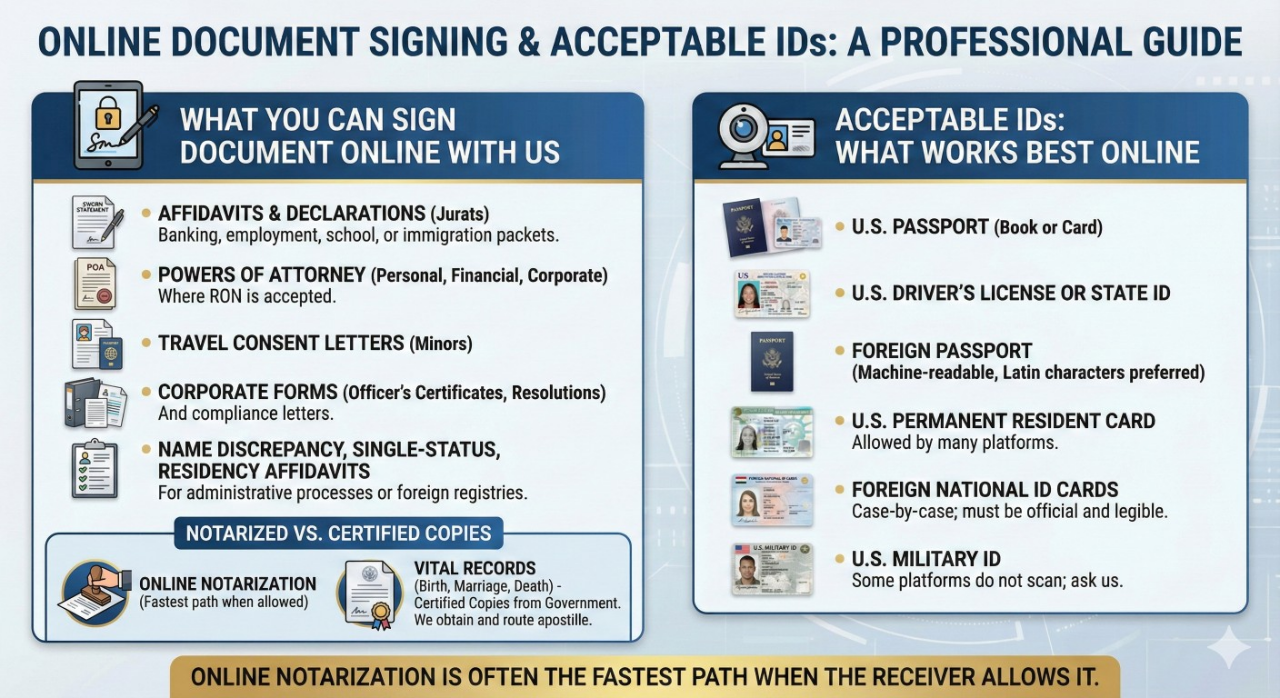
What you can sign document online with us
We support most standard notarial acts that people ask for daily:
-
Affidavits and declarations (jurats) for banking, employment, school, or immigration packets. (Note: If your immigration packet also requires an FBI Background Check or fingerprints, our team at Compliance Officers can coordinate this step along with your notarization.)
-
Powers of attorney (personal, financial, corporate) where RON is accepted.
-
Travel consent letters for minors leaving the country.
-
Corporate forms (officer’s certificates, resolutions) and compliance letters.
-
Name discrepancy, single-status, or residency affidavits used for administrative processes or foreign registries.
Some items are not notarized, such as vital records (birth, marriage, death). Those come as certified copies from the issuing government office. We can obtain those for you and then route the apostille on the registrar’s signature. For everything else, online notarization is often the fastest path when the receiver allows it.
Acceptable IDs: what works best online
Bring a current, government-issued, photo ID. These pass credential analysis most reliably:
-
U.S. passport (book or card)
-
U.S. driver’s license or state ID
-
Foreign passport (machine-readable with Latin characters preferred)
-
U.S. permanent resident card (allowed by many platforms)
-
Foreign national ID cards (case-by-case; must be official and legible)
-
U.S. military ID (some platforms do not scan these; ask us)
Pro tips for smooth approval:
-
Ensure the name on your document matches the name on your ID exactly (middle names/initials make a difference).
-
Use a well-lit space; avoid glare on the ID.
-
If your ID uses non-Latin script, have a passport with Latin characters handy.
-
If your name changed recently, bring supporting proof so we align the notarial certificate and avoid delays later—especially if you’ll need an apostille.
Errors we prevent (so you don’t have to sign twice)
People often think “sign document online” is just a quick click. It’s quick and precise. Here are the mistakes we intercept:
-
Wrong certificate (ack vs. jurat). Many affidavits arrive with acknowledgment language. We fix that to a jurat when required, so the state (and any apostille office) accepts it.
-
Pre-signing a jurat. For a jurat you must sign during the session. We guide you so the certificate reflects what actually happened.
-
Name/ID mismatches. We check the document’s spelling and order of names against your ID. This prevents rejections and apostille kickbacks.
-
Skipping recipient acceptance. We call or email the receiving office with you to confirm RON vs. paper, witnesses, and any special wording.
-
Trying to notarize or apostille a photocopy of a vital record. We remind you: vital records are not notarized. We obtain the certified original and then pursue the apostille.
-
Missing witnesses. We coordinate online witnesses where permitted or in-person witnesses in Miami so your packet is complete.
Security, privacy, and compliance
Security isn’t an afterthought; it’s engineered into every step:
-
Recorded session — A full video record of your ceremony allows recipients to verify how identity was established and when you signed.
-
Audit logs — Time stamps, IP metadata (where applicable), credential analysis results, and KBA outcomes create a defensible trail.
-
Exclusive control of seals — Only the commissioned notary controls the electronic seal and signature.
-
Tamper-evident PDFs — Any post-signing change is obvious in standard viewers; you’ll see an “invalid/modified” indicator.
-
Data retention — We retain recordings and journals only as required by rule and for verification requests.
-
Privacy first — Your information is used solely to complete your transaction and comply with recordkeeping obligations.
Speed without shortcuts
The phrase sign document online carries an expectation of speed. We meet it, but never at the expense of acceptance:
-
Same-day availability for most RON sessions.
-
Immediate delivery of your tamper-evident PDF.
-
Apostille routing begins as soon as your notarized original is complete (when required).
-
In-person fallback in Miami if online identity proofing cannot be satisfied.
-
Timeframes may vary by receiving office, state apostille unit, holidays, and courier options—but the signing itself is typically quick once we confirm acceptance.
Witnesses and special cases
Some forms—powers of attorney, estate documents, school or medical forms—ask for witnesses in addition to a notary. We can:
-
Provide or coordinate remote witnesses in an online session where allowed, or
-
Arrange in-person witnesses at our Miami office.
Tell us what the receiving party expects: independent witnesses (not related, not named) or extra information (address/phone). We’ll set it up so you don’t chase people last minute.
When your signed document will be used abroad (apostille)
When your signed document will be used abroad (apostille) If your document goes to a Hague Apostille Convention country, you’ll likely need an apostille. For a notarized private document, the apostille authenticates the notary’s signature. If your destination is not a Hague member, you’ll need authentication (and often consular legalization). We map the chain based on country of use and, through our specialized division Apostille de la Haya, we handle the filing end-to-end.
For translations, we clarify with the receiver whether the apostille must attach to the base document, the translator’s notarized statement, or both.
The “sign document online” checklist (copy/paste this before you book)
-
Recipient + country of use (so we confirm RON vs. paper + any special language).
-
Document type and certificate needed (jurat vs. acknowledgment).
-
Names on the document exactly as they appear on your ID.
-
Valid ID (passport or driver’s license recommended).
-
Witnesses (if required); tell us whether they must be independent.
-
Translation plans (if any).
-
Apostille needed? Tell us the destination country; we’ll set the chain.

Why choose Notary Public Center
-
Two clear routes: sign document online via RON or in person in Miami; we help you choose based on the receiver’s rules.
-
Three identity layers: biometrics/liveness, recorded video call, KBA, and credential analysis—plus a tamper-evident PDF and full audit trail.
-
Error-proofing by design: we correct the notarial block, align names with IDs, coordinate witnesses, and confirm acceptance before you sign.
-
Apostille: We can route apostilles/authentications when your document goes abroad.
-
Bilingual support: English/Spanish assistance for families and businesses.
Ready to sign document online fast—and get it accepted the first time? Contact Notary Public Center. We’ll confirm acceptance, verify identity with three layers, run a recorded ceremony, and deliver a tamper-evident PDF within minutes. «If you need an apostille, we manage the entire process for you with our partner Apostille de la Haya.
FAQ
1) Is an online notarization as valid as paper?
When conducted under applicable law, yes. The online act is treated as performed in the commissioning state (here, Florida). However, acceptance is set by the recipient. We confirm acceptance before you choose RON.
2) What if I fail KBA or my ID won’t pass credential analysis?
We can retry with better lighting or a different ID. If the platform still can’t verify identity, we switch to an in-person appointment in Miami so you can finish without delay.
3) Do online-notarized PDFs really prevent tampering?
Yes. Your PDF is sealed with a digital certificate. Any post-signing change triggers an invalid/modified status in standard viewers, and the recording plus audit log back up authenticity.
The information contained in this publication is provided for general informational purposes only and does not constitute legal advice. Reading or using this content does not create and is not intended to create an attorney-client relationship. No reader or user should act or refrain from acting based on the information presented herein without first consulting an attorney duly licensed to practice law in their jurisdiction.