A Florida State Apostille authenticates the origin of an eligible public document for use abroad under the Hague Apostille Convention. Florida’s Secretary of State is the competent authority, and the Division of Corporations issues the certificate. A private service can coordinate the request but cannot issue the apostille.
The correct route depends on the document’s issuing authority, its certification and the destination country. Therefore, a birth certificate, a notarized power of attorney and a federal background report need separate review. Living in Florida does not place every document within Florida’s authority.
Apostille de la Haya can discuss your records, destination and deadline before coordinating the service. This guide explains the distinctions that matter when assessing a Florida document for international use.
What a Florida State Apostille certifies
An apostille authenticates the official signature, the signer’s capacity and, where applicable, the seal or stamp on the document. However, it does not certify the truth of the document’s contents or decide whether a foreign authority must approve your application.
For example, authentication of a court official’s signature does not answer every question about a judgment’s legal effect abroad. Likewise, an apostille on a notarized statement does not independently establish that the statement is true. Those questions remain separate from authentication.
The HCCH guide to apostilles explains these limits. It also distinguishes authentication from the receiving country’s rules for using the underlying document.
Confirm the destination before choosing the route
The Apostille Convention must apply between the relevant countries, and the particular document must fall within its scope. In addition, some circumstances remove or simplify the need for authentication. Consequently, an apostille is not mandatory for every international transaction.
Ask the recipient what it requires for your specific purpose. A citizenship application, a university admission and a property transaction may involve different supporting records. Keep any written instructions so the proposed service addresses the actual request.
For general context, our guide to apostille certificates explains how authentication fits into a document package.
Identify the authority behind your document
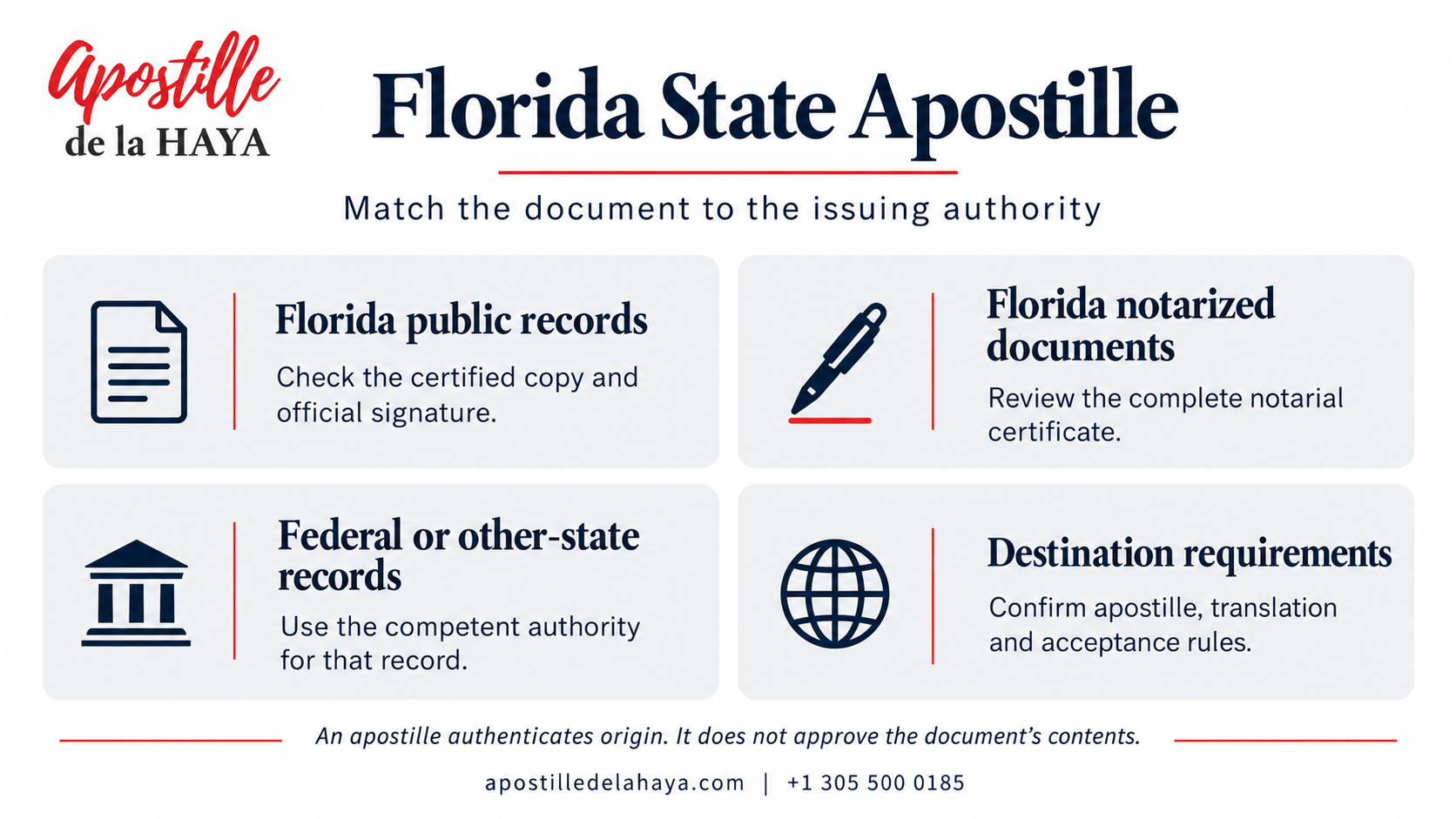
The Florida Department of State’s authentication page separates Florida documents from federal records and documents from other states. The relevant official signature determines which authority can handle the request.
For example, a Florida resident may hold a New York birth certificate and an FBI report. Residence alone does not make either record a Florida public document. Each record needs the route that corresponds to its origin.
Also, adding a Florida notarization to a photocopy does not automatically replace the issuing authority’s certification. Before arranging another signature, identify what the recipient wants authenticated. Otherwise, the resulting certificate may concern a different act from the one the recipient needs.
Separate mixed document packages
One international application can require records from several authorities. Make a list of the documents already available and those still missing. Then note who issued or certified each one, along with the intended country of use.
This review helps define the service without assuming that one submission covers the whole file. It also reveals practical questions early, such as whether a court record needs a new certified copy or a private document remains unsigned.
Florida vital records need the proper certification
Birth and death certificates require attention to the official certification and State Registrar’s signature. Florida’s published requirements recognize qualifying records from the Bureau of Vital Statistics or a county health department. The word “original” alone does not establish that an old copy meets the current requirements.
Marriage and dissolution records also need the appropriate official certification. A marriage certificate, a divorce certificate and a certified court judgment are different records. Therefore, ask which document the recipient needs before ordering or authenticating a replacement.
The Florida Department of Health’s apostille guidance explains the relationship between obtaining the vital record and requesting authentication. It also identifies access restrictions for confidential records.
A photocopy is not a substitute for a certified record
A Florida notary cannot certify a photocopy of a birth certificate as though it were an official vital record. The required certification must come from the appropriate record authority. Our article on a photocopy of a birth certificate explains this distinction.
If the recipient asks for a recently issued certificate, check that requirement before using an older copy. Similarly, raise spelling differences or missing information before requesting authentication. An apostille does not amend the underlying record.
Review private documents and notarial certificates
Private documents may enter the Florida authentication process through a qualifying Florida notarial act. Examples include affidavits, powers of attorney and certain business statements. However, the document still needs the appropriate signature and notarial certificate.
Florida requires a full notarial statement for this route. A stamp and signature alone do not supply every required element. The state’s accepted-document guidance also requires the notarial statement to be in English.
The required act depends on the document. An acknowledgment differs from an oath or affirmation, and a notary who is not an attorney cannot choose a legal course for the signer. Resolve substantive questions with the recipient or a qualified attorney before signing.
Review the certificate without altering it yourself
When an existing notarization raises a question, provide the complete document for review. Include the certificate page and any attachment that forms part of the signed instrument. A cropped image can omit information necessary to assess the issue.
If a correction requires a new act, coordinate it with the appropriate professional. Do not fill in or change a completed notarial certificate yourself. Our guide to a notarized application discusses signature timing and related preparation questions.
School and corporate records follow distinct rules
Florida’s requirements distinguish public-school transcripts from private-school transcripts. The public-school route involves a registrar or issuing official’s signed, notarized transcript. The private-school instructions describe a notarized printed transcript with a copy attestation and student or custodian signature. A single rule for every school record would be misleading.
For a diploma or other academic document, identify the exact record and issuing institution before choosing the certification. Also ask whether the foreign recipient requires an additional academic evaluation. Authentication alone does not establish academic equivalency.
Corporate records need similar care. A state-certified copy or certificate of status differs from an internal resolution or agreement. The first comes from the public record authority; the second may require review of a private signature and notarial act.
Clarify what the recipient means by a company document
A request for “company papers” can leave several questions unanswered. Does the recipient need evidence of formation, current status, signing authority or a particular decision? Ask for the exact document name and required certification.
In addition, check the company name against the proposed record. A trade name and the legal entity name may differ. Raising that difference early helps avoid authenticating a document that does not answer the recipient’s request.
Florida State Apostille: document comparison
This table identifies the main distinctions for an initial review. It does not replace the recipient’s instructions or the state’s current document requirements.
| Document | Review before authentication | Point to clarify |
|---|---|---|
| Florida vital record | Official certification and issuing signature | Which record and version does the recipient need? |
| Florida court record | Certification from the appropriate court office | Does the request concern a judgment or another record? |
| Private notarized document | Signature, notarial act and complete certificate | Does the act match the document's purpose? |
| Academic record | Institution, document type and applicable certification | Is the school public or private? |
| Corporate document | Publicly certified record or private company instrument | What fact must the document establish? |
| Federal or other-state record | Competent authority outside Florida's state route | Who issued the underlying record? |
Translation and recipient acceptance are separate
A document may require translation in addition to authentication. Confirm the recipient’s language and translator requirements before commissioning the work. For example, ask whether the translation must include the attached apostille as well as the underlying document.
The Florida Department of State does not provide translation services. Its published FAQ also states that the translator cannot be the person who notarizes the translation. Therefore, disclose translation needs when discussing the service.
If the Apostille Convention does not apply, ask about the relevant authentication and legalization route. Depending on the destination, additional authorities may be involved. Avoid assuming that a Florida certificate alone completes every non-Convention submission.
Keep the recipient's instructions with the file
Save the instructions that specify document age, format, language and supporting evidence. If the recipient changes its request, communicate that change before further processing. This helps everyone work from the same requirements.
Likewise, tell the service provider if the document will serve more than one purpose. A university and a foreign civil registry may request different materials. One authority’s acceptance does not establish another authority’s requirements.
Discuss timing without relying on a guarantee
Allow time for any replacement record, signature, authentication review and delivery. Each part can affect the date when the recipient receives the complete package. A quoted service estimate should explain which parts it covers.
Florida’s FAQ states that the office processes requests in the order received and does not offer expedited service. It also describes walk-in service. However, a private provider’s logistics arrangement does not guarantee state approval or a particular completion time.
If you have a deadline, share the actual date and what must happen by then. For example, distinguish a signing appointment from a foreign filing deadline. That distinction makes the timing discussion more useful than a general request for “urgent” service.
Ask what a proposed service includes
Clarify whether the scope includes document review, coordination of missing records, translation, submission or delivery. Also identify any work that remains your responsibility. A written scope helps you compare proposals and understand the next step.
Apostille de la Haya can discuss these arrangements for your file. Still, the competent authority decides whether to issue the authentication, and the recipient assesses the underlying submission. No provider can remove those independent decisions.
Frequently asked questions about a Florida State Apostille
How long does a Florida State Apostille take?
Timing depends on the document’s readiness, the state’s processing and delivery. Check the current official information and ask what any service estimate includes. Avoid treating an estimate as a guarantee, especially when a replacement record or new signature remains necessary.
Can Florida apostille a document from another state?
For an official record from another state, use that state’s competent authority. A Florida address does not change the record’s origin. Likewise, a Florida notarized photocopy does not automatically replace the authentication required for the original public record.
Should I notarize my Florida birth certificate first?
No. Use the appropriately certified vital record for the state’s authentication review. A notary cannot turn an ordinary birth-certificate photocopy into an official certified copy. Confirm the record format and recipient requirements before proceeding.
How does an apostille differ from a notarial certification?
The destination and applicable international rules determine the route. Florida issues apostilles where the Apostille Convention applies and uses notarial certification for the alternative authentication route. Additional legalization may be necessary. Confirm the requirements for the specific country and document.
What should I do if Florida returns my document?
Read the stated reason and have the complete document reviewed. The issue may involve the record, certification, notarial act or request details. Resolve that specific issue before resubmission. Do not alter an official certificate or assume that adding another stamp will correct the problem.
Discuss your documents with Apostille de la Haya
Contact Apostille de la Haya with the document type, issuing authority, destination and deadline. Include the recipient’s requirements when available so the team can discuss the appropriate scope of service.
Request information by WhatsApp at +1 305 500 0185. Clarify the proposed coordination and delivery arrangements before proceeding.
This article provides general information and does not constitute legal advice. Reading it does not create an attorney-client relationship. Consult a qualified attorney about the legal effect of a document. The competent authority’s current rules and the receiving organization’s requirements govern the particular request.