
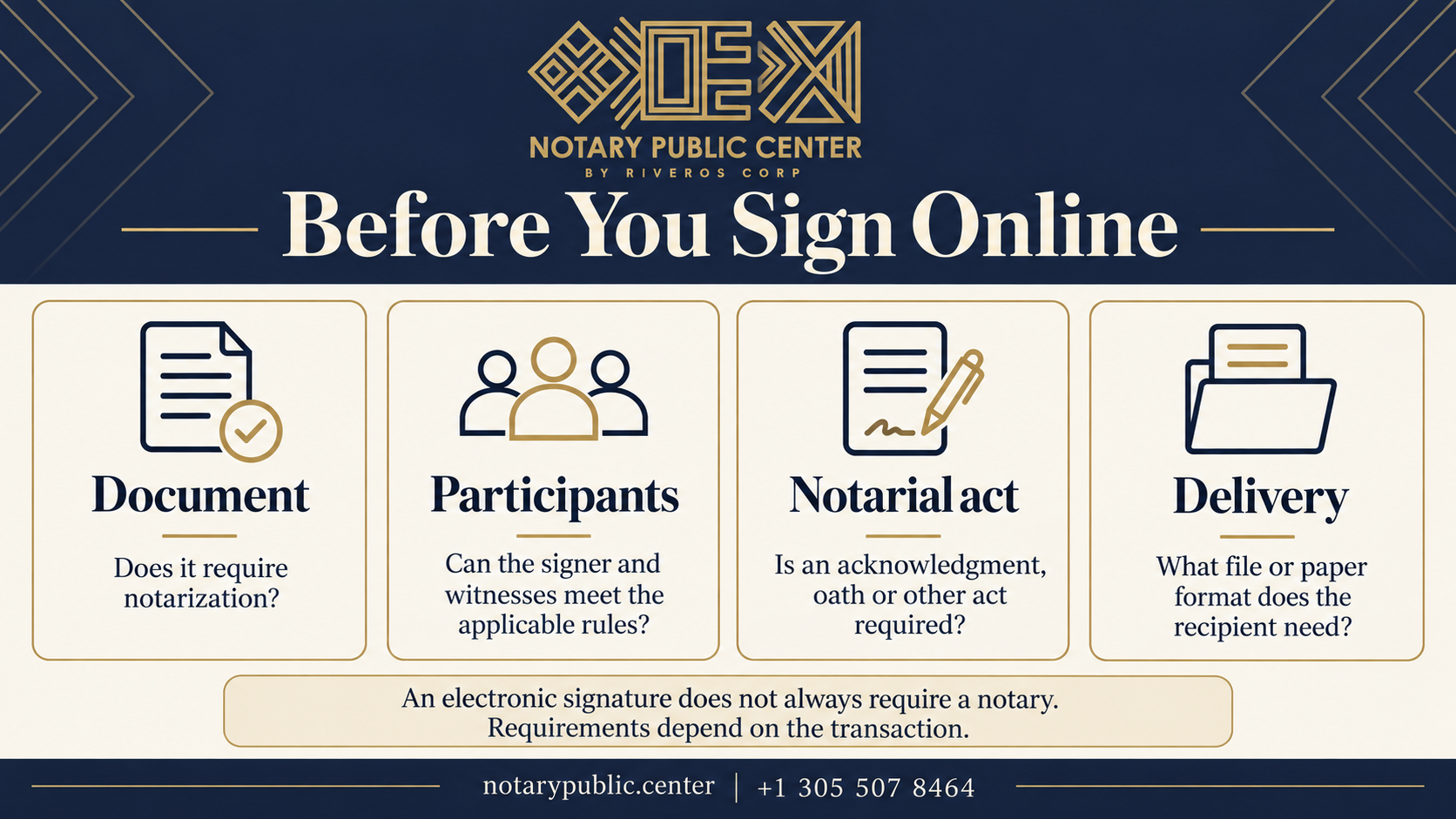
To sign a document online, first check whether the transaction requires an electronic signature alone or a notarial act as well. Many agreements can use electronic signatures without a notary. Other documents require an acknowledgment, an oath, witnesses or additional formalities that a signature platform does not replace.
Remote online notarization, or RON, allows a qualifying notarial act through live audiovisual communication. Florida law sets requirements for the notary, participants, identity checks and electronic record. The document’s intended use also matters.
Notary Public Center can discuss Florida remote notarization and in-person alternatives in the Miami area. The review should begin with the complete document and recipient instructions, so the proposed appointment fits the actual requirement.
What does it mean to sign a document online?
An electronic signature can be a sound, symbol or process adopted with the intent to sign a record. The form of the signature is only part of the analysis. Applicable law, the parties’ agreement and the circumstances affect its legal consequences.
Florida’s Uniform Electronic Transaction Act recognizes qualifying electronic records and signatures. It also has scope limits and does not require every person to conduct every transaction electronically.
Therefore, it is inaccurate to describe all ordinary electronic signatures as legally weak or suitable only for casual agreements. The relevant question is whether the chosen method meets the particular transaction’s requirements.
Electronic signature and notarization are separate requirements
A contract may be enforceable without notarization, while another instrument may require a notarial act or witnesses. The value or importance of a transaction does not, by itself, establish that RON is mandatory.
Ask the document’s preparer, receiving institution or qualified attorney what execution requirements apply. A notary who is not an attorney cannot select legal provisions or determine the legal strategy for your transaction.
What remote online notarization adds
RON involves a commissioned and appropriately registered online notary performing an authorized act. In Florida, the process includes the required audiovisual appearance, identity review and recordkeeping. The notary completes the applicable electronic certificate.
Under Florida section 117.265, the Florida online notary must be physically located in the state. A qualifying act is treated as performed in Florida, even when the signer is elsewhere.
However, notarization does not establish that a contract is fair, an affidavit is factually correct or an agency must approve a filing. It documents the notarial act. Other legal and factual questions remain separate.
Compare the signing methods before booking
| Question | Electronic signature without notarization | Remote online notarization |
|---|---|---|
| Is a notary involved? | Not as part of an ordinary signing alone | A qualified online notary performs the required act |
| How is identity addressed? | Methods depend on the platform, agreement and law | The applicable notarial identity rules must be met |
| Is a live notarial session required? | Not simply because the signature is electronic | Florida RON uses live audiovisual communication |
| Does it satisfy every document requirement? | No; separate formalities may apply | No; witnesses and other requirements may still apply |
| Is acceptance guaranteed? | No | No |
A platform’s features and a notary’s duties should be assessed accurately. Some signature services offer extensive identity and audit features. Conversely, a RON label does not excuse a missing legal requirement.
Identify the notarial act your document needs
An acknowledgment concerns acknowledgment of execution. A jurat involves an oath or affirmation and signing as required before the notary. These acts cannot be exchanged merely because both end with a certificate and seal.
For example, if a sworn statement requires an oath, an acknowledgment does not supply it. Florida addresses that distinction in section 117.03. Obtain clarification if the instructions and certificate appear inconsistent.
Our article on oaths and affirmations explains sworn statements in more detail. Provide the actual form so the provider can assess the requested appointment.
Explain any signature already on the document
A document may permit acknowledgment of an existing signature. A jurat generally calls for signing during the session and making the required sworn commitment. Tell the notary if anyone has already signed.
Also identify the capacity in which you will sign, such as individually or for a company. A notary’s certificate does not automatically establish your authority to act for another person or business.
Identity requirements for signing with an online notary
Florida permits identification through the online notary’s personal knowledge or through the required alternative process. That alternative involves identification presentation, credential analysis and identity proofing under the governing rules.
It is therefore too broad to say every participant must complete the same knowledge-based questions. The available method depends on the law, provider and circumstances. The notary cannot proceed if the required identity standard cannot be satisfied.
Discuss your identification and location before the appointment. A passport or other credential does not guarantee that a particular platform can complete the review. Avoid sending sensitive identification through an unconfirmed channel.
Technology and participation also matter
The session requires reliable audiovisual communication and the ability to participate in the required signing process. Tell the provider about access or communication needs beforehand. The appointment should allow the notary to carry out the applicable duties.
Do not assume another person can answer identity questions or make the sworn statement for you. If someone will assist with technology, disclose that arrangement. The relevant participants must still complete their own required acts.
Can you sign a document online from another country?
Florida’s RON framework can permit a signer outside Florida while the online notary remains in Florida. However, the document, participants and applicable conditions must still qualify. A foreign location does not remove identity or witness requirements.
The receiving country’s rules and the institution’s instructions also need review. A Florida notarial act does not guarantee that a foreign court, bank or registry will accept the record in the proposed form.
Before arranging the session, identify where you will be and where the document will be used. Our guide Can a document be notarized online? addresses the broader suitability review.
Witnesses may have separate requirements
Some documents require witnesses in addition to notarization. The notary’s presence does not automatically replace them. The number, qualifications and location of witnesses depend on the document and governing law.
Florida section 117.285 regulates supervised witnessing of electronic records. A remote witness appearing through audiovisual communication must confirm US or territorial residency and physical location, as required by that section.
Additional safeguards apply to certain estate and related documents, including circumstances involving vulnerable adults. Consequently, an available remote witness does not make every planned signing suitable for a fully remote session.
Powers of attorney deserve a document-specific review
Florida section 709.2202 limits the effect of remotely witnessed powers of attorney for specified powers when the principal is domiciled in Florida. This is one reason broad promises about signing every power of attorney online are unreliable.
Have qualified counsel review the instrument and intended authority where necessary. Then coordinate the notarial and witness arrangements around those requirements. The service should follow the document’s legal needs.
Electronic seals and the completed record
Florida requires electronic notarial signatures to meet control, verification and alteration-detection requirements. Section 117.021 explains those requirements and the information associated with the seal.
A pasted picture of a stamp does not establish a compliant electronic notarization. Likewise, “tamper-evident” means the record is designed to reveal alteration. It should not be described as impossible to change or as a guarantee against every form of fraud.
Retain the completed electronic record in the delivered format. A screenshot or printed copy may not preserve the features used to verify its signatures. Ask what the recipient needs before converting or combining files.
Keep delivery instructions with the file
A recipient may specify an electronic portal, a particular format or a paper original. Those requirements can differ from whether the underlying electronic signature is legally recognized. Clarify them before relying on the completed file.
Our guide to the notary’s seal and certificate explains the role of those elements. Read the certificate and record together rather than treating a visible seal as the entire result.
Apostille considerations for an online-signed document
A document for foreign use may need an apostille or another authentication route. The competent authority depends on the document’s origin and the relevant official signature. A Florida-notarized private record and a federal document do not follow the same authority.
The Florida Department of State publishes requirements for its authentication service. Review the acceptable document format before assuming that an electronic file can simply be emailed or printed for submission.
Florida law provides certain authorized copy and printout attestations, subject to the document and statutory conditions. A plain printout or photocopy is not automatically equivalent to that process. Ask the provider to assess the appropriate route for the actual record.
What an apostille does and does not establish
An apostille authenticates the relevant official signature, capacity and seal under the applicable framework. It does not certify the truth of an affidavit or make an otherwise defective transaction valid.
Notary Public Center can discuss coordination with Apostille de la Haya when international authentication is needed. Government processing and recipient acceptance remain separate decisions. A provider cannot guarantee a fixed outcome or eliminate every delay.
Vital records require the correct issuing document
A birth certificate is different from a private affidavit. A Florida notary cannot make an ordinary photocopy into an official certified vital record. The proper certified copy comes from the authorized issuing office.
A separate statement related to a vital record may involve notarization, but that does not replace the official record itself. Identify exactly what the recipient requested before selecting an online service or an apostille route.
Prepare for the service discussion
Provide the document type, recipient instructions and planned country of use. Identify all signers and any required witnesses. Also mention whether anyone has already signed or whether the transaction has a deadline.
Notary Public Center can then discuss remote service or in-person coordination, including the Miami-Dade and Broward areas where applicable. Confirm the appointment scope and delivery arrangements before proceeding.
For substantive questions about a contract, estate document or immigration matter, consult a qualified legal professional. Notarial service addresses the required act; it does not replace advice about the rights and obligations in the document.
Frequently asked questions about signing online
Must every document signed online be notarized?
No. Many transactions can use electronic signatures without notarization. Others require a notarial act, witnesses or additional formalities. The applicable law, agreement and document instructions determine what is needed; the importance of the transaction alone does not make RON mandatory.
What is the difference between an electronic signature and RON?
An electronic signature records a person’s intent to sign through an electronic method. RON involves an authorized notary performing a notarial act through the required audiovisual process. It adds specific notarial duties but does not guarantee every legal or factual aspect of the transaction.
What identification do I need for online notarization?
The available process depends on Florida law and the provider’s requirements. Personal knowledge or the required alternative identity checks may apply. Discuss your credentials before booking. Possessing a particular ID does not guarantee completion if the required verification cannot be satisfied.
Can I sign from outside the United States?
It may be possible while the Florida online notary remains in Florida. The document, identity process, witnesses and other applicable conditions must qualify. Also confirm the receiving institution’s requirements and any relevant foreign rules before relying on the proposed format.
Does a digital certificate make the document tamper-proof?
No. The applicable technology must make later alterations evident; that differs from making alteration impossible. Keep the original electronic file and follow the recipient’s verification and delivery requirements. A screenshot of the signed page does not preserve every security feature.
Discuss online signing with Notary Public Center
Contact Notary Public Center to review whether your document needs notarization and whether a Florida remote appointment is appropriate. Share the recipient instructions and any witness or delivery requirements.
Request information by WhatsApp at +1 305 507 8464. The team can discuss the notarial service and related coordination. The relevant law, authorities and receiving institution determine the applicable requirements.
This article provides general information and does not constitute legal advice. Reading it does not create an attorney-client relationship. Consult a qualified attorney about your document and transaction.