
When founders compare corporations vs llc, they really compare capital strategy, tax posture, and governance. The label you pick affects how money moves, how decisions are made, and how institutions onboard you. The good news: you don’t have to decide alone—or risk a misfiled entity. Riveros Corp designs an incorporation path that fits your goals, prepares the documents banks and platforms expect, secures your EIN, and coordinates notarization and apostille when a document must be used abroad. Our approach is acceptance-first, so your paperwork works in the real world, not just on a registry portal.
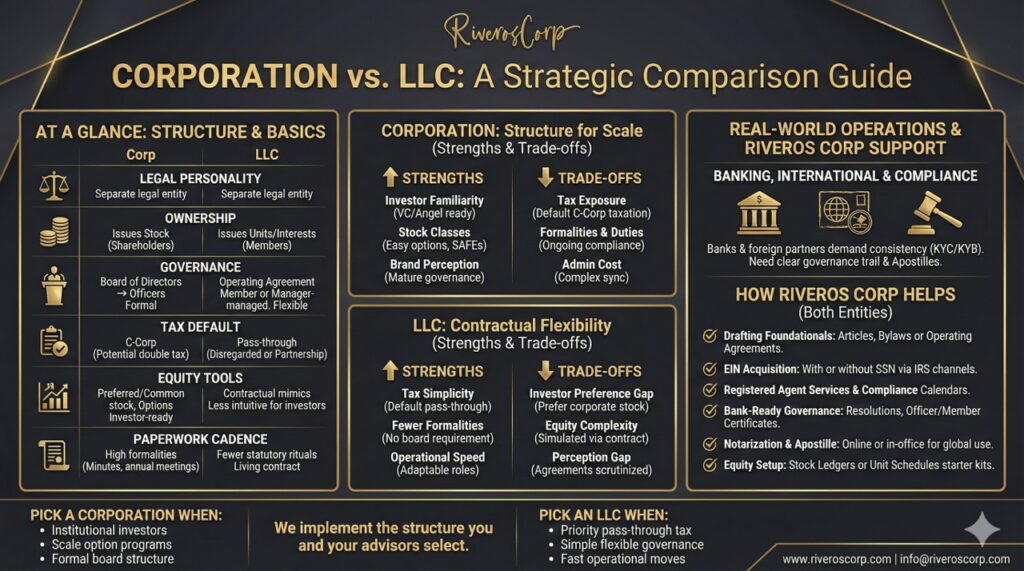
Corporations vs LLC at a glance
Legal personality: Both are separate legal entities that can own assets, sign contracts, and sue or be sued.
Ownership: Corporations issue stock; LLCs issue membership interests/units.
Governance: Corporations run on shareholders → board → officers; LLCs follow an operating agreement and can be member-managed or manager-managed.
Tax default: Corporations default to C-Corp taxation; LLCs default to pass-through (disregarded entity for single-member or partnership for multi-member).
Equity tools: Corporations natively support preferred/common stock, options, and investor-friendly cap tables; LLCs can mimic with contract mechanics but some investors prefer corporate stock.
Paperwork cadence: Corporations require formalities (board minutes, annual meetings); LLCs rely on a living contract and fewer statutory rituals.
What is a corporation?
A corporation is a stock-based structure with a predictable chain of authority. Shareholders elect a board of directors; the board appoints officers who run day-to-day affairs. This separation of ownership and management is attractive for scale.
Strengths of a corporation
Investor familiarity: Venture funds, accelerators, and many angel groups are set up to invest in corporate stock, not LLC units.
Stock classes & instruments: Easy to implement preferred stock, convertible notes, SAFEs, and employee stock option plans.
Continuity and transferability: Shares are straightforward to transfer or pledge; board governance creates consistent decision logs.
Brand perception: Larger customers and international partners often equate corporations with mature governance.
Trade-offs of a corporation
Tax exposure: Default C-Corp treatment can mean taxation at the corporate level and again on dividends (double taxation), unless planning mitigates it.
Formalities & ongoing duties: Boards, minutes, consents, and more frequent filings.
Administrative cost: More touchpoints to keep synchronized (cap table, option grants, multiple classes).
How Riveros Corp helps: We draft articles of incorporation, establish your registered agent, create bylaws, prepare organizational consents, set up your stock ledger/cap table starter, and obtain your EIN. If your bank or landlord asks, we notarize officer certificates (online or in office). If a counterparty abroad needs proof, we coordinate apostille for state certificates (e.g., Certificate of Status/Good Standing) or notarized officer statements.
What is an LLC?
An LLC (Limited Liability Company) is a contractual wrapper around a business. Instead of stock, members hold membership interests or units. The heart of the entity is the operating agreement, which can be simple for a solo founder or robust for multi-member teams.
Strengths of an LLC
Tax flexibility and simplicity: Default pass-through treatment avoids entity-level tax (subject to your situation). With your tax advisor, you can elect alternatives when it makes sense.
Fewer formalities: No board requirement; governance matches your operating agreement.
Operational speed: Easier to adapt roles, distributions, and decision thresholds as the business evolves.
Privacy in some states: Certain jurisdictions allow less public disclosure than corporate filings.
Trade-offs of an LLC
Investor preference: Many institutional investors and option-plan frameworks prefer corporate stock mechanics.
Equity complexity: You can simulate vesting, options, and waterfalls with contract language, but it’s often less intuitive to external parties.
Perception gap: Some large vendors still ask, “Can we see your operating agreement?”—and scrutinize it line by line.
How Riveros Corp helps: We file your articles of organization, designate the registered agent, draft a bank-ready operating agreement, prepare organizational resolutions, and secure your EIN (with or without SSN). We coordinate notarization for signatures when required and obtain apostille for state certificates or notarized statements bound for international use.
Tax posture (high-level, advisor-friendly)
Corporation (C-Corp by default): Pays corporate income tax; distributions can be taxed again at the shareholder level. Planning and elections may influence outcomes—coordinate with your CPA.
LLC (pass-through by default): Income, losses, and certain deductions flow through to members. A single-member LLC is typically disregarded for federal tax; multi-member is treated as a partnership unless an election changes it.
Elections: Some LLCs elect to be taxed as corporations for specific benefits; eligible corporations or LLCs may pursue S-corp treatment where appropriate.
State layers: Franchise taxes, annual reports, and local registrations vary. Riveros Corp aligns your filings with the plan your advisor recommends. (We don’t give tax advice; we implement your advisors’ decisions.)
Governance & compliance in practice
Corporations need a board, officer appointments, bylaws, and a rhythm of minutes and consents. The paper trail is part of their value: it proves how decisions were made.
LLCs rely on the operating agreement and periodic resolutions/consents. You still keep records, but the law gives you more elbow room.
Riveros Corp advantage: We produce a clean governance set from day one—bylaws or operating agreement, organizational minutes, officer/member/manager certificates, and a starter records kit that banks and auditors actually understand.
Equity, investors, and talent
If venture financing or complex option plans are central to your roadmap, a corporation may be the cleanest fit. It natively supports preferred vs. common stock, option pools, RSUs, and accelerator standards.
If you’re building a consulting firm, a small e-commerce brand, or a cash-flow business with a tight founding team, an LLC often wins on simplicity and net-of-tax results (subject to your facts and advisor guidance).
Riveros Corp bridges both worlds: we set up stock ledgers and board consents for corporations, or unit schedules, capital accounts, and distribution rules for LLCs—drafted so counterparties can approve you without delays.
Banking, payments, and KYC/KYB
Banks and payment processors want consistency: the entity name, EIN data, responsible party info, and control persons must match across filings and documents. They may also ask for notarized officer certificates or operating-agreement excerpts.
Riveros Corp aligns your articles, EIN, and governance documents so your onboarding sails through. We provide bank-friendly certificates and, if needed, online notarization with credential analysis, KBA, biometrics/liveness, and a recorded ceremony. Prefer paper? Visit us in office for wet-ink notarization. Timeframes may vary.
International use and apostille
When a corporate proof must be recognized abroad (for example, opening a foreign bank account or registering a branch), the destination may ask for a state-issued certificate (e.g., Certificate of Status/Good Standing or a certified copy of your Articles) or a notarized officer affidavit—and then require an apostille (Hague countries) or authentication/legalization (non-Hague).
Riveros Corp secures the correct state document, coordinates notarization through our specialized Notary Public Center, and obtains the apostille from the competent authority via our direct channel, Apostille de la Haya.. We also manage translations and confirm whether the apostille should attach to the notary’s signature (for affidavits/translator statements) or to the state officer’s signature (for status certificates). Acceptance first, paperwork once.Choosing between a corporation and an LLC (a practical guide)
Pick a corporation when you want to:
Court institutional investors who expect preferred/common stock.
Run stock option programs at scale.
Embrace a formal board structure that separates strategy and execution.
Present a familiar package to global counterparties.
Pick an LLC when you want to:
Prioritize pass-through taxation by default (subject to your advisor’s planning).
Keep governance simple with a customizable operating agreement.
Move fast on distributions and internal changes without board formalities.
Preserve flexibility to elect different tax treatment later.
Still unsure? Riveros Corp maps your goals, advises on operational fit (not legal/tax advice), and implements the structure you and your professional advisors select.
What Riveros Corp does for you (end-to-end)
Discovery & planning: Goals, investors, banking, marketplaces, and any cross-border needs.
Name clearance & registered agent: We verify availability and install a reliable address for legal notices.
Formation filings:
Corporation: Articles of Incorporation, bylaws, organizational consents, initial officers, and stock ledger.
LLC: Articles of Organization, operating llc agreement, organizational resolutions, and member/manager certificates.
EIN procurement: We secure your EIN from the IRS—with or without SSN, for founders inside or outside the U.S.
Bank/KYB kit: Officer/member certificates, W-9, banking authority language, and consistent addresses.
Notarization: Online (recorded identity proofing) or in-office wet-ink when a receiver demands it.
Apostille/authentication: When foreign use is required, we obtain the proper state certificate and route apostille or authentication/legalization.
Ongoing updates: Amendments, ownership changes, additional consents, and good-standing maintenance.
Timeframes may vary by state, IRS load, and destination requirements. We set realistic windows and keep momentum.

Why choose Riveros Corp
-
Two clear paths, one expert team: corporation or LLC formed correctly the first time.
-
Turnkey execution: filings, EIN, bylaws/operating agreement, bank-ready documents, notarization, and apostille when needed.
-
Acceptance-first mindset: we build documents that recipients accept—banks, payment processors, landlords, and foreign authorities.
-
Global-founder friendly: with or without SSN, inside or outside the U.S.
-
Ongoing support: amendments, ownership updates, and compliance reminders.
Ready to stop comparing corporations vs llc and start building? Contact Riveros Corp. We’ll translate your goals into the right entity, draft the documents institutions expect, secure your EIN, coordinate notarization, and, if your papers must travel, obtain the apostille. Timeframes may vary, but our aim is constant: get it right the first time.
FAQ
1) Which is cheaper to maintain: a corporation or an LLC?
Maintenance depends on your state’s annual reports, franchise taxes, and your governance rhythm. LLCs often feel lighter; corporations carry more formalities. We’ll outline your ongoing calendar before you choose.
2) Do I need bylaws or an operating agreement for a single-owner business?
Yes. Banks, landlords, and counterparties often request them. Riveros Corp drafts lean, bank-readable versions that still protect you.
3) Can Riveros Corp help if I’m outside the U.S. and don’t have an SSN?
Absolutely. We form corporations or LLCs for non-U.S. founders, obtain EINs without SSN where allowed, coordinate notarization online, and arrange apostille when documents must be recognized abroad.
The information contained in this publication is provided for general informational purposes only and does not constitute legal advice. Reading or using this content does not create and is not intended to create an attorney-client relationship. No reader or user should act or refrain from acting based on the information presented herein without first consulting an attorney duly licensed to practice law in their jurisdiction.