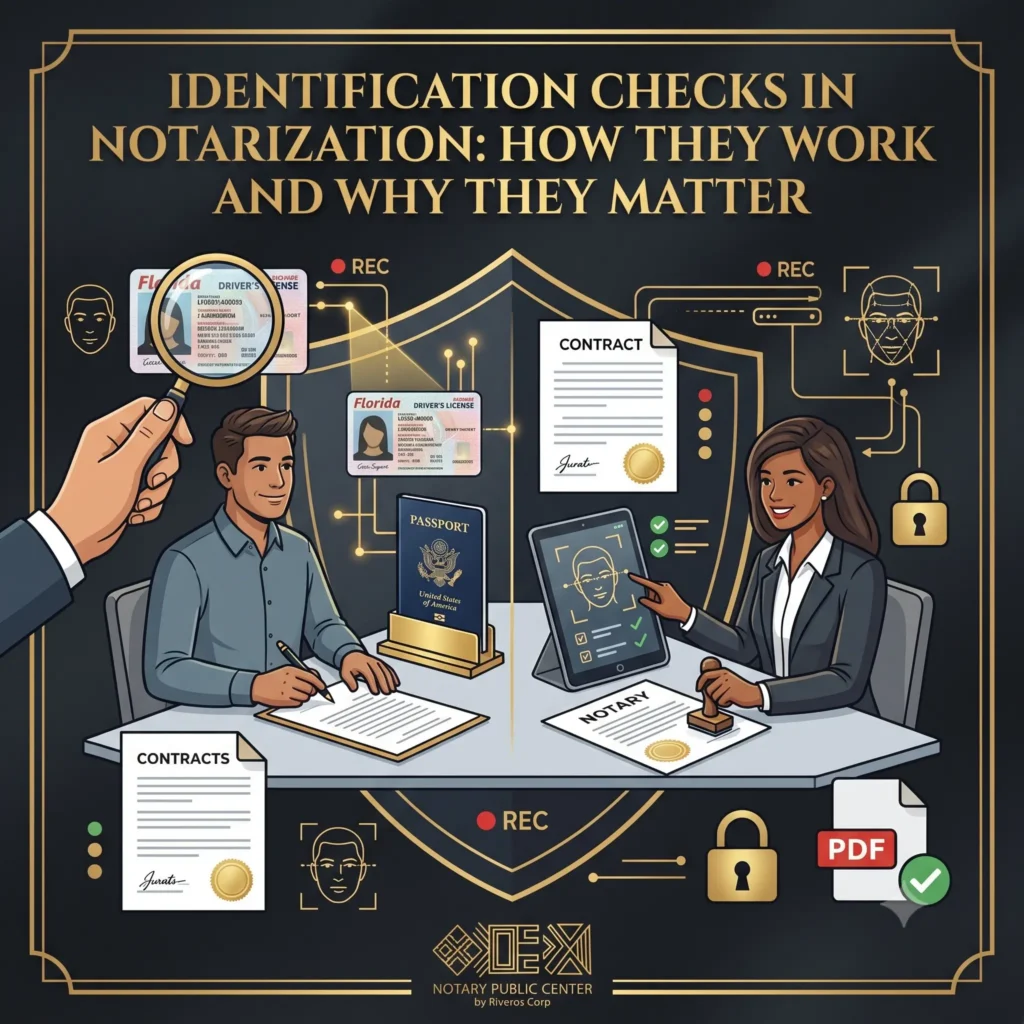
Identification checks are the mandatory legal procedures where a commissioned notary public verifies a signer’s identity using a valid, government-issued photo credential (such as a passport or driver’s license) before executing any notarial act. This strict verification process is the first line of defense against fraud, ensuring that the person signing a document is precisely who they claim to be.
Failing to undergo a proper ID check can lead to invalidated documents, rejected apostille applications, and severe legal liabilities. Whether you are executing a real estate closing, a power of attorney, or a corporate affidavit, identity verification cannot be taken lightly. At Notary Public Center, our specialists conduct rigorous identification checks that comply strictly with state statutes, ensuring your sensitive transactions are legally sound and protected from future disputes.
What Are Identification Checks in a Notarial Context?
The primary duty of a notary public is to serve as an impartial witness. To fulfill this role, they must establish the identity of the signer beyond any reasonable doubt. Identification checks involve a detailed visual and physical inspection of the credential presented.
During an in-person appointment, the notary examines the ID for:
Authenticity: Checking for holograms, micro-printing, and signs of tampering or forgery.
Photographic Match: Ensuring the photograph on the ID matches the physical appearance of the person standing before them.
Signature Consistency: Comparing the signature on the ID card to the signature the individual makes on the document.
While state laws govern the exact requirements—such as those enforced in Florida for in-person or online notarizations—the core principles remain the same. For instance, if you require mobile notarial services in jurisdictions like Miami-Dade or Broward counties, our notaries ensure that every verification step strictly adheres to Florida’s statutory mandates.
Two ways to notarize with Notary Public Center (and how ID works in each)
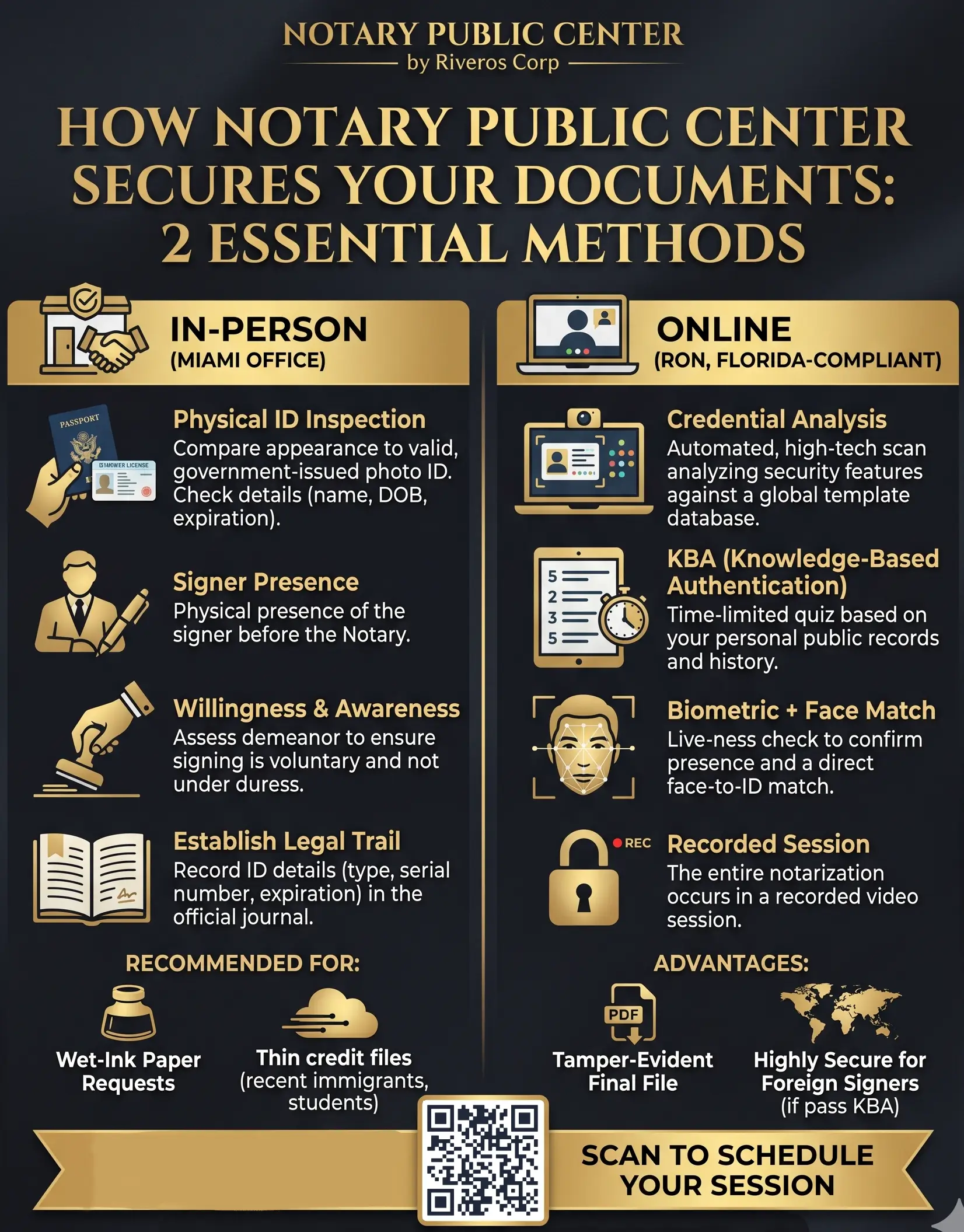
Option A — In-person notarization (Miami)
You bring your current, government-issued photo ID. We compare your appearance to the ID, check validity details (name, DOB, expiration), and complete the notarial act. This route is ideal if a recipient wants wet-ink paper or if you suspect online databases may not have enough data for KBA (common for newcomers, students, or people with thin credit history). Timeframes may vary based on scheduling and document complexity.
Option B — Online notarization (RON, Florida-compliant)
We meet by two-way live audio/video while the notary is physically in Florida. You’ll pass layered identity checks:
KBA (Knowledge-Based Authentication) — Time-limited questions built from public/credit data tied to your identity.
Credential analysis — Automated inspection of your government ID (data integrity, security features, expiration).
Biometric/live-ness + face match — Confirms a real person is present and the face matches the ID.
The entire session is recorded and the final file is tamper-evident. If identity proofing doesn’t pass, we switch to in-person so your paperwork doesn’t stall.
Tip: Some recipients love the online audit trail; others still insist on paper. If you’re unsure, we’ll help you confirm acceptance before you choose RON.
Acceptable Documents for Identification Checks
Not all identification cards are created equal. To pass a formal identification check for notarization, the credential generally must be current (unexpired), issued by a state or federal government agency, and contain both a photograph and a signature.
Primary Valid IDs
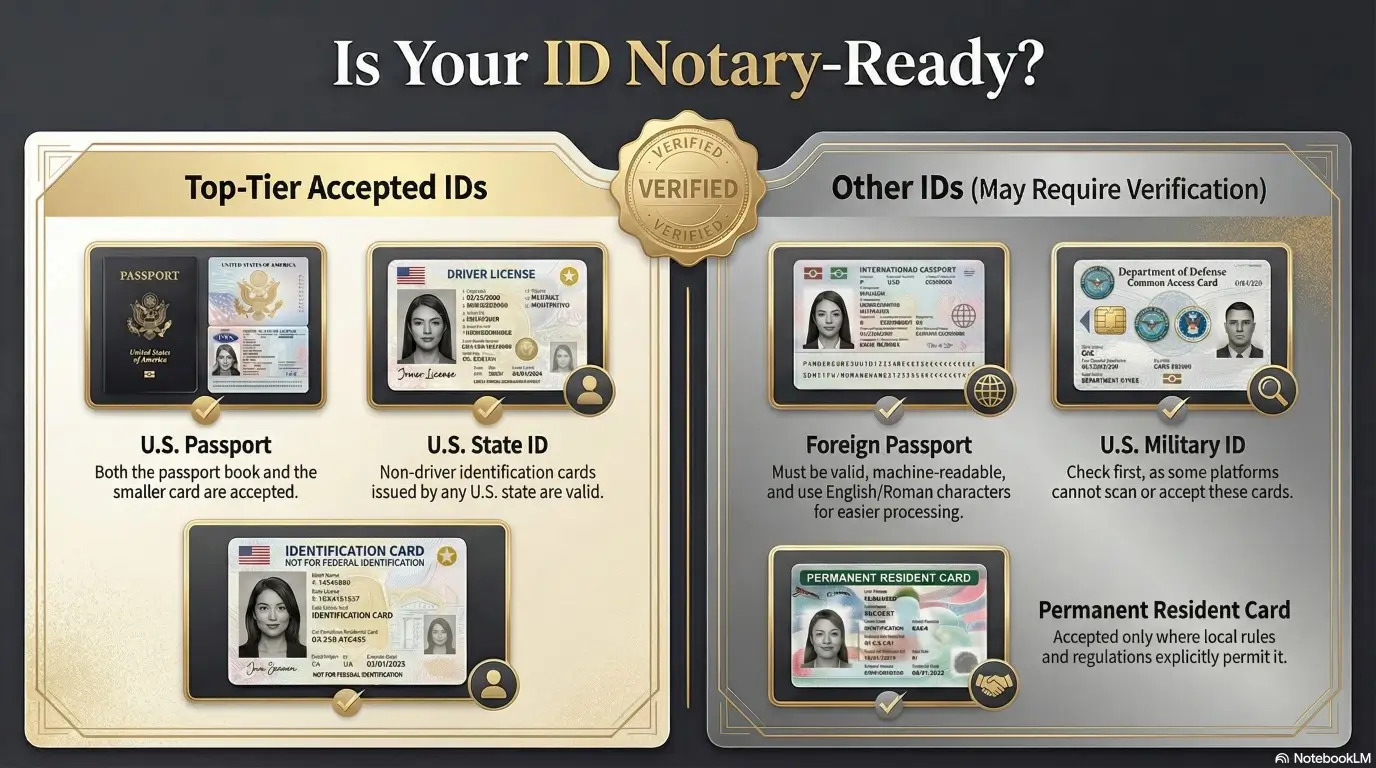
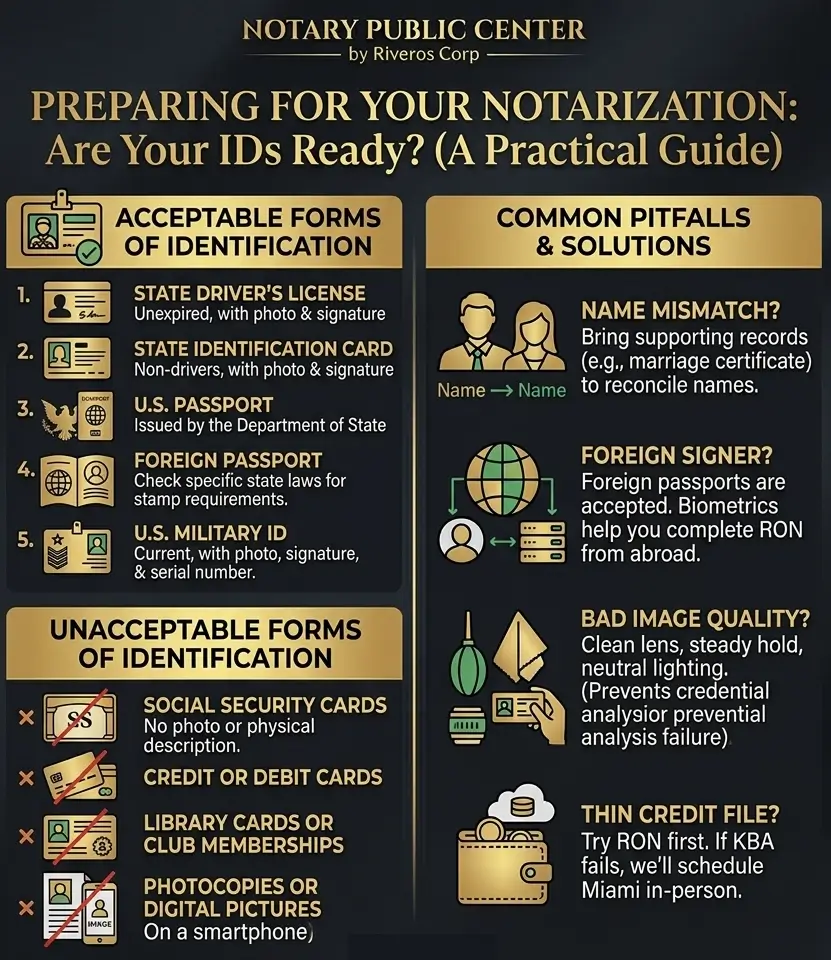
State-Issued Driver’s License: A current driver’s license or non-driver ID issued by a U.S. state or territory.
U.S. Passport: A valid, unexpired United States passport is universally accepted.
Foreign Passports: Often accepted if they are current and contain a stamp from U.S. Citizenship and Immigration Services (USCIS), or if they meet specific state criteria for recognizable biometric data.
U.S. Military ID: Acceptable provided it contains the requisite signature and photo.
Unacceptable Forms of ID
Documents that will instantly fail identification checks include:
Credit cards or bank cards.
Social Security cards (they lack a photo).
Birth certificates (they lack a photo).
Student IDs or gym memberships (not government-issued).
How Digital Identification Checks Work (RON)
With the widespread adoption of Remote Online Notarization (RON), identification checks have evolved from physical inspections to highly secure, multi-layered digital protocols. When using RON, the «DIY» approach of simply showing your ID to a webcam is legally insufficient.
Compliant digital identification checks involve two advanced technological steps:
Credential Analysis: You capture images of the front and back of your ID. Sophisticated software analyzes the barcode, layout, and security features against a global database to ensure the ID is not counterfeit.
Knowledge-Based Authentication (KBA): You must answer a timed quiz (typically 5 questions in 2 minutes) generated from your public and financial records. Questions might ask about past addresses or vehicles you have owned.
Only after passing both the digital credential analysis and the KBA will you be permitted to join the secure audiovisual session with the notary.
Name matching, signatures, and the notarial certificate
Identity verification doesn’t end with the ID. It also covers how your name appears in the document and notarial certificate:
Use one consistent legal name across ID, document, and certificate (including middle names/initials).
If there’s a discrepancy (accent marks, compound surnames, hyphens), we’ll align the certificate to your ID and note variants in the document if the recipient expects them.
For jurats, do not sign in advance; you must sign in the notary’s presence (in person or live online).
For acknowledgments, you can sign earlier and acknowledge the signature during the session.
Correct names and the right certificate language are often the difference between a smooth apostille later and a rejected packet.
Security, privacy, and tamper-evidence
Recording & audit trail (RON). Online sessions are recorded under program rules. We retain evidence per policy to answer acceptance questions from banks, schools, courts, or consulates.
Tamper-evident PDFs. After e-signing and sealing, any post-signing change triggers a clear “modified/invalid” indicator in standard PDF viewers.
Limited-use data. We use your information only to complete the notarial act and required compliance steps.
No shortcuts. If identification checks don’t meet the standard, we won’t proceed online—this protects you and the enforceability of your document.
How identification checks support apostille later
If your signed document goes to a Hague Apostille country, the state’s competent authority will issue an apostille over the notary’s signature (for private documents) or the issuing official’s signature (for public records). Clean identification checks up front help avoid questions later:
The notarial certificate will show a clear venue, date, and name that match your ID.
The RON evidence (recording + logs) provides confidence if a foreign reviewer asks how identity was verified.
For vital records going abroad, we’ll obtain the certified originals from the correct office first—vital records aren’t notarized—and then route the physical apostille. Timelines may vary.
If you expect an apostille, tell us at intake; we’ll format your notarial certificate to match the competent authority’s expectations and the destination’s preferences (paper vs. electronic).
Trust Notary Public Center for Secure Signings
Identity verification is not a mere formality; it is the foundation of legal document execution. Do not risk your vital documents with generic local shops or unverified online platforms.
At Notary Public Center, our specialists are rigorously trained in the latest fraud detection and identification protocols. We ensure that every ID check—whether performed in-person or via our secure online platform—is executed flawlessly and in total compliance with state laws. We handle the technicalities so you can proceed with confidence.
Contact Notary Public Center today to schedule your secure notarization appointment and ensure your documents are legally watertight.
FAQ
What forms of ID are valid for identification checks?
To pass a notarial ID check, you generally need a current, unexpired, government-issued ID that includes your photograph and signature. The most common acceptable IDs are a U.S. State Driver’s License, a State Non-Driver ID, and a U.S. Passport.
Can identification checks be performed online?
Yes. For Remote Online Notarization (RON), identification checks are performed digitally using a two-step process: Credential Analysis (verifying the physical security features of your ID via software) and Knowledge-Based Authentication (KBA), which requires you to answer specific questions based on your public history.
What happens if my ID is expired?
In most jurisdictions, an expired ID will result in a failed identification check. Some states allow the use of an ID issued within the last five years, but it is highly situational. If you lack a valid ID, you may be able to use Credible Identifying Witnesses—impartial individuals with valid IDs who swear an oath to your identity.
Do digital identification checks involve running my credit report?
No. While Knowledge-Based Authentication (KBA) uses data compiled from public records and credit bureaus to generate identity verification questions, this process is strictly an identity check. It is considered a «soft inquiry» and does not affect your credit score.
Why do notaries require such strict identification checks?
Notaries act as impartial witnesses mandated by the state to deter and prevent fraud. Strict identification checks ensure that signers are not impostors attempting to forge signatures on deeds, powers of attorney, or financial documents. Proper verification protects all parties involved in a transaction.
The information contained in this publication is provided for general informational purposes only and does not constitute legal advice. Reading or using this content does not create and is not intended to create an attorney-client relationship. No reader or user should act or refrain from acting based on the information presented herein without first consulting an attorney duly licensed to practice law in their jurisdiction.