You may need a US Department of State apostille to use an eligible federal document in a country where the Hague Apostille Convention applies. The review starts with the document’s issuer or signer, the country of use, and the receiving institution’s instructions. Your residence and mailing location do not determine which authority handles the document.
The Office of Authentications handles the federal process. State-issued records follow a different route. Confusing the two can delay a request or lead to the wrong type of authentication. This article explains the federal office’s role, the DS-4194 request form, and the available submission routes. It also explains what an apostille actually certifies.
Federal instructions, office hours, and processing windows can change. The information below reflects the government guidance reviewed on September 30, 2026. Before a request proceeds, the review should confirm the current service requirements and the recipient’s instructions.
US Department of State apostille: eligible documents
The United States has federal and state competent authorities under the Hague Apostille Convention. The relevant authority depends on the official signature or certification requiring authentication. For example, a Florida resident may need federal authentication for an FBI record but state authentication for a Florida vital record.
The Office of Authentications handles eligible records bearing federal officials’ signatures and other documents within its published authority. Examples include FBI Identity History Summaries, qualifying federal court and agency records, and certain naturalization, patent, or trademark records. Each document needs a review of its particular certification.
Federal guidance generally calls for an original or certified copy with a legible official signature, printed name and title, agency seal, and issuance date. A document’s familiar name does not establish that the copy in hand meets those requirements.
For Hague Convention use, state-issued documents normally follow the issuing or certifying state’s competent-authority process. This generally includes state vital records, educational records, notarized instruments, and state corporate records. Their intended use abroad does not, by itself, place them within the federal apostille route.
Some documents need an appropriate certification or notarial act before authentication. In addition, non-Hague destinations use authentication and legalization procedures instead of the Convention apostille route. Those procedures may involve additional authorities. The receiving country’s current instructions determine what the final file must contain.
Our overview of apostillation and document origin explains the broader Convention framework. This article focuses on the federal Office of Authentications and the distinctions that affect a federal submission.
What a US Department of State apostille certifies
The Office of Authentications issues apostille and authentication certificates for documents within its authority. Its public office is in Washington, D.C., while its mailed intake uses a separate address in Sterling, Virginia. Each location serves a different function, so the submission method matters.
An apostille confirms the document’s origin through the signature, the signer’s official capacity, and, where applicable, the seal or stamp. However, it does not establish that the document’s statements are true. It cannot correct a defective record or require a foreign institution to accept unsuitable material.
The recipient may still require a particular record, a recent underlying document, a translation, or supporting material. Those requirements exist separately from authentication. Consequently, a completed apostille does not resolve every question about the document’s intended use.
Where the Hague Convention applies, the office may issue an apostille for an eligible federal document. For a destination outside that framework, it may issue an authentication certificate. The destination country’s legalization requirements may then call for further action. Identifying the country of use helps establish the appropriate certificate and route.
DS-4194 and your US Department of State apostille request
Form DS-4194, Request for Authentication Service, accompanies a federal request by mail or in person. It identifies the requester, the documents, the return arrangements, and the country of use. That destination helps determine whether the office should consider an apostille or an authentication certificate.
The form and enclosed documents need to agree. A reviewer should resolve missing information or inconsistent descriptions before submission. If a representative will handle the file, the review should also confirm the current representation and collection requirements. Completing a form cannot make an otherwise ineligible document suitable for authentication.
Documents and return materials
A federal submission includes the completed DS-4194, eligible documents, and the return materials that the current instructions require. Mailed requests use tracked delivery and a self-addressed prepaid return envelope. The published instructions specify USPS or UPS for return delivery. In-person submissions also require a prepaid return envelope.
Document preparation requires a separate review. The federal office looks for the appropriate original or certified signatures and seals, issuance date, and agency letterhead. Its guidance warns against notarizing the original federal document for this purpose. An unnecessary notarization can make that document ineligible for the intended authentication.
Federal service routes and travel circumstances
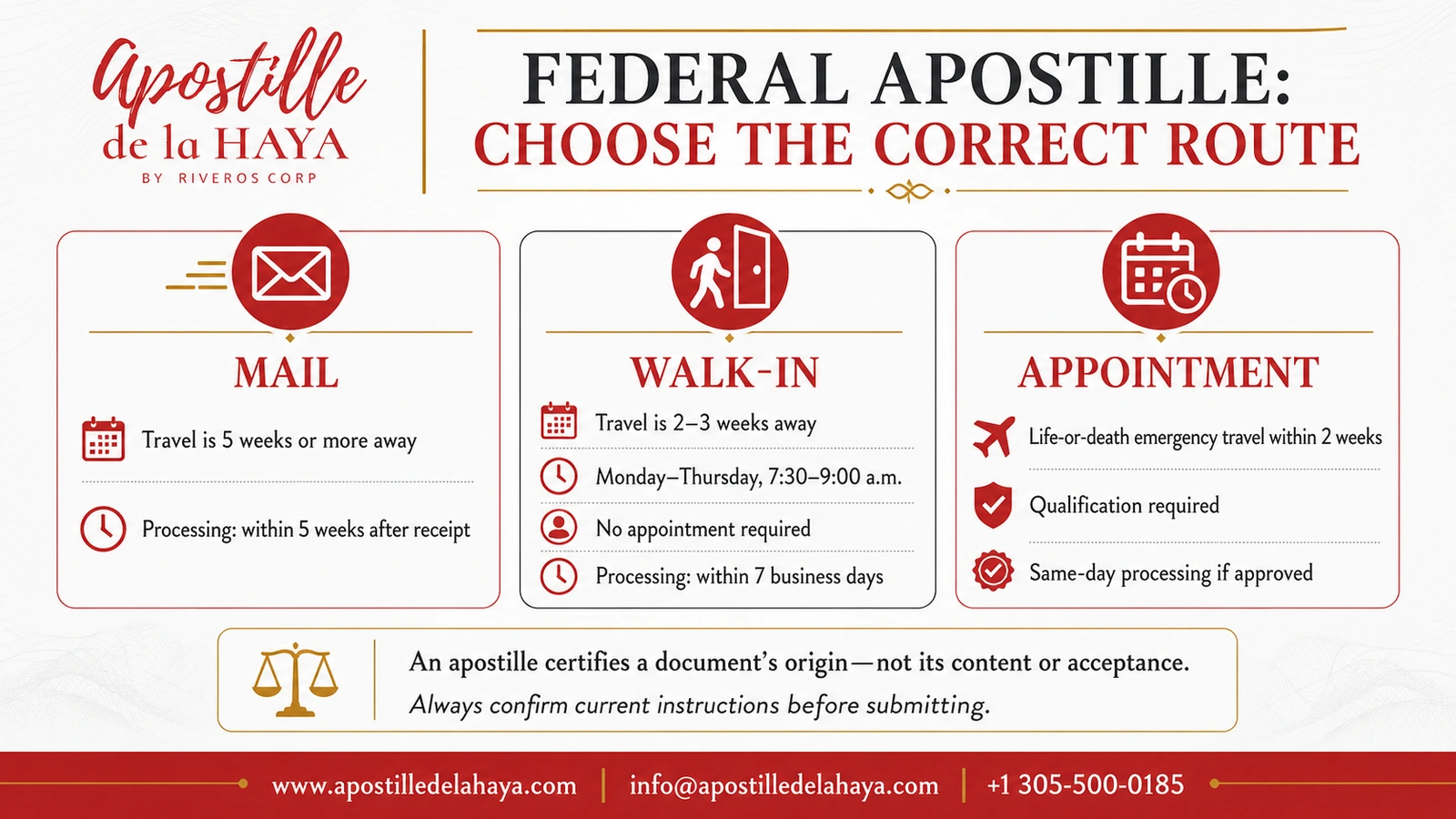
The Office of Authentications organizes its published service options around the requester’s international travel timeline. Its mail guidance applies to travel at least five weeks away. The office states that it processes a mailed request within five weeks after receipt at its Washington office.
For travel two to three weeks away, the published instructions provide walk-in drop-off and pick-up in Washington, D.C. Routine walk-ins take place Monday through Thursday during the stated morning window. They do not require an appointment. The office states that it processes these requests in seven business days.
Emergency appointments have narrower eligibility. They concern international travel within two weeks because an immediate family member abroad has died, is dying, or has a life-threatening illness or injury. The office requires supporting evidence. It states that it processes a qualifying request on the appointment day.
An urgent business, school, or private deadline does not by itself establish eligibility for that emergency service. Therefore, the review should separate the importance of a deadline from the authority’s appointment criteria.
US Department of State apostille processing time
The published processing windows cover the authority’s handling of a request. They do not cover every part of the document’s journey. Obtaining an eligible federal record, arranging a translation, shipping, and the foreign recipient’s review can add time outside that window.
For planning, distinguish the federal stage from the complete file timeline. Mail, routine walk-in service, and qualifying emergency appointments have different criteria. A service provider should explain which route applies instead of presenting them as a general promise of expedited processing.
Processing information can change between the initial review and submission. Confirm the current instructions before the request proceeds and before any visit. A published service window helps with planning, but it does not establish the date when a foreign recipient will accept the completed file.
Federal mailing and in-person locations
The mailing intake is in Sterling, Virginia. A delivery notification there does not mean that the Washington office has started processing the request. The Department of State explains that the package may take additional days to reach Washington, where its processing clock begins.
The Washington office handles the published walk-in and emergency-appointment services. Routine walk-ins use limited morning hours Monday through Thursday. Qualifying emergency appointments follow a separate schedule. Although staff process requests on Fridays, the office does not accept public walk-ins or appointments that day.
These distinctions affect travel and representative arrangements. Before anyone travels to the office, the file review should confirm the service type and current opening hours. The mail-intake address cannot substitute for the public service location.
Common federal apostille issues to review
A request can encounter problems when the document, authority, destination, or service route does not match. The following issues warrant review. They are screening considerations, not predictions that every file with a particular feature will receive the same decision.
- The file contains a state document. For Hague use, a state vital record or state-notarized instrument ordinarily follows that state’s competent-authority route.
- The federal record lacks the required certification. A plain copy may lack the original or certified signature and seal that federal guidance requires.
- The destination is missing or inaccurate. The country of use helps distinguish an apostille from an authentication certificate.
- Someone notarized the original federal document unnecessarily. Federal guidance warns that this can invalidate it for the intended authentication.
- The submission uses the wrong location. Sterling handles mailed intake; Washington provides the published public services.
- The requested service does not match the travel circumstances. Routine walk-in service and emergency appointments have different criteria.
- The file assumes the recipient’s requirements. Authentication cannot resolve an outstanding question about translations, document age, or record type.
Reviewing those issues helps match a request to the document and its intended use. Our guide to common apostille mistakes explains related concerns. The authority still controls eligibility and processing.
How Apostille de la Haya coordinates the federal process
Apostille de la Haya reviews the issuing authority, document format, destination, and recipient’s instructions before coordinating the applicable administrative route. This review also helps distinguish a federal request from a state apostille or a non-Hague legalization matter.
Support may include document screening, DS-4194 preparation, tracked logistics, status coordination, and return delivery. These services aim to reduce incomplete submissions and avoidable routing errors. The U.S. Department of State decides whether to issue the certificate and controls its processing. Meanwhile, the receiving institution sets its own document requirements.
The review considers the record’s issuer, the signature and seal on the available copy, and the destination’s instructions together. It should also identify any translation requirement or request for a particular form of the underlying record. Keeping those questions distinct prevents confusion about what the apostille can accomplish.
If instructions conflict or leave a material question unresolved, the receiving authority should clarify its requirement before the service proceeds. That clarification can affect document preparation and delivery arrangements. A service provider’s assumption cannot replace the recipient’s answer.
Need help with a US Department of State apostille?
Apostille de la Haya can review your document type, destination, and recipient’s instructions before coordinating the applicable services. Share any deadline during that review so the team can explain the available arrangements and their limits.
Call +1 305 500 0185 or contact the team on WhatsApp. Authority decisions and government processing times remain outside the team’s control.
US Department of State apostille: frequently asked questions
Which documents require a US Department of State apostille instead of a state one?
Eligible federal records include FBI Identity History Summaries and qualifying federal court or agency records. Certain naturalization, patent, and trademark documents also fall within the federal office’s authority. State-issued records generally follow the relevant state’s route for Hague use. The official signature and certification determine the route.
What does a federal apostille certify?
It authenticates the signature, the signer’s official capacity, and, where applicable, the seal or stamp. It does not verify the truth of the document’s statements or cure defects in the record. The recipient still decides whether the document meets its requirements.
What is the DS-4194 form and when is it required?
DS-4194 accompanies federal authentication requests by mail or in person. It identifies the requester, the documents, return arrangements, and country of use. The destination helps establish whether an apostille or an authentication certificate applies.
Can I walk in, or do I need an appointment?
Current guidance provides routine walk-ins for travel two to three weeks away. Appointments concern qualifying life-or-death emergencies involving immediate family abroad and travel within two weeks. The office requires evidence for emergency eligibility. Confirm current hours before making travel arrangements.
How long does the US Department of State apostille process take?
Current guidance states five weeks for mailed requests after receipt in Washington and seven business days for routine walk-ins. The office states that it processes qualifying emergency requests on the appointment day. Document preparation, translation, shipping, and recipient review add separate time.
Can I coordinate a federal apostille while living outside the United States?
Yes. Living abroad does not itself prevent a federal request. The document still needs the required certification, and the submission and return arrangements must fit the applicable service route. The recipient’s instructions also remain relevant.
Related federal document guidance
For related document questions, see our guides to the DS-4194 request form and the FBI background check authentication process.
For help with your file, visit Apostille de la Haya or use the team’s contact details above. The initial review should establish the document’s origin and intended use before any submission arrangement.
Authentication disclaimer: This publication provides general information and is not legal advice. Federal instructions can change. The competent authority controls issuance, and the receiving institution controls its document and acceptance requirements.