To apostille a birth certificate in Florida, you need the appropriate certified record and the correct state authentication route. Florida’s Department of State issues the apostille for a qualifying Florida birth certificate. A notary or private service provider can assist with coordination, but cannot issue that state certificate.
Before arranging the service, confirm the destination country and the receiving authority’s instructions. The recipient may specify a particular record format, a recent issue date or a translation. Those requirements matter even when the document qualifies for an apostille.
Notary Public Center can discuss your available certificate, deadline and proposed service. The sections below explain what to clarify before relying on a document for citizenship, marriage, study or another purpose abroad.
Apostille birth certificate Florida: what it means
An apostille authenticates the origin of a public document. It concerns the official signature, the signer’s capacity and, where applicable, the seal or stamp. However, it does not independently verify every fact in the birth record or guarantee approval of a foreign application.
The Hague Apostille Convention provides the international framework. Its application depends on the relevant countries and document. Therefore, an apostille does not create universal validity for every purpose in every country.
For example, a foreign civil registry may need evidence beyond one birth certificate. A university may have its own translation rules. Ask the recipient what the complete submission must contain before treating authentication as the final requirement.
Confirm whether the recipient requires an apostille
The HCCH’s practical guide explains that some rules or agreements remove the need for authentication. It also distinguishes an apostille from other legalization arrangements. Consequently, the intended use belongs in the initial review.
If the Convention does not apply, clarify the alternative route with the relevant authorities. A state authentication and further legalization may be necessary. Do not assume that the same certificate and timetable cover every destination.
Who issues the Florida birth certificate apostille?
The Florida Secretary of State is the state’s competent authority, and the Division of Corporations issues apostilles. The Department of State’s authentication page identifies that authority and the document categories it handles.
A private company may review the file and coordinate the requested service. However, the government authority decides whether to issue the apostille. A provider’s review cannot guarantee that decision or the foreign recipient’s eventual acceptance.
Our Florida State Apostille guide discusses the wider distinction among vital records, notarized instruments and documents from other authorities.
Your current address does not change the issuing state
If your birth certificate comes from another U.S. state, its authentication follows that state’s competent authority. Moving to Florida does not turn it into a Florida birth record. Likewise, a Florida notary’s stamp does not transfer the original record into Florida’s jurisdiction.
Identify the issuing authority from the document itself. If you are unsure whether you hold a state record or another type of certificate, explain that uncertainty during the review. The correct document route should follow that answer.
Which Florida birth certificate do you need?
Florida’s accepted-document guidance calls for a birth certificate signed by the State Registrar. It recognizes qualifying certificates from the Bureau of Vital Statistics or a county health department. The issuing signature deserves attention, not just the office name.
A hospital keepsake or ordinary photocopy does not replace the official certified birth record. Similarly, a scan may help with preliminary review but does not automatically satisfy the state’s document requirement.
Tell the provider what you actually have before arranging delivery. A clear description of the issuer, certification and condition helps identify whether further review is necessary. Avoid assuming that any paper called a birth certificate will serve the same purpose.
Check the record format with the recipient
The receiving authority may ask for information that your current copy does not display. Florida’s guidance specifically notes limited information in certain older county-issued birth records. Therefore, ask whether the available format meets the recipient’s needs before relying on it.
If the recipient uses terms such as “long form,” ask what information or certification it means. Labels can create confusion when different offices use different terminology. Written requirements give the record provider a clearer basis for discussing the appropriate copy.
Do you need to notarize the birth certificate?
No. The official certified birth record follows the vital-record authentication route. A notary cannot certify an ordinary photocopy of that record as though it came from the official custodian.
Florida Statutes section 117.05 limits notarial copy attestations for vital and public records. Our article on a photocopy of a birth certificate explains why that distinction matters.
A related document may have a separate notarization requirement. For example, an authorization connected with requesting a confidential record can differ from the birth certificate itself. Keep those documents and their purposes distinct when discussing the file.
A notarial act cannot correct the birth record
If the certificate contains an error, authentication will not amend it. Contact the record authority about the appropriate correction process. Also discuss any mismatch with the receiving agency before ordering further services.
For instance, a different spelling between a birth certificate and a passport may require additional review. The apostille does not decide whether the two records establish the same person’s identity. Raise that issue before the filing deadline becomes urgent.
Who may request a replacement certificate?
Florida birth records have access restrictions. The Department of Health’s apostille guidance explains that confidential records require an eligible requester. When another person requests the record, an appropriate authorization and identification may be necessary.
As a result, a private provider cannot promise to obtain every birth certificate without checking authority and supporting information. Ask which documents the record custodian requires for your situation. This is particularly relevant when you act for a child or another family member.
The service discussion should identify who will request the record and what remains outstanding. If you already have a qualifying certified copy, explain that as well. Ordering another copy may be unnecessary unless the recipient or record requirements call for it.
Discuss personal information through the agreed channel
A birth record contains personal details. Ask how the provider wants to receive the material needed for review, and follow that agreed method. You do not need to place a full certificate or identification number in a public comment.
Also clarify which documents must travel as paper records and which copies serve only for preliminary review. That distinction helps you plan delivery without assuming that an emailed image completes the service.
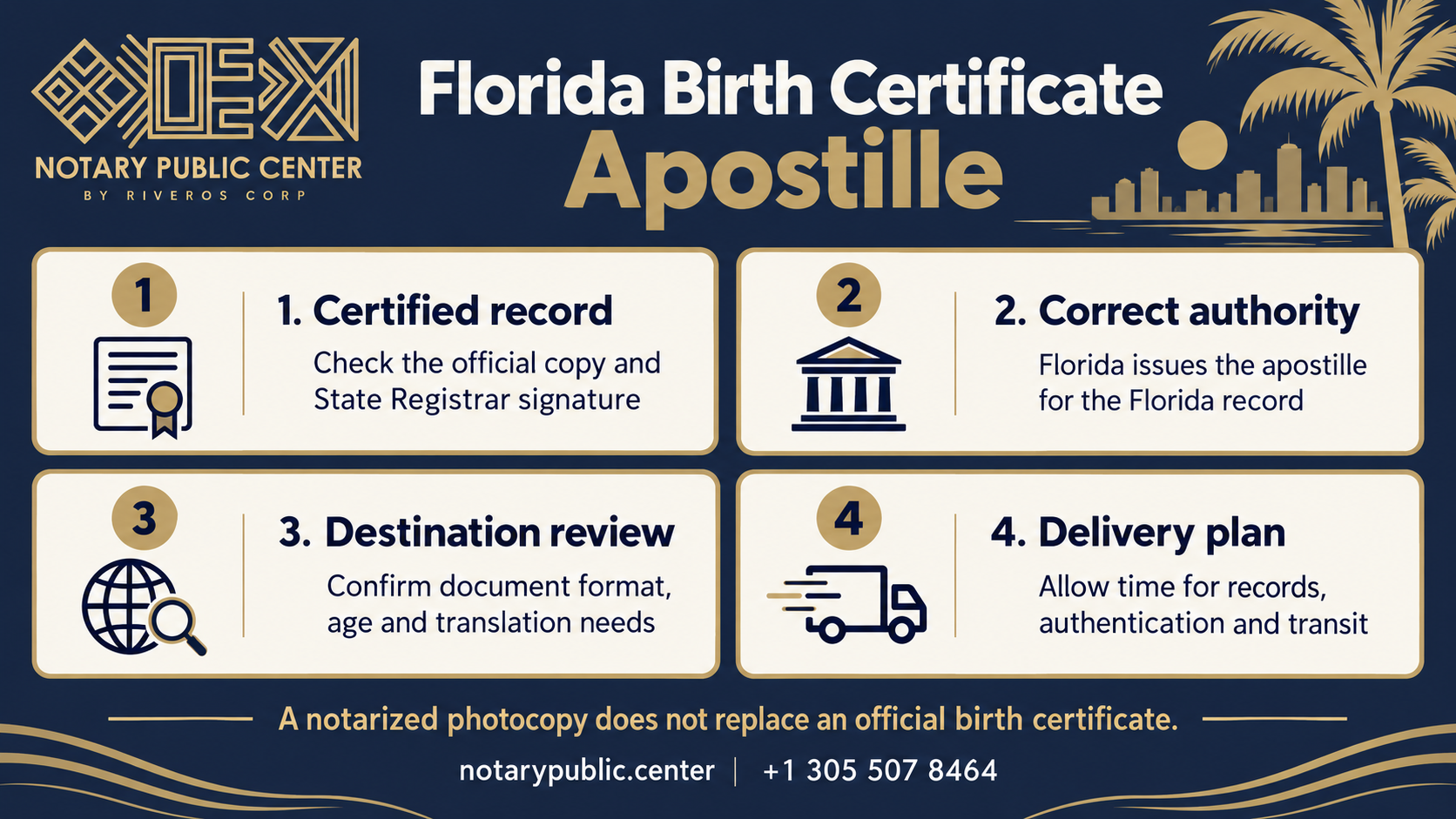
Review the document before arranging authentication
The following table organizes the main questions for a Florida birth certificate apostille. Each answer helps define the next step; none replaces the authority’s final review.
| Point to review | Question to clarify | Why it matters |
|---|---|---|
| Issuing authority | Is this a Florida birth record? | Another state's record follows another authority. |
| Certification | Does the official copy carry the required signature? | An ordinary photocopy is insufficient. |
| Record format | Does it contain the information the recipient requests? | Authentication does not add missing details. |
| Access | Who may request a replacement record? | Confidential records have eligibility requirements. |
| Translation | What language and translator requirements apply? | The recipient sets its submission rules. |
| Timing | When must the complete package arrive? | Record preparation and delivery take additional time. |
Translation requirements depend on the destination
Ask whether the recipient needs a translation and what credentials or certification it expects. Also confirm whether the translation must cover the apostille attached to the birth certificate. That answer can affect the order of the work.
There is no universal rule that every translation must precede or follow authentication. Likewise, a blanket statement that Florida never authenticates anything connected with a translation is misleading. A qualifying notarial act concerning a translator’s declaration raises a separate question from authenticating the original birth record.
The Florida Department of State’s FAQ states that the office does not provide translations. It also notes that the translator cannot notarize the translation themselves. Clarify the proposed arrangement before commissioning either service.
Keep the original record and translation distinguishable
A translation conveys information from the source document. It does not replace the record authority’s certification or correct an error in the original. If you notice a discrepancy, raise it with the appropriate professional before submission.
In addition, tell the translator exactly what the recipient requested. A general request for an “official translation” may leave important details unresolved. Written instructions help define the deliverable and avoid assumptions about acceptance.
Can you arrange the service from outside Florida?
You do not necessarily need to travel to Florida to arrange authentication of a Florida birth certificate. However, remote coordination does not make every part of the process electronic. Official paper records and delivery arrangements may still be necessary.
Notary Public Center can discuss the available service for your location and document. Confirm the scope before sending originals, including the delivery address and who will receive the completed package. Also mention any restrictions that affect your ability to receive mail.
If another person handles the file for you, clarify their role and any required authorization. This helps distinguish ordinary coordination from access to a confidential record. Ask about unresolved eligibility issues before treating the request as ready.
How long does the process take?
The total time includes any replacement record, authentication processing and delivery. Translation or correction work may add another stage. Therefore, a state processing estimate does not necessarily describe the complete time until the foreign recipient receives the file.
Florida’s published FAQ says the office does not offer expedited service, although it describes walk-in arrangements. A private courier or provider may handle logistics, but that does not guarantee immediate issuance. Ask what a quoted estimate includes and when it starts.
Provide the actual deadline and explain its purpose. For example, a consular appointment date may differ from a deadline for submitting supplemental evidence. Clear dates help the provider discuss feasible arrangements without promising an outcome.
Frequently asked questions
Can I use a hospital birth certificate for the apostille?
A hospital keepsake does not substitute for the official certified birth record required by Florida. Confirm the appropriate vital-record copy and signature. If you only have a commemorative certificate or scan, disclose that before arranging the service.
Can a notary issue my birth certificate apostille?
No. Florida’s competent authority issues the apostille. A service provider may coordinate the request, but its role does not replace the government decision. Also, a Florida notary cannot certify an ordinary birth-record photocopy as an official vital record.
Does the certificate have to be less than six months old?
Do not apply a universal six-month rule. Ask the recipient whether it requires a recently issued record and which date it uses. In addition, confirm that the available copy meets Florida’s authentication requirements. Document age and acceptable certification are separate questions.
Can I obtain a Florida apostille if I was born elsewhere?
Your current residence does not control the authentication of another state’s birth certificate. Use the competent authority for the issuing state. If you hold a different type of record, identify its actual issuer before selecting the route.
Must I translate the certificate after the apostille?
Confirm the receiving authority’s requirements first. It may need a translation of both the record and the attached apostille. The required translator, certification and sequence depend on that request. Avoid assuming that one translation format works for every country or institution.
Discuss your certificate with Notary Public Center
Contact Notary Public Center with the record type, destination country and deadline. Explain whether you already have the certified copy and whether the recipient requested a translation or a recent issue date.
Request information by WhatsApp at +1 305 507 8464. The team can discuss the proposed coordination and identify what remains necessary before proceeding.
This article provides general information and does not constitute legal advice. Reading it does not create an attorney-client relationship. Consult a qualified attorney about citizenship, family status or other legal consequences. The issuing authority’s current rules and the recipient’s requirements govern the particular request.