
FL Notary Public: The Complete 2026 Guide to Services and Compliance
An FL Notary Public is an official commissioned by the State of Florida to serve as an impartial witness to the signing of critical documents, administer oaths, and solemnize marriages. Consequently, if you need a document notarized in Florida, state law strictly dictates how the process must be handled. This includes mandatory physical or authorized digital presence and specific identification protocols.
However, navigating the complexities of Florida’s notarial laws is not a «do-it-yourself» task. For instance, a single mistake in the notarial certificate, an expired ID, or an improper oath can render your real estate deed, power of attorney, or corporate contract legally void. At Notary Public Center, our commissioned specialists ensure that every notarization is executed with flawless precision and full statutory compliance. Ultimately, this protects you from future legal disputes or document rejections.
What Does an FL Notary Public Actually Do?
A Florida Notary Public acts as the state’s first line of defense against fraud. Specifically, their primary duty is to verify the true identity of the signer, ensure they are signing willingly without duress, and confirm they understand the contents of the document.
Furthermore, unlike notaries in many Latin American or European countries (who are often highly trained lawyers that draft legal documents), an FL Notary Public cannot provide legal guidance or prepare documents unless they are also a licensed attorney. Therefore, their power lies strictly in the verification and execution of the signature.
Common Notarial Acts Performed in Florida
When you hire an FL Notary Public through Notary Public Center, you are typically requesting one of the following official acts. Importantly, each requires a different specific notarial certificate attached to your document:
1. Acknowledgments
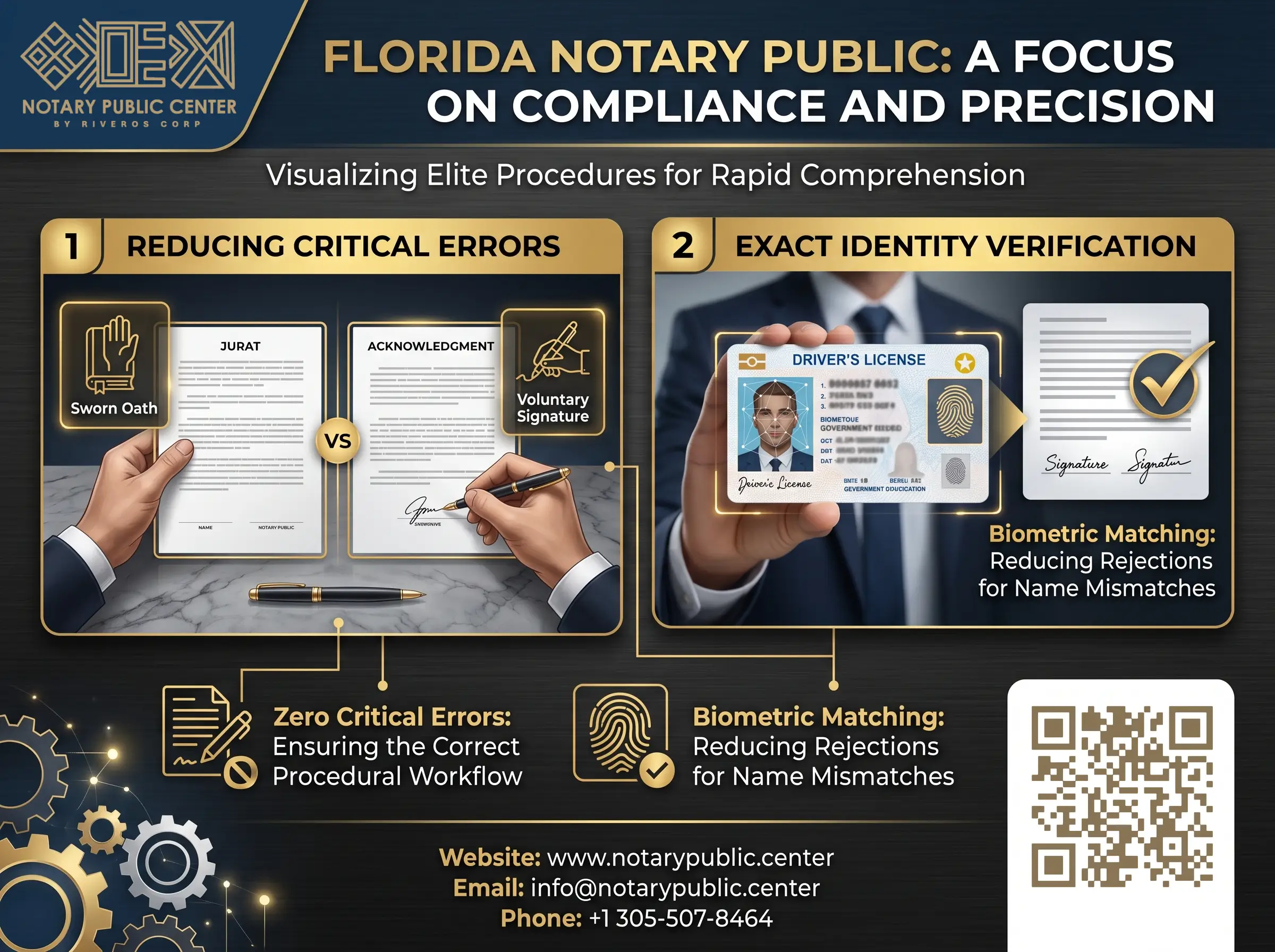
This is the most common notarial act. The signer must declare (acknowledge) to the notary that they have willingly signed the document. Although the paperwork can be signed before bringing it to the notary, the signer must still personally appear before the official to acknowledge the signature.
2. Jurats (Oaths and Affirmations)
For a jurat, the signer must swear an oath or make an affirmation under penalty of perjury that the contents of the document are true. Crucially, the document must be signed in the physical or secure digital presence of the notary. You cannot sign this in advance under any circumstances.
3. Copy Certifications
An FL Notary Public can certify that a reproduction of an original document is a true, exact, and complete copy. Nevertheless, Florida law forbids notaries from certifying copies of public records (like birth certificates or court documents) if certified copies are already available from another public official.
4. Solemnizing Marriages
Florida is one of the very few states where a commissioned Notary Public is legally authorized to perform civil marriage ceremonies. Indeed, this is a specialized service frequently managed by the experts at Notary Public Center.
In-Person Florida Notarization: What to Bring & Expect
To ensure a smooth process, you must come prepared. Bring the following items to your appointment:
Valid Identification: A government-issued photo ID that is current (such as a driver’s license, passport, etc.).
The Document: Keep in mind, it must be un-signed if a jurat is required (since you must sign in our presence). For acknowledgments, you may have signed already, but bring the document intact.
Required Witnesses: Bring them along if your specific document requires additional signatures.
Complete Paperwork: Any supporting pages (exhibits, attachments) your recipient expects to be part of the notarized set.
Pro tip: Names should match your ID (including hyphens and suffixes). If they do not align perfectly, bring supporting ID or ask the recipient about acceptable alternatives.
The Rise of Remote Online Notarization (RON) in Florida
Since 2020, Florida law permits an FL Notary Public to perform notarial acts online through secure, state-approved audiovisual platforms. This modern process is known as Remote Online Notarization (RON).
With RON, you do not need to be physically present in Florida. You can be anywhere in the world, provided the notary is physically located in Florida during the session. Moreover, the identification process is more rigorous, requiring Knowledge-Based Authentication (KBA) and advanced credential analysis. Notary Public Center utilizes state-of-the-art RON platforms to notarize your documents instantly and securely. As a result, the digital seal complies with all federal and state regulations.
Remote Online Notarization (RON): How It Works
Florida explicitly authorizes Remote Online Notarization. In practice, the workflow involves several key steps:
Identity proofing & credential analysis: You will pass a short knowledge-based check and scan an acceptable ID so the system can validate it.
Live audio-video: The notarization happens on camera. Subsequently, the session is recorded and retained per law.
Tamper-evident e-signature and e-seal: Your document is signed and notarized electronically. Finally, you receive a tamper-evident PDF.
When RON is a Strong Choice
This method is ideal when you are traveling or out of state. Additionally, it is perfect if you simply want quick scheduling and an e-notarized file.
When RON May Not Be Accepted
Certain foreign authorities, court clerks, or banks still prefer wet-ink notarization. Because of this, Notary Public Center uses compliant RON platforms and will advise whether your recipient typically accepts RON, so you do not gamble on the format.
Copy Certifications in Florida (With Important Exceptions)
Florida notaries can attest to the trueness of a photocopy, but not for everything.
Allowed: Copies of non-recordable personal documents the notary can compare to the original (e.g., diplomas, passports, invoices).
Not allowed: Vital records (birth, death, marriage), court documents, or other public records that must be obtained as certified copies directly from the issuing agency/office.
Special Note: Some recipients want a passport attestation instead (a notarized statement by the holder), or they may require a certified copy from the issuing authority. Therefore, tell us your recipient’s rules, and we will prepare the right format. Furthermore, Notary Public Center can also retrieve certified copies of Florida vital, court, or corporate documents from the proper authority if that is what your case requires.
Special Florida Notary Powers You Might Not Know
Beyond standard documents, an FL Notary Public has unique capabilities.
Marriage ceremonies: As mentioned, Florida notaries can solemnize marriages within the state. We can officiate and properly complete the license for filing.
Depositions: We can administer oaths and notarize deposition transcripts.
Ultimately, these niche services often speed up edge-case workflows. Ask us if your situation qualifies.

The Risks of Improper Notarizations
Relying on inexperienced individuals or attempting to force a notarization without the proper procedures is highly risky. Financial institutions, county recording offices, and foreign governments (through the Apostille process) meticulously check notarial certificates.
If the FL Notary Public uses the wrong certificate, fails to administer an oath, or incorrectly documents the type of ID used, your document will be rejected. This leads to missed real estate closings, invalidated contracts, and wasted time and money.
Headed Overseas? How Notary Ties Into Apostille
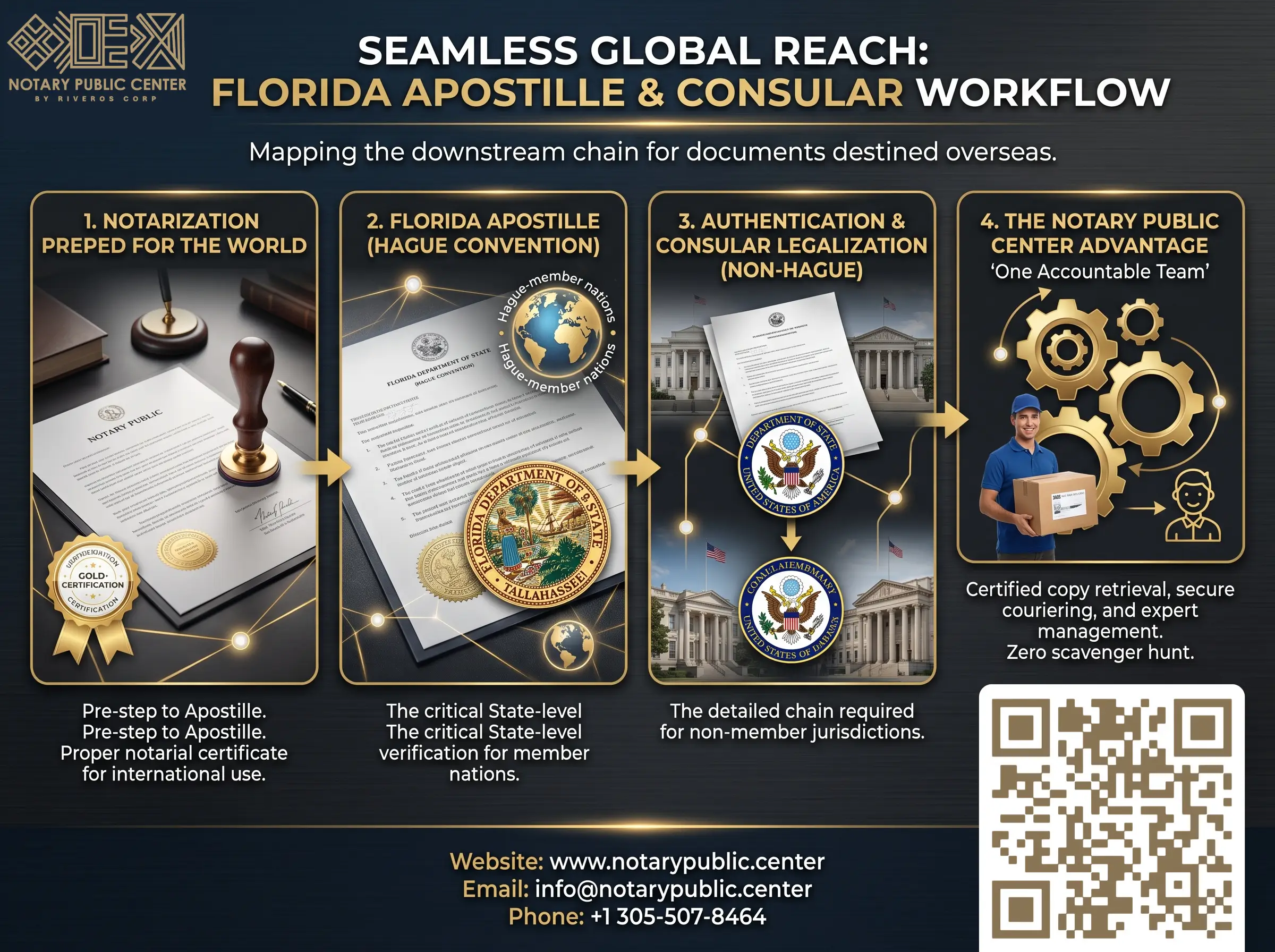
If Your notarized document is destined for a Hague Apostille country, the next step is usually a Florida apostille from the Florida Department of State (Tallahassee). If the destination is not in the Hague Convention, you’ll need Florida authentication plus consular legalization. Notary Public Center can manage the entire downstream chain once the notarization is complete—so you don’t juggle multiple vendors. Learn more about our online public notary option, and if the document at hand is a sworn statement, see our dedicated guide to the notarized affidavit. New to the terminology? Start with what «notarized» actually means.
Compliance & Privacy (Because Your Data Matters)
Least-privilege access: only assigned staff handle your documents and PII.
Secure storage: encrypted storage for e-records and protected physical storage for paper records.
Retention & destruction: we keep only what’s necessary for the legitimate purpose and dispose of residuals per policy.
- Transparent records: we can show a timeline of each step—helpful for corporate compliance and counsel.
Secure Your Documents with Notary Public Center
Do not leave the legality of your critical documents to chance. Whether you need a complex real estate package executed, a corporate affidavit sworn, or a remote online notarization completed from overseas, you need experts who understand the nuances of Florida law.
Contact Notary Public Center today. Our highly trained FL Notary Public specialists are ready to handle your notarization end-to-end with unmatched security, speed, and absolute compliance.
Are Florida notaries allowed to draft legal contracts?
No, they cannot. Under Florida law, a Notary Public who is not a licensed attorney cannot draft legal documents, give advice on how to fill them out, or tell you which notarial certificate you need. Doing so is considered the unauthorized practice of law. You must have your documents prepared before contacting our specialists for execution.
Where does an FL Notary Public have legal jurisdiction?
The jurisdiction of a Florida Notary Public is strictly limited to the geographical borders of the State of Florida. However, through Remote Online Notarization (RON), our Florida-based notaries can legally notarize documents for signers located anywhere in the world.
Will a notary ever refuse to execute my document?
Absolutely. An FL Notary Public is required by law to refuse a notarization if the signer lacks valid identification, appears confused or under duress, cannot communicate directly with the notary (without a third-party translator), or if the document is incomplete or blank.
How does notarization work for documents in a foreign language?
A Florida notary can notarize a signature on a document written in a foreign language, provided the notarial certificate itself is in English. Additionally, the notary must be able to communicate directly with the signer in a shared language to ensure they understand what they are signing.
What happens if the document is signed prior to the appointment?
It depends entirely on the required notarial act. For example, if the document needs an Acknowledgment, you can sign it beforehand, but you must still appear before the notary to acknowledge your signature. Conversely, when the document requires a Jurat (an oath), you must sign it in the presence of the notary. In that case, if you already signed it beforehand, you will have to sign it again in front of them.
Legal Disclaimer
The information contained in this publication is provided for general informational purposes only and does not constitute legal advice. Reading or using this content does not create and is not intended to create an attorney-client relationship. No reader or user should act or refrain from acting based on the information presented herein without first consulting an attorney duly licensed to practice law in their jurisdiction.