
Introduction: Understanding what is apostille services
If you’ve ever wondered what is apostille services, imagine you need to get married in Italy or enroll your child in a school in Spain. Suddenly, you realize your birth certificate or diploma must be officially recognized in another country. That’s when understanding what is apostille services becomes essential—this process ensures your documents are authenticated and legally accepted abroad, allowing them to cross borders smoothly and without complications.
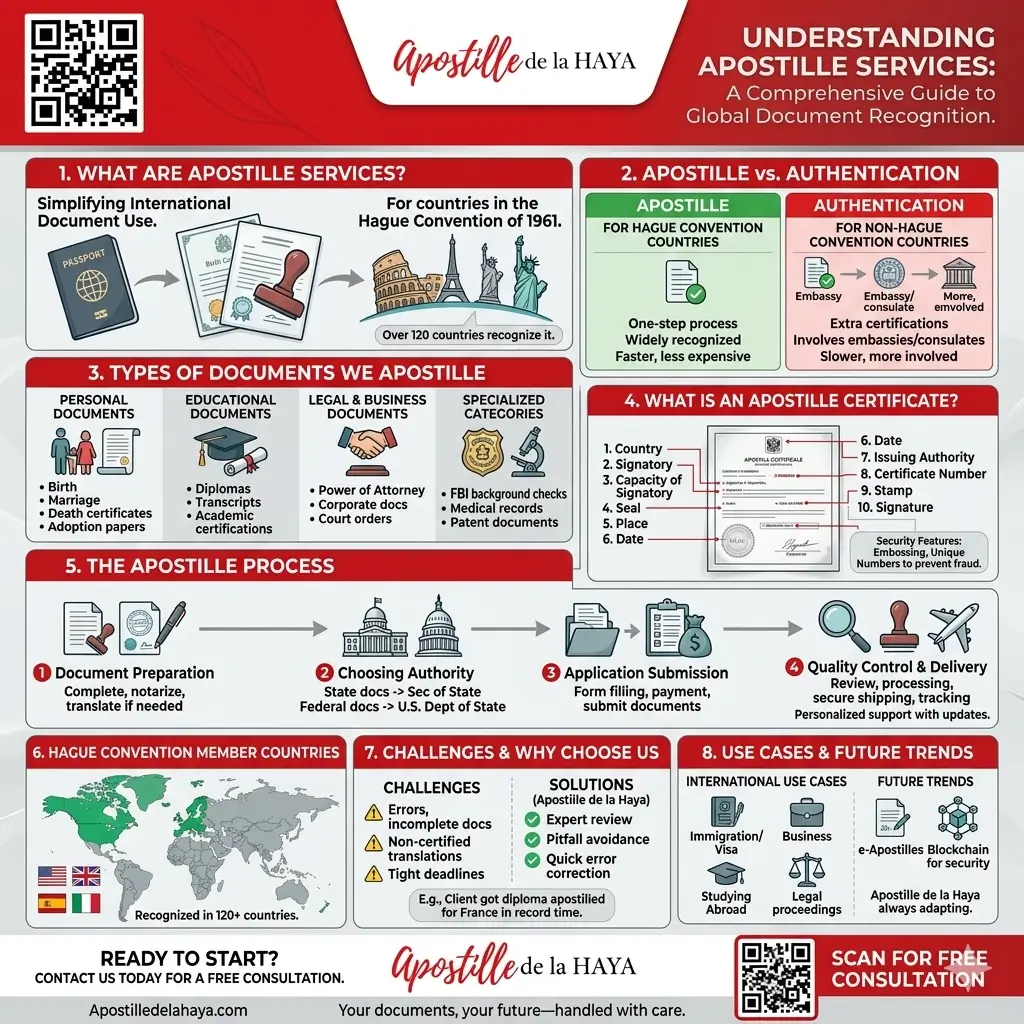
Apostille services are the process of certifying public documents so they’re valid in countries that are part of the Hague Convention of 1961. This international agreement was created to make it easier for people and businesses to use official documents abroad, without endless paperwork or confusing legal steps. At Apostille de la Haya, we guide you through every stage, making sure your paperwork is ready for wherever life takes you.
What is an Apostille Certificate?
An apostille certificate is a special stamp or paper attached to your document. It proves that the signature and seal on your document are authentic, so authorities in another country can trust it. The word “apostille” comes from French and is pronounced “ah-pos-TEEL.”
This system was established in 1961 to simplify international document authentication. Today, an apostille is recognized by over 120 countries, making it the gold standard for global paperwork. You’ll usually see it as a square or rectangular form attached to your document, listing details like the country of issue, the official who signed it, and a unique registration number.
How Apostille Services Work
The process may sound complicated, but it’s easier than you think:
Authentication: First, your document is checked by a notary or government official to confirm it’s genuine.
Secretary of State Offices: In the U.S., state-level documents go to the Secretary of State, while federal documents (like an FBI background check) are handled by the U.S. Department of State.
Federal vs. State Processing: For example, a birth certificate is processed at the state level, but a federal criminal record check needs federal authentication.
Personalized Support: Our team reviews every document carefully and keeps you updated at every step, so you always know where your paperwork stands.
Types of Documents Requiring Apostille Services
People use apostille services for all sorts of reasons. Some common examples include:
Personal Documents: Birth, marriage, divorce, and death certificates; adoption papers.
Educational Documents: Diplomas, transcripts, academic certifications, professional licenses.
Legal and Business Documents: Power of attorney, corporate documents, court orders, notarized agreements.
Specialized Categories: FBI background checks, medical records, patent documents.
If you’re moving abroad for work, studying in another country, or handling family matters overseas, chances are you’ll need an apostille at some point.
Apostille vs. Authentication: Key Differences
Not every country accepts apostilles. Here’s what you need to know:
Apostille: Used for countries that are part of the Hague Convention. It’s a one-step process that’s widely recognized.
Authentication: Needed for countries outside the Hague Convention. This process involves extra certifications, sometimes from embassies or consulates, and can take longer.
Cost and Time: Apostilles are usually faster and less expensive. Authentication can be more involved and may require more patience.
Hague Convention Member Countries
More than 120 countries now accept apostilles, including the United States, most of Europe, and many others. If your destination isn’t on the list, you’ll need to go through the traditional authentication process. We keep track of the latest updates so you don’t have to worry about changing rules.
The Apostille Process: Step-by-Step Guide
Step 1: Document Preparation
Make sure your document is complete and, if needed, notarized. If it’s in another language, you might need a certified translation.
Step 2: Choosing the Right Authority
State documents go to the Secretary of State. Federal documents are handled by the U.S. Department of State. If you’re unsure, our team can help you figure out the right path.
Step 3: Application Submission
Fill out the required forms and submit your documents, along with payment. Fees and processing times can vary depending on where you live and what type of document you have.
Step 4: Quality Control and Delivery
We check every detail, process your apostille, and send your documents securely. You’ll receive updates and tracking so you always know what’s happening.
Apostille Requirements and Standards
Every apostille certificate must include ten key pieces of information: country, signatory, capacity, seal, place, date, issuing authority, certificate number, stamp, and signature. Security features like embossing and unique numbers help prevent fraud and ensure your document is accepted internationally.
Common Challenges and Solutions
Sometimes, documents get rejected because they’re incomplete or have errors. Other times, translations aren’t certified, or there’s a rush to meet a tight deadline. We’ve seen it all—and we’re here to help you avoid these pitfalls. If something goes wrong, we’ll work with you to fix it quickly.
Why Choose Professional Apostille Services
Trying to navigate this process alone can be overwhelming, especially if you’re dealing with multiple documents or tight deadlines. Our experience means fewer mistakes, less stress, and a smoother experience from start to finish. We treat every document as if it were our own, so you can focus on what matters most.
International Use Cases and Applications
Apostille services are essential for:
Immigration and Visa Applications
International Business Transactions
Studying Abroad
Legal Proceedings in Foreign Countries
For example, one of our clients needed to prove her academic credentials to a university in France. With our help, she had her diploma apostilled and accepted in record time, making her transition abroad seamless.
Digital Apostilles and Future Trends
The world is moving online, and so are apostilles. Electronic apostilles (e-apostilles) are becoming more common, offering faster processing and better security. Technologies like blockchain are being explored to make the process even more reliable. We’re always adapting to these changes to offer you the best possible service.
Getting Started with Apostille de la Haya

If you’re unsure where to begin, we offer a free consultation to review your needs. Our team will evaluate your documents, explain your options, and help you choose the right service package. Ready to start? Contact us today and let’s make your international plans a reality.
Conclusion
Apostille services open doors—whether you’re moving, studying, working, or handling legal matters abroad. At Apostille de la Haya, we’re committed to making the process clear, reliable, and stress-free. If you have questions or need guidance, reach out to our team for personalized support. Your documents, your future—handled with care.
Frequently Asked Questions
How long does it take?
Processing times vary, but expedited options are available.
Do apostilles expire?
What if I need to use my document in more than one country?
Can I get help in an emergency?
Legal Disclaimer:
This article is provided for informational purposes only and does not constitute legal advice. The content herein is not intended to substitute professional legal consultation. For specific guidance regarding your individual circumstances, please consult directly with a qualified attorney licensed to practice in your jurisdiction.