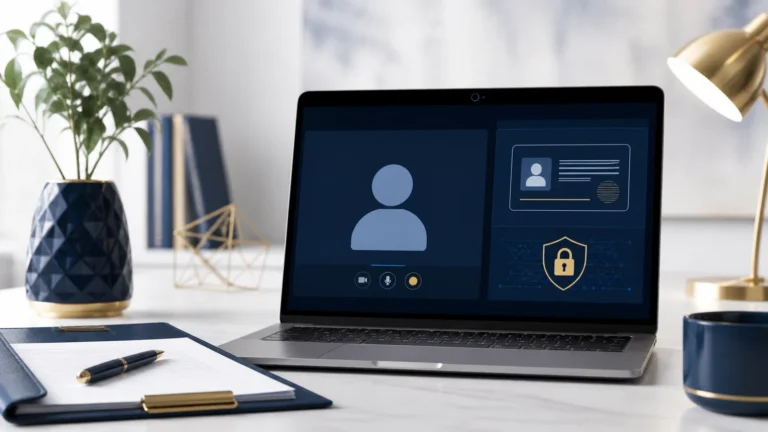
Searching for a notary near me assumes the notarization happens where you are standing. It does not. In a remote online notarization the act is performed where the notary is commissioned and physically sitting — Florida law requires a Florida online notary to be located in Florida, and treats the resulting act as performed in Florida no matter which country you joined from.
Notary Services · Online & Mobile Notarization
Which moves the real question somewhere else. If your location is irrelevant, the one thing that can stop the session is your identity: the notary has to verify it, analyse the credential and record the whole thing, and if the identity-proofing databases do not hold enough about you, the notary is not permitted to finish. That is where these sessions fail — not at the border, at the ID check.
The other half of the section’s name deserves a plain answer: Notary Public Center does not send a notary to your home or office. What it offers instead is the recorded, identity-verified online session described below.
Identity proofing asks time-sensitive questions tied to public and credit data. If those databases lack enough information, the notary is not permitted to complete the online notarization.
Credential analysis inspects the ID itself. It has to be current, valid and readable on camera — a passport is the safest choice for a signer outside the United States.
Where a document needs witnesses, they may appear remotely — but they go through the same identity verification as the signer, and they have to be ready at the same time.
What the law asks for
Three elements, and a session is invalid without any one
Two-way, real-time communication between signer and notary, with the notary physically located in the state that commissioned them. A consumer video call is not a substitute and does not produce a valid act.
Remote presentation and inspection of the identity document itself. This is the step a screenshot or a photocopy cannot pass, and it is separate from the questions that follow.
Knowledge-based authentication, or another conforming method: questions drawn from public and credit records that only the real person should be able to answer. It is the step that most often stops a session.
The search that starts most of these files, and why distance is the wrong variable.
The file
Four things this section settles
40+
States that authorise it
Remote online notarization is authorised in more than forty states, with requirements that vary by jurisdiction.
2030
California’s date
California has authorised RON, but its notaries will perform it once the state system goes live, no later than 1 January 2030.
FL
Where the notary sits
A Florida online notary must be physically located in Florida, and the act counts as performed there.
0
Home visits offered
Notary Public Center does not send a notary to your address. The alternative is the recorded online session.
Notary Public Center
A recorded session, from wherever you can pass the identity check
Notary Public Center performs remote online notarizations as a Florida-commissioned notary, with credential analysis, identity proofing and a recorded session. Bring the document and a current, valid ID; the rest is scheduling.