A foreign registry, a consulate or an immigration office asks you to prove you are free to marry, and the only honest answer the United States can give is a negative: an office searched its files and found nothing. That is what a Certificate of No Record of Marriage says — and it is why the request so often comes back. There is no federal marriage registry to search. Records live at state, county and sometimes city level, so the certificate proves an absence in one jurisdiction, for one name, over one date range. Read as «I have never been married in the United States», it promises far more than it says.
Notary Public Center · Marriage Records & Licenses
What it proves: that a named office searched its records for a named person, over a stated period, inside a stated jurisdiction. Everything outside that frame stays unproven — which is why many destinations ask for a notarised affidavit of single status alongside it.
A no-record certificate covers the office that issued it, the name spelled as written and the date range printed on it. Prior names, prior states and alternative spellings are outside it unless the certificate says otherwise.
In Florida marriage licences are public records, so anyone can look up names, date and certificate number. Only the couple or an authorised person can be issued a certified copy — the search alone never produces the document.
The decorated document signed by the officiant on the day of the wedding is not a public record. An apostille authority can only authenticate the signature and seal of a public official whose specimen it can verify.
The four papers
One legal moment each — and the fourth is not a public record
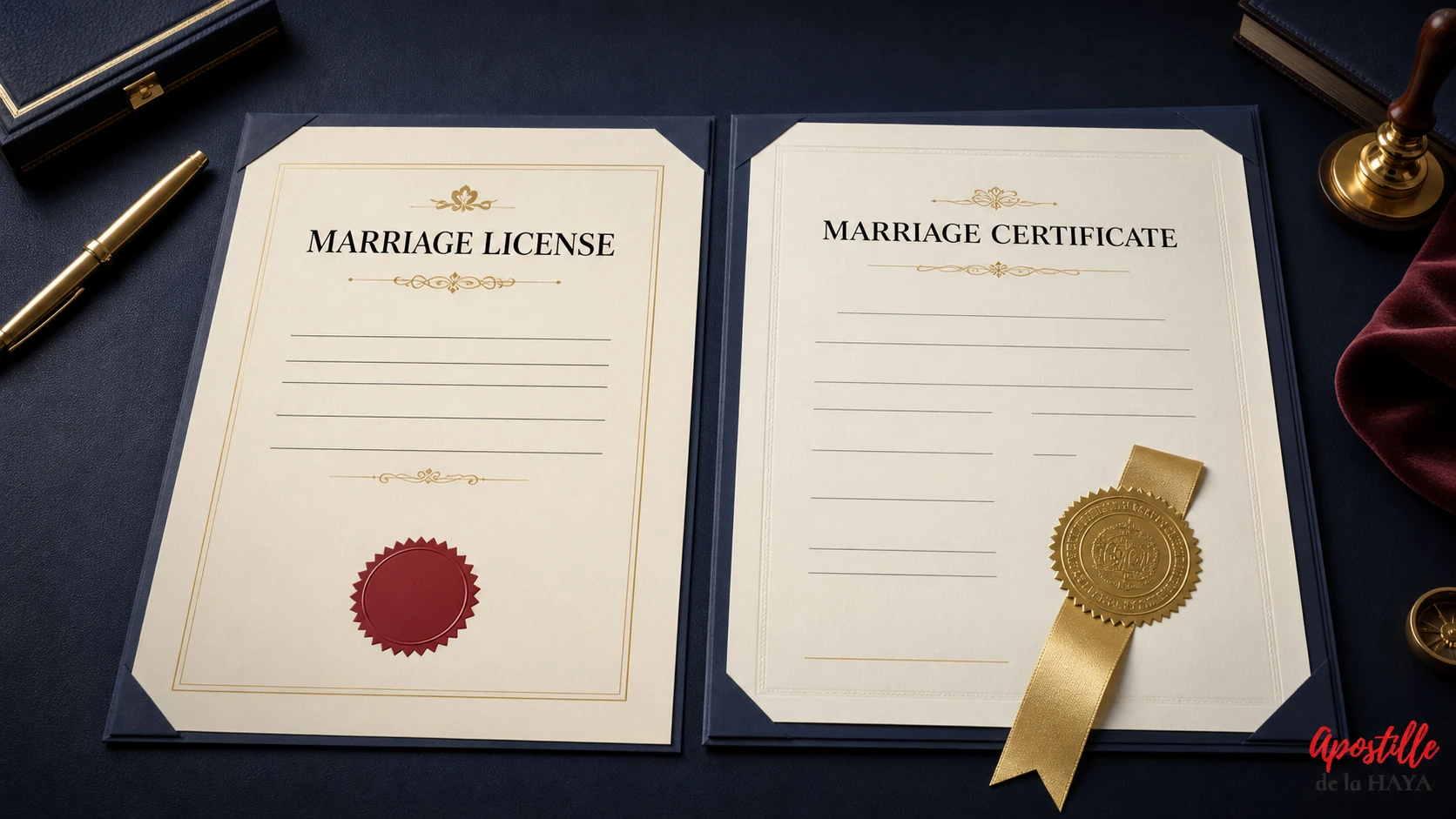
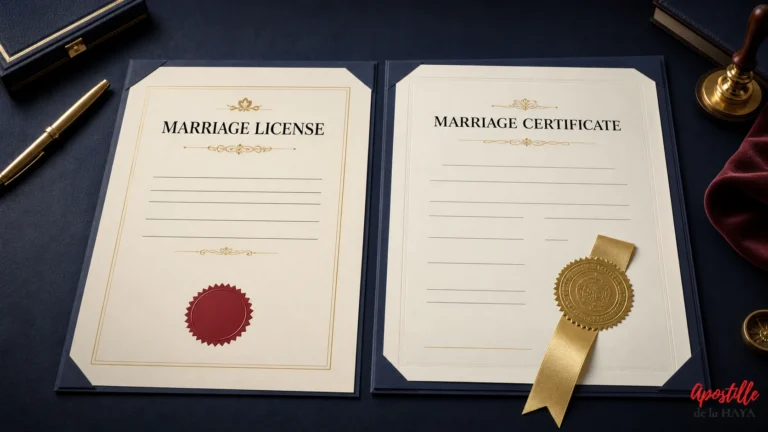
Two documents, two moments: permission before the wedding, record after it. In many states they are physically the same form at two stages of its life, which is exactly why the confusion survives.
Authorisation issued before the ceremony by a county clerk or equivalent, once both parties meet the state’s requirements. It says you may marry. On its own it does not prove that you did.
After the officiant returns the completed form, the office records it and can issue certified copies of that entry. This is the document a consulate, a registry or a court can act on.
Where registration has reached state level, the vital records office issues its own certification. Florida accepts a Certification of Marriage signed by the State Registrar, and also a certified copy from the Clerk of the Circuit Court where the marriage was recorded.
Handed to you on the day, signed by the officiant, sometimes sealed by a church. It is a memento. It is not a public record and it does not enter the apostille process.
A Florida licence is valid for 60 days from issue: the ceremony has to happen and the licence has to be returned inside that window. If either applicant is a Florida resident there is a three-day waiting period, waived by a state-approved premarital course; if neither is a resident, there is no wait at all and the same day is possible.
Full names, date of issue, certificate number and place of marriage are open to anyone. The certified copy is not: only the couple or an authorised person can be issued one, and a valid photo ID is part of the request. Anything destined abroad needs the certified copy first and the apostille second — never the other way round.
Three sentences from the guide, and they are the reason files come back: it does not prove that you have never been married anywhere in the United States; it does not prove that you are legally «single» under the receiving country’s definition; and it does not prove that every possible spelling, prior name or prior jurisdiction was searched, unless the certificate says so.
That gap is why so many destinations ask for a notarised affidavit of single status next to the certificate: the sworn statement covers what the search cannot. And the vocabulary shifts as you cross a border — single status statement, letter of no record, certificate of non-impediment — because in the United States no single federal document exists to match the request.
A Florida marriage licence expires 60 days after it is issued. The ceremony must happen and the licence must be returned inside that window.
3 or 0
days of waiting
Three days if either applicant is a Florida resident — waived by a state-approved premarital course. None at all if neither of you is.
2
people may request the copy
The search is public; the certified copy is not. Only the couple, or someone authorised, can be issued one.
5
years in Texas
Texas can authenticate a certified recordable copy only if it was issued within the preceding five years — an example of how the rule changes with the state.
Notary Public Center
The record, the licence, or the proof that neither exists
Certified copies of marriage records, single-status documentation and the notarisation that goes with them — obtained from the office that actually holds the record, and routed for apostille when the destination asks for it.