
Introduction
If you need to execute a power of attorney online, the most critical factor is ensuring your document meets strict state requirements for legal validity. A Power of Attorney (POA) grants someone else the authority to make critical financial, legal, or medical decisions on your behalf. Because of the immense power this document conveys, institutions like banks, title companies, and hospitals are incredibly strict about accepting them.
At Notary Public Center, we specialize in the secure, legally compliant execution of these documents. Through Florida’s Remote Online Notarization (RON) laws, our professionals help you finalize your drafted power of attorney online from the comfort of your home, ensuring every statutory requirement is meticulously met to minimize the risk of future rejection.
What “power of attorney online” means in Florida
Florida’s RON framework authorizes notaries physically located in Florida to notarize documents even if the principal or witnesses are outside the state, provided statutory procedures are followed. That includes identity proofing, credential analysis, and real-time audio-video communication. Sessions are recorded and retained under rule. If identity checks cannot be satisfied—e.g., databases lack adequate information—the notary cannot proceed.
For powers of attorney, formal execution is governed the principal signs in the presence of the principal, and the principal’s signature is acknowledged before a notary. Discover more here!
Florida Requirements for a Valid Power of Attorney Online
To ensure your digital POA holds up under legal and institutional scrutiny, Florida law mandates specific requirements, particularly for Durable Powers of Attorney:
Testamentary Capacity: The principal (the person granting the power) must be of sound mind and acting voluntarily, without coercion.
Two Qualified Witnesses: Florida law strictly requires that a POA be signed in the presence of two witnesses. Under RON regulations, these witnesses can appear virtually, provided they undergo the same identity verification as the principal.
Supervised Notarization: An authorized Florida Remote Online Notary must supervise the entire signing, administer necessary oaths, and affix their electronic seal.
Identity Safeguards: Strict verification protocols must be passed before the signing begins to prevent identity fraud.
Our Streamlined Execution Process
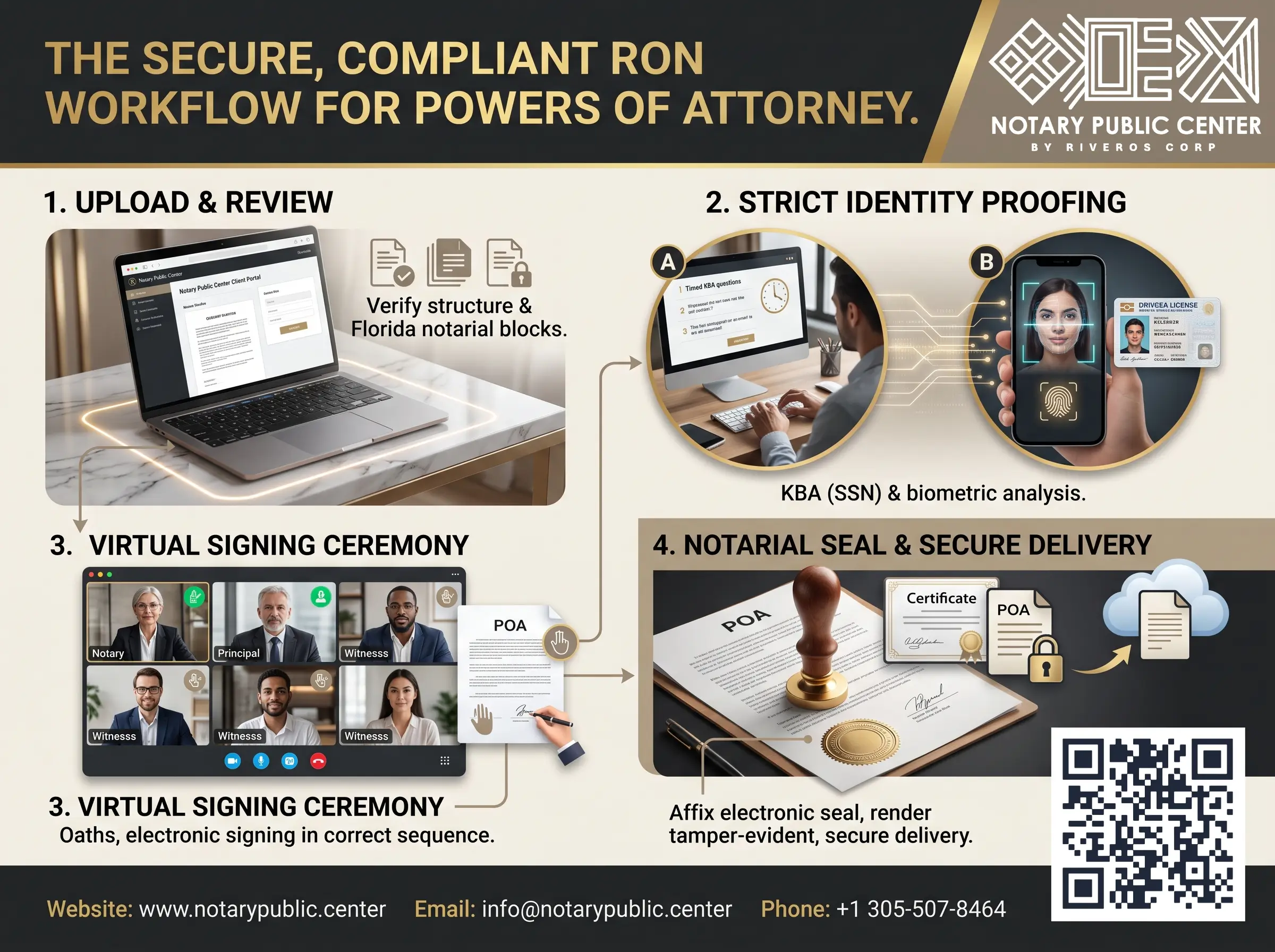
To guarantee a seamless and compliant experience, Notary Public Center utilizes a strict, non-redundant workflow for executing your power of attorney online. Every step has a distinct purpose:
1. Document Upload & Formatting Review You provide your legally drafted POA. We review the document’s structure to ensure it is compatible with our secure RON platform and contains the mandatory Florida notarial blocks.
2. Strict Identity Proofing You (the principal) and your witnesses undergo rigorous identity verification. This includes scanning government-issued IDs and passing Knowledge-Based Authentication (KBA) questions.
3. The Virtual Signing Ceremony All parties connect with our commissioned Notary Public in a recorded, secure audio-video session. Oaths are administered, and the document is electronically signed in the correct statutory sequence.
4. Final Step: Notarial Seal & Secure Delivery Once all signatures are captured, the Notary Public immediately affixes their official electronic seal and digital certificate, rendering the document legally binding and tamper-evident. The finalized document is then securely delivered to you for immediate use.
POA-specific formalities we handle for you
A Florida power of attorney must be executed with two witnesses and notarized. In our RON flow, witnesses can appear remotely (subject to statutory conditions) and are recorded alongside the principal. We confirm that the principal is not acting as their own witness (explicitly barred) and that all disclosures required by law are made on record—especially when signers are outside Florida but elect Florida law for the act.
We also align with any receiving institution’s checklist (financial institutions, title companies, universities, agencies). Some recipients add policy items—for example, specific initials on each page or forms attached to the POA. We incorporate those so the first submission is the final one.

How your power of attorney online works with us (step-by-step)
1) Intake & document pre-review
Send the draft POA, the names and emails of signers and witnesses, and the receiving party’s instructions. We confirm whether your case requires durable language, limited powers, or property-related provisions that the recipient may scrutinize. If the recipient wants a particular notarial certificate, we format that from the outset.
2) Scheduling & tech check
We coordinate time zones, devices, and any additional participants (agents, interpreters). We check camera/mic, connectivity, and ID legibility. If a signer recently relocated or has thin credit history, we give KBA prep tips (have past addresses handy, etc.). Timeframes may vary depending on calendars and identity outcomes.
3) Identity proofing (multi-layered)
Credential analysis of a valid government ID.
Biometric live-ness and face match.
KBA (SSN-based) timed questions.
All participants pass individually. If a test fails or data are insufficient, we re-route within the law (permissible reattempts, different ID, or—in rare cases—refer to in-person options).
4) Remote witnessing + notarization
We supervise the witnessing via the same secure audio-video session and complete the notarial acknowledgment. Our platform ensures exclusive control of the notarial seal and creates an immutable trail tied to the document.
5) Delivery & evidence package
You receive the executed POA, the notarial certificate, and instructions for presenting the document. Upon request, we facilitate the recording retrieval or verification metadata the recipient might ask for (subject to custody rules).
Why choose Notary Public Center
Florida-compliant from end to end. We supervise witnesses remotely, and retain the recording properly.
Listed platform + strict standards. We operate on a provider listed by the Florida DoS and tamper-evidence requirements.
Identity you can defend. Biometric, KBA (SSN), and a recorded session produce a robust audit trail—far beyond a simple video call.
Transparent guidance. Clear prep, short sessions when feasible, and realistic expectations about what may vary (availability, ID checks, witness schedules).

Readiness checklist (so your session sails through)
Confirm the receiving party and any extra instructions (initials, annexes, certificate language).
Ensure a valid government ID in good condition.
Have past addresses/loan info nearby for KBA.
Tell us where each participant will be located; if a signer is outside Florida, we will confirm their consent to Florida law for the act on record.
If witnesses are needed from our side, we schedule vetted witnesses who will also pass identity steps and appear on the recording.
Common scenarios we handle
Banking & finance: limited POAs for transactions that must close on a deadline.
Real estate: POAs to sign closing documents when a principal is away (recipient policies apply).
Corporate: POAs to empower a representative for filings or contract execution.
Education & family: temporary delegations for school or care decisions where institutions want a firm audit trail.
Considering a broader digital program? See our e-notary workflow to compare process options and roles.
DIY Execution vs. Professional RON Execution
To understand why professional execution is vital, compare the standard DIY approach against our secure framework:
| Feature | Automated DIY Platforms | Notary Public Center Execution |
| Legal Execution | You must find your own notary and witnesses. | We provide the authorized online notary platform. |
| Witness Coordination | Left entirely to you. | We guide the witness integration during the session. |
| Risk Mitigation | High risk of improper signing sequence. | Supervised process to minimize the risk of invalidation. |
| Identity Safeguards | Basic email/password checks. | Strict KBA (Knowledge-Based Authentication) and ID analysis. |
Internal vs. external acceptance (set expectations early)
Florida’s framework is strong and clear. Still, private recipients (banks, title insurers, corporate registries) may impose extra internal requirements. We surface those upfront and embed them in the process, reducing the chance of “sign again” requests later. For cross-state or cross-border use, tell us early; additional steps (like apostille/legalization for paper outputs) might apply depending on the jurisdiction.
Security, custody, and verification
Our listed platform implements tamper-evident technology so any change to the electronic record is detectable. We maintain exclusive control of the electronic seal and keep logs/recordings under the administrative rules. If a recipient needs assurance, we provide the appropriate verification path without exposing private data.
Timing, availability, and what can vary
Session length depends on the number of signers/witnesses, the POA’s complexity, and identity outcomes. Timeframes may vary due to KBA and scheduling across time zones. We propose a realistic window after pre-review and keep buffers for re-attempts if the identity service requests it.
Ready to execute your power of attorney online the right way? Contact Notary Public Center to book a Florida-compliant RON session on a DoS-listed platform with biometric, recorded video, and KBA (SSN) identity proofing. We orchestrate witnesses, meet the recipient’s checklist, and deliver the evidence package you need.
FAQ
1. Is a power of attorney online legally valid?
Yes. Under Florida’s Remote Online Notarization (RON) laws, a digital power of attorney is fully valid and legally binding, provided it is properly executed, witnessed, and notarized according to strict state statutes.
2. Can I use my own witnesses for the online signing?
Yes, you can provide your own witnesses. However, they must also pass the required identity proofing (KBA and ID analysis) to join the secure virtual session. We will coordinate their participation during the ceremony.
3. Will my bank accept an electronic power of attorney?
Yes. Florida electronically notarized POA has the same standing as a paper document. Our structured execution process is designed to minimize the risk of rejection by ensuring all statutory requirements are meticulously followed.
4. Does Notary Public Center draft the power of attorney for me?
No. Notary Public Center focuses exclusively on the secure execution and notarization of the document. You must have your power of attorney already drafted (by an attorney or drafting service) before we perform the online signing ceremony.
5. How long does the online execution process take?
Once your document is uploaded and identity proofing is successfully completed, the actual virtual signing ceremony typically takes less than 15 minutes. Your finalized, legally binding document is delivered to you immediately after the session concludes.
The information contained in this publication is provided for general informational purposes only and does not constitute legal advice. Reading or using this content does not create and is not intended to create an attorney-client relationship. No reader or user should act or refrain from acting based on the information presented herein without first consulting an attorney duly licensed to practice law in their jurisdiction.