Compliance Officers · Due Diligence
FBI Background Check Expedite: What Can Actually Move Faster?
Published

If you need an FBI background check quickly, the first step is to identify the correct request and the recipient’s requirements. The FBI says it does not offer an expedited procedure for Identity History Summary requests. It also explains that electronic submissions are typically received and processed faster than mailed submissions, but no provider can guarantee the FBI’s processing time.
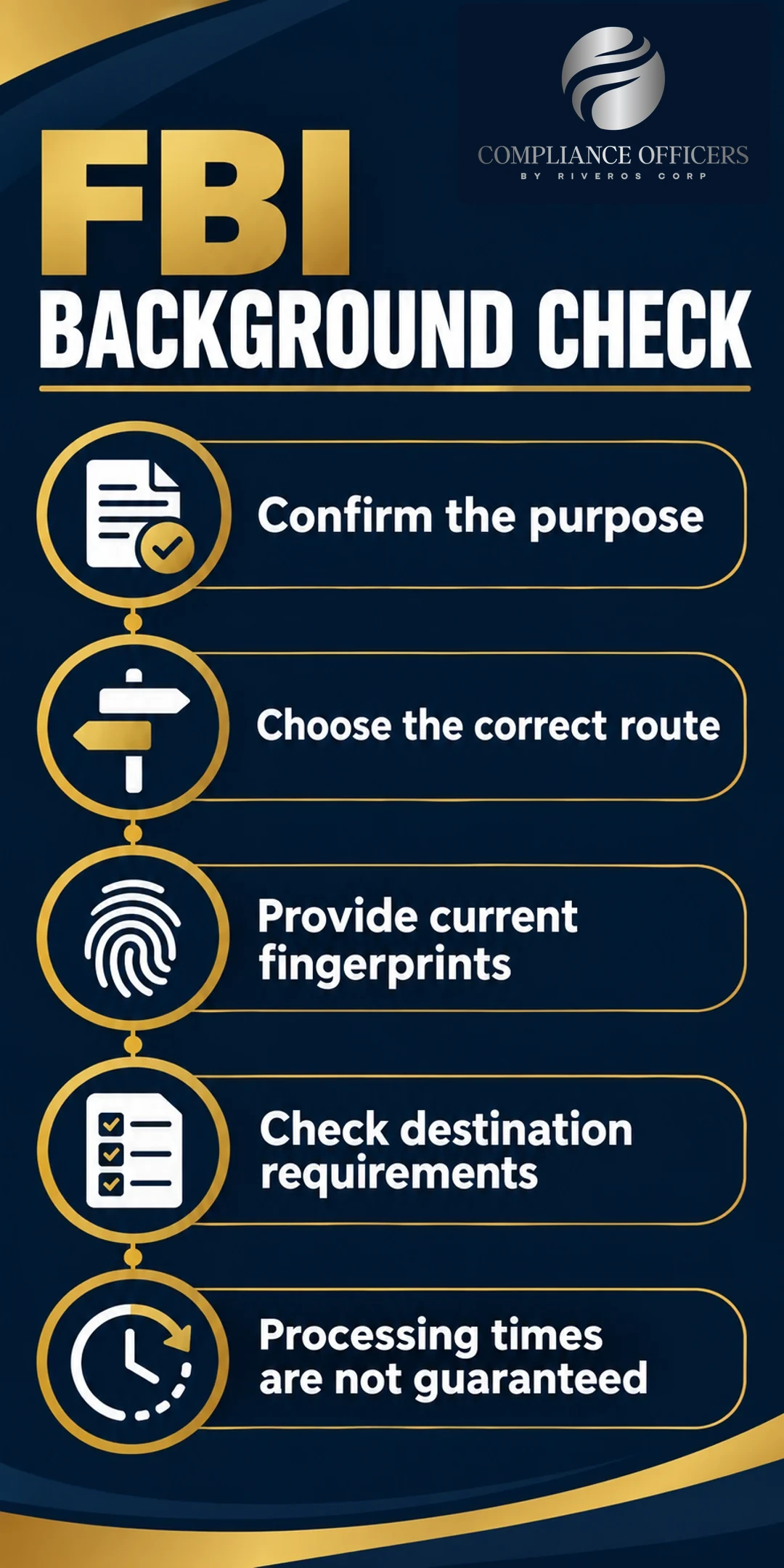
Preparation can reduce avoidable problems: confirm the purpose, use the appropriate submission route, provide current fingerprints and check how the result must be delivered. Compliance Officers can discuss fingerprinting and related coordination for a particular request. The FBI, an approved channeler and any receiving authority make their own decisions.
What an FBI Identity History Summary contains
An FBI Identity History Summary is a record based on information submitted to and retained by the FBI in connection with fingerprint-based events. It may include information associated with arrests and, in some cases, federal employment, naturalization or military service. The contents depend on the information available in the FBI’s systems.
People sometimes call the summary a criminal history record or an FBI background check. It is not a guarantee that a person has no record anywhere, and it does not replace every state, local or international check. An agency may require a different search or a specific program for its purpose.
A person can request a copy of their own summary under the FBI’s personal review process. That process should not be confused with an employer or licensing authority’s legally authorized background check. However, the recipient may require a different route and may not accept a personal copy.
Before starting, ask the institution requesting the record what it calls the document, who must request it and whether it needs authentication. If the requirement is unclear, obtain clarification from the institution rather than assuming that any report labeled “background check” will be sufficient.

Tell us what you need to verify
Ask Compliance Officers about the scope of a review or verification.
Does the FBI expedite background checks?
The FBI’s published FAQ says it does not expedite Identity History Summary requests. It processes requests in the order they and completed fingerprints are received. Electronic submissions are typically received and processed faster than mail, according to the FBI, but that is not a promise of a particular result or completion date.
An FBI-approved channeler receives the fingerprint submission and required information, sends them electronically to the FBI and receives the result for dissemination to the individual. The FBI describes approved channelers as helping expedite delivery of summary information. The channeler’s role should not be described as changing the FBI’s rules or guaranteeing priority processing.
A service provider may help coordinate an appointment and prepare the information needed for an eligible route. It cannot control the FBI’s queue, the quality review performed by an agency or the recipient’s acceptance. Any estimated timing should be confirmed with the responsible authority and treated as dependent on the case.
If a deadline is approaching, contact the receiving institution as well as the service provider. Ask whether it accepts the available form of the result and whether additional authentication or translation is required. Starting with the destination’s instructions can prevent obtaining the wrong record.
Personal review, employment and licensing are different
The FBI’s personal review procedure allows an individual to request their own Identity History Summary. Depending on the permitted route, the applicant may submit a request directly or use an FBI-approved channeler. Eligibility and available services can differ by channeler and circumstance.
A background check required for employment, licensing or another regulated purpose may have a separate process under federal or state law. The requesting agency may direct the applicant to a state identification bureau, an authorized channeling agency or another designated route. Follow that agency’s instructions.
Do not submit a personal review request on the assumption that it will satisfy an employment or licensing requirement. The receiving institution may need to receive the result through a specific authorized channel. The individual’s possession of a summary does not automatically authorize another party to use it for every purpose.
Document the purpose and authority for a compliance request, and limit access to sensitive information. If the applicable screening rules are uncertain, consult qualified counsel. Compliance Officers can discuss services within their scope, while the requesting authority determines what it will accept.
Choosing a submission route
The FBI offers a direct electronic option for an Identity History Summary request. It also provides instructions for mailed submissions and lists approved channelers. The appropriate route depends on eligibility, location, the purpose of the request and the form of result the recipient requires.
For an eligible direct electronic request, the FBI describes options for submitting fingerprints, including participating U.S. Postal Service locations. Applicants may also mail a completed fingerprint card under the FBI’s instructions. An approved channeler has its own procedures and eligibility requirements, which should be checked before making arrangements.
Do not assume that a fingerprinting provider is itself an FBI-approved channeler. A provider may offer fingerprint capture or coordination without issuing the FBI result or acting as a channeler. Ask who performs each part of the service and who will receive or deliver the response.
If the applicant is outside the United States, discuss the available fingerprint and delivery options with the responsible provider and review the FBI’s current instructions. Location and eligibility may affect the route. No single method is appropriate for every applicant or every destination.
Fingerprints and identification
The FBI requires current fingerprints for an Identity History Summary request and does not provide a name-only search as a substitute. Submit fingerprints in the manner required for the chosen route. The agency’s instructions identify acceptable options and forms.
A clear set of fingerprints and accurate identifying information help the request move through the normal process. The capture method and the condition of a person’s fingers can affect quality. The agency decides whether the submission is suitable; a provider cannot guarantee that any set will be accepted.
Check that the name and other required information correspond to the applicant and the intended request. For electronic requests, the FBI says the name on its response matches the name entered in the request. A discrepancy can create questions for the receiving institution even if a result is issued.
If the agency rejects fingerprints or cannot process them, consult the FBI’s instructions and the provider about next steps. The FBI provides guidance for repeated fingerprint difficulties. Avoid claiming that a rejection has a universal cause or that a particular provider can prevent every issue.
Preparing for a time-sensitive request
Start by identifying the destination, purpose and deadline. Ask whether the recipient wants an FBI Identity History Summary, a state record or a check obtained through a specific authorized program. These records are not interchangeable just because they all concern background information.
Confirm the exact name required, the applicant’s location and the method by which fingerprints can be submitted. If the result is for use abroad, ask the destination whether it requires an apostille or another form of authentication and whether a translation is needed.
Arrange the fingerprint appointment and submission route with enough room for each organization to perform its part. The FBI does not promise expedited processing, and later authentication or delivery involves separate authorities. A recipient’s deadline does not change an agency’s queue.
Keep track of the reference information supplied by the responsible service or agency. Ask how status notifications work and who can answer questions about the request. Limit sharing of personal information to the people who need it for the process.
Receiving and reviewing the result
The form of the FBI response depends on the submission route and the options you choose. The FBI states that direct electronic requesters receive an electronic response and can also elect a mailed response. Channelers explain their own delivery procedures for eligible applicants.
Check that the result corresponds to the applicant and the recipient’s instructions. An electronic response, a printed copy and an authenticated document can serve different purposes. Do not assume that a copy accepted for one transaction will satisfy another.
Other agencies supply some information in an Identity History Summary. If an entry appears inaccurate or incomplete, follow the FBI’s published challenge and correction guidance. The contributing agency may be responsible for correcting the information. A fingerprinting provider does not decide whether a record will be changed.
Protect the result because it can contain sensitive personal information. The individual and any authorized recipient should use appropriate access and retention practices. A compliance team should consider applicable privacy, employment and records rules with qualified advice.
Apostille or authentication for international use
A foreign authority may require authentication of an FBI result. Ask the recipient which document it accepts, which country will use it and whether an apostille, another authentication or a translation is required. Requirements vary by destination and purpose.
Federal and state documents follow different authentication routes. A state apostille is not automatically the correct process for a federal FBI record. Confirm the current instructions of the competent U.S. authority and the receiving institution before sending a result for authentication.
An apostille authenticates the origin of a qualifying public act under the applicable convention. It does not certify that a person has no criminal history or guarantee that the receiving authority will approve an application. The underlying record and the destination’s requirements remain important.
Authentication is separate from obtaining the FBI result. A provider can coordinate available services. The FBI, authentication authority and foreign recipient make their own decisions. Discuss the complete sequence before choosing a submission route.
Common causes of avoidable delay
A request can encounter difficulties when the wrong type of check is ordered. A personal review summary may not satisfy an employer’s authorized screening process, and a state record may not be the FBI document requested by a foreign authority. Clarify the purpose before submitting.
Incomplete or inconsistent information can also create questions. Compare the applicant’s name and details with the request and the recipient’s instructions. The FBI and the receiving institution decide how to handle discrepancies.
Another issue is overlooking the form of the final record. If a recipient needs authentication or a translation, obtaining an electronic result may be only one part of the process. Confirm what the destination accepts before arranging later services.
Finally, be cautious of a promise that a private provider can make the FBI expedite a request. The FBI expressly says it does not offer expedited processing for Identity History Summary checks. A provider can help coordinate the steps within its role, but agency decisions and timing remain outside its control.
How Compliance Officers can help
Compliance Officers can discuss fingerprinting, the intended use of an FBI background check and available coordination for an eligible request. The team can help identify questions for the requesting agency or recipient and explain the scope of the service before an appointment.
For related topics, see our guides to business due diligence (Spanish-language guide), FBI background check apostilles and proof of business registration. Availability and the appropriate route depend on the applicant and purpose.
Frequently asked questions
Does the FBI offer expedited Identity History Summary processing?
The FBI says it does not expedite these requests. Electronic submissions are typically received and processed faster than mail, but timing is not guaranteed.
Can an approved channeler submit fingerprints electronically?
Yes. An FBI-approved channeler receives the submission and required information and forwards them electronically to the FBI for an eligible request. The channeler explains its own requirements.
Can a personal FBI summary replace an employment background check?
Not necessarily. Employment and licensing checks may require a specific authorized process. Follow the instructions of the requesting agency or institution.
Can I obtain an FBI summary without fingerprints?
The FBI requires current fingerprints for an Identity History Summary request and does not provide a name-only check for this purpose.
Does an FBI background check need an apostille?
It depends on the destination and recipient. Ask the receiving authority whether it requires authentication or an apostille and which form of the result it accepts.
Visit Compliance Officers, call +1 305-647-3000, write to info@complianceofficers.org or contact the team through WhatsApp.
This article provides general information and is not legal advice. Consult qualified professionals about your circumstances.
Compliance Officers · Contact
Tell us what you need to verify
Ask Compliance Officers about the scope of a review or verification.
Contact form

Professional background
Security consultant accredited by Colombia’s Superintendencia de Vigilancia y Seguridad Privada; forensic fingerprint examiner. A business administrator with a specialization in finance, he brings more than 27 years of experience protecting people, valuables and infrastructure. His career includes administrative and financial management at McKinsey & Company in Colombia and executive roles at multinational companies. As Partner and Senior Consultant at Compliance Officers, he applies that experience to background screening, due diligence and compliance.