Marriage records · Choose the right document
Marriage Certificate vs. Marriage License: Which Can Be Apostilled?
Published
A marriage license authorizes a marriage; a marriage certificate records that it took place. Some states use one form for both stages, so a certified record may still say “license.” For apostille preparation, inspect the completed record and its official certification, not just the heading.
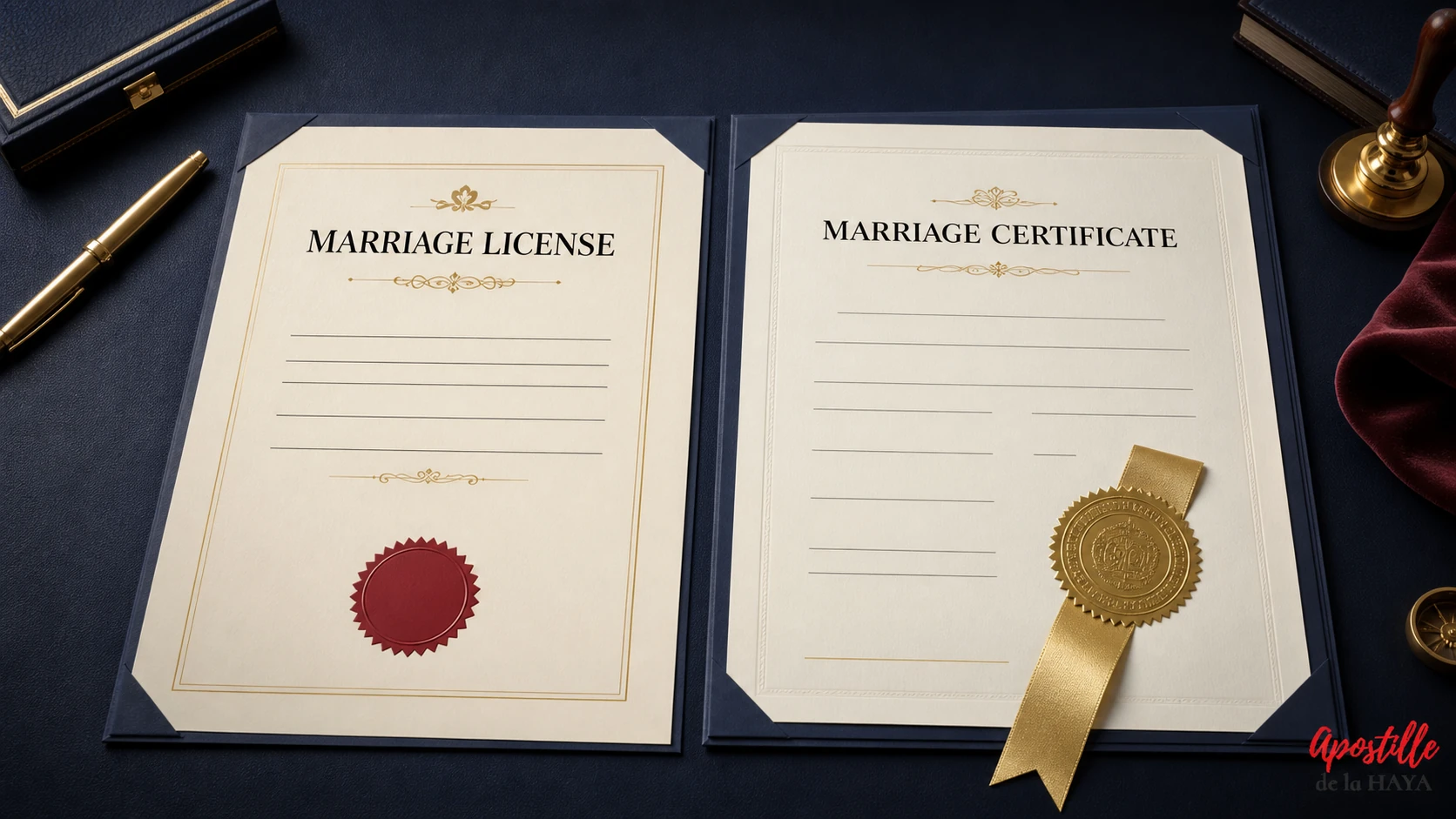
Distinguish permission to marry, a recorded marriage, and a ceremonial keepsake before ordering certification.
Before you start
Look beyond the title
A recorded, officially certified marriage document may carry the word “license.”
Confirm the public record
Proof of permission to marry is different from proof of a recorded marriage.
Match the recipient’s request
The required contents, copy format, and issue date can affect which official version you need.
01 / Your document
Separate permission from the recorded event
A license is issued before the marriage under the jurisdiction’s rules. By itself, it does not show that the ceremony occurred or that the completed marriage was recorded. A certified marriage record comes from the public office that holds the recorded entry.
The same physical form may move through several stages: issuance, completion after the ceremony, return, and recording. A certified copy of that completed record can therefore retain the license heading. Read its status and certification before deciding whether it matches the foreign request.
When an institution needs proof of an existing marriage, an authenticated document showing only permission to marry may not answer the question. An apostille authenticates the relevant official signature; it does not change what the underlying record proves.
02 / Your document
Compare the document in your folder
| Document | What it establishes | What to check |
|---|---|---|
| Unused marriage license | Permission to marry, rather than proof of the completed marriage. | Do not use it as a substitute when the recipient requests the marriage record. |
| Certified recorded license or marriage record | The recorded event, certified by its public custodian. | Confirm the eligible official signature and recipient’s required details. |
| State registrar’s marriage certification | An official record or extract in the state’s format. | Check that its contents and certification fit the intended filing. |
| Ceremonial keepsake | A commemorative document that may not be the official certified record. | Request the public custodian’s copy when that is what the authorities require. |
A church seal, decorative border, or officiant’s signature does not by itself make a keepsake the certified public record. Likewise, an ordinary photocopy and a custodian-issued certified copy are different. Inspect the full certification statement and all sides of the document.

Let’s review your document
Tell us what document you have, where it was issued and where you need to use it.
03 / Your document
Understand why the issuing office matters
Texas lists certified marriage licenses and applications among recordable documents it authenticates. Its current requirements also specify that eligible certified records must have been issued within the past five years. That concerns the copy’s issue date, not the age of the marriage.
Florida accepts qualifying Bureau of Vital Statistics certifications and qualifying Clerk of the Circuit Court copies. Those versions can differ in their contents and certification arrangements. The better choice depends on the recipient’s request and the available record, rather than a universal preference for a state or county copy.
New York distinguishes qualifying Department of Health records from locally issued records that require County Clerk certification. Older records may also be available only from a local custodian. Start with the actual issuer and its current instructions instead of assuming every jurisdiction follows the same sequence.
04 / Your document
Translate the recipient’s terminology into a copy requirement
A foreign registry may request a full record, extract, or “literal” certificate using its own terminology. Ask which details it needs, whether it accepts an abbreviated record, and whether it imposes a recent-issue requirement. The closest English label does not automatically identify the right U.S. version.
Some jurisdictions issue both authorized and informational certified copies. California’s informational copy, for example, cannot establish identity. “Informational” does not necessarily mean uncertified, but it can limit the copy’s use. Match the actual restriction to the recipient’s procedure.
Obtain the written instructions before ordering extra copies or translation. An older certified copy may be usable for one filing while another requires recent issuance. Neither the event date nor the presence of an apostille answers that format question on its own.
05 / Your document
Resolve an unrecorded marriage before authentication
If the issuing office cannot locate a recorded marriage, check the names, dates, and responsible custodian first. Ask whether the completed license was returned and recorded. A missing search result is a record issue to investigate, not something an apostille can repair.
Where no recorded entry exists, follow the jurisdiction’s procedure with the issuer and, when necessary, a qualified legal professional. The required evidence and correction process depend on the circumstances. A rush certification service cannot create the underlying marriage record.
Do not alter a document or describe an unused license as a recorded certificate to keep an appointment. Establish the correct official record before arranging its international certification.
06 / Your document
Prepare the right version before sending it
Apostille de la Haya can review the request and the copy you hold, assess permitted record retrieval, and coordinate the required certification stages. The scope should identify unresolved record or access questions before any promise about the final packet is made.
Read the foreign request
Identify the institution, country, required details, copy format, and any issue-date condition.
Identify the U.S. record
Confirm the public custodian and whether your document records the completed marriage.
Check the certified copy
Review the official signature, completeness, and any required preliminary certification.
Choose the certification route
Follow the issuing jurisdiction and applicable destination framework, then plan translation and delivery.
07 / Your document
Marriage license or certificate: common questions
A certified copy of a completed, recorded marriage document may qualify even if its heading says license. Check the issuing authority’s requirements and the official certification. An unused license proves something different: authenticating its signature would not turn permission to marry into evidence that the marriage was completed and recorded.
Contact the responsible public custodian and request information about the recorded entry or an eligible certified copy. Provide the names, date, and relevant jurisdiction. If no entry appears, verify the search details and ask about the returned license before assuming the record is missing or arranging international certification.
Not necessarily. A ceremonial document may be a keepsake rather than a public custodian’s certified marriage record. Examine the issuing office and certification statement, not just its seal or appearance. If the recipient needs the recorded marriage, request the official version accepted by the authorities handling that record.
It may describe a full registry entry rather than a summary, but confirm the recipient’s specific requirement. U.S. offices use different names and formats. Ask which details must appear and compare them with the available official copies instead of assuming a foreign label has one exact American equivalent.
Possibly, if its certification and condition remain acceptable and it meets the applicable requirements. Check any issue-date rule from the competent authority or recipient before ordering a replacement. The marriage date and the date a certified copy was issued are different, so an old marriage does not automatically require rejection.
No. The appropriate version depends on the available record, the recipient’s required information, and the certification route. A state version may have different contents or preparation requirements, while an older entry may be available only locally. Review the actual options before deciding which custodian should issue your submission copy.
Not always. Some jurisdictions issue certified informational copies with restrictions on their use. California distinguishes those from certified authorized copies and states that informational copies cannot establish identity. Check both the certification and any printed restriction, then confirm whether that particular version meets the recipient’s requirements for your filing.
No. An apostille supports the relevant official signature; it does not create a missing marriage entry or correct the underlying record. Work with the issuer to establish the record and its correction procedure when needed. Once an eligible certified version is available, its international preparation can be assessed.
Apostille de la Haya · Contact
Find out which marriage document you need
Contact Apostille de la Haya with the recipient’s request and the copy you hold. We can identify the record, assess retrieval options, and explain its apostille or legalization preparation.
Tell us about your document
Related guides

Professional background
Florida Supreme Court Certified County Court Mediator. Certified Notary Signing Agent through the National Notary Association (NNA), Certified Anti-Money Laundering Specialist (CAMS) and Florida Notary Public. With legal training in Colombia and 30 years of professional experience, she combines technical knowledge, business leadership and international experience. Since 2009, she has led Riveros Corp and a network of services helping individuals and businesses navigate cross-border processes involving the United States.