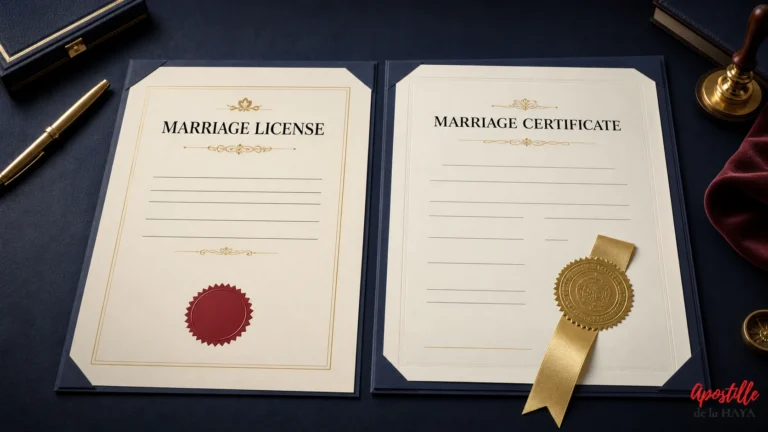
Somebody abroad asked for your marriage certificate, you went to look for it, and what you found was a document that says license across the top. Or the opposite: you have a certificate with a gold seal from the day of the ceremony, and the consulate is telling you it is not what they need. The marriage certificate vs marriage license question sounds like semantics, and in ordinary conversation it is. In an apostille file it is the difference between a document that moves and a document that comes back.
The two are not different names for the same paper. They are two distinct legal moments: one is permission granted before the wedding, the other is the record created after it. In several states they are physically the same form at two different stages of its life, which is exactly why the confusion is so durable. Below is what each document actually is, which one an apostille authority can act on, and the one scenario in this area that genuinely cannot be fixed by paying a rush fee.
What each document is, in legal terms
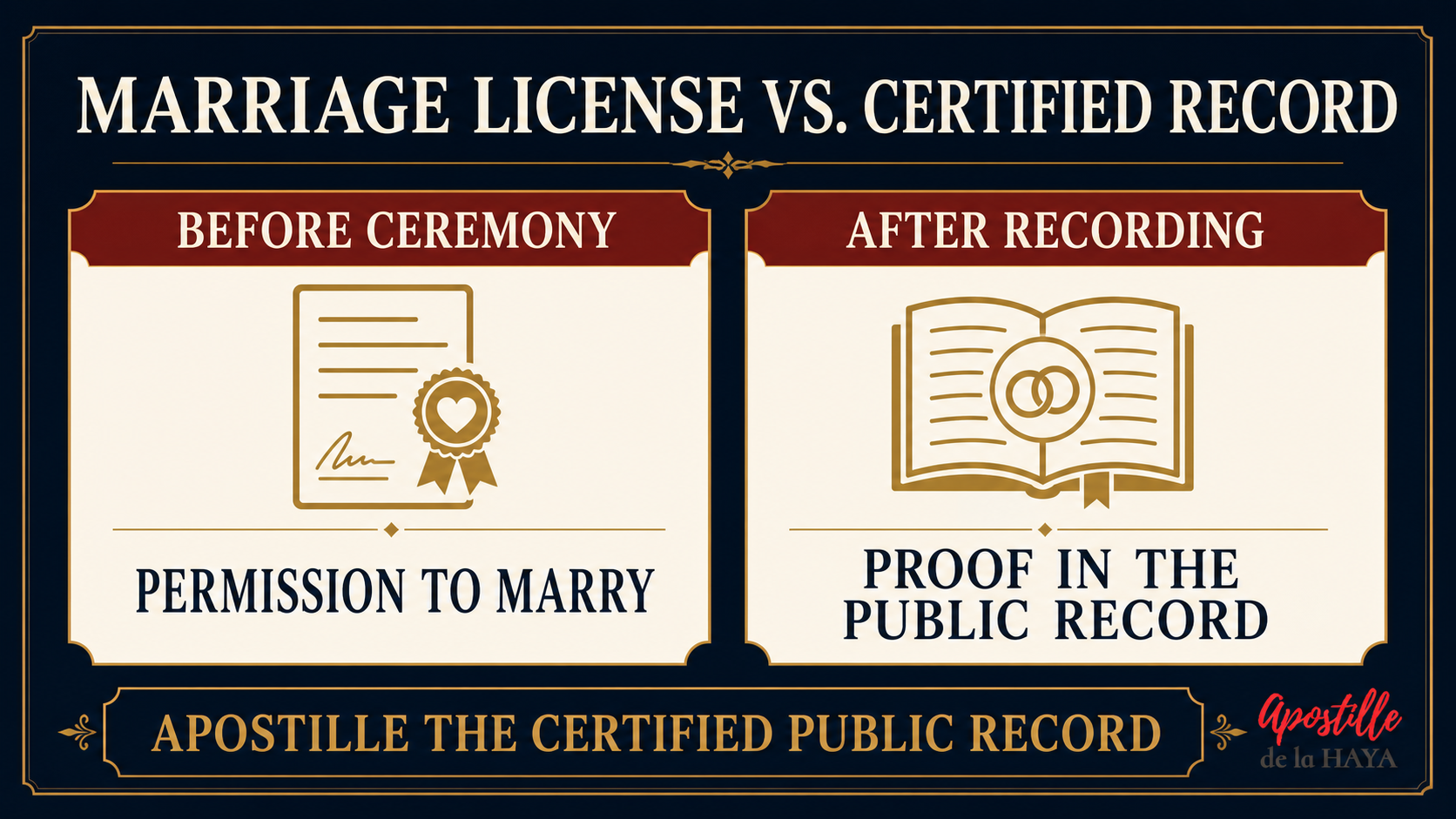
A marriage license is an authorisation. A county clerk, a probate judge or an equivalent local official issues it before the ceremony, after confirming that both parties meet the state’s requirements to marry. It has a validity window and, in many states, a waiting period. Its legal content is forward-looking: it says you may marry. It does not say you did.
A marriage certificate is a record. After the ceremony, the officiant completes the document and returns it to the issuing office, which records or registers it. From that moment there is an entry in the public record showing that the marriage took place on a given date, and the office can issue certified copies of that entry. Its legal content is backward-looking: it says the marriage happened and was registered.
A foreign authority asking for proof of an existing marriage generally needs the second thing. A registry that will inscribe your marriage, a consulate processing a spousal visa, a court hearing an inheritance matter or a bank changing an account name is not interested in whether you were permitted to marry. It needs proof that the marriage exists in the public record of the jurisdiction where it took place. A license, on its own, does not prove that.
Why the vocabulary changes from state to state
Here is the complication that keeps this question alive. In a large number of states there is no separate physical certificate at all. The same form is issued as a license, completed by the officiant, returned, and then recorded. Once recorded, the certified copy the clerk issues is the marriage record, and different states call that record different things.
Texas is a useful illustration of the vocabulary problem. The Secretary of State lists certified marriage licenses and applications among recordable documents that can be authenticated, so the eligible record may still carry the word license. Under the current Texas rule, the certified recordable copy must also have been issued within the preceding five years. Florida runs on different terminology again: the state accepts a Certification of Marriage issued by the Bureau of Vital Statistics and signed by the State Registrar, and it also accepts a certified copy of the marriage record issued by the Clerk of the Circuit Court of the county where the marriage was recorded. Both are the record; neither is called a certificate in ordinary speech.
So when a consulate abroad writes «marriage certificate» and your state writes «marriage license», the mismatch is not evidence that you have the wrong document. It is evidence that two legal systems name the same thing differently. What matters is not the word printed on the form but whether the copy in your hand was issued and certified by the office that holds the record.
| Document | Created | Issued by | Can it carry an apostille? |
|---|---|---|---|
| Marriage license (unused) | Before the wedding | County clerk or equivalent | Not useful: it proves permission, not marriage |
| Recorded marriage record, certified copy | After the officiant returns the form | The office holding the record | Yes, this is the document |
| State registrar certification | After registration reaches the state | State vital records office | Yes, and often with fewer steps |
| Ceremonial or keepsake certificate | Day of the wedding | Officiant, church, wedding venue | No: not a public record |
Practical points the checklist may not resolve
State pages explain fees and mailing addresses. They do not explain which of the documents in your drawer is the one they can process, and there are four points that decide it.
A keepsake certificate can look official while still being the wrong document. The document handed to you at the ceremony, signed by the officiant and the witnesses, sometimes with a church seal or a decorative border, feels like the most official thing you own. An apostille authority authenticates the signature and seal of a public official whose specimen it can verify. An officiant’s signature on a commemorative certificate is not that, and Florida states plainly that an original certified copy of a public document is required and that a photocopy is not acceptable. Unless it was also issued as the certified public record, the keepsake does not enter the apostille process.
Which office certified the record changes the file’s cost and length. In Florida the apostille fee is charged per document and is higher where the record was certified by any Clerk of the Court in the state, because that file needs an apostille plus a Certificate of Incumbency confirming the Clerk held office. New York goes further: a marriage certificate issued by a local or county official must first be certified by the County Clerk of the county that issued it, and a New York City record must then be certified by the New York County Clerk’s Office, whereas a certificate issued by the New York State Department of Health bearing the signature of the Director of Vital Statistics or the NYS Registrar needs no County Clerk step at all. Same marriage, materially different files. For Florida specifically, the choice between the two offices also changes what the document contains, which we examine in our guide to the Florida marriage certificate apostille.
Older marriages can sit at only one of the two levels. State registries began collecting marriage records at different dates, and a marriage from before a state centralised its records may exist only in the county that recorded it. In that case the county version is not the inferior option, it is the only option, and the file has to be built around the extra certification rather than around a state certificate that does not exist.
A license that was never returned may mean that no marriage record was created. If the issuing office reports no recorded entry, there is no certified marriage record to apostille. The correction procedure depends on state law, the available evidence and the time elapsed; it may involve the officiant, witnesses, an administrative correction or a court proceeding. That underlying record issue must be resolved before authentication can begin.
Mistakes that can add time and cost
The errors follow directly from the confusion, and each carries a distinct price.
- Sending the ceremonial certificate for apostille. Returned unprocessed. You lose the transit time in both directions and still have to order the real record.
- Sending an unused or expired license. Some offices will process it because it is technically a certified county document, which is worse than a rejection: you pay, you wait, you receive an apostilled document, and the authority abroad rejects it because it does not evidence a marriage.
- Ordering an informational or non-certified copy. Several vital records offices issue copies marked as informational, not valid to establish identity or for legal purposes. They look almost identical to the certified version and they are not accepted.
- Assuming the destination’s wording describes a U.S. document. A registry asking for a «literal certificate» or an «extract» is using its own legal vocabulary. Matching it to the correct American record is a judgement call, and guessing costs a full processing cycle.
- Discovering late that the issuing office has no recorded marriage. Any correction must be completed before the apostille stage, which can disrupt an existing appointment or filing schedule.
None of these are visible at the moment they happen. That is the whole difficulty: the file looks fine when it leaves your hands and fails at a counter thousands of miles away, when the cost of being wrong is at its highest.
How Apostille de la Haya resolves it for you
We start by reading the request from the receiving authority, not the document you have. What a Spanish consular registry, a Mexican civil registry or an immigration office abroad means by «marriage certificate» is a specific thing, and that determines which American record we obtain: the county-recorded certified copy, the state registrar’s certification, or, where the destination is particular about it, a version issued within a recent window.
From there we order the record from the office that holds it, absorb the county-level certification when a state requires one, submit it to the correct competent authority, and deal with the payment methods and submission rules that stop most self-managed files. We coordinate the clerk, registrar and Secretary of State stages for you. We coordinate the required offices and document handoffs, reducing avoidable paperwork and preventable submission errors. You can review the full scope on our apostille services page, and if you are unsure what your own state issued, our overview of the marriage certificate apostille explains how the pieces fit together.
We are also direct when the answer is unwelcome. If the marriage was never recorded, no service can apostille its way around that, and you are better off knowing in the first week than in the sixth.
Frequently Asked Questions
Can a marriage license be apostilled?
A certified copy of a recorded marriage document can be, and in some states that document is called a license. Texas, for instance, lists certified marriage licenses and applications among recordable documents it authenticates, subject to its current rule that the copy was issued within the preceding five years. What cannot serve the purpose is an unused or never-returned license, because it evidences permission to marry rather than a marriage. We confirm which version your state issues before ordering anything.
How do I know whether my marriage was actually recorded?
The reliable test is to request a certified copy from the office that issued the license. If the record exists, the office can produce a certified copy of it; if it does not, the office will say so. County record searches are public in many jurisdictions, as our guide to Miami-Dade marriage license records shows. We run this check at the start of every file so nothing surprising appears later.
The consulate asked for a "literal" certificate. What is that in the United States?
It is a term from civil-law registries, meaning a full transcription of the entry rather than a summary. There is no American document with that name, so the file has to be matched to the closest equivalent, usually the full certified copy of the recorded marriage record rather than an abbreviated version. Because the choice depends on the receiving registry, we confirm it with the destination requirement in hand.
Can I use a copy issued years ago?
Sometimes, but the apostille is not the limiting factor. Some registries and consulates only accept certificates issued within a recent window, frequently a matter of months, in which case an older certified copy has to be replaced regardless of its condition. Since the rule belongs to the destination rather than to the apostille office, it needs to be confirmed before the record is ordered.
Which one should I order if I do not know what they want?
Where a state offers both, the state-registrar version usually travels with fewer intermediate certifications, which reduces both cost and handling. But «usually» is not «always», and the correct answer depends on where the document is going and which authority receives it. Tell us the destination and we will identify the right version and obtain it for you. For the certified-copy question specifically, see our article on which marriage certificate copy qualifies.
Not sure whether your license or your certificate is the document they want?
Apostille de la Haya coordinates the document from record retrieval through apostille or legalization and delivery, reducing avoidable paperwork and preventable submission errors.
Phone and WhatsApp: +1 305 500 0185